Interior with a Violin
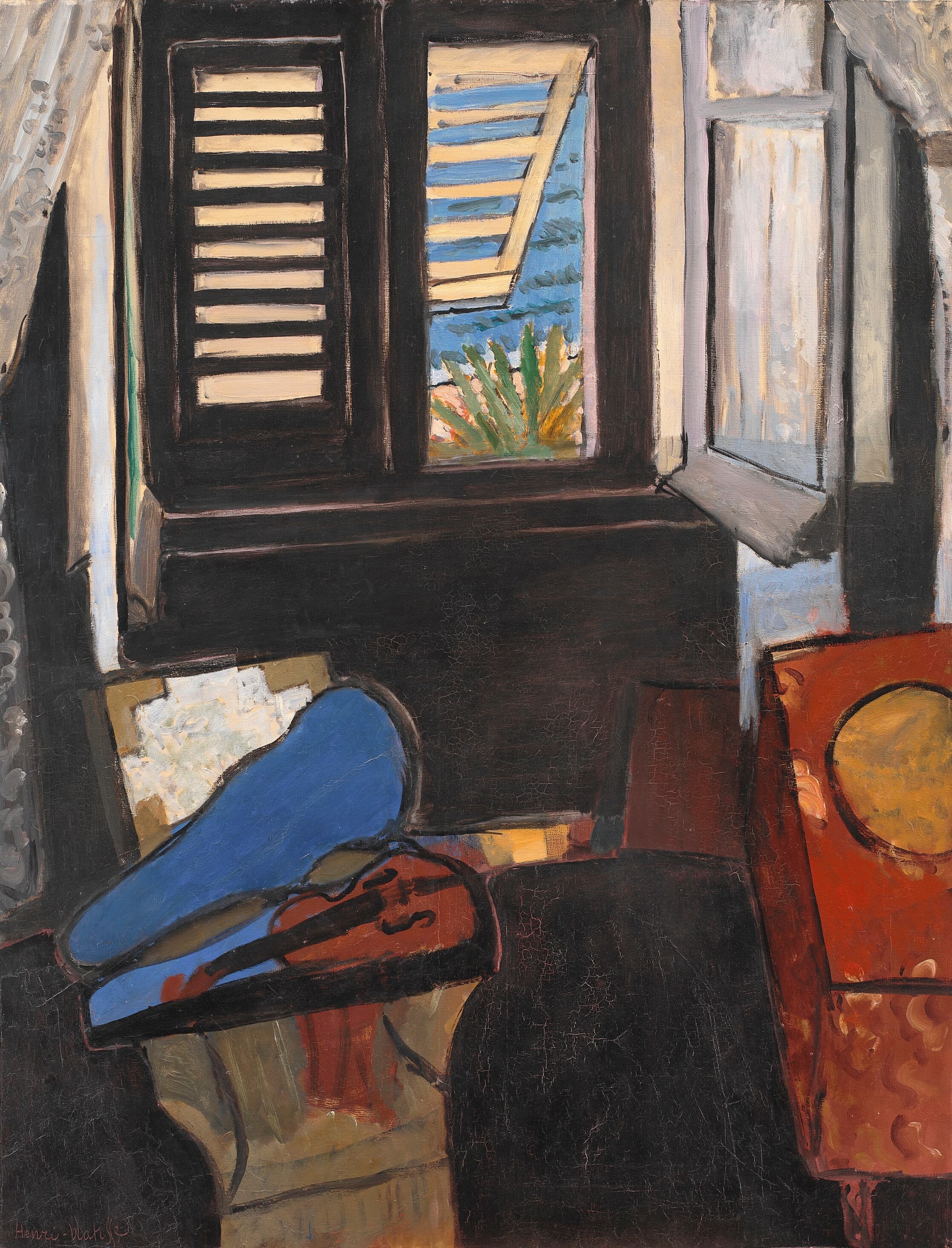
A violin lies in its open case on an armchair, in a hotel room painted almost entirely black. Behind the chair a window shutter stands closed, and its neighbour swings inward on a strip of blue sea. Henri Matisse painted the room at the Hôtel Beau-Rivage in Nice in the first half of 1918. He had arrived from Paris the previous December and taken the hotel for a studio. Statens Museum for Kunst in Copenhagen has held the canvas since 1928.
- 1918
- Oil on canvas
- Statens Museum for KunstCopenhagen, Denmark
About Henri Matisse
What the painting shows
A violin lies across its open case, and the case rests on an armchair. The case lining is a flat cobalt blue cut to the shape of a violin, and the instrument laid across it is a dark red-brown with its f-holes drawn in heavy black line. Behind the violin case stands a rectangular panel, a cream and grey centre inside an ochre border. It is not clear what the panel is — a small canvas, perhaps, or a mirror.
Above and behind, a window fills the upper third. The left window shutter is closed and holds ten pale cream slats. The right shutter has been swung inward, and the blue of the sea shows between its tilted slats. Below the opening a spiky plant fans upward in grey-green, with salmon and yellow beneath it. To the right a pale hinged window of cream and warm grey lets in the second source of light.
Everything else is black, or nearly black. The dark field is a warm brown-black rather than a true black. It covers the wall below the window, the floor, and all the space between the objects. The museum's own colour extraction returns near-black as the painting's dominant value. At the right edge a brick-red chest carries a large dull gold disc.
The canvas is 116 by 89 centimetres, about forty-six by thirty-five inches, and hangs portrait. Henri Matisse signed the lower left corner in a thin red-brown line, hyphenating the name as Henri-Matisse.
The room was a hotel room
Henri Matisse left Paris for the south at the end of October 1917, stopped at Marseille, and reached Nice around 20 December. He took a room at the Hôtel Beau-Rivage, 107 quai des États-Unis, and used it as a studio to begin with. He stayed in Nice until June 1918.
The Centre Pompidou's catalogue notice records what he found there. On arriving in Nice he met rain, and only after weeks did he discover the silvery light that would hold him for so long. Writing to Charles Camoin on 10 April 1918, he was still complaining of eight days of rain and a rough sea, and painting flowers indoors instead.
Statens Museum for Kunst places the painting in the first half of 1918 and identifies the subject as the hotel room, with its window facing the beach and the sea. The museum's wall text, by Dorthe Aagesen, sets out what the picture is doing. The contrast between outside and inside, and between light and darkness, carries the composition. So does a second contrast, between two ways of painting.
Henri Matisse handled the interior in what the museum calls an abstract, plane-oriented style that points back to the preceding years. He painted the glimpse of nature through the shutters in the naturalist idiom that would characterise the work that followed. The turn towards a less abstract manner around 1918 was not unique to Henri Matisse, the museum adds, and applied to many artists on the Paris scene.
Why a violin
Henri Matisse played seriously in these years. The Centre Pompidou's collection catalogue, in a note by Isabelle Monod-Fontaine, records that he practised intensively during exactly these weeks, and gives a reason: he was trying to free himself of a recurring fear of losing his sight. Music would give him a second trade if it came to that.
The same catalogue records that he gave up the daily hour of study in 1920, finding it drained the energy he wanted for painting. The catalogue also records that he tried to pass the musical calling on to his younger son, Pierre Matisse, to the son's considerable dismay.
Which picture this is
Statens Museum for Kunst records two artist's titles, one Danish and one French: Interiør med violin and Intérieur au violon. The museum also records an earlier Danish title the canvas once carried, Violinen, meaning the violin. The English form, Interior with a Violin, is the one used here. The canvas itself is inscribed interieur violon I.
The Metropolitan Museum of Art writes the title in a fuller form that settles which room is meant: Interior with a Violin (Room at the Hôtel Beau-Rivage). It groups the picture with two others painted in Nice across the winter and spring of 1917–18. One is Interior at Nice (Room at the Hôtel Beau-Rivage), at the Philadelphia Museum of Art; the other is The Open Window (Room at the Hôtel Beau-Rivage), in a private collection.
Two further Matisse pictures with the instrument in them are easily confused with Interior with a Violin, and neither shows a hotel room. Interior with a Violin Case, at the Museum of Modern Art, is dated Nice, winter 1918–19 and measures 73 by 60 centimetres. Le Violoniste à la fenêtre, at the Centre Pompidou, was painted in the spring of 1918 at 105 quai des États-Unis. That address was a room next door to the hotel, and Henri Matisse rented it as a studio in February or March.
Statens Museum for Kunst also holds a pencil drawing of the same title, Interiør med violin, catalogued KKS1971-93 and dated 1917–18. The museum links the two records to each other. No published source explains what the numeral I on the painting stands for.
How it reached Copenhagen
The accession number is KMSr83, and the r marks the collection of Johannes Rump. Johannes Rump was a Danish engineer, born in Copenhagen in 1861 and dead at Hellerup in 1932, who began buying contemporary French painting during a stay in Paris in 1912 and went on buying for years.
Statens Museum for Kunst does not tell one story about the gift. Its object record dates the acquisition of this painting to 1928, and Dansk Biografisk Leksikon agrees that the museum received the collection in 1928, together with substantial funds for installing and extending the collection. The museum's Danish page on donations says Johannes Rump gave sixteen works by Henri Matisse in 1928. Its English page on the collection says he donated the collection in 1927, including twenty-five works by Henri Matisse. The atlas follows the object record and reports the difference rather than choosing.
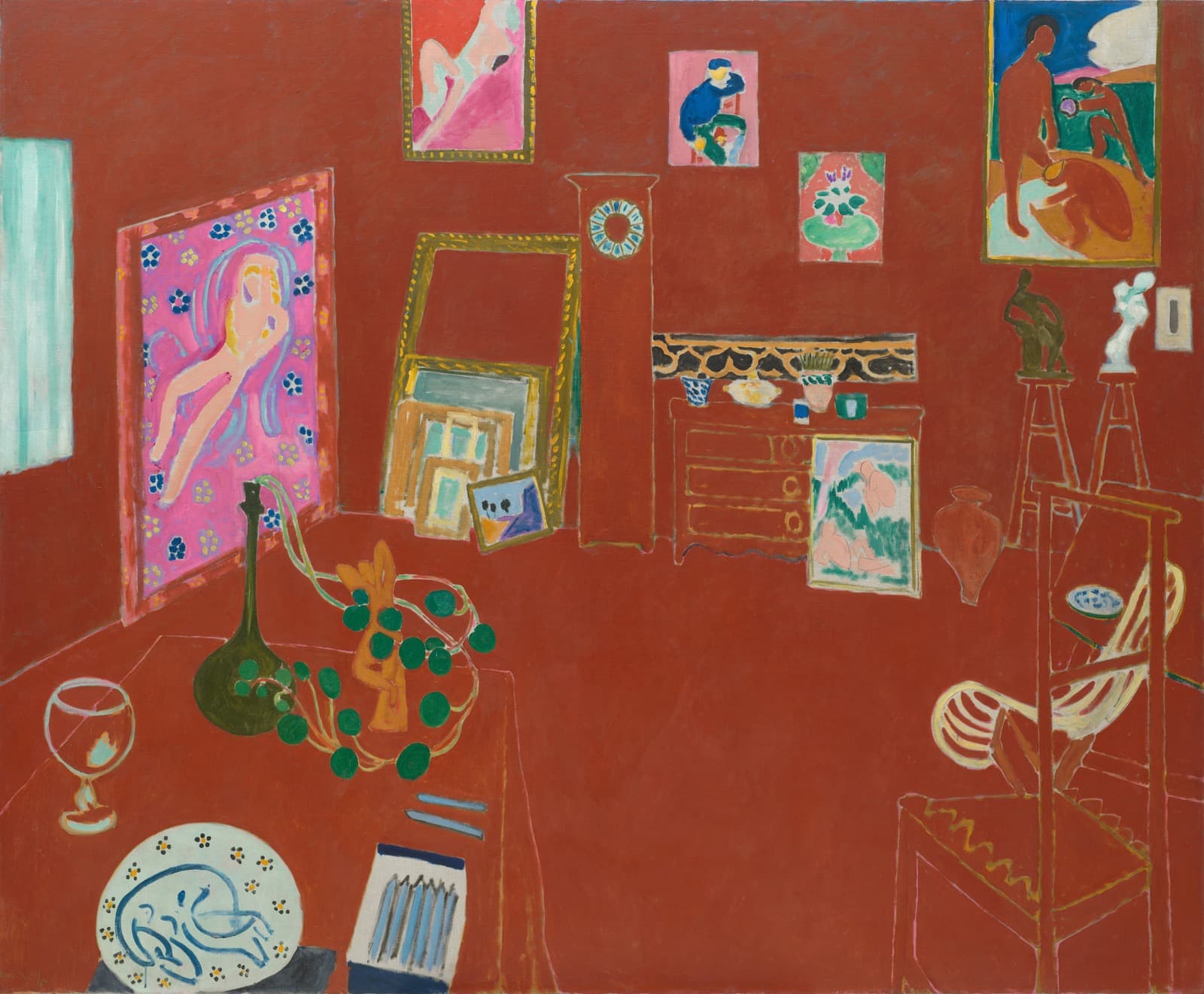
The same 1928 gift brought the museum two of the paintings Henri Matisse had depicted inside The Red Studio seventeen years earlier: Le Luxe (II) of 1907 and 1908, and Nude with a White Scarf of 1909. Both were lent back to New York in 2022, when the Museum of Modern Art reassembled the room.
The painting has travelled a good deal since. Statens Museum for Kunst put the collector himself on show in Johannes Rump: portræt af en samler in 1994, and the painting was in it. The Galeries nationales du Grand Palais in Paris borrowed it for Méditerranée: de Courbet à Matisse in 2000 and 2001. It then went to Tate Modern, the Grand Palais and the Museum of Modern Art for Matisse–Picasso, across 2002 and 2003.
In 2012 the painting was in an exhibition that three museums gave three names. The Centre Pompidou called it Matisse: Paires et séries, Statens Museum for Kunst called it Matisse: Fordobling og variation, and the Metropolitan Museum of Art called it Matisse: In Search of True Painting. It then travelled to the Baltimore Museum of Art and the San Francisco Museum of Modern Art for Matisse/Diebenkorn in 2016 and 2017.
As of September 2026 the museum's own record lists it as on display, in room 214.
Why most of the canvas is black
A room described as dark is an ordinary subject. A canvas given over to black on this scale is not. The scale of the black separates the picture from the bright Nice interiors that followed it.
The black paint is not flat. The brush direction reads through it, and fine cracks from age now run across the whole field. Against that dark field, the cream shutter slats, the cobalt case lining and the brick-red chest each carry more weight than their area would suggest.
Statens Museum for Kunst publishes no commentary on the black paint specifically. The fullest published treatment of the painting appears to be Isabelle Monod-Fontaine's essay Et spørgsmål om vinduer — Interiør med violin, in the museum's 2005 catalogue of its Matisse holdings, which is not online.
Close reading
Reading the work, detail by detail
Most of the canvas is a warm brown-black. Henri Matisse painted the room dark and put the light in two places only: the slatted window shutters, and the pale window at the right. The violin lies in its open case on an armchair. The blue lining of the violin case is the strongest colour in the picture, after the red chest at the right edge. The close views take the dark field first, then the objects it surrounds.
1.The dark field is a warm brown-black
The dark field is a warm brown-black rather than a true black, with the brush direction still readable through it. A fine network of age cracks runs across the whole area. The dark field covers the wall below the window, the floor and the space between the objects.
2.Ten slats on the closed window shutter
Ten pale slats are stacked in the closed left-hand window shutter, each one a single loaded stroke. The cream paint on the slats is warm, and thin enough that the canvas weave shows through it. The shutter's dark frame around them is brushed in visible vertical strokes rather than filled flat.
3.Blue shows between the open slats
The right-hand window shutter has been swung inward, and its slats tilt so that the blue of the sea outside shows in the gaps between them. That blue is a mid tone, crossed with darker teal-green strokes laid on dry. A long cream upright of the window frame runs diagonally across the opening, and a pale mauve strip closes the opening at the right.
4.A spiky plant below the opening
Blade-shaped leaves fan upward at the foot of the window opening, painted in a grey-green. Pale salmon-pink and yellow-ochre touches sit beneath them. The plant is the only growing thing in the picture, and the only part Henri Matisse painted as a recognisable object rather than a flat shape.
5.The violin case lining is flat cobalt
The open violin case shows its lining as a flat mid cobalt, with almost no modelling across the whole shape. A wide dark brown outline bounds the blue lining, drawn and in places redrawn so that two lines run close together. Fine cracks from age run across the whole painting. They are just as thick over the blue lining of the violin case as over the black wall behind it.
6.The violin lies across the open case
The violin is a dark red-brown, laid across the lower half of the violin case. Its two f-holes, tailpiece and fingerboard are drawn in a heavy black-brown line rather than modelled. Unlike the flat blue lining beneath it, the violin's body carries visible brush variation.
7.A pale panel stands behind the violin case
Behind the violin case stands a rectangular panel: a centre of cream and pale grey, scrubbed on in short strokes, inside a warm ochre border. It is not clear what the panel is — a small canvas hung on the wall, perhaps, or a mirror. The violin case covers the panel's lower right corner, so that corner is hidden and the panel must stand behind the case.
8.A red chest with a dull gold disc
The chest at the right edge is a strong brick red, the hottest colour in the painting. A large dull gold ellipse sits on the chest's top under a heavy dark ring. Pale pink comma strokes run down the chest's left edge, and a mottled band of cream and ochre squiggles covers its front.
9.The window at the right is almost colourless
The window at the right, hinged and swung inward, is built from vertical bands of cream, warm grey, mauve-grey and off-white. The paint is dry and thin, and the weave of the canvas shows through every band. That window is the second source of light in the room, and it carries almost no colour.
10.A green line at the left margin
A narrow band of saturated dark green runs down beside the black window shutter at the far left. A pale blue-white bar sits to the left of the green band, and a buff curtain patterned in grey motifs sits to the left of the bar. Nothing else in the painting repeats that green.
11.The case rests on an olive armchair
Below the violin case the armchair is brushed in dark olive-gold, in loose vertical strokes. A rust-red panel runs down the chair's centre. The chair's arms are described by curving dark brown lines drawn over the olive-gold upholstery with a loaded brush, and the seat dissolves into the dark field at the bottom.
12.The signature is hyphenated
Henri Matisse signed the lower left corner in a thin red-brown line, with a hyphen between the two names — the form Statens Museum for Kunst records for this canvas. The dark paint around the signature carries the thickest of those age cracks anywhere on the canvas.
Timeline
1912
Johannes Rump begins buying contemporary French painting during a stay in Paris.
1917
Henri Matisse leaves Paris at the end of October and reaches Nice around 20 December, taking a room at the Hôtel Beau-Rivage, 107 quai des États-Unis.
1918
Paints the hotel room in the first half of the year, inscribing the canvas interieur violon I, and leaves Nice in June.
1928
Acquired by Statens Museum for Kunst with the Johannes Rump collection; accession number KMSr83.
1994–95
Shown at Statens Museum for Kunst in Johannes Rump: portræt af en samler.
2000–01
Shown at the Galeries nationales du Grand Palais, Paris, in Méditerranée: de Courbet à Matisse.
2002–03
Travels to Tate Modern, the Grand Palais and the Museum of Modern Art for Matisse–Picasso.
2012–13
Shown at the Centre Pompidou, Statens Museum for Kunst and the Metropolitan Museum of Art in the pairs-and-series exhibition each venue titled differently.
2016–17
Shown at the Baltimore Museum of Art and then the San Francisco Museum of Modern Art in Matisse/Diebenkorn.
Where to see it
Statens Museum for Kunst
Copenhagen, Denmark
A public viewing address has not yet been confirmed for this holding.
The museum's record lists the painting as on display in room 214 as of September 2026.
Frequently asked questions
Where is Matisse's Interior with a Violin?
Statens Museum for Kunst in Copenhagen, accession number KMSr83. The museum's own record lists it as on display in room 214 as of September 2026.
What room is Interior with a Violin set in?
A hotel room. Statens Museum for Kunst identifies it as Henri Matisse's room at the Hôtel Beau-Rivage in Nice, which he used as a studio when he first arrived. The Metropolitan Museum of Art writes the title in full as Interior with a Violin (Room at the Hôtel Beau-Rivage).
When did Matisse paint Interior with a Violin?
In the first half of 1918, according to Statens Museum for Kunst. Henri Matisse had reached Nice around 20 December 1917 and left again in June 1918.
Why is Interior with a Violin so dark?
Most of the canvas is given over to a warm brown-black covering the wall, the floor and the space between the objects. Statens Museum for Kunst reads the picture through the contrast between outside and inside, and between light and darkness.
Why did Matisse paint a violin?
He played one. The Centre Pompidou's collection catalogue records that Henri Matisse practised intensively during these weeks, partly to quiet a recurring fear of going blind, on the reasoning that music would give him a second trade. He gave up the daily hour of study in 1920.
How big is Interior with a Violin?
116 by 89 centimetres, roughly forty-six by thirty-five inches, painted in oil on canvas and hung portrait. Some reproductions online reverse the figures; Statens Museum for Kunst records the height as 116 and the width as 89.
What is the painting called in French and Danish?
Statens Museum for Kunst records two artist's titles — Intérieur au violon in French and Interiør med violin in Danish — and one earlier Danish title, Violinen. The canvas itself is inscribed interieur violon I.
How did Interior with a Violin get to Denmark?
Through the collection of Johannes Rump, a Danish engineer. The r in the accession number KMSr83 stands for Rump. Statens Museum for Kunst's object record dates the acquisition to 1928, though the museum's own English page on the collection says 1927.
More by Henri Matisse
If you like Henri Matisse
Explore painters from the same movements and circles.
André Derain
French painter who helped invent Fauvism with Henri Matisse at Collioure, translated London into explosive colour, and then turned toward an increasingly classical art.
View artist
Maurice de Vlaminck
Self-taught French painter whose intense colour and forceful brushwork around Chatou made him one of Fauvism’s central figures.
View artist
Tarsila do Amaral
Brazilian painter who spent the 1920s moving between São Paulo and Paris, studied Cubism under André Lhote, Albert Gleizes and Fernand Léger, and used what she learned to paint Brazilian towns, railways, plants and bodies. Her 1928 painting Abaporu prompted the manifesto that gave the Anthropophagic movement its name.
View artist
References
The sources below include collection records, catalogues, scholarly research, and primary materials that informed this page. They document Interior with a Violin, its making, and its place in cultural history.


1Interiør med violin / Intérieur au violon — Henri Matisse, KMSr83
WebsiteSMK — National Gallery of DenmarkUsed forWeb source consulted for documented facts and historical context presented on the Interior with a Violin page.

2Collection record for KMSr83: titles, dimensions, inscriptions, acquisition, wall texts and rights
Official recordSMK — National Gallery of Denmark, open collection APIUsed forOfficial record used to verify names, dates, institutional details, or other factual information on this page.
3Le Violoniste à la fenêtre — Henri Matisse, AM 1975-260
WebsiteCentre Pompidou, Musée national d'art moderne, ParisUsed forWeb source consulted for documented facts and historical context presented on the Interior with a Violin page.
4Matisse: In Search of True Painting — exhibition announcement
WebsiteThe Metropolitan Museum of ArtUsed forWeb source consulted for documented facts and historical context presented on the Interior with a Violin page.
5Johannes Rump, by Leo Swane
WebsiteDansk Biografisk Leksikon, Lex.dkUsed forWeb source consulted for documented facts and historical context presented on the Interior with a Violin page.
6Om donationer: the Rump collection and its Matisse paintings
WebsiteSMK — National Gallery of DenmarkUsed forWeb source consulted for documented facts and historical context presented on the Interior with a Violin page.
7The collection: the Johannes Rump donation
WebsiteSMK — National Gallery of DenmarkUsed forWeb source consulted for documented facts and historical context presented on the Interior with a Violin page.
8Interiør med violin / Intérieur au violon, drawing, KKS1971-93
WebsiteSMK — National Gallery of DenmarkUsed forWeb source consulted for documented facts and historical context presented on the Interior with a Violin page.
9Henri Matisse, Interior with a Violin Case, Nice, winter 1918-19 — 86.1934
WebsiteThe Museum of Modern ArtUsed forWeb source consulted for documented facts and historical context presented on the Interior with a Violin page.
10Matisse/Diebenkorn, edited by Janet Bishop and Katherine Rothkopf
WebsiteSan Francisco Museum of Modern ArtUsed forWeb source consulted for documented facts and historical context presented on the Interior with a Violin page.
11Press release: the first exhibition to reunite all the works in Henri Matisse's The Red Studio
Official recordThe Museum of Modern ArtUsed forOfficial record used to verify names, dates, institutional details, or other factual information on this page.
These references provide the documented foundation for this work's history and interpretation. Claim-level citations remain attached to the specific claims they support.
 Explore more resources