The Red Studio
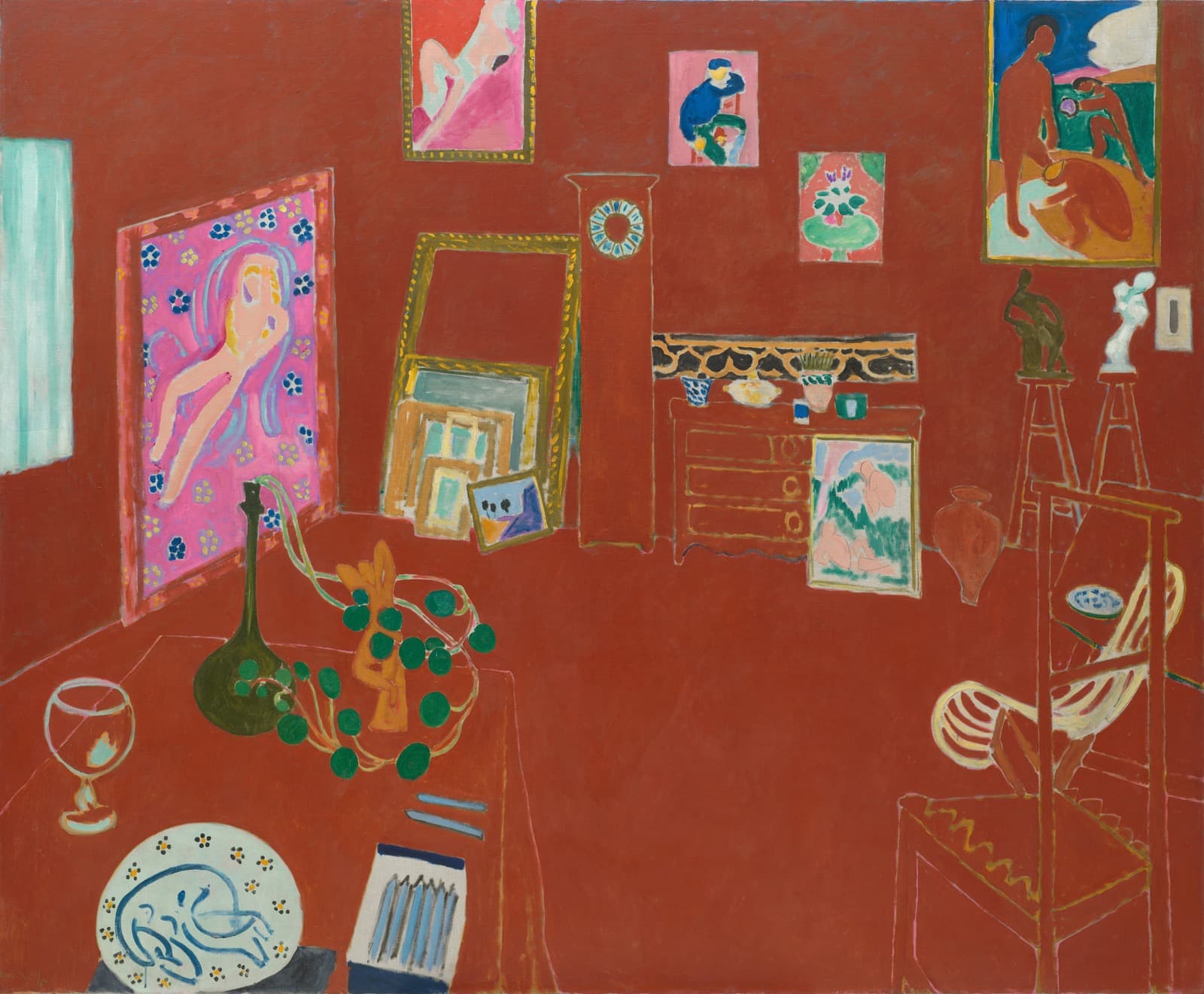
Henri Matisse painted the studio he had built in the garden at Issy-les-Moulineaux, and then covered his own painting. Conservators established in 2022 that a complete painting lies under the red: blue walls, ochre furniture, a pink floor, and viridian wall panelling. He let that first painting dry for weeks, then laid a red earth pigment over about two-thirds of it. The red stopped at the edges of his own works. The furniture survives only as the lines where the red stopped. The Museum of Modern Art bought the canvas in 1949.
- autumn 1911
- Oil on canvas
- The Museum of Modern ArtNew York, United States
About Henri Matisse
What the painting shows
The painting shows a room seen from a corner, all in one red. The Museum of Modern Art's date line reads "Issy-les-Moulineaux, fall 1911", naming the studio Henri Matisse had built in the garden of his house outside Paris.
Along the walls hang his own paintings, each keeping its own colours. Sculptures stand on two low stools at the right, one a dark olive bronze and one a pale plaster. A decorated ceramic plate lies on the table at the lower left, beside a stemmed glass, a dark green long-necked bottle, a trailing nasturtium and an open box of crayons.
Everything that is furniture has been left out. The chest of drawers, the grandfather clock, the table, the stools and a large empty picture frame are described only by thin uncovered lines — ochre, cream, green and in places pink. The red runs behind and between them without a break.
The canvas is 181 by 219.1 centimetres, about six feet by seven feet two. The Museum of Modern Art states the dimensions as 71 1/4 inches by 7 feet 2 1/4 inches.
A finished painting lies under the red
When the canvas was unframed at the Museum of Modern Art's conservation centre in 2022, pink, blue and ochre paint were found under the red along the edges where the canvas folds round the stretcher. The study that followed was published in Heritage Science in October 2022 by conservators and scientists at the museum, Statens Museum for Kunst and the Metropolitan Museum of Art.
The buried colours sit in thin separate layers that do not mix with the red above them, so they had dried completely before the red went on. Blue was used for the wall, ochre for most of the wooden furniture — the table, the chair, the chest and the clock — and pink for the floor in the foreground.
A scan that maps the chemical elements across a painting (macro X-ray fluorescence) found something the eye could not. It picked up a run of chromium-rich vertical brushstrokes across the wall, matching the panelled design visible in the earlier Pink Studio. Henri Matisse had painted that panelling in viridian. The same chromium map showed that the window at the left was first one of the glazed double doors into the studio, and that he painted out the lower half of the door in red.
The red paint itself is a red earth pigment, identified as hematite by laboratory analysis (Raman spectroscopy), with gypsum and lead white in it. Henri Matisse named the colour in a letter to Sergei Shchukin: the whole is Venetian red, a little warmer than red ochre, and a precise colour of the palette. He covered about two-thirds of the original composition with that red. He also added natural resin to the red alone, so that it would sit glossy against the matte passages he left.
The red, and where it stops
The museum's gallery label of 2006 quotes Henri Matisse on the colour: "Where I got the color red—to be sure, I just don't know. I find that all these things . . . only become what they are to me when I see them together with the color red."
The same label describes the method. The artworks appear in colour and in detail, while the room's architecture and furnishings are indicated only by negative gaps in the red surface. The composition's central axis, it adds, is a grandfather clock without hands.
Those gaps can be read off the surface. A band of deep blue-green runs down the right edge of the big empty frame, and that band is the viridian panelling. A short pink line under the table's left leg is the floor. The ochre outlines of the chest are the furniture. Henri Matisse brought the red up to each of them and stopped.
Ann Temkin, who organised the 2022 exhibition, puts the sequence plainly. The floor was pink, the walls were blue, and the furniture was an ochre yellow. After living with that for a while, Henri Matisse decided to coat the whole surface in one colour, except his works of art. Cross-sections say the first painting needed weeks to dry before the red went on.
Eleven works of his own
The Museum of Modern Art calls the arrangement a small retrospective of Henri Matisse's recent painting, sculpture and ceramics. Ann Temkin counts eleven of his own works in the room: seven paintings, three sculptures and a ceramic plate, made between 1898 and 1911.
Six of the paintings survive. Corsica, The Old Mill of 1898 is the small landscape propped on the floor against the stack of frames, and belongs to the Wallraf-Richartz-Museum in Cologne. Young Sailor (II) of 1906 is the small unframed canvas on the wall, now at the Metropolitan Museum of Art. Cyclamen of 1911 is in a private collection.
Three belong to Statens Museum for Kunst in Copenhagen: Bathers of 1907, Le Luxe (II) of 1907 and 1908, and Nude with a White Scarf of 1909. Two of those three reached Copenhagen in the same 1928 gift from Johannes Rump that brought the museum Interior with a Violin. The largest depicted painting shows three figures in the same Venetian red as the room. The museum records that Henri Matisse repainted the three women of Le Luxe (II) in that red when he laid the red over the floor and walls.
The seventh painting is gone. Large Nude, painted at Collioure in the late summer of 1911, is visible at the left. Henri Matisse considered Large Nude unfinished and, according to his daughter Marguerite Duthuit, asked that it be destroyed after his death. It survives only in photographs and in this canvas.
Three sculptures stand in the room. Upright Nude with Arched Back is a headless terracotta of 1906 and 1907, rediscovered among the belongings of his son Jean Matisse. Decorative Figure of 1908 has its bronze at the Art Gallery of Ontario, and Jeannette (IV) of 1911 is at the Fondation Beyeler. The plaster of Jeannette (IV) that appears in the painting was never exhibited and was later destroyed. The ceramic plate in the foreground is his own tin-glazed earthenware of 1907, made with the ceramist André Metthey, and the Museum of Modern Art bought it in 2001.
The clock has no hands
The dial is painted as a pale ring divided by gold spokes into wedges, each holding a turquoise dash where a numeral would go. The centre is left as bare red. The dial has no hub and no hands.
The clock case around it is drawn in a pale cream-green line and filled with the same red as the wall behind. The Museum of Modern Art reads the missing hands as time suspended in the oasis of the artist's studio.
The studio arrived flat-packed
The building in the painting was not designed by an architect. On 2 June 1909 Lucien Assire of the Compagnie des Constructions Démontables et Hygiéniques in Paris sent Henri Matisse a handwritten proposal for a demountable studio, ten metres by ten, with walls five metres high and a shed roof.
The specification called for an iron framework, a roof of corrugated sheet metal, a wood ceiling, a red fir floor and fir wall panelling. The whole thing could be delivered and assembled two months later. It went up beside the house Henri Matisse had rented at Issy-les-Moulineaux and was finished in October 1909. The studio gave him a little over a thousand square feet of working space.
The viridian under the red is that fir panelling. Three letters from Lucien Assire survive in the Archives Henri Matisse. The last of them records two additions the painter asked for after delivery: an entryway at the front and a covered store behind.
The commission Sergei Shchukin declined
In January 1911 Sergei Shchukin asked Henri Matisse for three paintings for a room in his Moscow house, on any subject the painter chose. Henri Matisse chose the studio. He answered first with The Pink Studio, now at the Pushkin State Museum of Fine Arts, and then with The Red Studio.
The correspondence survives. Writing from Tangier on 1 February 1912, Henri Matisse sent a watercolour of the painting and set the price at ten thousand francs. "The painting is surprising at first sight," he wrote. "It is obviously new. Mme Stein finds it the most musical of my paintings." The Mme Stein is Gertrude Stein.
Sergei Shchukin replied from Moscow on 14 February. "It must be very interesting," he wrote, "but I now prefer your paintings with figures, mainly the portrait of your family." He had turned the painting down without seeing it, on the evidence of a watercolour sketch.
Panneau rouge, and sixteen years unsold
Henri Matisse sent the painting to the Second Post-Impressionist Exhibition at the Grafton Galleries in London, which ran from 5 October to 31 December 1912. Roger Fry selected the French section. The catalogue lists it as number 35, under the title Le panneau rouge, hung in the Large Gallery among eight Matisses. The Red Studio was second on the list of twelve paintings he lent.
The only surviving picture of that hang is Roger Fry's own painting A Room in the Second Post-Impressionist Exhibition, of 1912, at the Musée d'Orsay. In 1913 the canvas travelled to New York, Chicago and Boston for the Armory Show, catalogued as number 406, Panneau Rouge.
It did not sell. The Museum of Modern Art says the painting was met with bafflement or indifference, and Henri Matisse kept it for sixteen years. He was uncertain about the painting himself. Speaking to a Hungarian writer around the turn of 1912, he said it had not turned out the way he first imagined. He liked the painting, he said, but did not quite understand it, and did not know why he had painted it exactly as he did.
The Gargoyle Club, and then MoMA
David Tennant bought the painting directly from the artist. He was the English collector who founded the Gargoyle Club in Soho, a members' club for artists and aristocrats. The museum's provenance record dates the purchase to 1926. Its own exhibition texts, its 1949 press release and the 2022 technical study all say 1927. The painting hung in the club for some thirteen years.
It left in the early 1940s, passing to Georges Keller, director of the Bignou Gallery in New York, who brought it to the United States. The Bignou Gallery showed it in 1948, and it went to a Matisse retrospective at the Philadelphia Museum of Art the same year.
In December 1948 the museum trustee James Thrall Soby wrote to the Committee on the Museum Collections arguing for the painting's purchase, and then gave up arguing. "Every time I look at it," he wrote, "I get such sheer pleasure out of it that any other reaction comes as an afterthought." He ended: "Let's for heaven's sake buy it."
The Museum of Modern Art announced the acquisition on 5 April 1949, calling it the most important work by Henri Matisse to enter its collection. It was bought through the Mrs. Simon Guggenheim Fund. Its object number is 8.1949, and it hangs on Floor 5, in Gallery 506, among the Alfred H. Barr, Jr. Galleries.
The room was reassembled in 2022
The Museum of Modern Art showed Matisse: The Red Studio from 1 May to 10 September 2022. The exhibition was the first time the depicted works had been together since they stood in the studio itself. Ann Temkin of the museum and Dorthe Aagesen of Statens Museum for Kunst organised it, with the Archives Henri Matisse, and the two museums co-published the catalogue.
The exhibition travelled to Copenhagen, where it ran from 13 October 2022 to 26 February 2023. The Fondation Louis Vuitton in Paris then showed it from 4 May to 9 September 2024, alongside a retrospective of Ellsworth Kelly.
Ann Temkin has described what changed the painting's standing. Viewers in 1911, or 1920, or 1930 saw a red rectangle with small patches of colour in it and could not read it. The painting became legible, she argues, through the eyes of later painters such as Mark Rothko and Ellsworth Kelly, as an ancestor of abstract painting.
Who claims the copyright
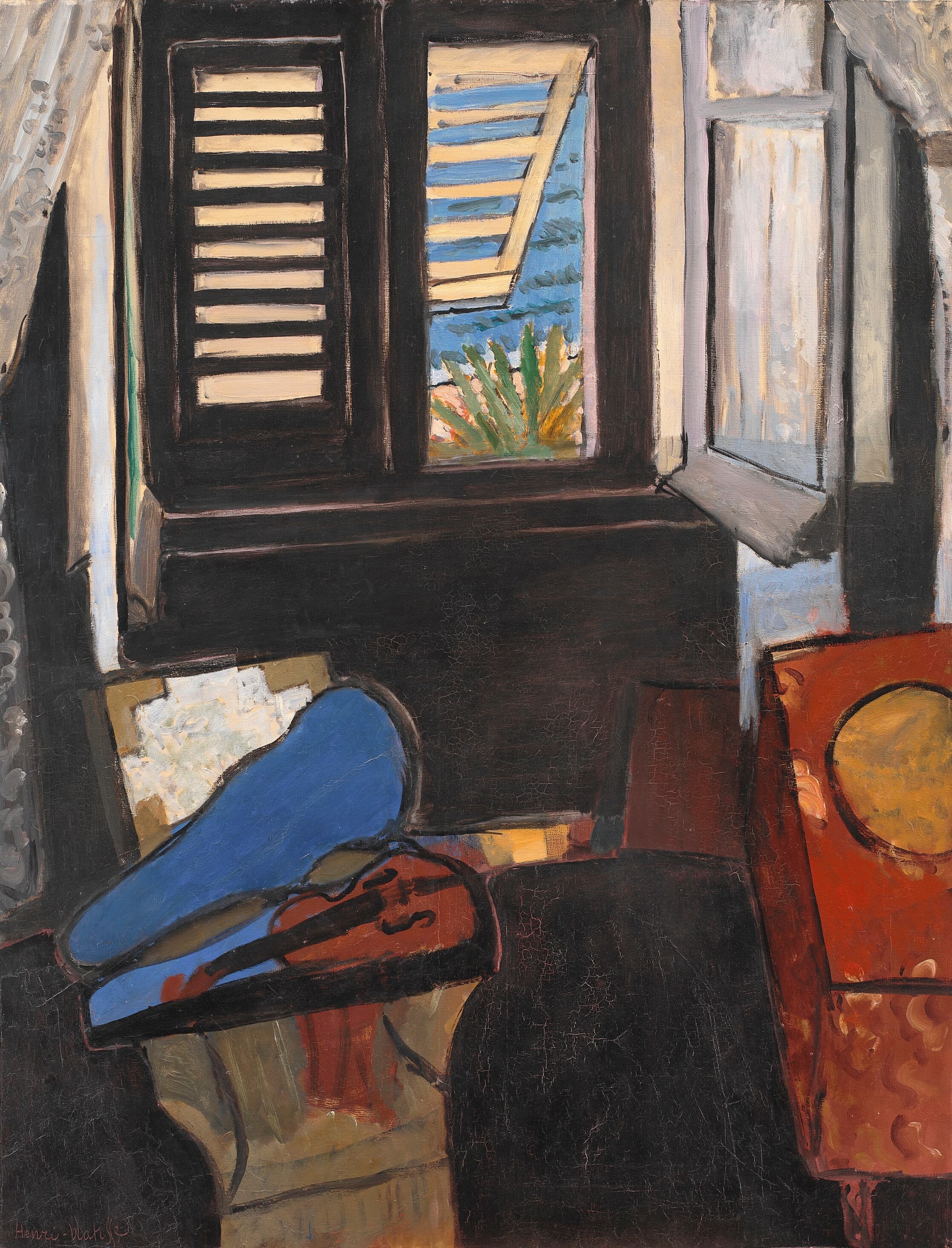
The Museum of Modern Art prints a copyright notice on its own record: "© 2026 Succession H. Matisse / Artists Rights Society (ARS), New York". It prints the same notice on Interior with a Violin Case, its Matisse of 1918 and 1919.
Other institutions have stopped. The Centre Pompidou labels its own 1918 Matisse, Le Violoniste à la fenêtre, as domaine public, and Statens Museum for Kunst publishes Interior with a Violin under the Creative Commons Public Domain Mark. Henri Matisse died in 1954, and the French term of the author's life plus seventy years expired on 1 January 2025.
The atlas follows the holding institution where it speaks. The reproduction here is therefore reduced below the resolution the museum itself serves, and carried under fair use for commentary.
Close reading
Reading the work, detail by detail
One red covers the wall, the floor and the table, and the junctions between them are gone. The room survives as a set of thin uncovered lines where Henri Matisse did not bring the red all the way up. Conservators at the Museum of Modern Art established in 2022 what those lines are. Under the red paint lies a complete earlier painting in blue, ochre, pink and viridian, and that painting had dried for weeks before the red went over two-thirds of it. The close views follow those uncovered lines, and read the eleven works of his own that Henri Matisse left in their first colours.
1.Wall, floor and table are the same red
The red on the wall and the red on the floor are the same colour, thinly brushed, with the strokes running long and horizontal. Laboratory analysis (Raman spectroscopy) identified the paint as a red earth pigment, hematite, sold by colourmen as Venetian red. Henri Matisse used the name himself in a letter to Sergei Shchukin.
2.The chest of drawers is a line, not an object
Three drawer fronts, three ring handles and a plinth are drawn in a thin ochre-yellow line. Inside those lines the chest is the identical red as the wall. The ochre is not a drawn line at all but the first painting showing through. Conservators found natural yellow ochre used for most of the wooden furniture, and the red laid up to the ochre's edges.
3.Viridian survives beside the gold frame
A band of deep blue-green runs down the right edge of the big empty picture frame, then turns pale cream and bends along the floor. A scan that maps the chemical elements across a painting (macro X-ray fluorescence) found chromium in vertical strokes under the red across the wall. The studio had fir wall panelling, and Henri Matisse painted that panelling viridian before he covered it in red.
4.Pink shows under the table's leg
A short pink line runs along the bottom of the table's left leg. Pink was the floor. Cross-sections taken from the edge of the canvas where it folds round the stretcher found a layer of lead white with natural madder lake beneath the red. Visual examination placed that pink layer in the foreground. The table's top edge carries a yellow zigzag drawn in the same ochre as the chest.
5.The clock face is a ring around bare red
The clock's dial is a pale ring divided by gold spokes into wedges, each carrying a turquoise dash where a numeral would be. The centre is bare red. The dial has no hands and no hub, and the clock case is drawn only in a pale cream-green line. The Museum of Modern Art calls the clock the composition's central axis.
6.The window is what is left of a door
The only daylight in the painting is a narrow strip at the extreme left, brushed in pale mint and white. The strip stops well above the floor, and red closes over it below. The chromium map explains why: the opening was first one of the glazed double doors into the studio, and Henri Matisse painted out its bottom half.
7.The goblet is a hole cut in the red paint
The goblet's rim is a pale mint-green line with pink running along its inner edge. The bowl is filled with the table's own red, so the glass is a gap in the paint rather than a thing on top of it. A small patch of turquoise sits low in the bowl, ringed with ochre.
8.Young Sailor (II) hangs unframed
A young man sits astride a red chair in a deep cobalt smock, with a flat yellow face and green trousers. The Museum of Modern Art identifies the canvas as Young Sailor (II) of 1906, now at the Metropolitan Museum of Art. Conservators found green vestiges of the buried layer surviving along the canvas's painted edges.
9.A destroyed painting hangs at the left
The ground of the depicted canvas is a strong magenta-pink, scattered with blue five-petalled flowers. The Museum of Modern Art identifies the picture visible at the left as Large Nude, painted at Collioure in 1911. Henri Matisse thought Large Nude unfinished and asked that it be destroyed after his death. Large Nude survives now only in photographs and in The Red Studio.
10.Three figures repainted in the room's own red
A terracotta standing nude turns away against a deep cobalt sky, with a crouching figure at the right and a third mass below. The three figures read in the same Venetian red as the room. The Museum of Modern Art records that Henri Matisse repainted the three women of Le Luxe (II) in that red when he laid it over the floor and walls.
11.A nasturtium grows over a terracotta figure
Henri Matisse described this passage himself: a nasturtium branch soaking in a long-necked bottle on the table at the left, and the yellow ochre of a statuette around which the nasturtium has grown, enveloping it. The statuette is his terracotta Upright Nude with Arched Back. The same scan found that Henri Matisse first painted the statuette orange in vermilion, then covered the vermilion with yellow ochre.
12.A Persian tapestry border above the chest
A horizontal band above the chest of drawers carries a repeating arcade of lobed black shapes outlined in apricot ochre. Writing to Sergei Shchukin in February 1912, Henri Matisse listed it among the colours the red holds together: the warm blacks of a border of a Persian tapestry placed above the chest of drawers.
13.The rattan chair is lemon yellow
The chair's curved back rail and two fans of caned ribs are laid in pale lemon strokes, with its legs in a browner red. Henri Matisse named it in the same letter: the lemon yellow of a rattan chair placed at the right of the painting between a table and a wooden chair. A small blue and white dish sits on a green-rimmed stand above it.
14.Two sculptures on two drawn stools
The stools are outlined in ochre and have no substance of their own. On the left a dark olive-bronze crouches forward. On the right a plaster arches back, and the plaster's white is a cool off-white with a green cast. Conservators found that plaster modelled in lead white mixed with viridian.
15.His own plate, in the bottom corner
The glaze reads as a pale grey-white, and carries a reclining nude drawn in a single cerulean line, with small flowers ringing the border. The object is Henri Matisse's own tin-glazed plate of 1907, made with the ceramist André Metthey, and the Museum of Modern Art bought it in 2001. The nude curls downward, as if seen from where Henri Matisse stood.
16.Six crayons in an open box
Six pale blue crayons stand in a cream box banded in navy at top and bottom, each tip drawn to a point. Two more lie loose on the table above the box. The crayons are a pale steel blue, not a bright one. They are working materials, and they are painted with the same attention as the sculptures.
Timeline
1909
A demountable studio ten metres square, ordered from the Compagnie des Constructions Démontables et Hygiéniques in June, is delivered and assembled at Issy-les-Moulineaux by October.
1911
Sergei Shchukin asks in January for three paintings on any subject; Henri Matisse answers with The Pink Studio and then, in the autumn, The Red Studio.
1912
Shown at the Second Post-Impressionist Exhibition, Grafton Galleries, London, as number 35, Le panneau rouge. Shchukin declines the painting by letter on 14 February.
1913
Travels to New York, Chicago and Boston for the Armory Show, catalogued as number 406, Panneau Rouge.
1926
Bought from the artist by David Tennant and hung in his Gargoyle Club in Soho, London, where it stays some thirteen years. The museum's other accounts date the purchase to 1927.
1942
Acquired by Georges Keller of the Bignou Gallery, New York, who brings it to the United States.
1949
Acquired by the Museum of Modern Art through the Mrs. Simon Guggenheim Fund and announced on 5 April; object number 8.1949.
2022
Technical study at the museum's conservation centre finds a complete earlier painting in blue, ochre, pink and viridian beneath the red, and is published in Heritage Science in October.
2022–23
Matisse: The Red Studio reunites the depicted works at the Museum of Modern Art and then at Statens Museum for Kunst in Copenhagen.
2024
The exhibition is shown at the Fondation Louis Vuitton in Paris, from 4 May to 9 September.
Where to see it
The Museum of Modern Art
11 West 53 Street, New York, NY 10019, United States
On view on Floor 5, Gallery 506, in the Alfred H. Barr, Jr. Galleries, as the museum's record read in September 2026.
Plan your visit on the museum’s official website (opens in a new tab)Frequently asked questions
Where is Matisse's The Red Studio?
The Museum of Modern Art in New York, object number 8.1949. It hangs on Floor 5 in Gallery 506, part of the Alfred H. Barr, Jr. Galleries.
What is underneath the red in The Red Studio?
A finished painting. Conservators at the Museum of Modern Art found blue walls, ochre furniture, a pink floor and viridian wall panelling beneath the red, published in Heritage Science in 2022. The layers had dried fully before Henri Matisse covered about two-thirds of the composition.
What colour is the red in The Red Studio?
A red earth pigment, identified as hematite by laboratory analysis, of the kind colourmen sold as Venetian red. Henri Matisse used that name for it in a letter to Sergei Shchukin, calling it a little warmer than red ochre.
Who commissioned The Red Studio?
Sergei Shchukin, who asked Henri Matisse in January 1911 for three paintings for a room in his Moscow house, on any subject the painter chose. Shchukin bought The Pink Studio and then turned down The Red Studio by letter, on 14 February 1912, without having seen it.
What are the paintings inside The Red Studio?
Eleven works by Henri Matisse himself — seven paintings, three sculptures and a ceramic plate. They include Corsica, The Old Mill of 1898, Young Sailor (II) of 1906, Le Luxe (II), Bathers, Nude with a White Scarf, Cyclamen, and Large Nude, which he had destroyed after his death.
Why does the furniture in The Red Studio look transparent?
The furniture is not painted. The chest of drawers, the clock, the table and the stools exist only as the lines where the red stopped, so the earlier ochre and pink layers show through where their bodies would be. The museum calls these negative gaps in the red surface.
Why does the clock in The Red Studio have no hands?
Henri Matisse left the centre of the dial as bare red, painting only a ring of blue marks where the numerals would go. The Museum of Modern Art reads it as time suspended in the oasis of the artist's studio.
How big is The Red Studio?
181 by 219.1 centimetres, which the Museum of Modern Art states as 71 1/4 inches by 7 feet 2 1/4 inches — roughly six feet high by seven feet across.
Is The Red Studio in the public domain?
It depends who is asked. Henri Matisse died in 1954, so the French term of life plus seventy years expired on 1 January 2025, and Wikimedia Commons treats the painting as public domain. The Museum of Modern Art still prints an Artists Rights Society copyright notice on its own record.
More by Henri Matisse
If you like Henri Matisse
Explore painters from the same movements and circles.
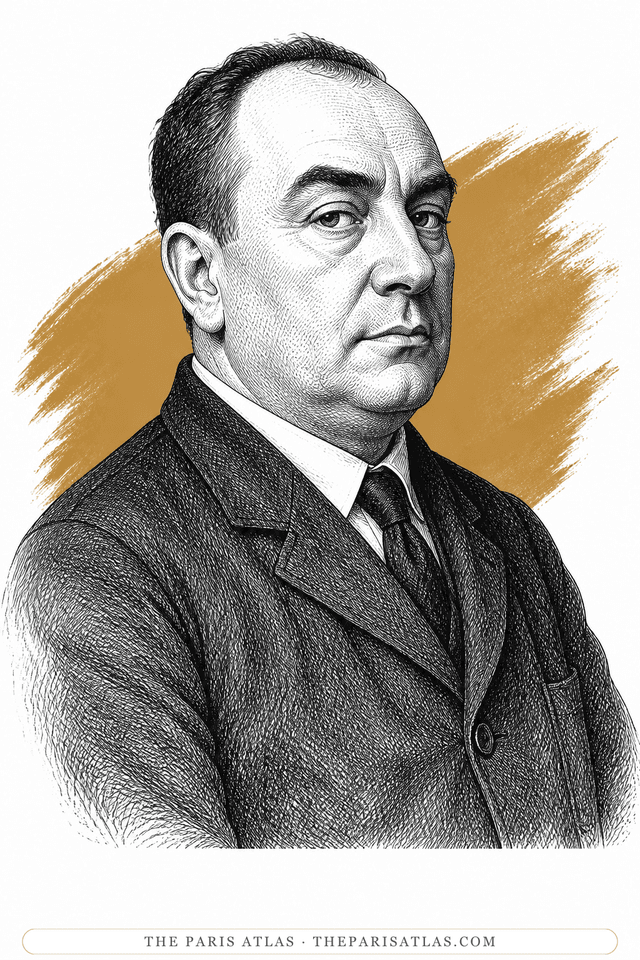
André Derain
French painter who helped invent Fauvism with Henri Matisse at Collioure, translated London into explosive colour, and then turned toward an increasingly classical art.
View artist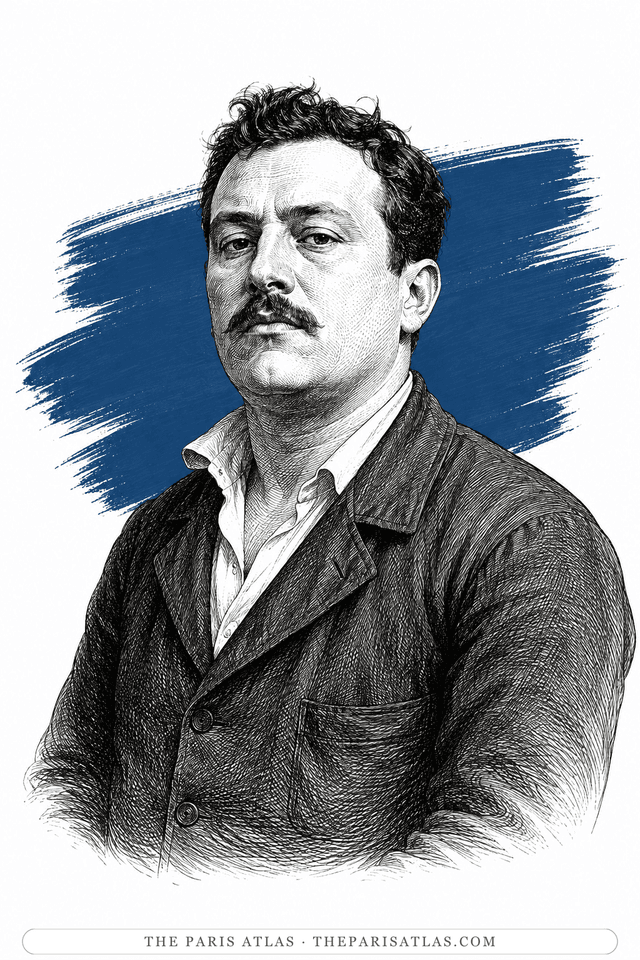
Maurice de Vlaminck
Self-taught French painter whose intense colour and forceful brushwork around Chatou made him one of Fauvism’s central figures.
View artist
Tarsila do Amaral
Brazilian painter who spent the 1920s moving between São Paulo and Paris, studied Cubism under André Lhote, Albert Gleizes and Fernand Léger, and used what she learned to paint Brazilian towns, railways, plants and bodies. Her 1928 painting Abaporu prompted the manifesto that gave the Anthropophagic movement its name.
View artist
References
The sources below include collection records, catalogues, scholarly research, and primary materials that informed this page. They document The Red Studio, its making, and its place in cultural history.


1Henri Matisse, The Red Studio, Issy-les-Moulineaux, fall 1911 — 8.1949
WebsiteThe Museum of Modern ArtUsed forWeb source consulted for documented facts and historical context presented on the The Red Studio page.

2Archived collection record for The Red Studio, 14 September 2026: gallery label, medium, dimensions, credit line, object number and copyright notice
ArchiveInternet Archive Wayback Machine, capturing moma.orgUsed forArchival evidence used to document the historical record connected to The Red Studio.
3Exploring the private universe of Henri Matisse in The Red Studio, by Abed Haddad and others, Heritage Science 10:168
PeriodicalHeritage Science (Springer), 23 October 2022Used forContemporary reporting or criticism used to document the historical reception and context of The Red Studio.
4Matisse: The Red Studio, 1 May – 10 September 2022
WebsiteThe Museum of Modern ArtUsed forWeb source consulted for documented facts and historical context presented on the The Red Studio page.
5Press release: the first exhibition to reunite all the works in Henri Matisse's The Red Studio
Official recordThe Museum of Modern ArtUsed forOfficial record used to verify names, dates, institutional details, or other factual information on this page.
6Matisse: The Red Studio — exhibition checklist
Official recordThe Museum of Modern ArtUsed forOfficial record used to verify names, dates, institutional details, or other factual information on this page.
7Matisse: The Red Studio — section texts, including the 1912 Matisse–Shchukin correspondence
Official recordThe Museum of Modern ArtUsed forOfficial record used to verify names, dates, institutional details, or other factual information on this page.
8Matisse: The Red Studio — extended artwork labels
Official recordThe Museum of Modern ArtUsed forOfficial record used to verify names, dates, institutional details, or other factual information on this page.
9The First Studio Henri Matisse Invented Entirely for Himself, by Ann Temkin and Dorthe Aagesen
PeriodicalMoMA Magazine, 27 April 2022Used forContemporary reporting or criticism used to document the historical reception and context of The Red Studio.
10Museum of Modern Art shows two major acquisitions, press release 490405-23, 5 April 1949
ArchiveThe Museum of Modern ArtUsed forArchival evidence used to document the historical record connected to The Red Studio.
11Second Post-Impressionist Exhibition, Grafton Galleries, 5 October – 31 December 1912
Exhibition catalogueBallantyne & Company for the Grafton Galleries, LondonUsed forCatalogue scholarship used to verify attribution, provenance, chronology, and interpretive context for The Red Studio.
12Matisse: The Red Studio, 4 May – 9 September 2024
WebsiteFondation Louis Vuitton, ParisUsed forWeb source consulted for documented facts and historical context presented on the The Red Studio page.
13Le Violoniste à la fenêtre — Henri Matisse, AM 1975-260
WebsiteCentre Pompidou, Musée national d'art moderne, ParisUsed forWeb source consulted for documented facts and historical context presented on the The Red Studio page.
14Henri Matisse, Interior with a Violin Case, Nice, winter 1918-19 — 86.1934
WebsiteThe Museum of Modern ArtUsed forWeb source consulted for documented facts and historical context presented on the The Red Studio page.
15Henri Matisse — artist profile
WebsiteThe Museum of Modern ArtUsed forWeb source consulted for documented facts and historical context presented on the The Red Studio page.
16Henri Matisse (1869–1954)
WebsiteThe Metropolitan Museum of ArtUsed forWeb source consulted for documented facts and historical context presented on the The Red Studio page.
These references provide the documented foundation for this work's history and interpretation. Claim-level citations remain attached to the specific claims they support.
 Explore more resources