Henri de Navarre
The Protestant bridegroom, nineteen years old, who keeps his life by going to mass and keeps his kingdom by never quite saying what he thinks.
To leave the Louvre alive and reign in Navarre, and he will convert, dissemble and let his wife keep a lover to get there.
The book
Queen Margot
Alexandre Dumas
At a glance
- King of Navarre, leader of the French Protestants, brother-in-law of Charles IX
- About nineteen in August 1572
- Henriot by the king, the Béarnais by the narrator, Harry by the Paris crowd
- In the Louvre, one floor below Madame de Sauve's
- Charlotte de Beaune, baronne de Sauve, placed near him by the queen mother
- Henri de Bourbon, King of Navarre, later Henri IV of France · 1553–1610
Who they are in the book
Spoiler-freeHenri de Navarre is about nineteen at his wedding, the son of Jeanne d'Albret, who died two months earlier of what everyone at court believes was a pair of poisoned gloves. He has been King of Navarre for those two months, and the narrator tells the reader on his first appearance that he will one day be Henri IV. He speaks French with a Gascon accent, swears by ventre saint gris, and is in love not with his bride but with Charlotte de Sauve, one of the queen mother's ladies.
What he wants is to survive the Louvre and get home to his mountains, and he will kneel, swear, hunt and flatter to do it. Dumas gives him the book's sharpest political scenes: the wedding-night bargain with Marguerite, the arquebuse at his chest, the hunting knife in the boar's shoulder. He also gives him the book's most dangerous friend in Charles IX, who comes to love him, and its most dangerous enemy in Catherine de Médicis, who has read his future in a hen's brain.
How Henri de Navarre Is Portrayed
- The face in the crowdIn Chapter I he walks the ballroom with his head a little on one side: keen eyes, black hair cut close, thick brows, a nose hooked like an eagle's, a sneering smile and a beard still coming in. He made his name at the battle of Arnay-le-Duc.
- Four Henrys in the roomIn Chapter I he tells Madame de Sauve that there are four Henrys present, of France, of Condé, of Guise and of Navarre, and promises that the last will spend his wedding night with her rather than with his wife.
- The closet he never opensIn Chapter II he walks towards his wife's closet, reads her alarm, and stops. He tells her she is an unfaithful wife but a faithful ally, and that just now he has more need of fidelity in politics than in love.
- Death, mass or the BastilleIn Chapter X Charles IX cocks an arquebuse in his face and shouts the three choices. He answers with a question, whether the king will kill his own brother, and the narrator notes that a plain no would have killed him.
- To mass, HarryIn Chapter XVI the crowd on the way to Montfaucon shouts at him to go to mass. He answers that he went yesterday, is going today and will go tomorrow, and asks whether that is not enough.
- A knife in the boarIn Chapter XXXI, armed only with a hunting knife, he kneels and drives it to the hilt into the boar's shoulder while the duc d'Alençon's musket ball breaks the king's horse's knee instead. He cleans the blade in the earth and says one does what one can.
Henri de Navarre quotes
I now know that some one is concealed here--that you are an unfaithful wife, but a faithful ally; and just now, I confess, I have more need of fidelity in politics than in love.
Death, mass, or the Bastille!
In Chapter LXV the dying Charles IX names him regent in front of his mother and brother, and hands him the parchment. Catherine de Médicis calls in the soldiers. René, changing sides because he believes the horoscope, leads Henri down a secret corridor to a horse at the postern, and he is over the drawbridge as the sentinels fire. The duc d'Anjou arrives from Poland minutes later and is proclaimed Henri III.
The epilogue finds him back in Paris a year later, in secret, to see Madame de Sauve in a house near the Croix des Petits-Champs. Maurevel comes to kill him there and is killed by De Mouy instead. The novel ends with Henri in the street with a sword in his hand, and the crown still three deaths away.
If you like Queen Margot


If you like Alexandre Dumas
Explore authors with a similar voice, perspective, and influence.
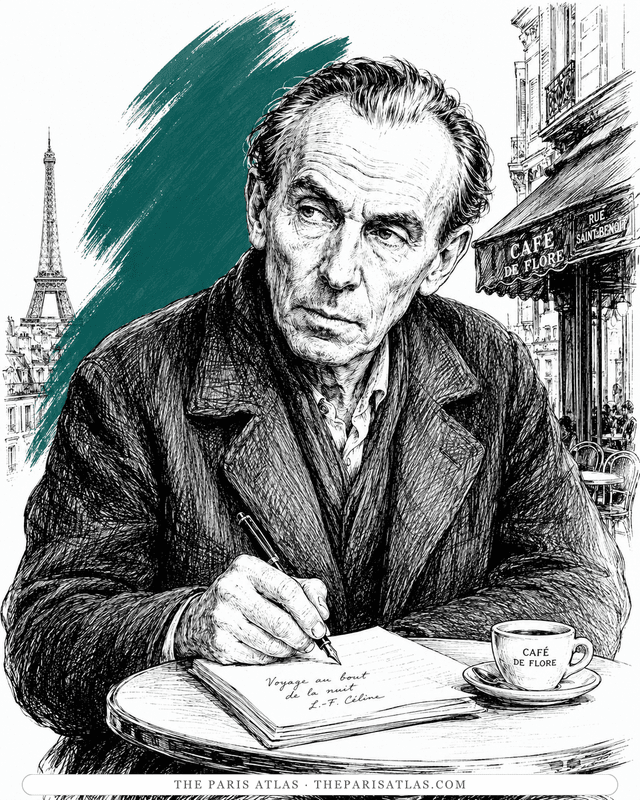
Louis-Ferdinand Céline
The doctor of the Paris slums who wrote the century's blackest, funniest novel — and changed the sound of French prose.
View author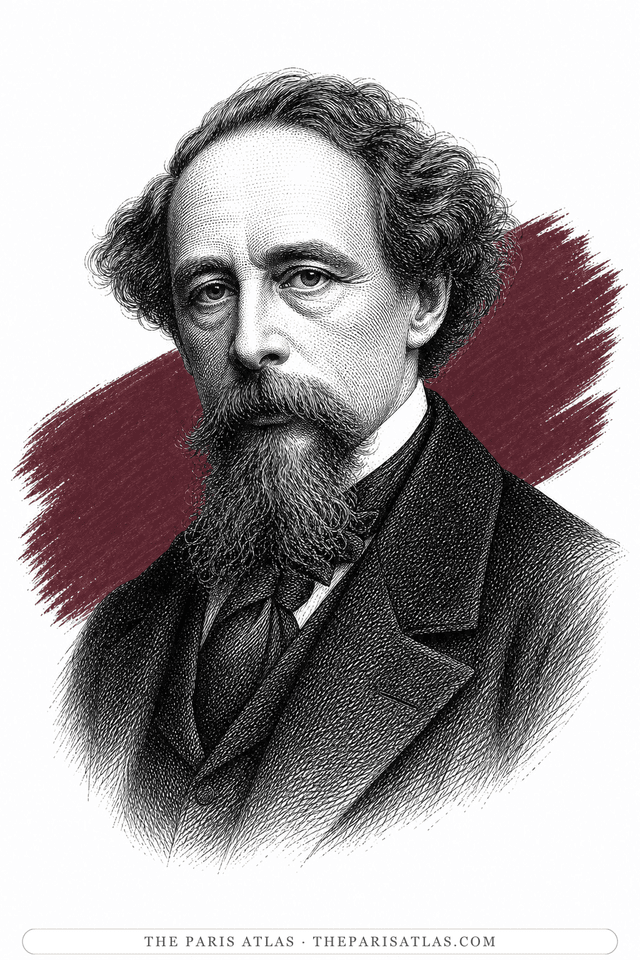
Charles Dickens
The most popular English novelist of the nineteenth century, who was never a Paris resident in the ordinary sense but kept coming back for twenty-five years: one winter in a rented mansion on the rue de Courcelles, a second winter on the Champs-Élysées writing Little Dorrit, repeated compulsive visits to the Paris Morgue — the riverside building where the city displayed its unidentified dead to the public — and a novel of the French Revolution, A Tale of Two Cities, that has shaped how English readers picture Paris ever since.
View author
Henry Miller
The Brooklyn dropout who arrived in Paris broke at thirty-eight and wrote the exuberant, banned books that ended American censorship.
View author