La Mole
Joseph de Lerac de la Mole, a Protestant gentleman from Provence who arrives in Paris on the eve of the massacre with letters for Coligny and a face that undoes the queen.
To be near Marguerite, whatever it costs; on the scaffold he says that having seen her once more he can go.
The book
Queen Margot
Alexandre Dumas
At a glance
- A Protestant gentleman of Provence, later a Catholic, in the household of the duc d'Alençon
- Twenty-four or twenty-five
- La Belle Étoile, Rue de l'Arbre-Sec, kept by Maître La Hurière
- Annibal de Coconnas, who stabbed him twice on the night they met
- Marguerite, in the house with two doors on the Rue Cloche-Percée
- Joseph de Boniface, seigneur de La Mole · Executed in Paris, 30 April 1574
Who they are in the book
Spoiler-freeLa Mole rides into Paris by the Porte Saint-Marcel on the evening of 24 August 1572, twenty-four or twenty-five years old, on a white Spanish horse, in a black doublet and a violet velvet cloak. He is a Protestant with letters for Admiral Coligny and a recommendation to the King of Navarre, and he is handsome in a way the book never stops mentioning: dark, blue-eyed, with a sweet and melancholy smile. Charles IX, who knows every family in France, places him at once as a Lerac de la Mole of Provence.
He is the lover in a book that is otherwise about survivors. Stabbed on the night of the massacre, he vows to turn Catholic if he lives, and keeps the vow. Hidden and healed by Marguerite, he becomes her lover and, through the duc d'Alençon, a piece in the plot to get Henri de Navarre out of the Louvre. He is brave in the duel and braver under torture, and he never learns to be careful.
How La Mole Is Portrayed
- The arrivalIn Chapter IV he crosses the Place Maubert, the Petit Pont and the Pont Notre-Dame and stops under the sign of La Belle Étoile on the Rue de l'Arbre-Sec. White horse, black doublet trimmed with jet, dark violet cloak, sword and dagger with chased steel hilts, and a Provençal accent.
- The full nameHe introduces himself to Coconnas in Chapter IV as the Comte Joseph Hyacinthe Boniface de Lerac de la Mole, and the two go into the inn arm in arm because neither will go first.
- The passwordIn Chapter VIII, wounded and hunted, he throws away his sword and doublet, runs along the river, leaps the Louvre drawbridge among the soldiers, and beats on a door two floors up. Asked who he is, he remembers the word: Navarre. He faints on the queen's carpet.
- The vow keptIn Chapter XVI, under the gibbet at Montfaucon, he tells Coconnas he is now a Catholic, having vowed to convert if he escaped the massacre, and that his second vow was to hang Coconnas from the nail beneath the admiral. He lays his cherry-coloured cloak on the ground and draws.
- The cherry-coloured cloakChapter XXV is named for it. The cloak and its white plume are so well known that Coconnas can pick his friend out by lantern light at the Louvre gate, and the duc d'Alençon later uses the cloak to make a decoy of another man.
- The scaffoldIn Chapter LX, his legs broken by the boot, he is carried up the steps by Coconnas, kisses the reliquary Marguerite gave him, turns his eyes to the tower window and begins to say goodbye to her. The sword falls before he finishes the sentence.
La Mole quotes
I love you more than any woman, and I love La Mole more than any man.
Adieu, adieu, youth, love, life!
Arrested in the forest of Vincennes with Coconnas, he is tried for sorcery against the king and tortured with the boot in Chapter LVIII. He confesses nothing, and the crowd on the way to the Place Saint-Jean-en-Grève knows it. Caboche stops the cart opposite the Rue Tizon so that he can look once more at the little house. He is beheaded first, at his own request, with the queen's name on his lips.
Marguerite keeps his head. The real La Mole and Coconnat were beheaded together on the Place de Grève on 30 April 1574 after plotting for the duc d'Alençon; the sorcery charge, the torture scene and the reliquary are the novel's.
If you like Queen Margot


If you like Alexandre Dumas
Explore authors with a similar voice, perspective, and influence.
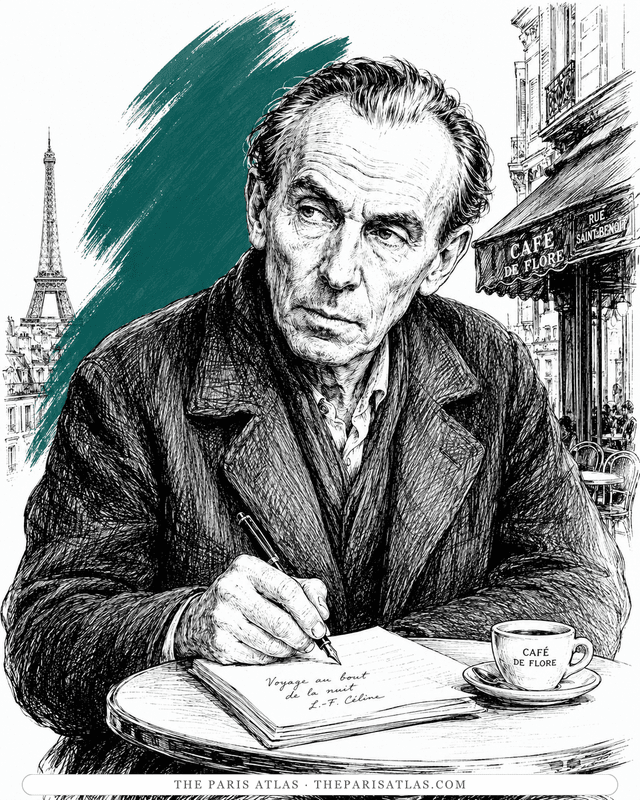
Louis-Ferdinand Céline
The doctor of the Paris slums who wrote the century's blackest, funniest novel — and changed the sound of French prose.
View author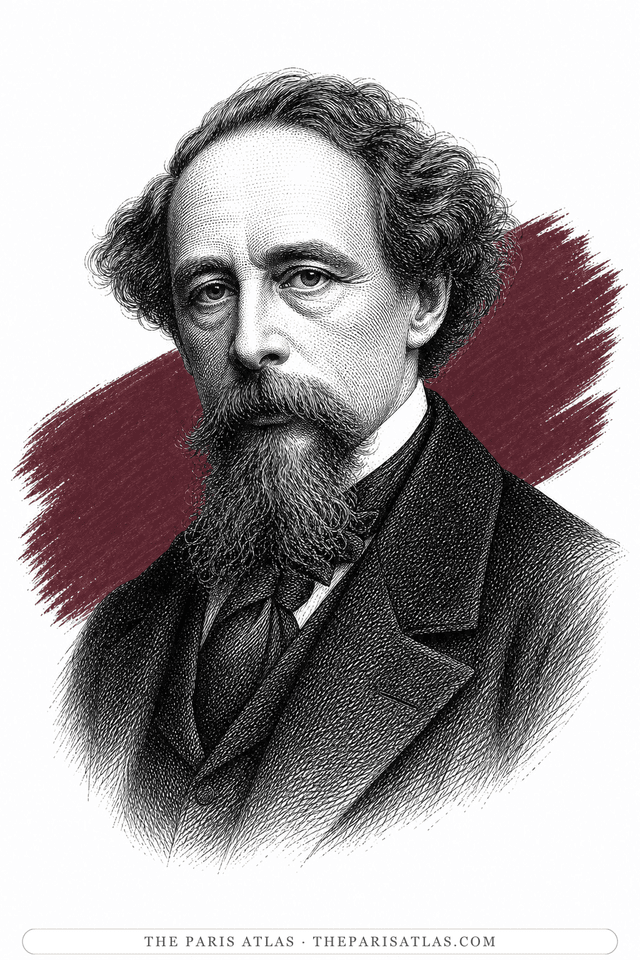
Charles Dickens
The most popular English novelist of the nineteenth century, who was never a Paris resident in the ordinary sense but kept coming back for twenty-five years: one winter in a rented mansion on the rue de Courcelles, a second winter on the Champs-Élysées writing Little Dorrit, repeated compulsive visits to the Paris Morgue — the riverside building where the city displayed its unidentified dead to the public — and a novel of the French Revolution, A Tale of Two Cities, that has shaped how English readers picture Paris ever since.
View author
Henry Miller
The Brooklyn dropout who arrived in Paris broke at thirty-eight and wrote the exuberant, banned books that ended American censorship.
View author