Adam Bede
George Eliot
Adam Bede
George Eliot's first novel, set in the same kind of Midlands village with the same dialect and the same eye for farm and workshop.
Read our takeSilas Marner
George Eliot
by George Eliot
A lonely weaver loses the gold he has hoarded for fifteen years, and finds a sleeping child with golden curls on his hearth instead.
Silas Marner is George Eliot's shortest novel, published in one volume in 1861. A linen-weaver is driven out of his chapel in a northern town after he is falsely accused of theft. He settles in the village of Raveloe, works at his loom and hoards gold for fifteen years. The squire's wastrel son steals it. Soon after, a little girl toddles in from the snow, and Silas raises her as his own. Her real father, the squire's elder son Godfrey Cass, keeps quiet for sixteen years. George Eliot, the pen name of Mary Ann Evans, wrote it in a few months between Adam Bede and Romola.
The idea came suddenly. In November 1860 George Eliot wrote in her journal that a new story had thrust itself between her and the Italian novel she was planning. In February 1861 she told her publisher, John Blackwood, where it came from. She remembered seeing, in early childhood, a linen-weaver with a bag on his back. The story came to her first as a sort of legendary tale.[1]
She knew the book might look gloomy. She wrote to Blackwood that nobody would have been interested in it but herself, since Wordsworth is dead, if George Henry Lewes had not been gripped by it. She hoped readers would not find it a sad story as a whole. The book was meant to show the healing power of plain, natural human ties.[1]
The novel is set in the early years of the nineteenth century, when weavers still worked by hand in country cottages. Its opening pictures these pale, stooping men carrying their bags of thread through the lanes. The shepherds of the time, the narrator says, suspected the trade could not be carried on entirely without the help of the Evil One.[2]
Silas Marner is a young weaver in Lantern Yard, a small chapel congregation in a northern manufacturing town. He sometimes falls into strange fits, when he goes rigid and seems unaware of the world. One night, while he watches over a dying deacon, the church's money disappears from the room. His pocket-knife is found in the bureau, and the chapel decides his guilt by praying and drawing lots.[2]
The lots say he is guilty. Silas tells his friend William Dane that he stole the money himself and laid the blame on him. Silas adds that there is no just God, only a God of lies. Sarah, the woman he was engaged to, breaks it off and marries William a month later. Silas leaves the town.[2]
He settles in a stone cottage by a disused quarry, the Stone-pit, near the village of Raveloe. For fifteen years he weaves linen for the local farmers, and the villagers think him strange. He is paid in gold guineas and keeps them in an iron pot under the bricks of his floor. At night he takes them out and counts them.[2]
The richest man in the village is Squire Cass. His elder son Godfrey is secretly married to Molly Farren, a woman from a nearby town who drinks and takes opium. His younger brother Dunstan knows and blackmails him. One foggy evening Dunstan rides Godfrey's horse, Wildfire, to a hunt meeting, kills it on a fence and walks home past Silas's cottage. He finds the door open and nobody inside, takes the two bags of gold and disappears into the dark.[2]
Silas runs to the Rainbow inn, where the village men are drinking, and cries that he has been robbed. The village grows kinder to him after the robbery. Dolly Winthrop, the wheelwright's wife, brings him little cakes and urges him to go to church. On New Year's Eve Molly carries her little daughter through the snow towards the squire's party. She means to shame Godfrey in front of everyone, but she takes a dose of opium on the way and collapses by a furze bush.[2]
The child crawls towards the light of Silas's open door. Silas, whose eyes are weak, sees what he takes to be his gold on the floor by the fire. His fingers touch soft warm curls instead. He follows the child's tracks back to her dead mother and carries the girl to the squire's house for the doctor. Godfrey sees his own daughter in the weaver's arms and says nothing.[2]
Silas keeps the child and names her Hephzibah, after his mother and little sister, and calls her Eppie. Godfrey marries Nancy Lammeter. Their only baby dies, and Nancy refuses to adopt a child. Sixteen years pass. Then the Stone-pit is drained, and Dunstan's skeleton is found at the bottom with Silas's gold beside him.
Godfrey tells Nancy the whole truth, and together they go to Silas's cottage to claim Eppie and make a lady of her. Eppie refuses. She says she cannot feel she has any father but Silas, and that she is promised to a working man, Dolly's son Aaron. Godfrey accepts that some debts cannot be paid like money debts.
Silas takes Eppie back to the northern town to find Lantern Yard. The chapel has been pulled down and a big factory stands in its place, so he never learns whether he was cleared. Eppie marries Aaron Winthrop in the spring, and they all stay together at the Stone-pit. The book ends with Eppie saying she thinks nobody could be happier than they are.
The whole book turns on one exchange. Silas treats his gold as company. He handles the coins until their shape and colour are like a drink to him, and he takes them out only at night, when his work is done, to enjoy their companionship.
When the gold comes back, it is a child. George Eliot makes the swap literal: Silas sees a heap of gold glowing by the hearth, reaches out, and touches curls. His first thought is that his little sister, who died when he was a barefoot boy, has come back to him in a dream.
A few weeks after the book came out, George Eliot wrote to Blackwood about misers. There could be no great paintings of misers now, she wrote, because nobody could handle cheques and paper money the way men once handled glittering gold.
Paris read Silas Marner within months. On 1 September 1861 the Revue des Deux Mondes, the city's leading literary review, ran a long article on it by Athanase Cucheval-Clarigny. The review had praised Adam Bede in 1859 and retold The Mill on the Floss in 1860.
Cucheval-Clarigny knew that George Eliot was a woman, and he did not like the new book. He thought it hurried, and worse than The Mill on the Floss, which was itself worse than Adam Bede. He blamed a success that pushed her to produce a novel every spring. He also attacked what he called her false doctrines about truth in literature.
He ended by saying he would have been gentler if he thought less of the author of Adam Bede. Along the way he translated Eppie's refusal of Godfrey into French for his readers. For many people in Paris, that review was their first taste of the book.
Books in French followed. François d'Albert-Durade was a Geneva painter in whose flat George Eliot had lodged in 1849 and 1850, and he translated several of her novels. The national library in Paris holds a new edition of his Silas Marner, published in Paris by Fischbacher in 1881. Hachette published a second translation, by Auguste Malfroy, in 1889.
Near the end, Silas goes back to the town he left thirty years before. He wants to ask the minister whether the truth about the stolen money ever came out. The streets are dark and noisy, and he cannot find his way. When he finds the old house with the overhanging window, the chapel beside it has gone, and a large factory stands there. Men and women are pouring out of it for their midday meal.
Nobody can tell him anything about his old friends. Silas never learns whether he was cleared, and the novel does not tell us either. Back in Raveloe he tells Dolly Winthrop that the matter is dark to him and will be dark to the last. But since the child came, he says, he has had light enough to trust by.
In old days there were angels who came and took men by the hand and led them away from the city of destruction. We see no white-winged angels now. But yet men are led away from threatening destruction: a hand is put into theirs, which leads them forth gently towards a calm and bright land, so that they look no more backward; and the hand may be a little child’s.
Gold!—his own gold—brought back to him as mysteriously as it had been taken away!
I can’t feel as I’ve got any father but one
At about two hundred pages it is a fraction of the length of Middlemarch, with a clear plot and a happy ending.
George Eliot said the story came to her as a legendary tale. The gold that turns into a child's curls is pure fable, but the village around it is drawn from life.
Silas, who took the child in, and Godfrey, who let her go, both come to claim her. Eppie's choice between them is the heart of the ending.
Chapter VI, where the village men argue about ghosts and cattle just before Silas bursts in, is one of the funniest scenes she wrote.
A short-sighted linen-weaver who leaves his chapel after a false accusation and lives alone in Raveloe for fifteen years.
The squire's good-natured elder son, secretly and unhappily married, who lets his own daughter be raised by the weaver.
Godfrey's daughter by Molly Farren, found on Silas's hearth as a toddler and raised by him in the stone cottage.
The wheelwright's wife, a kind, slow-spoken neighbour who helps Silas bring up Eppie.
Godfrey's spiteful younger brother, known as Dunsey, who steals Silas's gold on a foggy night and disappears.
A pretty, strict, principled farmer's daughter whom Godfrey marries after Molly's death.
Godfrey's secret wife, addicted to opium, who dies in the snow on New Year's Eve.
Silas's closest friend in Lantern Yard, who steals the church money and marries the woman Silas was engaged to.
Dolly's son, a gardener, who marries Eppie and comes to live with her and Silas.
28 November 1860
George Eliot's journal says a new story, Silas Marner, the Weaver of Raveloe, has thrust itself between her and the novel she was planning.
24 February 1861
She tells John Blackwood the story came from a childhood memory of a linen-weaver with a bag on his back.
10 March 1861
She finishes the novel and sends the last thirty pages to Edinburgh.
Spring 1861
Blackwood publishes it in one volume. Advance orders from booksellers reach about 5,500 copies.
1 September 1861
The Revue des Deux Mondes in Paris prints Athanase Cucheval-Clarigny's long, severe review.
1 January 1862
Blackwood forwards her a letter about the book from Charles de Montalembert, the French historian of monasticism.
1881
Fischbacher publishes a new edition of François d'Albert-Durade's French translation in Paris.
1889
Hachette publishes Auguste Malfroy's French translation in Paris.
2003
Penguin Classics publishes David Carroll's edition.

Adam Bede
George Eliot
George Eliot's first novel, set in the same kind of Midlands village with the same dialect and the same eye for farm and workshop.
Read our takeMiddlemarch
George Eliot
Her longest novel, written ten years later. Read Silas Marner first for the voice, then Middlemarch for the full range.
Read our take
Charles Dickens's story of a miser brought back to life by other people, published eighteen years earlier.
Read our take
Victor Hugo's novel, published a year after Silas Marner. In it a hunted man takes in an orphaned girl and raises her as his daughter.
Read our takeA weaver who has lost his faith and his friends lives alone with his hoard of gold. The gold is stolen, and a toddler wanders into his cottage in its place. Raising her brings him back to life.
In the spring of 1861, by William Blackwood and Sons, in one volume. George Eliot had finished it on 10 March that year.
A childhood memory. She told her publisher she had once, in early childhood, seen a linen-weaver with a bag on his back, and the story came to her suddenly as a sort of legendary tale.
Godfrey Cass, the squire's elder son. He was secretly married to her mother, Molly Farren, and kept quiet when Silas took the child in.
Dunstan Cass, Godfrey's younger brother. He disappeared the same night, and his skeleton is found with the gold sixteen years later when the Stone-pit is drained.
The Revue des Deux Mondes reviewed it on 1 September 1861, harshly. French translations were later published in Paris by Fischbacher, from 1881, and by Hachette in 1889.
Explore authors with a similar voice, perspective, and influence.

The doctor of the Paris slums who wrote the century's blackest, funniest novel — and changed the sound of French prose.
View author
The Missouri newspaperman who became America's most famous writer, and whose first book made its reputation partly out of Paris: in 1867 he arrived with a shipload of American tourists, renamed his guide Ferguson, watched the high-kicking can-can through his fingers and wrote it all down. He kept coming back — and was living in Paris in the mid-1890s, broke, while finishing the novel he considered his best, Personal Recollections of Joan of Arc.
View author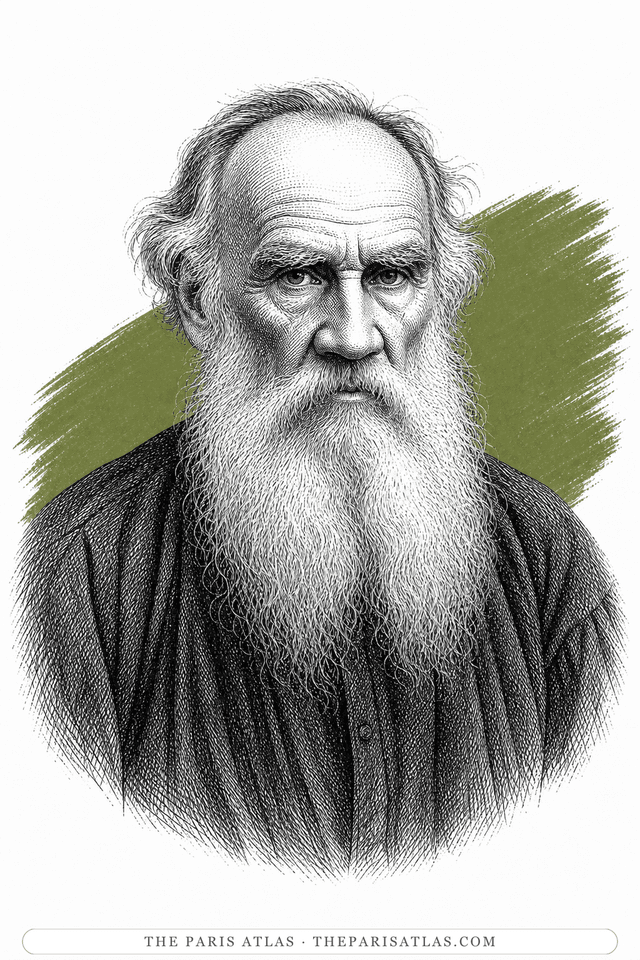
Russian novelist who wrote War and Peace and Anna Karenina, then renounced the life that produced them. He spent six weeks in Paris in 1857, and on one April morning went to watch a man beheaded in the street — an hour he said destroyed his belief in progress and in the state, and which he was still writing about twenty-two years later.
View authorThe sources below include the primary text, editions, scholarship, archival materials, and other records that informed this page. They document Silas Marner, its publication, and its place in literary history.


Who the first French translator was.

The Paris review of 1 September 1861.
Catalogue record for the 1881 Paris edition of the d'Albert-Durade translation.
Catalogue record for the 1889 Hachette translation.
Selected ISBN, on-sale date, page count and editor.
Library record confirming ISBN 9780141439754 as the Penguin Classics edition.
The primary text represented by this page, used for descriptions of the work’s contents and for any quoted passages shown here.
The primary text is the baseline reference for every book page. Additional references document publication history, interpretation, and historical context where that evidence is available.
 Explore more resources