The Mill on the Floss
George Eliot
The Mill on the Floss
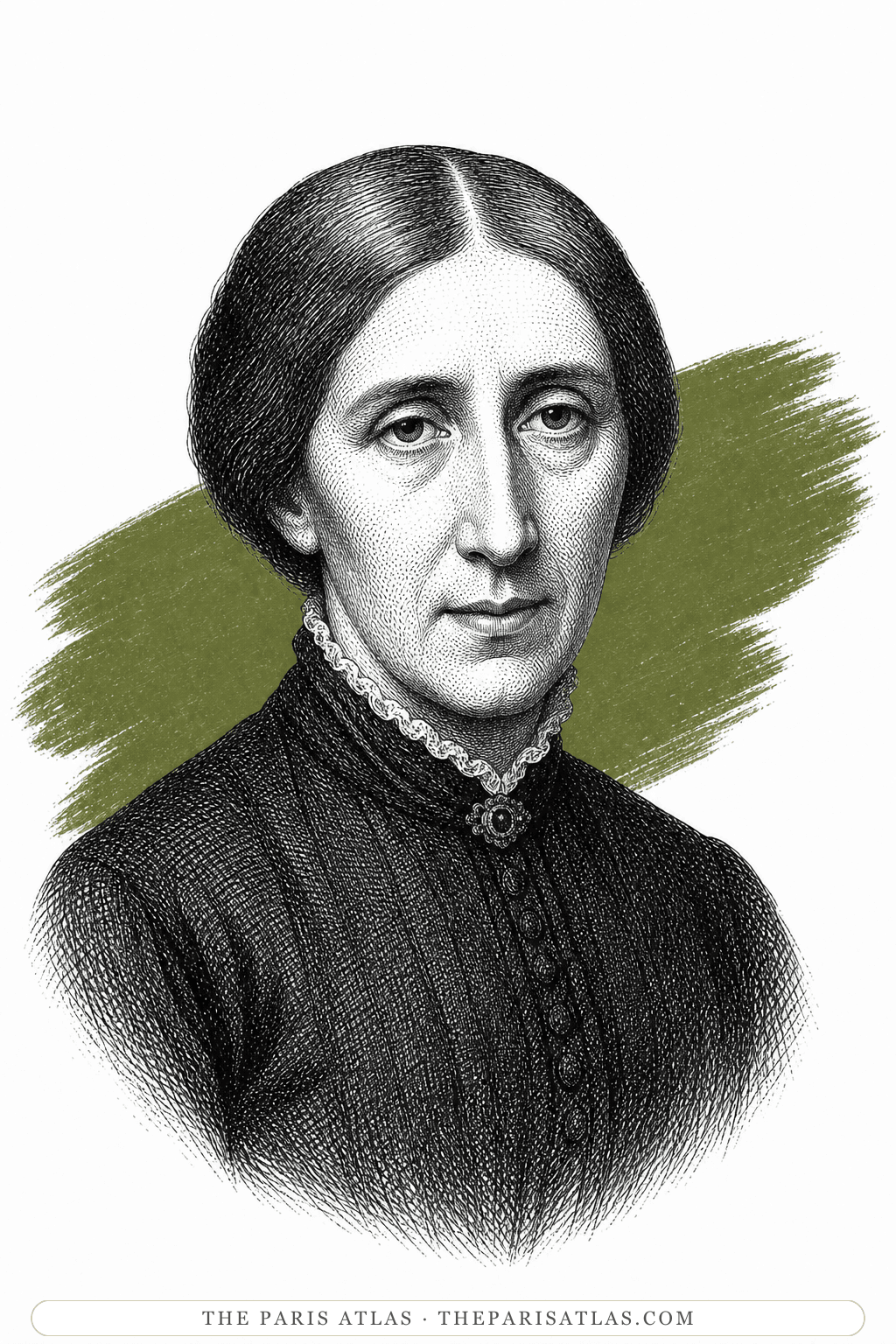
George Eliot's earlier novel about a clever girl with nowhere to put her gifts. Virginia Woolf saw the author herself in both Maggie Tulliver and Dorothea.
Read our takeMiddlemarch
George Eliot
by George Eliot
A clever young woman marries a dry old scholar, an ambitious young doctor marries the prettiest girl in town, and a Midlands town watches both go wrong.
Middlemarch is George Eliot's longest and best-known novel, set in an English country town between 1829 and 1832. Dorothea Brooke, earnest and not yet twenty, marries the elderly clergyman Edward Casaubon because she thinks his great book will give her life a purpose. Tertius Lydgate, a young doctor trained in Paris, arrives meaning to reform medicine and marries Rosamond Vincy, the mayor's daughter. Around them run the stories of a banker with a buried past, a spendthrift son and the girl who will not marry him until he finds honest work. George Eliot, the pen name of Mary Ann Evans, published it in eight parts in 1871 and 1872.
The novel began as two books. On 2 August 1869 George Eliot's journal records that she had begun Middlemarch with the Vincy and Featherstone parts, and a few days later she noted that she was reading Renouard's History of Medicine. Late in 1870 she started a separate story called Miss Brooke. On the last day of that year she had written a hundred printed pages of it. The two stories were then joined into one novel.[1]
The book is set about forty years before it was written. The first Reform Bill, which widened the vote in 1832, is being argued over, the railway is coming, and cholera is feared. Mr Brooke, Dorothea's rambling uncle, decides to stand for Parliament as a reformer. The town doctors fight Lydgate over a new fever hospital run by the banker Nicholas Bulstrode.[2]
Blackwood published the novel in eight parts, the first on 1 December 1871 and the last at the beginning of December 1872. George Eliot wrote in her journal that no book of hers had been received with more enthusiasm, not even Adam Bede.[1] The printed book is dedicated to George Henry Lewes, the man she lived with, in the nineteenth year of their blessed union.[2]
Dorothea Brooke and her sister Celia are orphans living with their uncle at Tipton Grange. Dorothea draws plans for better cottages for the farm labourers. She turns down Sir James Chettam, a kind young baronet, and accepts the Reverend Edward Casaubon, who is over forty-five. She believes he is writing a book that will explain all the myths of the world, called the Key to all Mythologies, and she wants to help him.[2]
Their honeymoon is in Rome. Casaubon spends his days in the Vatican library, and Dorothea is left alone and cries without quite knowing why. She meets Will Ladislaw, Casaubon's young cousin, who is studying painting. Will tells her what Casaubon cannot: that German scholars have already gone far beyond his work. Back at Lowick, Casaubon grows jealous of Will and ill with heart disease.[2]
In Middlemarch itself, Tertius Lydgate sets up as a doctor and votes with Bulstrode over the new hospital. He means to stay single, but Rosamond Vincy drops her chain one afternoon, he sees her tears, and he proposes. Her brother Fred hopes to inherit from his rich old uncle Peter Featherstone. Mary Garth, who nurses Featherstone, refuses to marry Fred unless he gives up waiting for money and does real work.[2]
Featherstone dies and leaves his land to a stranger. Casaubon dies in the garden summer-house at Lowick. His will contains a codicil: Dorothea loses his property if she marries Will Ladislaw. The town now assumes that something was going on between them. Meanwhile Lydgate and Rosamond furnish their house beyond their means, and he is soon deeply in debt.[2]
John Raffles, a drunken man who knows Bulstrode's past, comes to town. Years before, Bulstrode had made his money in a London pawnbroking business that took in goods without asking where they came from. He had also hidden the fact that his first wife's runaway daughter had been found. The runaway daughter was Will Ladislaw's mother. Raffles falls ill at Bulstrode's house. Lydgate forbids alcohol, but Bulstrode lets the housekeeper give him brandy, and Raffles dies. Bulstrode had just lent Lydgate a thousand pounds, so the town decides the doctor was bribed.
Dorothea believes in Lydgate when almost nobody else does. She visits Rosamond, finds Will with her, and spends the night in grief. In the morning she goes back to help anyway, and Rosamond tells her that Will loves only Dorothea. Dorothea gives up Casaubon's money and marries Will. Fred marries Mary Garth. Lydgate leaves the town, earns a good income treating rich patients, and dies of diphtheria still thinking of himself as a failure.
Tertius Lydgate learned his medicine in London, Edinburgh and Paris. Chapter XV says he went to Paris determined to come home and practise as a country doctor who would also do real science. His hero is the French anatomist Xavier Bichat, who, the narrator says, died at thirty-one after showing that living bodies are built from tissues. Lydgate had even thought of joining the Saint-Simonians, the Paris utopian socialists, in order to argue them out of some of their ideas.
Paris is also where Lydgate first made a fool of himself over a woman. While he was studying there, tired from experiments on frogs and rabbits, he went to a melodrama at the theatre of the Porte Saint-Martin. He was in love from a distance with the actress Laure, whose part was to stab her lover on stage. One night she really did stab her husband, who was playing the lover. Paris rang with the story, the novel says. Lydgate climbed onto the stage to help, and later argued loudly that she was innocent.
Laure left Paris without warning. Lydgate traced her to Avignon and asked her to marry him. She told him first that her foot had really slipped. Then she said she had meant to do it, because her husband wearied her and would insist on living in Paris. Three days later Lydgate was back at his experiments in his Paris rooms, sure that he would now take a strictly scientific view of women. The rest of the novel shows how wrong he was.
George Eliot knew Paris from short visits, not from living there. She was writing Miss Brooke, the story that became Dorothea's half of Middlemarch, during the Prussian siege of the city. Her journal for 31 December 1870 notes that the papers spoke of even harder winter weather about Paris, where her fellow men were suffering and inflicting horrors. In the same entry she counts the hundred pages of Miss Brooke she had written so far.
In October 1872, with only the last part of the novel still to come out, she and George Henry Lewes came home from a German spa by way of Paris. Her letter from Boulogne on 27 October is gloomy. They had travelled overnight, got headaches, felt disgust at the shops of the rue de la Paix, gone to Versailles in the rain and seen the sad ruins of the Hôtel de Ville, burned during the Commune the year before.
French readers wanted the book quickly. In 1872 George Eliot wrote that a Frenchman named Landolphe planned to translate the whole novel, and that a writer for the Revue des Deux Mondes, the leading Paris review, had asked leave to print Dorothea's story on its own. The first complete French edition the national library in Paris catalogues is Middlemarch: étude de la vie de province, published by Calmann Lévy in two volumes in 1890, translated by an unnamed M.-J. M.
Virginia Woolf wrote an essay called George Eliot, collected in The Common Reader in 1925. Woolf thought George Eliot's power was at its highest in Middlemarch, and she described the book in a sentence that has been quoted ever since.
the magnificent book which with all its imperfections is one of the few English novels written for grown-up people.
Woolf also saw George Eliot herself in the heroines. She found a hint of her in Dinah in Adam Bede, and a far more open portrait in Maggie in The Mill on the Floss. And she wrote that George Eliot is Dorothea, seeking wisdom and finding one scarcely knows what in marriage with Ladislaw.
The Finale follows everyone past the end of the story. Dorothea never becomes famous. The town remembers her as a fine girl who married a sickly clergyman old enough to be her father, then gave up her estate to marry his penniless cousin. The narrator argues that the good she did still counted, even though nobody recorded it. The book's last sentence says that the growing good of the world depends partly on unhistoric acts, and on the many people who lived faithfully a hidden life and rest in unvisited tombs.
The Prelude opens with the same idea. Saint Teresa of Ávila found a great purpose in reforming a religious order. Many later women with the same passion, the Prelude says, found nothing to spend it on, and became a Saint Theresa, foundress of nothing.
for the growing good of the world is partly dependent on unhistoric acts; and that things are not so ill with you and me as they might have been, is half owing to the number who lived faithfully a hidden life, and rest in unvisited tombs.
If we had a keen vision and feeling of all ordinary human life, it would be like hearing the grass grow and the squirrel’s heart beat, and we should die of that roar which lies on the other side of silence.
Here and there is born a Saint Theresa, foundress of nothing, whose loving heart-beats and sobs after an unattained goodness tremble off and are dispersed among hindrances, instead of centring in some long-recognizable deed.
Dorothea, Lydgate, Fred Vincy, Mary Garth and Bulstrode each get a full story. They are connected through money, marriage and gossip, and nobody is a minor character to themselves.
Lydgate studied in Paris and worshipped the anatomist Bichat. Chapter XV tells what happened to him there, at a melodrama at the Porte Saint-Martin theatre.
The novel shows two bad marriages from both sides. Casaubon and Rosamond are hard to like, but the book lets you see how things look to them too.
Mr Brooke's rambling speeches, Mrs Cadwallader's gossip and old Featherstone's relatives waiting for his will are comedy. The seriousness comes with jokes.
An earnest young heiress who wants to do some great good with her life and marries the wrong man in order to try.
A young doctor from a good family, trained in Paris, who comes to Middlemarch to practise medicine properly and reform it.
A scholarly clergyman of over forty-five, working for years on a book called the Key to all Mythologies that he never finishes.
Casaubon's young cousin, a would-be painter and writer who meets Dorothea in Rome and later edits Mr Brooke's newspaper.
The mayor's pretty, accomplished daughter. She marries Lydgate expecting a rise in the world and gets debt.
Rosamond's easy-going brother, who runs up debts while waiting to inherit from his uncle Featherstone.
A plain, sharp-tongued young woman who nurses old Featherstone and will not marry Fred until he earns a living.
A pious, powerful banker who runs the town's charities and hides how he made his money.
Dorothea's uncle, a rambling, well-meaning landowner who stands for Parliament as a reformer and is pelted with eggs when he makes a speech.
1 January 1869
George Eliot lists a novel called Middlemarch among her tasks for the year.
2 August 1869
She begins Middlemarch with the Vincy and Featherstone chapters, and reads Renouard's History of Medicine for Lydgate.
December 1870
She starts a separate story, Miss Brooke, while Paris is under siege. Miss Brooke later becomes Dorothea's half of the novel.
1 December 1871
Blackwood publishes the first of eight parts.
October 1872
Waiting for the proofs of the finale, she and George Henry Lewes return from Germany through Paris.
December 1872
The eighth and last part is published.
1890
Calmann Lévy publishes a complete French translation in Paris, Middlemarch: étude de la vie de province.
1925
Virginia Woolf's Common Reader reprints her essay calling Middlemarch one of the few English novels written for grown-up people.
2003
Penguin Classics publishes Rosemary Ashton's edition.

The Mill on the Floss
George Eliot
George Eliot's earlier novel about a clever girl with nowhere to put her gifts. Virginia Woolf saw the author herself in both Maggie Tulliver and Dorothea.
Read our takeDaniel Deronda
George Eliot
The novel George Eliot wrote next, set in the 1860s, close to her own time. Its early sales ran ahead of Middlemarch's.
Read our take
Virginia Woolf's essay asks what stood in the way of women writers, George Eliot among them. Woolf also wrote the most quoted line about Middlemarch.
Read our take
Charles Dickens's novel of a young man's ambitions and the money behind them, published a decade earlier. Dickens was one of the first to guess that George Eliot was a woman.
Read our takeThe Minister's Wooing
Harriet Beecher Stowe
A novel by Harriet Beecher Stowe, who was writing to George Eliot while Middlemarch came out. The two women corresponded for years and never met.
Read our takeLife in an English country town around 1830, seen through several connected stories. The two main ones follow Dorothea Brooke, who marries an old scholar hoping to share a great work, and Tertius Lydgate, a young doctor whose marriage and debts wreck his plans.
George Eliot, the pen name of Mary Ann Evans. She had used the man's name since her first stories in 1857, partly so the books would be judged without her private life in the way.
In eight parts by Blackwood, beginning on 1 December 1871 and ending in December 1872. The novel then came out as a four-volume book.
Yes. Lydgate trained in Paris, and Chapter XV tells how he fell for an actress at the theatre of the Porte Saint-Martin who stabbed her husband on stage. George Eliot also passed through Paris in October 1872, just before the last part came out.
Virginia Woolf, in her essay George Eliot, reprinted in The Common Reader in 1925. She called it the magnificent book which, with all its imperfections, is one of the few English novels written for grown-up people.
Eighty-six chapters in eight books, plus a Prelude and a Finale. The Penguin Classics paperback runs to 880 pages.
Explore authors with a similar voice, perspective, and influence.
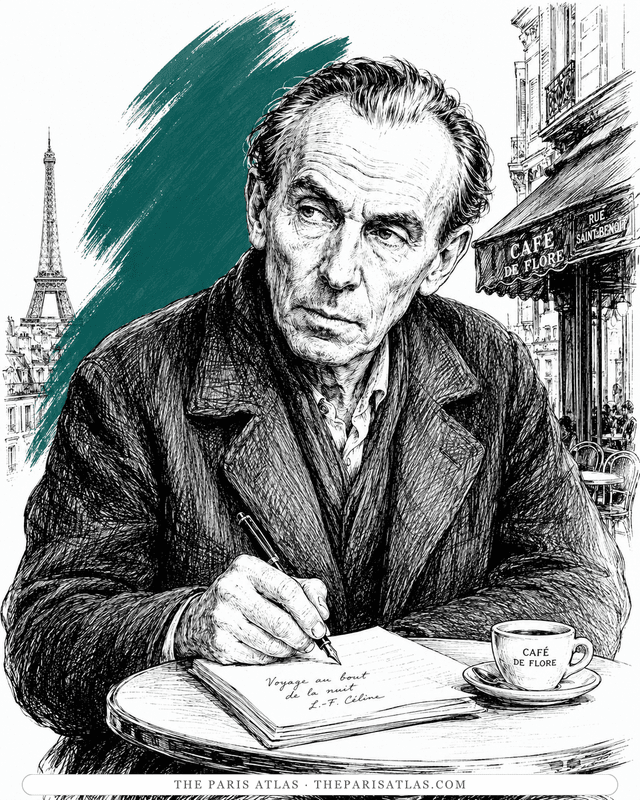
The doctor of the Paris slums who wrote the century's blackest, funniest novel — and changed the sound of French prose.
View author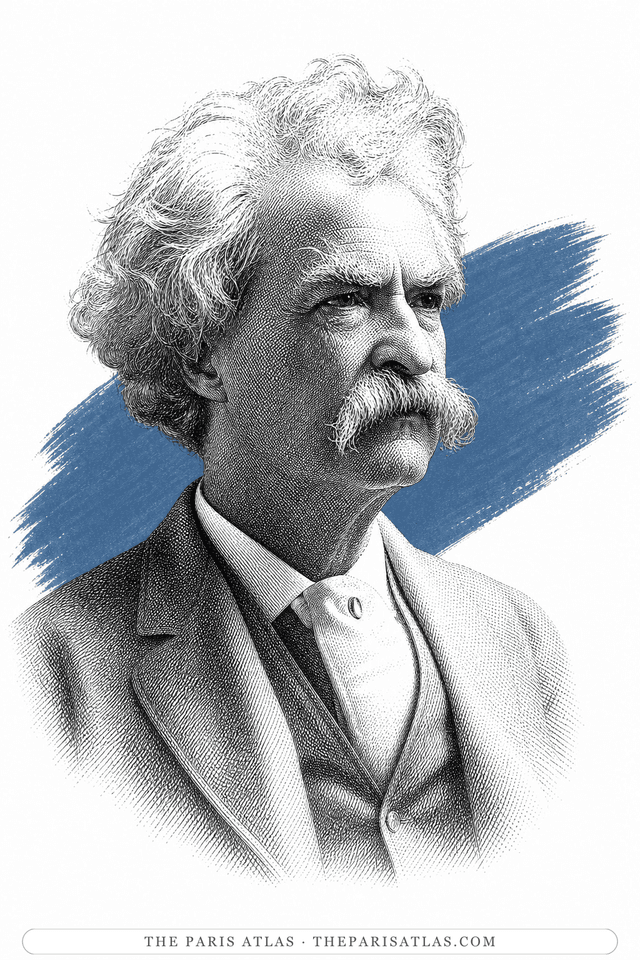
The Missouri newspaperman who became America's most famous writer, and whose first book made its reputation partly out of Paris: in 1867 he arrived with a shipload of American tourists, renamed his guide Ferguson, watched the high-kicking can-can through his fingers and wrote it all down. He kept coming back — and was living in Paris in the mid-1890s, broke, while finishing the novel he considered his best, Personal Recollections of Joan of Arc.
View author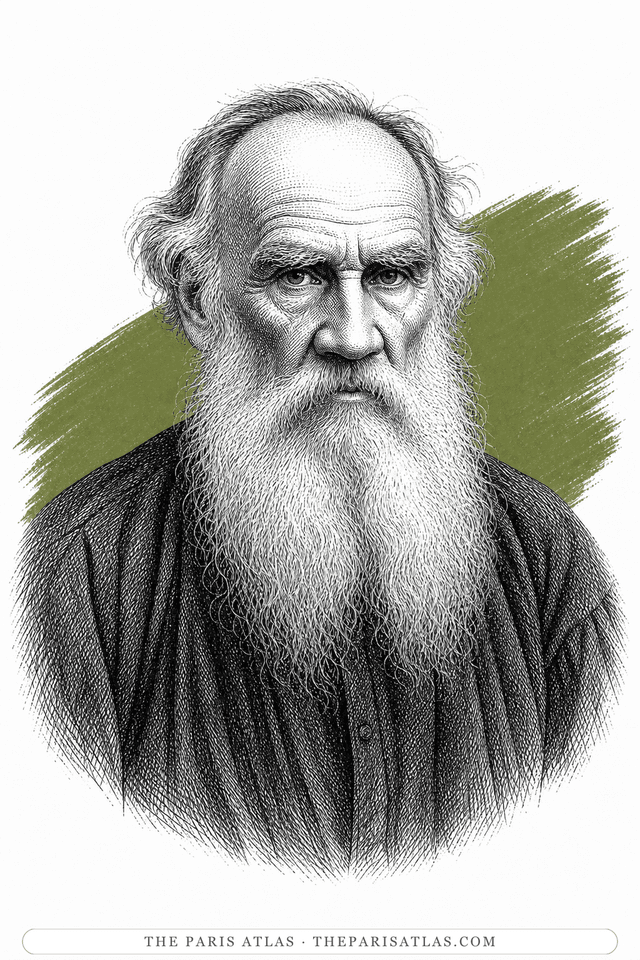
Russian novelist who wrote War and Peace and Anna Karenina, then renounced the life that produced them. He spent six weeks in Paris in 1857, and on one April morning went to watch a man beheaded in the street — an hour he said destroyed his belief in progress and in the state, and which he was still writing about twenty-two years later.
View authorThe sources below include the primary text, editions, scholarship, archival materials, and other records that informed this page. They document Middlemarch, its publication, and its place in literary history.

Virginia Woolf's essay on the novel.
Catalogue record for the 1890 French translation.

Selected ISBN, on-sale date, page count and editor.
Library record confirming ISBN 9780141439549 as the Penguin Classics edition.
The primary text represented by this page, used for descriptions of the work’s contents and for any quoted passages shown here.
The primary text is the baseline reference for every book page. Additional references document publication history, interpretation, and historical context where that evidence is available.
 Explore more resources