
Fred Peloux (Chéri)
Back from the war and nearly thirty, beautiful and obsolete — a man made entirely of a world that no longer exists.
To get back the life he had at twenty-four — Léa, and the leisured world she belonged to — which he keeps trying to reach through other people's memories.
The book

At a glance
- Fred Peloux, called Chéri since childhood; introduced formally once, to a visitor, as Monsieur Frédéric Peloux
- Thirty. The opening chapters call him close to thirty; halfway through the book he says outright that he is thirty
- Illegitimate, and raised in the world of Paris kept women, which is where he met Léa de Lonval
- To Edmée since 1913; they have no children
- Four years at the front, two small scars under the right breast, and a decoration he attributes partly to a dead comrade named Pierquin
- A private house on avenue Henri-Martin with a garden, a swimming pool and thick carpets throughout, so that he can move around it without being heard
- A large fortune that his wife now manages under his power of attorney
- None. He considers selling cars, breeding angora rabbits and working as an orderly or a bookkeeper in his wife's hospital, and does none of it
- Nounoune
Who they are in the book
Spoiler-freeFred Peloux, called Chéri since childhood, is the main character of this novel and of Chéri, the book that comes before it. He is rich, Parisian, and thirty years old in 1919. Nothing in his life has ever asked him to do anything. For years before the war he was the lover of Léa de Lonval, a woman who had made a large fortune out of a succession of wealthy men and who was around fifty-one when he left her, in 1913, to marry a young woman named Edmée. He was twenty-four. Then he spent four years at the front.
He came home whole, apart from two small scars, and found that there was no longer anything for him to be. Edmée runs a military hospital and is at her desk by nine. His mother, Charlotte Peloux, is making money out of army blankets and dried beans and is trying to reopen a set of mineral springs under a Passy street. His own fortune is bought and sold by his wife, who holds his written power of attorney. Beauty and idleness were his occupation, and in the Paris of 1919 they are worth nothing at all.
So he waits. He drives out of the city and comes back, walks in the Bois de Boulogne at two in the morning, and turns increasingly moralistic about everyone around him, which is new and which he cannot explain. Colette writes one line about this that is worth having in plain form: he begins to understand that being pure and being alone are the same misfortune.
The middle of the book is a single visit. He goes to see Léa, who is now about sixty, and afterwards he stops trying to live in the present at all. He finds an old woman from her world who has a wall of photographs of Léa young, and he goes there every evening to be told about a Paris that ended before he had finished growing up.
How Fred Peloux (Chéri) Is Portrayed
- The waitingHe left the army in December 1918 with a dislocated kneecap and lay in bed telling himself he felt well and would shortly feel better. Since then every day has been spent waiting for something he cannot name. He waits for Christmas, then for the guests to leave, then for sleep, then for breakfast. At breakfast he asks for another piece of toast he does not want, to keep his wife at the table a little longer and put off the moment when the waiting starts again.
- The two scars under his right breastHe carries two small twin scars below the right nipple and wears a green and red ribbon on his chest. He rubs the scars with his hand to keep their brown colour from fading, and he undresses at the smallest excuse.
- The story he tells after dinnerEdmée steers the table towards it and he performs it, awkwardly on purpose: a red-haired soldier named Pierquin who told him his dreams, was killed by a shrapnel burst, and was found a hundred metres away lying across him. Chéri says he tried to carry him out, and glances down at his ribbon. What he does not say is that he was pinned half-suffocated under a dead man, that he was furious about it, and that he has never forgiven Pierquin for it.
- He walks around the house with nothing onThinner than he was at twenty and harder, he parades between the bathroom and his wife's study without a stitch on. Colette says he does it as a rival rather than as a lover: he knows he is better looking than Edmée, appraises her hips and her small breasts from above like a connoisseur, and sometimes asks her whether she has melted, for the pleasure of watching her stiffen.
- The five louisHe now finds his mother's wartime dealing disgusting and tells her so. She answers by reminding him how he used to talk before the war, when he would say Léa, hand me five louis so I can go and buy cigarettes. A louis was twenty francs. He decides she has missed the point, because it was not the same thing.
- Lunch with the friend who is doing wellDesmond spent the war carrying paperwork, mess tins and hospital slops, and now runs a dance hall off the avenue de l'Alma and sells antiques to Americans. He makes Chéri guess how many bottles of champagne went out of the place between 1 May and 15 June. Chéri scratches at the tablecloth like a boy in an examination, says five hundred, and is told three thousand three hundred and eighty-two. Then he admits, with difficulty, that money has stopped interesting him.
- The mirror by the parlour doorThere is a mirror downstairs that he looks for and dreads. It stops him every time, because the man in it is not the twenty-four-year-old he expects, and he cannot locate what has changed. He asks himself what is wrong with him, the way you do when you feel slightly ill or badly dressed, and then walks through the door and forgets it.
- The night he adds up the yearsWalking in the Bois at night he works out, in years, months, days and hours, how much time he lost. If he had kept Léa when he went back to see her before the war, he calculates, that would have been three or four good years, hundreds of days and nights put by. Then he tilts his head back and says it quietly out loud: «Tout est foutu! J'ai trente ans!», which is to say that it is all finished and he is thirty.
- He decides everyone is a crookHe tells his mother to her face that the whole lot of them are swine: her blankets and her pasta and her Legion of Honour medals, Edmée's hospital, Desmond's dance hall, Filipesco cadging cigars off Americans and hospitals to resell in nightclubs. He makes a point of not excusing anyone present. What he cannot explain, when she asks, is why he has suddenly started noticing.
- The afternoon he faintsEdmée is talking about buying a house in the country next year. Chéri, half-listening, starts describing Normandy without saying that he is remembering anything: ponds, lime trees, cream, strawberries, peacocks, moonlight on the floors, a long red carpet thrown down over a path. Then he sways and slides to the carpet. Coming round he keeps his eyes shut, because if he opens them his wife will see what he is looking at.
- The room with the photographsAn old woman of Léa's generation, whom the book calls la Copine, the Pal, lives in a dark ground-floor flat at 214 avenue de Villiers with one wall covered in photographs of Léa at twenty-five. Chéri begins arriving every evening at dusk. He puts on a Japanese robe he has had bought for him, lies on the divan under a draped hanging, and gives her one instruction: talk. He pays for her meals, her coffee and her cigarettes, and corrects her sharply when she gets a date or a fabric wrong.
- What he refuses in that roomShe lays out an opium lamp and two pipes, a silver box of cocaine and a stoppered bottle of ether for him every evening, and he never touches any of it; he drinks redcurrant syrup instead. When she produces a pretty young woman for him he looks at her about as long as he would look at a small dog and asks whether the social calls are over. When she offers to invite one or two friends from the old days, Léa for instance, he says nobody, or he will find somewhere else to go.
Chéri shoots himself. The old woman with the photographs is called away to Tarascon for her mother's funeral, four or five days at least, and hands him her key on the way out with a list of instructions she would give a twelve-year-old: the light is on the left as you come in, the kettle is on the gas, your robe will be folded on the divan.
He spends the next day repeating to himself that he will not go, and goes. He lays the contents of his pockets out on the table one by one — cigarette case, the big key, the small key, the flat revolver, wallet, handkerchief, watch — puts on the Japanese robe, turns on the wall lamps and the chandelier, pushes the divan against the wall of photographs and lies down under them. He works out that having found her again on that wall he can now only lose her again; that in eight days the old woman will be back with stories he already knows by heart; and that she will bring him nothing. He tries to work himself up by saying Nounoune out loud, then stops, ashamed, because he knows perfectly well that he does not need to be worked up to pick up the gun.
He lies on his folded right arm with the revolver in that hand, puts his ear against the barrel pushed down into the cushions, and hurries because the arm is going numb and his fingers will soon stop obeying him. The last sentence of the novel is the pressure of his index finger on a small threaded ridge of steel.
Nothing about it is sudden. He has been carrying that flat revolver in his pocket for months; he offers it to Edmée as a joke when she recoils from him; and when he faints earlier in the book he tells her to leave him alone because he is dying, in a murmur Colette compares to the manner of very young suicides. The circumstances are all on the page: no work, no child, a wife who has moved her bed into the next room and thinks he is going mad, a fortune he does not touch, and a settled conviction that the only life that ever suited him ended in 1914 and that what he actually wants is a woman of sixty as she was at thirty-five.
If you like The Last of Chéri


If you like Colette
Explore authors with a similar voice, perspective, and influence.

Henry Miller
The Brooklyn dropout who arrived in Paris broke at thirty-eight and wrote the exuberant, banned books that ended American censorship.
View author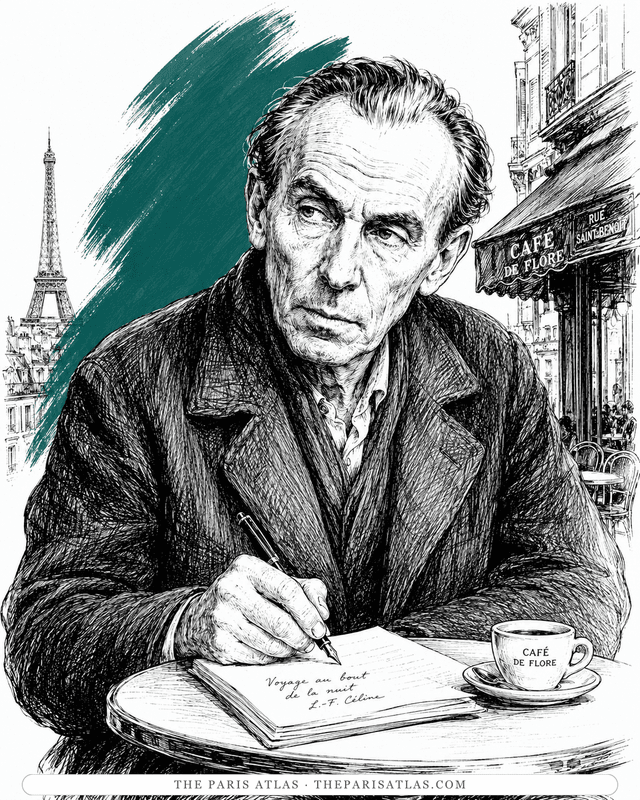
Louis-Ferdinand Céline
The doctor of the Paris slums who wrote the century's blackest, funniest novel — and changed the sound of French prose.
View author
Martha Gellhorn
War correspondent who covered the Spanish Civil War, D-Day, and conflicts across five more decades; Hemingway's third wife, 1940–1945.
View author