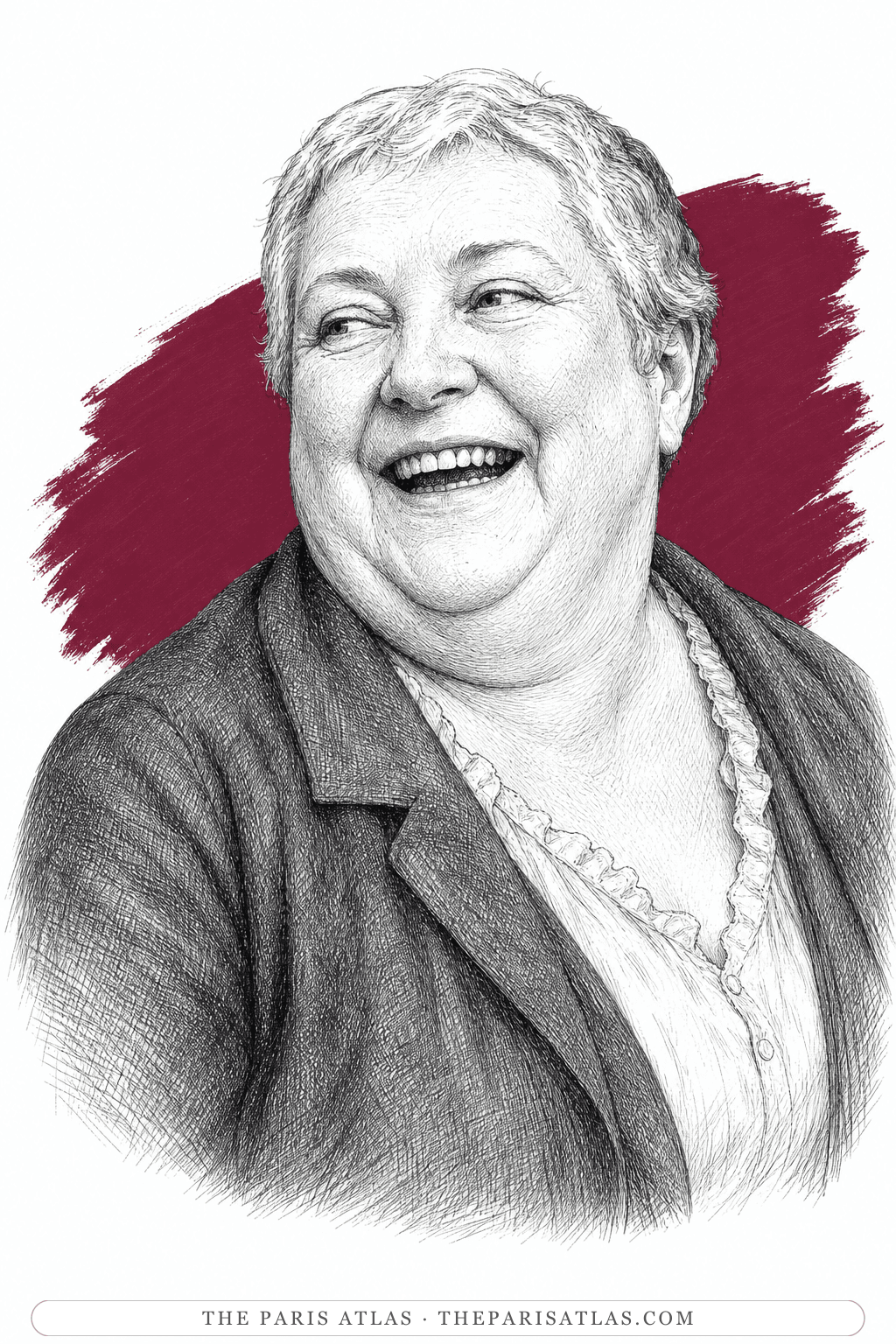
Léa de Lonval
Chéri's former lover, now old, stout, and cheerfully content — the living cancellation of the woman he remembers.
To be left in peace with the comfortable, ordinary old age she has settled into, which she describes to him as a relief.
The book

At a glance
- Léa de Lonval; Chéri called her Nounoune
- About sixty. Chéri works it out during the book from his mother's estimate that she was fifty-one, at the very least, when he married in 1913
- A small first-floor flat on the rue Raynouard in Passy, western Paris. She sold her private house to Americans during the war and thought it a good deal
- Her own, made across a long career and still working: she takes a half share in Charlotte Peloux's wartime trading
- Bacciocchi, Septfons, Spéléïeff, and then Chéri, in that order
- Bridge, the cinema, dinners out, a drive in the Bois, and advice given freely to anyone who calls
- Her rope of pearls, and photographs she wanted to burn on the grounds that nobody could still be interested in what she used to look like
Who they are in the book
Spoiler-freeLéa de Lonval spent her working life being kept by rich men, one after another, and made a large fortune doing it. In Paris before 1914 that was a recognised career with its own rules, its own gossip and its own celebrities, and she was one of them. The last of her lovers was Fred Peloux, known as Chéri, who was about twenty-four when he left her in 1913 to marry someone else, and who is the main character of this book. She was around fifty-one at the time.
In this novel she is about sixty and she appears in one chapter. Chéri, who has not seen her in five years and has barely thought about her, climbs one flight of stairs to her flat on the rue Raynouard and does not recognise her. She has sold her private house to Americans and moved somewhere small. She has cut her hair short and grey, stopped wearing a corset, stopped powdering her face, and put on a great deal of weight. She is cheerful, healthy and busy, she plays bridge, and she wants to take him to a cheap restaurant she has found.
Colette does not make her ridiculous and does not make her sad. Léa is the one person in the book who has come out of the wreck in good order, and she says so herself, more than once, without any apparent effort. The whole of Chéri's collapse follows from his refusal to believe her.
How Léa de Lonval Is Portrayed
- The woman he takes for a strangerA young maid shows him into a room lit pink by the late sun. A woman is writing at a desk with her back to him: a broad back, a grey stubble of hair cut short like his mother's. He assumes Léa has a visitor and wonders who the old woman is. Then she turns round and he takes her blue eyes full in the face.
- What Colette says she looks likeNot monstrous, the book says, but vast, and thickened everywhere at once. Her arms are like round thighs and are held out from her hips by their own bulk. She has wide jowls, a second chin, a red complexion she no longer bothers to powder, and a mouth full of gold when she laughs. She carries the weight herself, without stays or supports, and Colette calls the result a healthy old woman.
- Dressed for goodShe wears a plain skirt and a long jacket of no particular character over frilled linen. When Chéri asks whether he is keeping her from dressing to go out, she says she is dressed, permanently. Blouses, good underlinen, this uniform over the top, and she is ready for dinner at a restaurant, the cinema, bridge or a walk in the Bois. She says it as though a weight had been taken off her.
- She says out loud that she loved himHer friend Valérie Cheniaguine, who is in the room, remarks that Léa used to be very proud of Chéri. Léa says no, quietly: «Je l'aimais.» She loved him. Then she turns her whole body round to look at him and adds that it is true, and still is. He stares at the floor, humiliated at being told he was this fat old woman's lover in front of a stranger, while the sound of her voice goes through him.
- She likes her life«J'aime bien mon passé. J'aime bien mon présent.» She likes her past and she likes her present, she tells him, she is not ashamed of what she had and not sorry about what she no longer has, and she asks him whether he thinks she is wrong. He says of course not, in the voice of a man whose foot has been trodden on.
- She gives him medical adviceWithin a few minutes of his arrival she tells him he does not look well, that his colour and the pinched look around his mouth mean he is neglecting his kidney and ought to have his urine analysed, and that he is ten pounds underweight whatever people say about good cockerels being lean. He offers to take ten pounds off her. She says she could spare them.
- The restaurant on the avenue des GobelinsShe wants to take him to a bistro she has found where the woman of the house does the cooking herself, and says they should hurry, before the fashionable set decides the place is smart and a chef is installed. She has a theory to go with it: romanticism, low spirits and disgust with life are all a question of the stomach, and there is well-fed love and badly-fed love and the rest is literature.
- The pearlsOne thing in the flat has not changed. Out of a fold of her white silk scarf comes the long rope of pearls, and Chéri recognises them individually: the one with a dimple in it, the slightly egg-shaped one, the largest with its particular pink. He says, stupidly, that she still has her pearls. She says the war left them to her and asks why on earth she would have sold them.
- Two women pricing a young manValérie Cheniaguine has come back from Deauville having finally seen the famous new lover of a woman they both know, and the two of them take him apart in front of Chéri: too tall, something too round and silly in the cheek, the ear set low, the thigh too long for the lower leg. Léa defends the eyebrows and the bridge of the nose and concedes the chin, which will run to fat. Chéri, listening, thinks they would have done well judging livestock for the army supply corps.
- The one thing that gets throughWhen she lists her pleasures he asks what about love, is she forgetting love. She goes red under her permanent flush and says he knows she has never liked dirty talk or jokes that are not funny. Chéri, who enjoyed saying it for about a second, is ashamed. She does not hold it against him, but she asks him not to leave anything ugly behind him in the short time he is there.
- She is still in businessLéa has not vanished from anyone's life but his. She has gone on seeing Charlotte Peloux, his mother, throughout, and at lunch Charlotte complains loudly that Léa took half the profit on a deal in blankets. The baroness Camille de La Berche sends her cases of wine. Everyone in the house has been talking about her in front of Chéri for a year and he simply has not been listening.
Nothing. That single afternoon is her only appearance, and when Chéri goes down the stairs he never sees her again. She sighs with relief as he leaves and offers, politely, to help if he is ever in trouble.
For the remaining half of the novel she exists as photographs on an old woman's wall: Léa in sky-blue silk muslin trimmed with cords of small roses, worn to a carriage meet in 1888 or 1889; Léa in a high-waisted costume with her legs visible through gauze and her toes bare in antique sandals; Léa in navy blue in a hat trimmed with gulls. Chéri interrogates their owner about fabrics and dates and the names of the men standing beside her, and learns for the first time that there were lovers before him. He had never once wondered.
His last thoughts about her are bitter. Other people can say there was the war; he can say there was Léa, and that between them the two of them pushed him out of his own time. He decides that she got the better of the bargain, having finished with it all and consoled herself shamefully well, and he kills himself under her photographs. She is not present, and the novel ends without showing anyone telling her.
If you like The Last of Chéri


If you like Colette
Explore authors with a similar voice, perspective, and influence.

Henry Miller
The Brooklyn dropout who arrived in Paris broke at thirty-eight and wrote the exuberant, banned books that ended American censorship.
View author
Louis-Ferdinand Céline
The doctor of the Paris slums who wrote the century's blackest, funniest novel — and changed the sound of French prose.
View author
Martha Gellhorn
War correspondent who covered the Spanish Civil War, D-Day, and conflicts across five more decades; Hemingway's third wife, 1940–1945.
View author