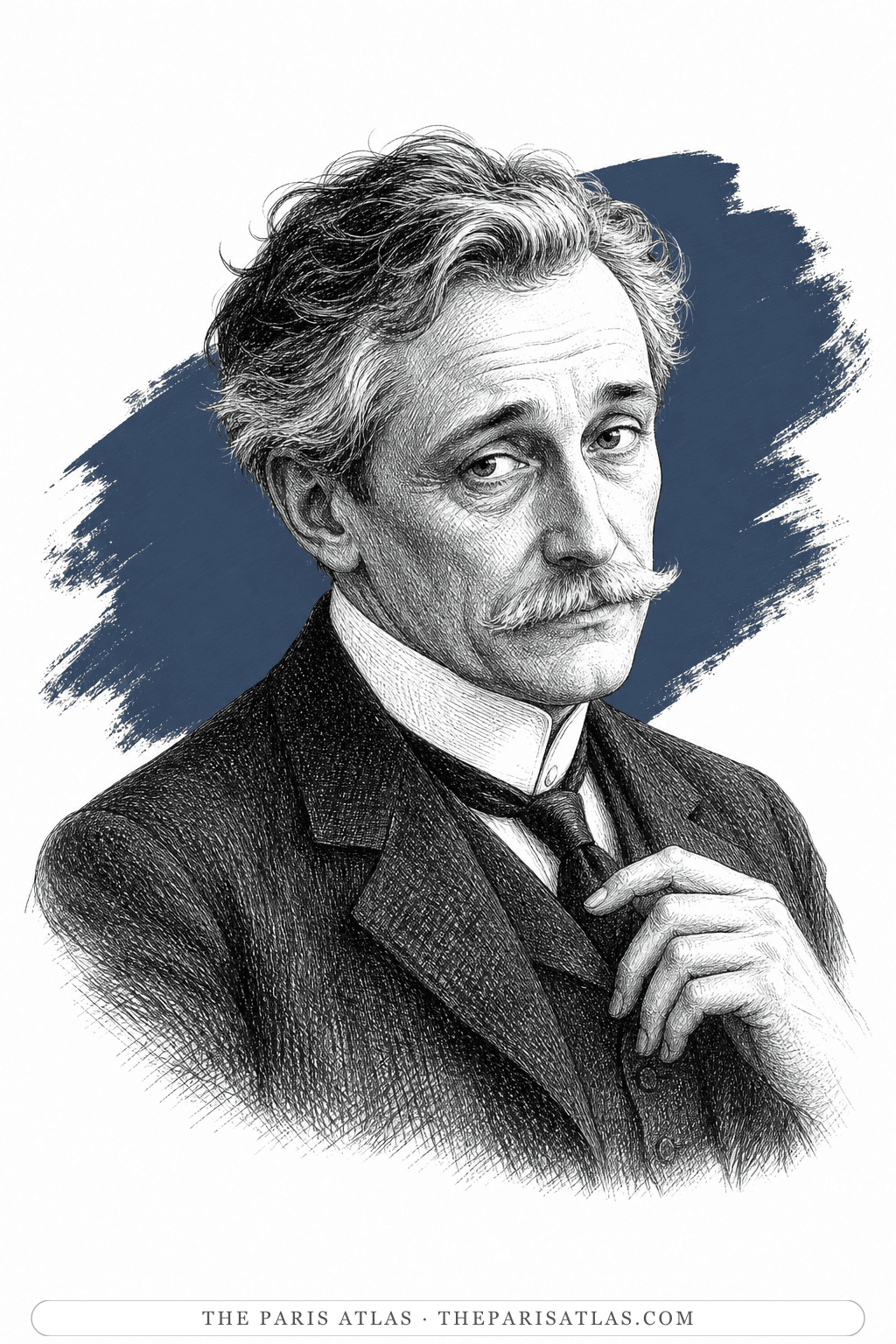
Renaud
Claudine's husband, ailing and mostly absent — the love whose long cost the novel weighs.
To come home, and to be told the truth when he gets there. He writes from Switzerland asking Claudine to exclaim at his white hair when she sees him, count his new wrinkles out loud, and go to bed disappointed in him, rather than spare him with the flawless lies he knows she is capable of.
The book

At a glance
- Fifty; Claudine is twenty-eight
- A Paris man of letters, photographed for the magazines; his right hand keeps a small tremor from years of writing
- A sanatorium high in the Engadine, in the Swiss Alps, for almost the whole novel
- Nervous exhaustion from overwork, with insomnia the doctors cannot account for; the phrases that come back from the consulting room include laziness of the heart
- His seated vagabond, his little girl, and his silent darling
- Marcel, his grown son, who is the same age as Claudine
Who they are in the book
Spoiler-freeRenaud is Claudine's husband, and the reason the book exists. He is fifty, twenty-two years older than she is, a Paris man of letters of the kind whose photograph appears in the illustrated magazines. He is also, for almost the whole novel, somewhere else.
What has happened to him is this. He had been working himself into the ground and hiding it, dosing himself with coca wine and iron tonics and every pepsin on the market, until one day he fainted against Claudine. By then it was too late for country air and a light diet, and she could read the word sanatorium on the doctors' reluctant faces before anyone said it. He did not want to go, and asked her to nurse him instead, telling her she would cure him better than they would. She heard the jealousy in it — the fear of leaving her alone in Paris — and sent him anyway, then went to stay with her friend Annie in the country because it was what he wanted. He spends the book in a clinic high in the Engadine, in the Swiss Alps, and reaches the reader almost entirely through letters.
The letters are the best evidence of what he is. He is funny about the treatment and frightened underneath it. He reports the insomnia nobody can explain, the daily weighing that has become the worst minute of his day, and the medical vocabulary he has started using without irony. He worries about money and his son. He calls her his seated vagabond and his silent darling. And in the middle of it he writes to say he has dreamt she is unfaithful, is ashamed of the dream, and blames his age for it.
Claudine's account of their marriage is that she has remade him. He used to collect women the way a stamp collector fills gaps in an album, and there had been a bad episode with a woman called Rézi that nearly ended them, and a whole summer at Bayreuth spent teaching Wagner to an American named Suzie while Claudine sat by. She says that by now he lies less, loses his temper more, has stopped needing the mirrors and the books and the coarse words in bed, and has been made, in her word, chaste.
How Renaud Is Portrayed
- The pose he is introduced inThe novel opens on him half turned in a chair with a newspaper on his knees, holding a cigarette with the little finger stuck out, the way a society woman holds a sandwich. Claudine laughs and makes him keep the pose, because it is exactly the one in his latest photograph in the magazine Femina. His moustache is nearly all white; his eyes are the dark blue of pond water.
- The scrap of clothShe shows him a yellowed strip of linen two fingers wide, from a drawer of keepsakes that also holds pebbles, a horseshoe, a dried lizard and a lock of her own hair. It is the shoulder strap of a chemise belonging to Rézi, a woman Claudine had wanted and Renaud had taken, years earlier. He does not move, but the ash falls off his cigarette. He asks why she kept it, then lowers his eyelids, which is what he does before telling the truth, and says he had put his whole heart into abolishing that memory. She keeps it anyway.
- How he got illHe hid the breakdown for as long as he could, then collapsed on her. Claudine's name for what he had is the neurasthenia of an overworked Parisian. His right hand carries a permanent small twitch she calls an overworked writer's dance, and the doctors send him to the mountains rather than treat him at home.
- The letters from the clinicHe writes three times a week. The first letter describes a bare white room with a printed set of rules on the wall, the only decoration in it, and jokes that they keep the fish that are past their best in the same conditions. Later ones report a fellow patient named Coucheroux, the rare case of the establishment, who turns up three times in four pages until Claudine writes that she would like a quarter of an hour alone with him.
- The dream he confessesHe dreams that she is deceiving him, and writes to say so, ashamed of the dream and half convinced it is a premonition. His explanation is that he is unhappy because he is old. Then he tells her that if she ever wanted another man she should come and ask him for the man outright, and that he would hand him over, even if it killed him several times over afterwards.
- The women before herClaudine describes what he used to be: a man who went at each new woman with the anxiety of a stamp collector, pleased to have found a specimen he was missing. She sets out the last of those affairs in detail — Suzie, a rich, showy American whom Renaud spent a Bayreuth summer instructing in Wagner, in front of his wife, until Suzie repeated one of his lessons wrongly in a crowded restaurant and a drunk friend of theirs demolished her for it.
- The cabin boy at Belle-ÎleOn a holiday at Belle-Île eight years earlier, Claudine had given up skirts and shoes and gone about the boats in a jersey and a wide blue collar. Renaud made love to her in the hollow of a red rock; two bathers saw the tail end of it from a distance, took her for a boy, and the town settled on the view that he was a filthy Parisian who paid small sailors two francs.
- The letter that says what he is coming back asBuried in snow, he writes that the mountain can do nothing more for him. «Je vais revenir, tel que je suis, tel que je me vois à présent, tel qu’il faut que je m’avoue : un vieillard…», he tells her — he is coming back as he is, as he now sees himself, and as he has to admit himself to be: an old man. He asks her not to hide her pity but to throw it at him, because he does not want it.
- The son he cannot manageMarcel is his son and is homosexual, and Renaud, who belongs to a less indulgent generation, has never got used to it. He talks about slapping him, or shipping him off to the colonies, and Marcel takes the storms in silence with a bad look on his face. He writes to Marcel, though, more like a friend than a father, and asks him to keep an eye on Claudine: she is as much his child as Marcel is, he says, and he no longer knows which of the two to put in the other's care.
He comes home, and the homecoming is the disaster of the book. Claudine had confidently expected to recognise him from the shape of his shadow in the carriage window. Instead the clinic hands her back a man who looks and moves like an old one: the eyes gone dull, the mouth withered, the strong arms slack. She refuses to let him touch her and will not discuss it, because an explanation would mean hearing him offer to give something up, and she will not have that. They live side by side lying to each other with the polite smiles of strangers.
About a year later he has a stroke and dies at Montigny, in their bedroom, after eight or ten days in bed. Claudine, watching him fight the last of it, asked the doctor to give him something to make him die faster. The detail she cannot get rid of is his hands, which the paralysis fixed in their usual attitude: the right half closed around a pen that was not there, the left idle and elegant with the little finger held away — the pose he was sitting in on the first page of the book.
Eighteen months later she is still at Montigny, still sleeping in that room, tending his grave without feeling anything at it, and saying that a grave is an empty box. She keeps him in a handkerchief that still smells of him, in a worn book, and on the bench where he used to sit. She has a game she plays with the bulldog, asking him aloud where his father is, and she notices that the dog's grief is wearing off and he will soon have forgotten. The book's final image is Claudine sitting out in the dark with her animals, leaving the door open, keeping her eyes shut in order to see him better.
If you like The Sentimental Retreat


If you like Colette
Explore authors with a similar voice, perspective, and influence.

Henry Miller
The Brooklyn dropout who arrived in Paris broke at thirty-eight and wrote the exuberant, banned books that ended American censorship.
View author
Louis-Ferdinand Céline
The doctor of the Paris slums who wrote the century's blackest, funniest novel — and changed the sound of French prose.
View author
Martha Gellhorn
War correspondent who covered the Spanish Civil War, D-Day, and conflicts across five more decades; Hemingway's third wife, 1940–1945.
View author