Jean
The attractive, self-absorbed younger man Renée takes from May — the possessive attachment that becomes her shackle.
To be taken seriously as a person rather than a body. He asks Renée to adopt him as he has adopted her, and tells her that some days it does not look as though she loves him, only as though she is employing him.
The book

At a glance
- Never stated. Asked directly he says he stopped admitting it two years ago; by the end Renée has decided he is a man of her own kind and her own age
- His father's bank. He calls his father the Autocrat, and takes over at the bank when the old man's health fails
- A small house on the boulevard Berthier in Paris, with a valet called Victor, and a low grey house on the Breton coast
- A year with May at the sea and in spa towns; they never shared a flat. He offered to furnish the Paris house for her and she told him he had a nerve offering her that «boîte à grue» — a house fit for a tart
- Motor cars, finance, and a spell as a departmental councillor in Ille-et-Vilaine, losing a little money at each
- Masseau, an opium smoker whose drug he quietly pays for, which is why Masseau will not take sides
Who they are in the book
Spoiler-freeJean is a character in The Shackle, the 1913 novel by the French writer Colette. He has money, no occupation for most of the book, and a young woman living on him: when the story opens he is on the Riviera with May, who is twenty-five and whose bills he pays. He puts the figure himself at three or four thousand francs a month. Renée Néré, the narrator, has known the couple for about a year and finds them exhausting company.
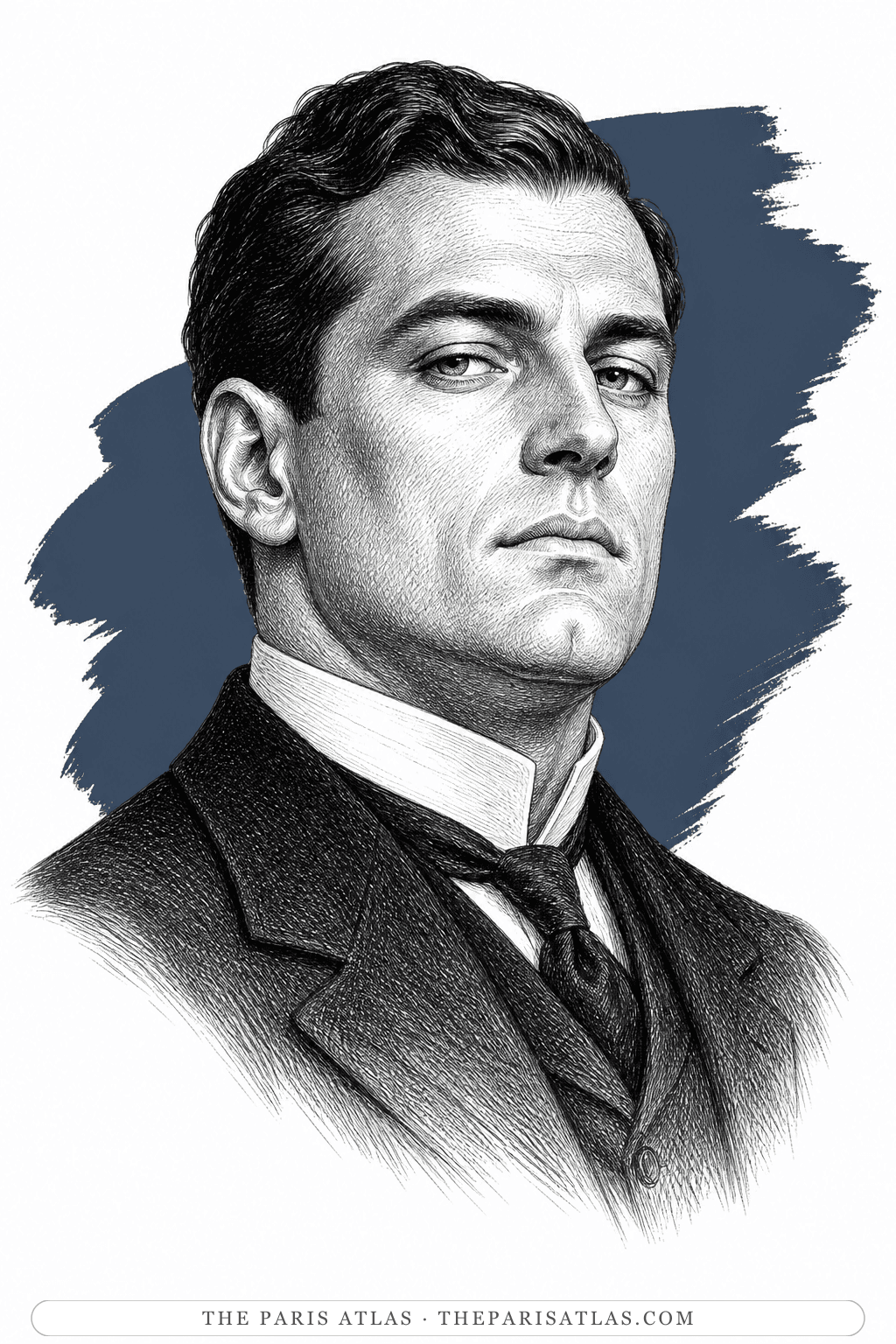
He is dark and solidly built, with grey eyes that look like silver in firelight, high cheekbones, a dented chin and a heavy hand. The money is his father's, from a bank; he calls his father the Autocrat. He has lost some of it in motor cars, some in finance and some in politics, having sat for a while as a departmental councillor in Ille-et-Vilaine. He owns a small house on the boulevard Berthier in Paris, a car, a valet called Victor and a low grey house on the Breton coast. His age is never given in the book. Asked outright, he says he stopped admitting it two years ago.
With May he is violent in a bored, matter-of-fact way that Colette records without comment: he hits her with the flat of his hand, she hits back, and the two of them treat it as exercise. With Renée he is careful instead. For weeks he tells her nothing, asks her nothing, and touches her constantly, which is exactly the arrangement she wants. It is Jean, not Renée, who breaks the silence and says he loves her, and she stops his mouth.
After that he wants the thing she is worst at giving. He gets up from lunch with a tape measure and goes upstairs to size the rooms for a bed and a mouse-grey carpet, and talks about their future life together. Renée keeps to herself the observation that these are not plans for a future, they are upholstery estimates.
How Jean Is Portrayed
- First seen behind a maskRenée looks at him properly for the first time in the back of a hired car coming home from Monte-Carlo, when all four passengers are wearing driving goggles. With the eyes covered she reads the rest of the face: a shaved, sulky mouth, fine at the corners; a chin at once stubborn and feminine; a thick neck with no muscle showing. From that half-face she concludes that he is the stronger of the two lovers.
- How he treats MayHe hits her flat-handed, without spite, with a sort of gymnastic cheerfulness — Renée's phrase for it. In the hotel lobby, when May performs for strangers, he kicks her in the shin. May turns up at Renée's door holding out two brown bruises, one round each arm, after a fight that ran to three in the morning and left six hundred francs' worth of tortoiseshell combs on the carpet.
- What he pays forMay's dresses cost fifty louis apiece, and he ruined one when she felt lucky and wanted to go and gamble. Told that she had things to complain of, he agrees at once: three or four thousand francs a month's worth, to put it in her own terms.
- Secretive about moneyMay lived with it for a year and gives the pattern to Renée: when you think he is broke he has money, and when you watch him throwing it out of the window he is short. She puts it down to pride, and says he is rotten with pride.
- The kiss at OuchyLate at night in the hall of a converted castle on Lake Geneva, after a whole day in which nothing has been said, Renée is filling the silence with a story about English housemaids' uniforms. He takes her by both elbows from behind and kisses the back of her neck. She finishes the sentence about the pink linen; he answers as though nothing had happened; neither of them mentions it again.
- How he looks after his looksHe checks his hair in the hall mirror twice before going out, the way an actor settles a wig. He has the barber take his hairline back a fraction at a time so that his forehead grows. Smoking after dinner he crooks his little finger, and runs a finger between collar and throat to draw attention to a neck that is still young. Renée, who comes out of the theatre, is not remotely offended by any of it.
- The word he says firstHalf asleep after their second afternoon together he says «Tu comprends… je t'aime.» — you understand, I love you. Renée presses her cheek against his mouth to stop him, tells him not to use that word, and says goodnight.
- What he accuses her ofShe is curious only about what he takes from her, he says, never about what he is. She does not arrange flowers, or straighten the rug, or thump the cushions; she sits down and crosses her legs like a lady paying a call, and it unsettles him. There are days, he tells her, when it does not look as though she loves him. It looks as though she is using him.
- How he leaves peopleThis is May's account, and she has watched him do it. There is no scene and no slow cooling off. He walks out in the middle of a sentence, or goes out to buy cigarettes, and the next thing you receive is a very well written farewell letter. Ask him for a meeting and he comes, in a tie you know, and is so completely gone that you find yourself wondering whether you ever slept with him at all. He had done it to an actress called Marthe Byse, and to a widow, before May.
He goes to his family in the country, calls «Au revoir» from the pavement, and does not come back. There is no farewell letter of the kind May had promised, only two neutral telegrams sent to find out whether Renée is still in his house. His own explanation, given much later, is that writing would have meant another exchange of words neither of them could forget.
When Renée ambushes him in his own bedroom at midnight, he has started working at the bank, because his father will never go back to the office. He has no taste for the work yet, he says, and does it the way a schoolboy does lines. He tells her she is free, and that she is the worst memory of his love life. What he resents most is being read: her claim to hear him think was an offence against his right to keep his own head shut, and he says so in the present tense, which she notices and takes as hope. He is right that she gave him silence and judgement and nothing else, and he says so at more length than he has said anything in the book.
Then she touches his ear, and he tells her twice to be careful, that this is only desire, before pulling her down with him. Two months later they are living in his house in Brittany. He walks the cliffs all day with a gun, comes back to tell her about the bird he chased and the marten that got away, and leaves again the next morning; she waits on the terrace and follows at his pace. He is the one moving now.
If you like The Shackle


If you like Colette
Explore authors with a similar voice, perspective, and influence.

Henry Miller
The Brooklyn dropout who arrived in Paris broke at thirty-eight and wrote the exuberant, banned books that ended American censorship.
View author
Louis-Ferdinand Céline
The doctor of the Paris slums who wrote the century's blackest, funniest novel — and changed the sound of French prose.
View author
Martha Gellhorn
War correspondent who covered the Spanish Civil War, D-Day, and conflicts across five more decades; Hemingway's third wife, 1940–1945.
View author