
Renée Néré
The former music-hall performer of The Vagabond, freed from the stage and drifting — the independent woman who here consents to be bound.
Something to want. She is free to go anywhere and do anything, and she admits the difficulty in the same breath: there is nothing she wants to do.
The book

At a glance
- Thirty-six. May is twenty-five, and Jean refuses to give his
- Twenty-five thousand francs a year, inherited from her sister-in-law Margot — roughly two thousand a month
- Music-hall mime and dancer, six years touring with Brague; last on a stage a year before the book opens
- Hotel rooms in Nice, Geneva and the Hôtel Meurice in Paris, then Jean's house on the boulevard Berthier, then his house on the Breton coast
- None left: a marriage behind her, her sister-in-law Margot dead, her old friend Hamond dead. Her friends are Brague and a dancer called Bastienne
- «la Rate-en-or» — his old nickname for her with the word for gold attached, once Margot's money arrived
Who they are in the book
Spoiler-freeRenée Néré is the narrator of The Shackle, the 1913 novel by the French writer Colette, and the whole book is told in her voice. She is thirty-six. For six years she earned her living on stage, touring the music halls of France with a partner called Brague, in the days when a music hall was a variety theatre where singers, acrobats and mime acts each did a short turn for a paying room. It was ordinary badly paid work and it kept her in cheap hotels and night trains. She stopped a year before the book begins, because her sister-in-law Margot died and left her an income of twenty-five thousand francs a year, which she says is wealth for a woman like her.
The money is what the novel is built on. Renée now has nothing she has to do and nowhere she has to be, and she has found nothing to put in the place of work. When the story opens she is living in room 157 of a hotel on the Promenade des Anglais in Nice, passing her days with people she does not much like: May, who is twenty-five and lives on money from her lover; that lover, Jean; and Masseau, an ageing former colonial official who smokes opium. Lunch is ordered for one and served at four, then there is a drive, then tea, and Renée watches another fine day go to waste.
Jean and May separate, and Renée takes Jean. That is the second half of the book. She moves into his small house on the boulevard Berthier in Paris with three trunks, and begins what she herself calls the life of a kept woman: living in a man's house, on his money, under his rules about where she may eat and who may take her out. She does not need his money. She has Margot's. She takes the position anyway, and the novel is her account of why.
The Shackle follows The Vagabond, published three years earlier, which ended with Renée Néré turning down a rich and kind suitor, Maxime Dufferein-Chautel, in order to keep herself to herself. In the first pages of this book she watches him walk past her on the Promenade with a young wife and a small child, and stands absolutely still so that he will not see her.
How Renée Néré Is Portrayed
- What she did for a livingSix years as a music-hall mime and dancer, touring with her stage partner Brague in a piece called L'Emprise. A year after leaving she still keeps the professional habit of covering her arms and shoulders in the street. Skin, in her trade, was something you displayed under the lights and nowhere else.
- The money that stopped her workingHer sister-in-law Margot died and left her twenty-five thousand francs a year, about two thousand a month. She could take a villa tomorrow, or a comfortable flat in Paris, and instead she stays in hotels. She compares herself to a dog kept on a chain for years: unhook it and it does not run, it goes on walking the same measured circle, judging the length of a chain that is no longer there.
- The man she did not marry, seen from a hotel windowMaxime Dufferein-Chautel, who three years earlier had offered her his name, walks past her on the Promenade des Anglais with a young wife and a toddler. She keeps still so that he will not see her, like a hare that knows it is the colour of the furrow. She says herself that this is not grief over him. What humiliates her is that he looks prosperous, and that she would have had nothing to show him but a tailored suit, a good hat and a slightly different way of doing her hair.
- Nothing she wants to doShe can go two floors up to the opium room, or one floor down to the couple who fight. She will be welcome in both, and nobody will mind when she goes back to her own room. Colette gives her a small girl's line for the position: «Je n'ai pas de guise.» She is free to do exactly as she pleases, and she has no pleases.
- Going backstage to see her old partnerIn Geneva she calls on Brague in his dressing room and finds her old act being played by another woman, advertised on posters in the same orange and black that used to carry her own name. Brague is delighted with the replacement and does not ask Renée one question about her life. She pays five francs at the window for a seat, and a stagehand who does not recognise her sends her round to the public stairs.
- Feeding the gullsOn a Geneva jetty she throws bread to the gulls and finds that what she wants, more than anything that day, is to hold one: to put a finger on the small racing heart under the feathers. She knows what the craving is. It is unused love, she says, and nobody feels it as strongly as an unmarried woman or a woman without children.
- What she brings when she moves inThree trunks of clothes and linen, papers in a box, a washbag. On the desk in Jean's bedroom she sets out the only two objects she counts as furniture of her own: a fountain pen and a very old Chinese fruit carved in jade, worn half away and pleasant to hold.
- The rules of the houseShe gives up eating alone at the cheap southern restaurant she likes, because Jean says a woman like her with a lover like him does not go trailing round beer halls. She goes to the theatre with Jean, or with Masseau as an escort, and nowhere by herself. When she points out that May had more freedom, Jean answers: «May ne vivait pas avec moi. Et puis May, c'était May, et toi, c'est toi.» May did not live with him; May was May, and Renée is Renée.
Jean goes to his family in the country and does not come back. There is no farewell letter, only two flat telegrams sent to find out whether she is still sitting in his house. She stays a month in rooms that are not hers and learns the routine of a woman who has been left: waking, walking from one wall to the other, keeping clear of his photograph and the cigarette case he forgot, counting the postmen. She takes a room at the Hôtel Meurice, hears the hall violins play a waltz that now belongs to him, says out loud that she cannot do it, and goes back to his house.
Then she sets a trap. Brague posts a letter for her saying she has gone to Le Havre and back to the stage, and she sits in Jean's dark bedroom until midnight. When she hears him on the stairs she calls his name through the door so that he will not be frightened. What follows is the only real conversation in the book. He tells her she is free, that she is the worst memory of his love life, and that her habit of claiming to hear him think was a standing insult. She takes the jade fruit off the desk and puts it in her bag. Then she touches his ear. He warns her twice that this is only desire; she agrees, goes into his arms and shuts her eyes so that he will not see she is handing over everything.
The last chapter is two months later, on the Breton coast. Renée sits on the terrace in a white dress and watches a small black figure moving along the cliff. She will not hurry down to meet him, because he is the one coming to her. She has decided that reaching him, watching him slip away and patiently getting him back is her work now, in place of the trade she gave up. He walks out every day, greedy for the country, and she follows behind him, slower and quieter than she used to be. He has taken her place, she thinks. He is the vagabond now, and she watches him from where she is moored.
If you like The Shackle


If you like Colette
Explore authors with a similar voice, perspective, and influence.
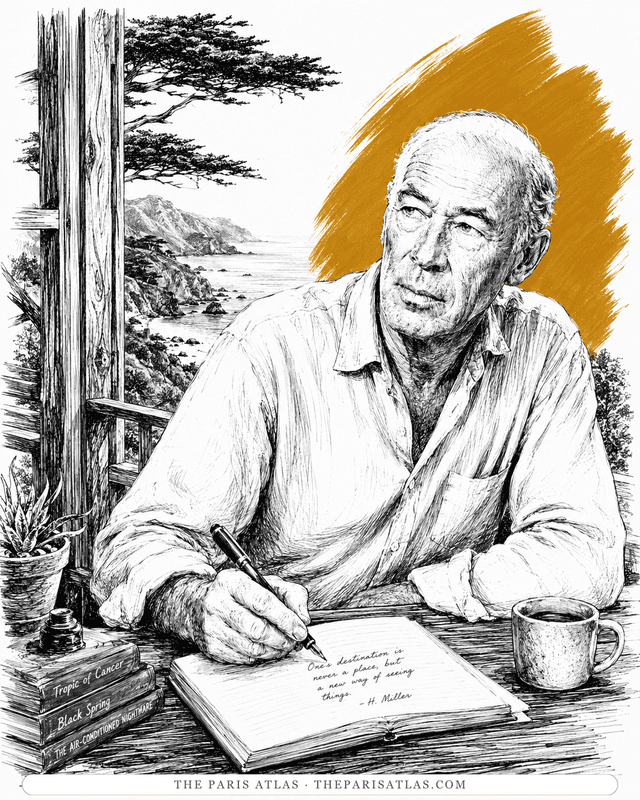
Henry Miller
The Brooklyn dropout who arrived in Paris broke at thirty-eight and wrote the exuberant, banned books that ended American censorship.
View author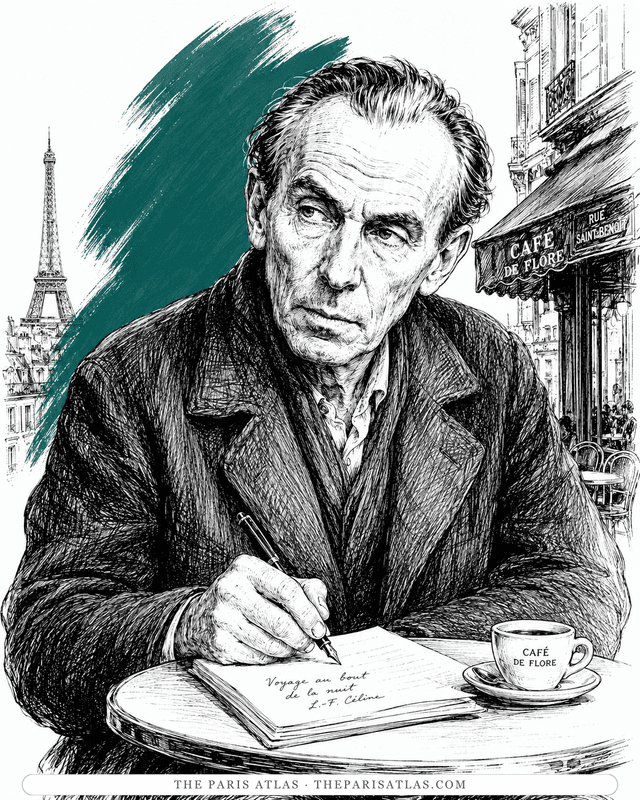
Louis-Ferdinand Céline
The doctor of the Paris slums who wrote the century's blackest, funniest novel — and changed the sound of French prose.
View author
Martha Gellhorn
War correspondent who covered the Spanish Civil War, D-Day, and conflicts across five more decades; Hemingway's third wife, 1940–1945.
View author