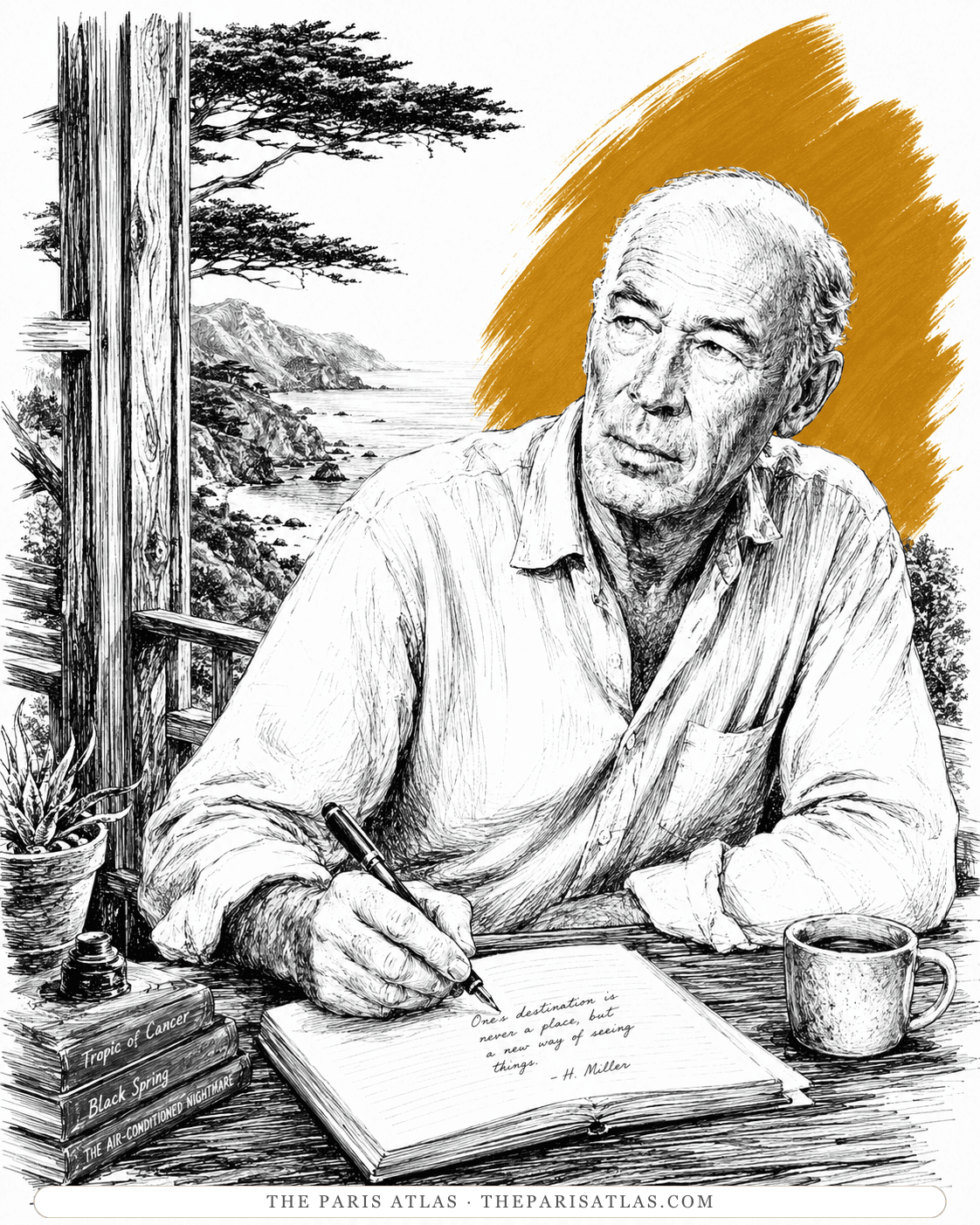

Black Spring
The surrealist flights of the Paris years — the fable is that mode, distilled and slowed.
Read our take
by Henry Miller
A clown, a ladder, a moon: the fable Miller called the strangest story he ever wrote — begun as a favor to Fernand Léger.
Auguste is the most beloved clown of his age, famous for one transcendent bit: seated at the foot of a ladder, smiling up at a painted moon, he gives audiences a happiness deeper than laughter. But Auguste wants to give them the real thing — joy without the mask — and the wish unmakes him. Miller's only pure fable, conceived when Fernand Léger asked him for a circus text, and unlike anything else he wrote: short, tender, and aimed straight at the meaning of art. (Full story below; the ending is behind the accordion.)
The commission came from painting: Fernand Léger, preparing a book of circus images, asked Miller in 1947 for an accompanying text. What arrived was not decoration but a fable that had clearly been waiting in him — the story of a clown who dies of wanting to give real joy — and the collaboration dissolved, amicably, under the weight of it. Léger published his Cirque with his own words; Miller's story appeared on its own in 1948, and he spent the rest of his life calling it the strangest thing he ever wrote, the one piece that arrived as pure invention rather than autobiography.
Strangest, and most confessional by other means: Auguste's predicament — the performer who has made ecstasy his act and can no longer tell the mask from the face — is Miller's own, transposed from the page to the ring. Written in the first Big Sur years, as the scandalous autobiographer was becoming a sage with a public, the fable asks the question the fame had forced: can the man who performs liberation ever simply possess it? Every clown in modern literature owes something to Rouault and the sad-circus tradition; Miller's addition is the theology.
Auguste has made the world laugh for decades, but his signature number does something stranger: seated at the foot of a ladder rising toward a painted moon, wearing his fixed smile, he sends audiences home touched by a peace they can't name. The act is a lie, and it corrodes him — the peace is theirs, never his. Wanting to give joy as himself, unmasked, he walks away from the ring at the height of his fame, and discovers the anonymous world has no use for an ex-clown with a message: away from the sawdust he is only a man, and not a specially happy one.
The middle of the fable is Auguste in the wilderness — odd jobs, obscurity, the slow burning-off of vanity, until the wish to give joy stops being about Auguste at all. When a shabby traveling circus crosses his path and needs a stand-in, he puts on another clown's face and returns to the ring with nothing left to prove and no self left to protect — which is, of course, when the transcendence he chased all his life finally arrives on its own terms.
In the ring, in a borrowed mask and a nameless act, Auguste at last experiences the real thing — the ecstasy he could only counterfeit at the height of his fame, given to him precisely because no one knows who he is. It is the peak of his existence and also the end of it: the trance carries him beyond the performance, and in the ring, mid-act, the accident comes — a kick from a circus horse — and kills him. The nameless clown dies unknown; Auguste dies fulfilled; the fable declines to call it tragedy. The smile of the title, Miller insists, was never the mask's — it was what the mask spent a lifetime learning to mean.
Auguste's opening number separates visible happiness from inward life. In the passage reproduced by Annick Asso, his smile seems to acquire an existence apart from his sad face, while his thoughts drift elsewhere. A ladder promises ascent, yet the clown remains at its foot: stillness becomes the spectacle of a journey. The contrast makes the act more than a conventional mask hiding sorrow. It asks how an audience reads a body, and whether a convincing image of ecstasy tells us anything certain about the person producing it.
While applying makeup, Auguste measures himself against the circus animals and even its furniture. As Asso notes, the seals remain seals and the horse a horse; the clown alone must remain a man while becoming something more. This comparison moves beyond a simple opposition between false paint and a true face. His work requires an additional identity, not merely a concealed one. The backstage ritual asks how he can give the audience an exceptional being without losing the ordinary person who has to sustain it.
Every theme of the vast autobiographies — masks, ecstasy, the price of freedom — folded into a story you can read in an evening.
What Rouault painted and the sad-circus tradition gestured at, Miller argues outright: the clown as the last saint.
No sex, no rage, no score-settling — the register the Tropics never let him use, sustained for a whole book.
1947
Fernand Léger, preparing a book of circus images, asks Miller for an accompanying text; the fable outgrows the project and each man publishes alone.
1948
Duell, Sloan and Pearce publishes the story on its own — Miller's only pure fable, and the one he called the strangest thing he ever wrote.
1974
New Directions publishes a new paperback edition of the novella.

The surrealist flights of the Paris years — the fable is that mode, distilled and slowed.
Read our take
The shelf's other book-length fable — Nin's dream-house and Miller's circus ring, one wall apart.
Read our take
The doctrine — surrender, the mask, the smile — argued as essay there, embodied here.
Read our takeHenry Miller. It was published in 1948 and is his only pure fable.
Auguste, the most beloved clown of his age, famous for one transcendent bit — seated at the foot of a ladder, smiling up at a painted moon — who longs to give audiences real joy without the mask.
The painter Fernand Léger, preparing a book of circus images, asked Miller in 1947 for an accompanying text. What arrived was not decoration but this fable.
It is short, tender, and aimed straight at the meaning of art — unlike the sprawling, autobiographical books he is known for.
The cost of art, and the distance between the happiness a performer gives an audience and the real thing he longs to hand them.
Explore authors with a similar voice, perspective, and influence.

Miller's acknowledged master at making literature out of the gutter. Journey gave him permission; Cancer is what he did with it.
View author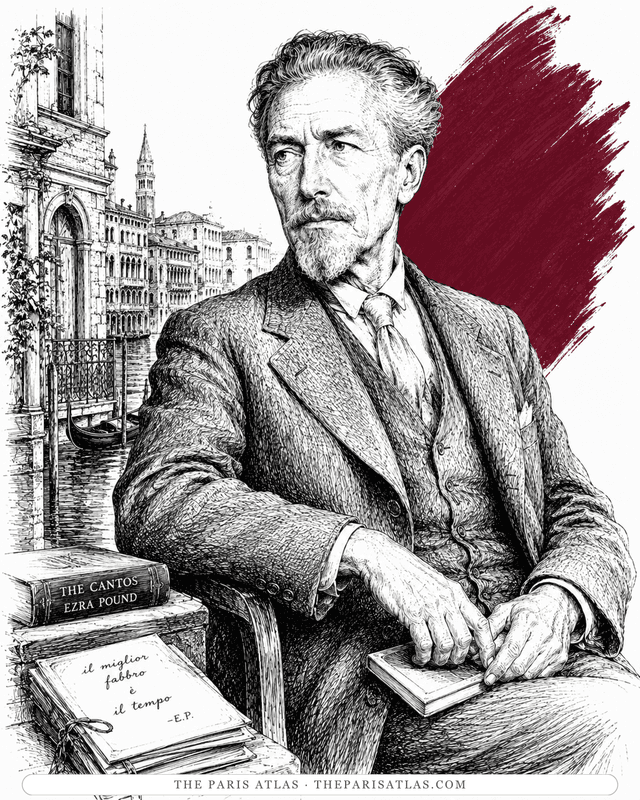
Pound read Cancer and sent Miller a famously backhanded postcard. Both believed literature's job was to wake the reader by any means necessary.
View author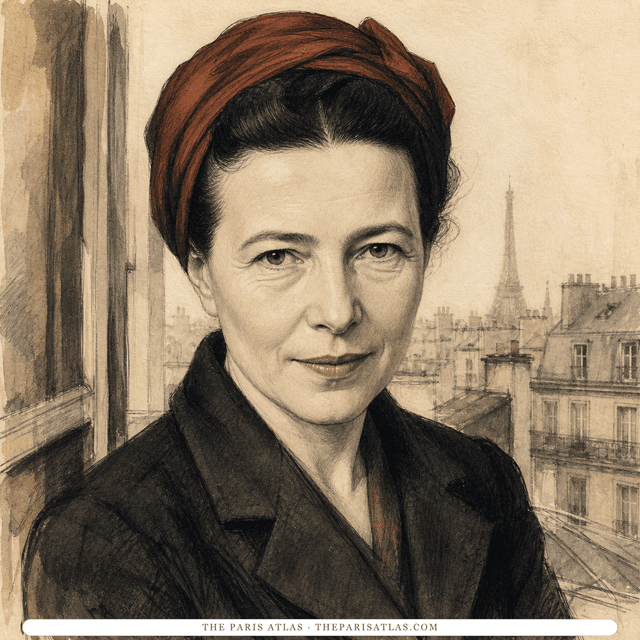
French writer and philosopher whose novels, memoirs, and social analysis examined freedom, gender, responsibility, aging, and the material conditions that shape a life.
View authorThe sources below include the primary text, editions, scholarship, archival materials, and other records that informed this page. They document The Smile at the Foot of the Ladder, its publication, and its place in literary history.


Used to verify The Smile at the Foot of the Ladder's bibliographic context and its place within Henry Miller's published work.

Used for independent archival, institutional, or historical context surrounding Henry Miller and The Smile at the Foot of the Ladder.

Used to cross-check chronology, publication history, and the circumstances in which The Smile at the Foot of the Ladder appeared.
Used for an additional scholarly or biographical perspective on The Smile at the Foot of the Ladder and Henry Miller's wider career.
Documents the dated edition or contemporary reception included in the timeline.
Pages 79 and 82 reproduce and discuss relevant passages in Georges Belmont's translation. The new readings distinguish those quotations from the article's account of a later stage adaptation; the full primary text was not independently collated.
The primary text is the baseline reference for every book page. Additional references document publication history, interpretation, and historical context where that evidence is available.
 Explore more resources