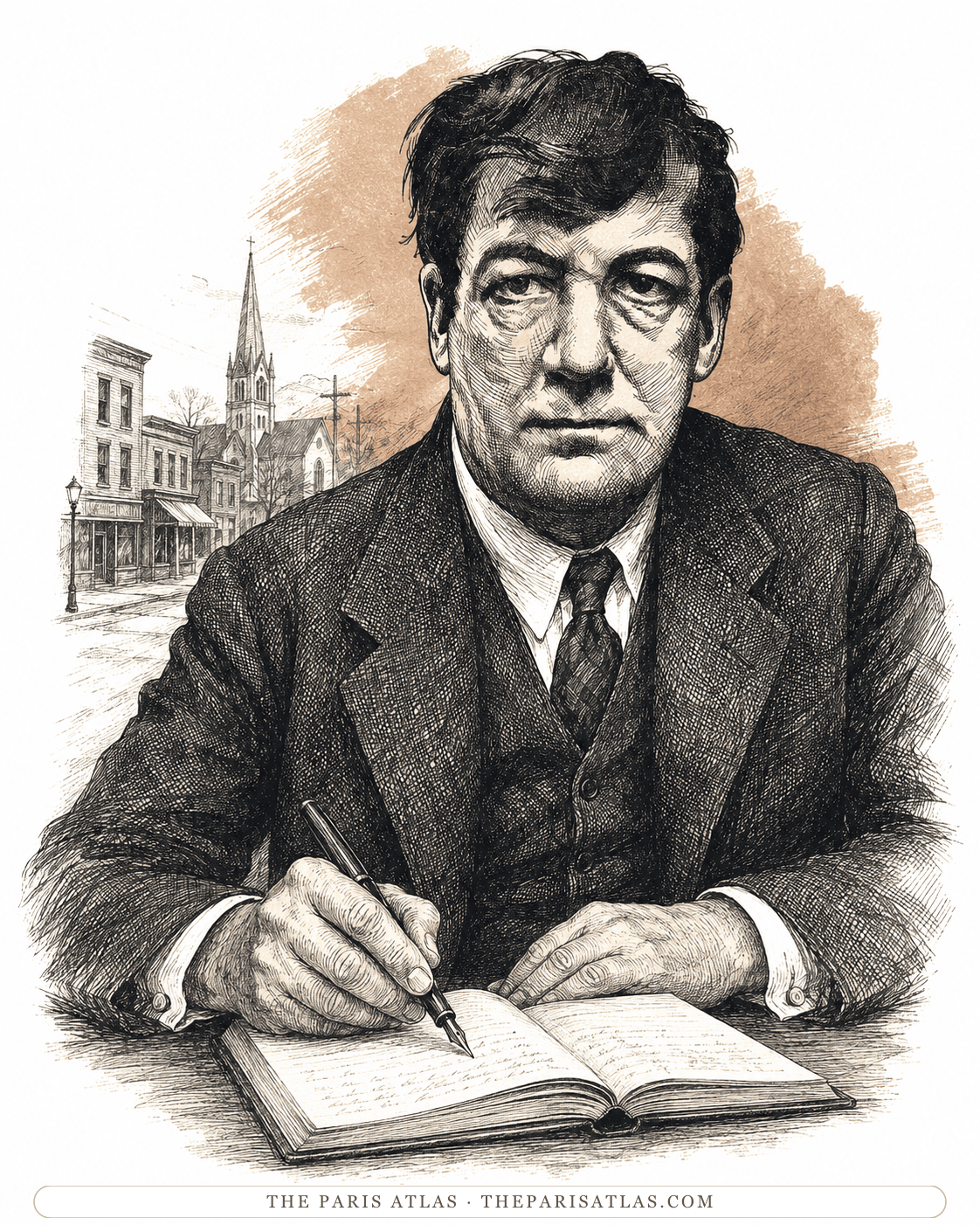
The American novelist who invented Yoknapatawpha County, the imaginary Mississippi county he called himself sole owner and proprietor of, and who spent the autumn of 1925 in a room at 26 rue Servandoni beside the Luxembourg Gardens — all but unpublished, calling himself a tramp, and walking to the café used by the Irish novelist James Joyce simply to look at him.
5 books on our shelves
Details
Lived
1897–1962
Born
25 September 1897
Birthplace
New Albany, Mississippi
Died
6 July 1962 · aged 64
Place of death
Byhalia, Mississippi
Nationality
American
Profession
Novelist and poet
Major works
The Sound and the Fury, As I Lay Dying, Sanctuary, Light in August, Absalom, Absalom!, Go Down, Moses, The Hamlet
Roles
AuthorPoet
About William Faulkner
William Faulkner published nineteen novels, almost all of them set in one imaginary place: Yoknapatawpha County, Mississippi, a county he mapped, populated and returned to for thirty years, and on one of the maps he drew he described himself as its 'sole owner and proprietor'. The Sound and the Fury (1929) told the collapse of a single family through the minds of four different people, one of them unable to order time at all. He won the Nobel Prize in Literature for 1949 — the world's senior literary award, given each year by the Swedish Academy — and collected it in Stockholm in December 1950.[1]
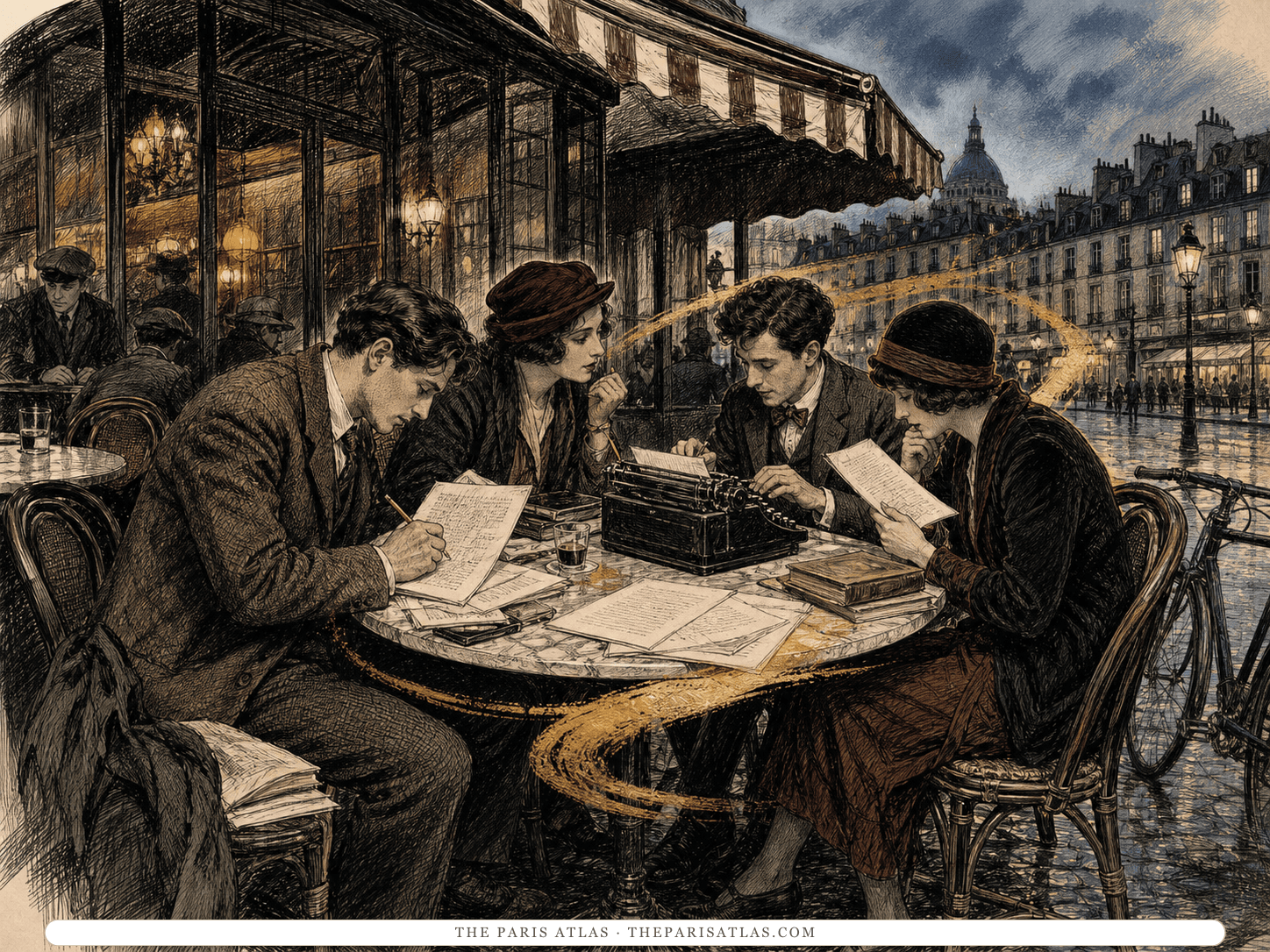
Before any of that, he spent the autumn of 1925 in Paris. He had turned twenty-eight that September, had published one thin book of verse and written one novel manuscript that had not yet appeared, and lived in a room at 26 rue Servandoni in the 6th arrondissement, a two-minute walk from the Jardin du Luxembourg. He knew almost nobody, and he wanted it that way — he said later he had not thought of himself as a writer then, was 'a tramp', and was not interested in literary people.[2] He made exactly one exception, and it is the most famous thing about his Paris months.
Mississippi, and a young man who read everything
Faulkner was born on 25 September 1897 in New Albany, in the hills of north Mississippi, into a family that had been locally prominent for three generations. The looming figure in it was his great-grandfather William Clark Falkner — lawyer, planter, colonel of a Confederate regiment, railroad builder and novelist, shot dead by a former business partner on the day he was elected to the state legislature. The family moved to the university town of Oxford, Mississippi, just before the boy turned five, and Oxford was home for the rest of his life.[3]
He was bright, lost interest, and dropped out of high school. His education came instead from Phil Stone, an older, better-read friend — an Oxford lawyer with two degrees from Yale — who from 1914 ran what amounted to a decade-long private tutorial: the classics, nineteenth-century English poetry, the French Symbolists (Mallarmé, Verlaine and the poets who followed them, who worked by suggestion, music and image rather than plain statement), and the living moderns — Oscar Wilde, W. B. Yeats, Ezra Pound, T. S. Eliot and the Irish novelist James Joyce, whose experiments with the inside of a character's mind were remaking the novel. In July 1918 he began pilot training in Toronto with the Royal Air Force's Canadian arm, and it was at this point that he added the 'u' to the family name Falkner. The war ended before he saw service. He came home, took odd jobs, spent nearly three grinding years as postmaster at the University of Mississippi, and kept writing verse.[3]
Late in 1924, just before his self-financed book of pastoral poems The Marble Faun appeared, he went down to New Orleans meaning to sail from there to Europe. He stayed six months. In the French Quarter he met Sherwood Anderson, the older American novelist whose linked story cycle Winesburg, Ohio had shown a generation how to build a book out of one small town, and settled into the circle around him — the architect William Spratling, the writers Lyle Saxon, Roark Bradford and Hamilton Basso — publishing sketches in the Times-Picayune, New Orleans's daily newspaper, and listening. It was, in his biographers' judgement, the only extended stretch of his life spent inside a community of intellectual peers. He sent a novel manuscript to Anderson's publisher and, in July 1925, sailed for Europe with Spratling.[4][3]
26 rue Servandoni, autumn 1925
They landed at Genoa and travelled up through Switzerland to Paris, where Faulkner stayed for the rest of the year apart from short trips into the French countryside and over to England. His room was at 26 rue Servandoni, a narrow street in the 6th arrondissement running from the flank of the church of Saint-Sulpice down to the railings of the Luxembourg Gardens. The City of Paris put a plaque on the building: ICI A VÉCU À L'AUTOMNE 1925 WILLIAM FAULKNER — 'here lived, in the autumn of 1925, William Faulkner' — with his dates and the Nobel Prize he would not win for another twenty-four years.[5]
He worked. What he produced in Paris was stories and unfinished novels, and he cannibalised the pieces for years afterwards rather than publishing them whole; the longest of the abandoned drafts, a novel about a would-be painter called Elmer, stayed unfinished and unpublished in his lifetime. What he did not do was join anything. Paris in 1925 held Ernest Hemingway, Gertrude Stein, the little magazines — the small, short-lived literary reviews in which most experimental writing of the period first appeared — and Shakespeare and Company, the English-language bookshop on the rue de l'Odéon that had published Joyce's Ulysses, the novel of one Dublin day that no commercial house would touch, three years earlier. Faulkner walked past all of it. Asked about that at the University of Virginia in March 1957, more than thirty years later, he was unsentimental: at that time, he said, he had not thought of himself as a writer; he was 'a tramp'; he was not interested in literature or in literary people.[2]
With one exception, which he described in the same answer.
I knew Joyce — I knew of Joyce, and I would go to some effort to go to the café that he inhabited to look at him, but that was the only literary man that I remember seeing in Europe in those days.[2]
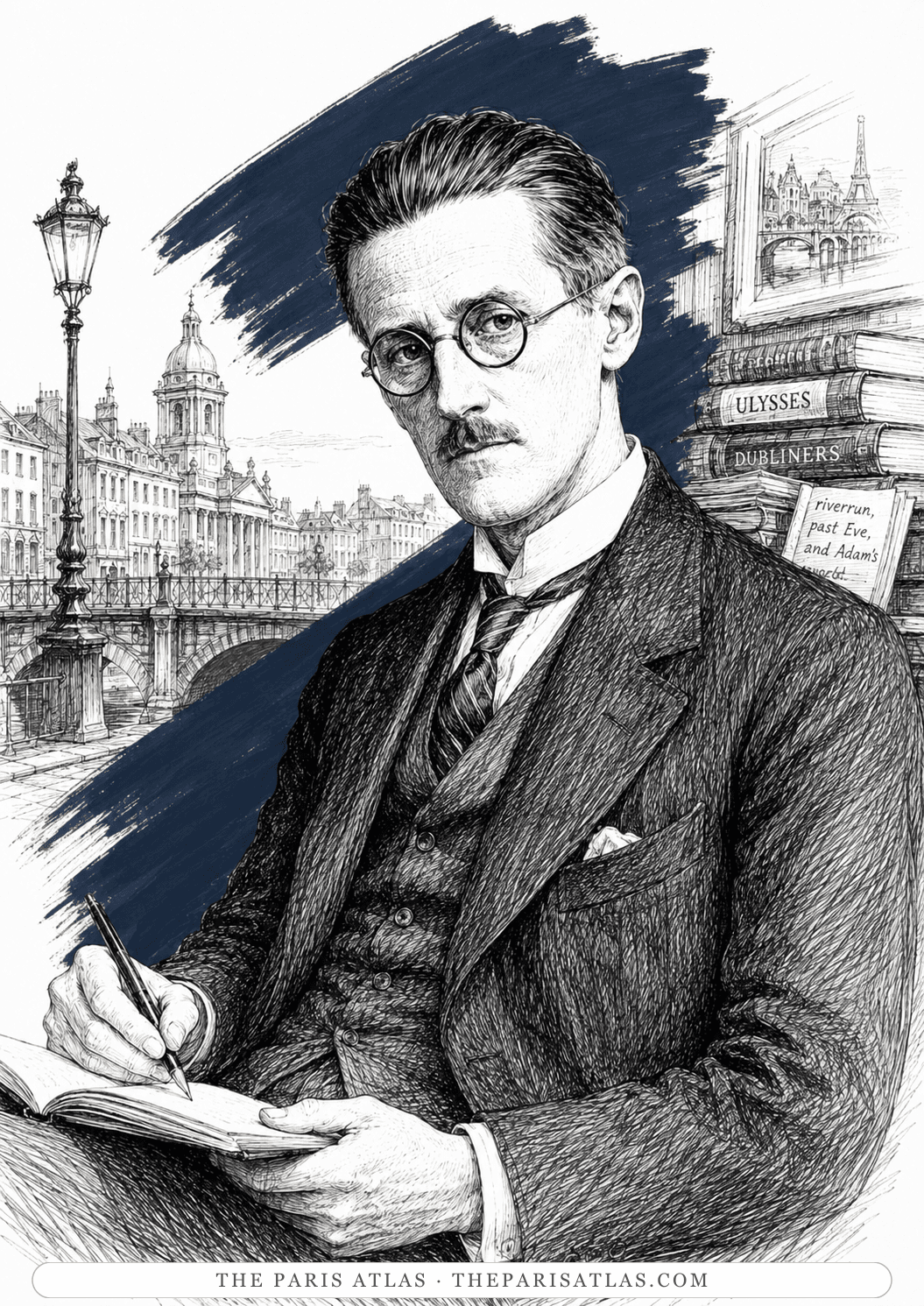
The story is usually retold with an extra detail — that Faulkner sat in the café night after night and never dared speak to him. That embellishment is not in the recording. What Faulkner actually said is that he would go to some trouble to get to the café Joyce used, in order to look at him, and that Joyce was the only writer he remembers laying eyes on in Europe. He never claimed they spoke, and never claimed they did not. What he did say, plainly, at Mary Washington College in Fredericksburg, Virginia, in April 1957, was how much the looking had been worth: asked whether Joyce had influenced his work, he answered, 'Yes, a great deal.'[6] A year later he put it more grandly — Joyce was one of the great men of his time, a man 'electrocuted by the divine fire', who had more talent than he could control.[7]
The country he invented
He was back in the United States by early 1926, and the New York publisher Boni & Liveright brought out that first novel, Soldiers' Pay, a book about disillusioned soldiers coming home from the war. Mosquitoes followed in 1927, a satire of arty poseurs on a boat, most of them recognisable New Orleans acquaintances. Then came a sprawling manuscript called Flags in the Dust, the first book he set in a Mississippi county of his own invention; his publisher made him cut it, and it appeared in 1929 as Sartoris.[8] From that point he stopped writing about the world and started building one.
Yoknapatawpha County is the simplest and strangest thing about Faulkner, so it is worth stating plainly. It is an invented county in north Mississippi, with an invented county seat called Jefferson, closely modelled on the real Lafayette County and Oxford where he lived. Almost everything he wrote after 1929 takes place there. The same families recur across book after book — the Compsons, the Sartorises, the McCaslins, and the grasping, rising Snopeses — so that the novels and stories accumulate into one continuous history of a place from the frontier to the present. Faulkner drew maps of it. On one of them he wrote the credit line that has followed him ever since: 'William Faulkner, sole owner and proprietor.' The critic Malcolm Cowley — the editor whose 1946 anthology The Portable Faulkner rescued the books from being out of print and put Yoknapatawpha in front of American readers as one connected story — did the arithmetic and reported its population as 15,611 people spread over 2,400 square miles.[9]
The book that made the method famous was The Sound and the Fury, published in October 1929: the fall of the Compson family told four times over, first from inside the mind of Benjy Compson, who has severe intellectual disabilities and no sense of chronology, so that the reader must assemble the story out of a shuffled sequence of moments. Faulkner said it began as a short story and got away from him. It is the novel that carried the stream-of-consciousness technique — the attempt to put a character's unedited flow of thought directly on the page — into American fiction, and it opened the greatest run of his career: As I Lay Dying (1930), Sanctuary (1931), Light in August (1932), Absalom, Absalom! (1936) and Go Down, Moses (1942).
Rowan Oak, and the Hollywood years
In 1929 he married Estelle Oldham Franklin, his high-school sweetheart, newly divorced. In 1930 he bought a run-down two-storey house on the edge of Oxford in the Greek Revival style — white, symmetrical, with a columned porch copied from a Greek temple front — — built in the 1840s by a planter named Robert Sheegog and known in Faulkner's day as the Bailey Place — and renamed it Rowan Oak the following year. He lived there until he died, and it is now a house museum run by the University of Mississippi, kept with much of the family's own furniture, and open to visitors.[4]
Reviews were respectful and sales were not, so from the spring of 1932 he went out to Hollywood as a screenwriter — a lucrative, dispiriting second career that ran on and off for more than twenty years, through several studios and finally Warner Brothers. He kept publishing roughly a book a year regardless, moving through the Southern subjects that are the reason he matters: the ruin of the old plantation order, the arrival of the pitiless Snopes family, and above all race, treated in Light in August and Absalom, Absalom! as the wound that explains the region's violence. It was Intruder in the Dust, a novel of detection and race published in 1948, that finally brought him money and a wide readership.[3]
Stockholm, 1950
The Nobel Prize in Literature for 1949 went to Faulkner 'for his powerful and artistically unique contribution to the modern American novel' — awarded a year late, so that he collected it at the banquet in Stockholm City Hall on 10 December 1950.[1] He spoke for four minutes. He said the award belonged to his work rather than to himself, that the only subject worth writing about is 'the problems of the human heart in conflict with itself', and that a generation of young writers had let a general physical fear of the atomic age — the speech was given five years after Hiroshima — push that subject aside.[10]
I decline to accept the end of man. … I believe that man will not merely endure: he will prevail.[10]
The last decade was public in a way the earlier ones had not been: goodwill tours abroad for the US State Department, which sent him as a cultural ambassador to Japan, Europe and South America; two Pulitzer Prizes, America's principal award for a novel, for A Fable (1954) and for his last novel The Reivers (1962); and, from 1957, the post of first Writer-in-Residence at the University of Virginia, where he held office hours six days a week and answered questions in classroom after classroom while a tape recorder ran. Those recordings, which are why we know in his own voice about the café in Paris, are now published online by the University of Virginia Library, which also holds the manuscripts he left it. He died at Byhalia, Mississippi, on 6 July 1962, eleven weeks short of his sixty-fifth birthday.[11]
Life events
1897
Born on 25 September at New Albany, Mississippi; the family moves to Oxford before his fifth birthday.
— William Faulkner — Facts; Joseph Blotner, William Faulkner
1914
Phil Stone begins the long private education that carries him from the classics to the French Symbolists to Joyce, Pound and Eliot.
— Donald Kartiganer, William Faulkner (2017)
1918
Begins pilot training in Toronto with the Royal Air Force's Canadian arm, spelling his name Faulkner for the first time; the war ends before he flies.
— Joseph Blotner, William Faulkner
1924
Goes to New Orleans to arrange a passage to Europe, meets Sherwood Anderson, and stays half a year in the French Quarter writing for the Times-Picayune.
— Joseph Blotner, William Faulkner; Donald Kartiganer, William Faulkner (2017)
1925
Sails for Europe in July with the architect William Spratling; from Genoa they travel through Switzerland to Paris.
— Joseph Blotner, William Faulkner
1925
Spends the autumn at 26 rue Servandoni beside the Luxembourg Gardens — the address the City of Paris later marked with a plaque — working on stories and on novels he never finishes, keeping out of expatriate literary Paris, and walking to the café James Joyce used in order to look at him.
— Plaques commémoratives; McAleer's Literature Class, tape 1, 13 March 1957 (Faulkner at Virginia) (1957); Joseph Blotner, Faulkner: A Biography (1984)
1926
Soldiers' Pay, his first novel, is published by Boni & Liveright.
— William Faulkner: Novels 1926–1929
1929
Marries Estelle Oldham Franklin; Flags in the Dust appears in cut form as Sartoris, and The Sound and the Fury comes out in October.
— Donald Kartiganer, William Faulkner (2017); William Faulkner: Novels 1926–1929
1930
Buys the derelict 1840s house outside Oxford known as the Bailey Place and renames it Rowan Oak the following year; he lives there until his death.
— William Griffith, Rowan Oak (2017)
1932
Goes to Hollywood as a screenwriter, beginning a well-paid and costly second career that runs on and off for two decades.
— Joseph Blotner, William Faulkner
1948
Intruder in the Dust, a novel of detection and race, brings him financial security and a wide readership at last.
— Joseph Blotner, William Faulkner
1950
Receives the Nobel Prize in Literature for 1949 and gives the banquet speech in Stockholm on 10 December: man will not merely endure, he will prevail.
— William Faulkner — Facts; William Faulkner, William Faulkner: Nobel Banquet speech (1950)
1957
Becomes the University of Virginia's first Writer-in-Residence; the classroom recordings made there are the fullest record of him talking about his own work.
— The William Faulkner Collection
1962
His last novel, The Reivers, appears and brings him a second Pulitzer Prize; he dies at Byhalia, Mississippi, on 6 July.
— Donald Kartiganer, William Faulkner (2017); William Faulkner — Facts
People William Faulkner Knew
Relationships with other people, with sources for each connection.
Faulkner went to New Orleans late in 1924 intending to sail for Europe and stayed six months, largely because of Anderson. In the French Quarter he joined the circle around the older novelist - the architect William Spratling, the writers Lyle Saxon, Roark Bradford and Hamilton Basso - published sketches in the Times-Picayune, and, by his biographer's account, sent his first novel manuscript to Anderson's publisher before sailing. Scholarship on Faulkner treats it as the only extended period of his life spent inside a community of intellectual peers.
— Joseph Blotner, William Faulkner; Donald Kartiganer, William Faulkner (2017)
Who Inspired William Faulkner
People whose work inspired William Faulkner. They did not necessarily meet or know one another.
Faulkner said so himself, on tape. Asked at Mary Washington College in April 1957 whether Joyce had influenced his work and to what extent, he answered 'Yes, a great deal', before adding his standing caveat that a writer is influenced by everything he ever reads, 'from the telephone directory up and down'. He had read Joyce as a young man through Phil Stone's tutorial in Oxford, Mississippi, and in Paris in the autumn of 1925 he went out of his way to sit in the cafe Joyce used in order to look at him - the only literary figure he remembered seeing in Europe. In 1958 he called Joyce one of the great men of his time, 'electrocuted by the divine fire'.
— At Mary Washington College, tape 1, 25 April 1957 (Faulkner at Virginia) (1957); McAleer's Literature Class, tape 1, 13 March 1957 (Faulkner at Virginia) (1957); Visitors from Other Colleges, tape 1, 12 May 1958 (Faulkner at Virginia) (1958)
Movements
The artistic and literary currents this life ran through.
The connection is real and one-sided. Faulkner was in Paris in the autumn of 1925, at 26 rue Servandoni beside the Luxembourg Gardens, while Hemingway, Stein and the little magazines were a short walk away, and the novel he had just finished - Soldiers' Pay, about soldiers coming home damaged from the war - is described by his own house museum as his Lost Generation book. But he joined nothing. Asked at the University of Virginia in 1957 why he had not fallen in with the expatriate writers, he said he had not thought of himself as a writer then, he was 'a tramp', and he was not interested in literary people. He belongs beside the movement rather than inside it.
— Joseph Blotner, William Faulkner; McAleer's Literature Class, tape 1, 13 March 1957 (Faulkner at Virginia) (1957); Plaques commémoratives
William Faulkner's fifth novel: a poor Mississippi family hauls their mother's coffin to town through flood and fire, and fifteen voices tell the trip.
William Faulkner's 1932 novel: a pregnant girl walks into a Mississippi town on the day a woman is murdered, and a man who does not know his own race is hunted down.
William Faulkner's 1936 novel: four people try to piece together the story of Thomas Sutpen, who built a plantation out of nothing and was destroyed by the son he refused to acknowledge.
4.5
Questions about William Faulkner
Who was William Faulkner?
An American novelist, born in Mississippi in 1897 and dead there in 1962, who set almost all of his mature work in one invented Mississippi county and won the Nobel Prize in Literature for 1949. His best-known books are The Sound and the Fury (1929), As I Lay Dying (1930), Light in August (1932) and Absalom, Absalom! (1936). He is famous for very long sentences, for telling a story through the minds of several different characters in turn, and for making the history of the American South the subject of modernist fiction.
What is Yoknapatawpha County?
A county Faulkner invented and then used as the setting for nearly everything he wrote after 1929, with its own county seat, Jefferson, and its own recurring families — the Compsons, the Sartorises, the McCaslins and the Snopeses. It is closely based on Lafayette County, Mississippi, and the town of Oxford, where he lived. Because characters and events carry over from one book to the next, the novels and stories add up to a single continuous history of the place. Faulkner drew maps of it and signed one 'William Faulkner, sole owner and proprietor'; the critic Malcolm Cowley put its population at 15,611 across 2,400 square miles.
Did William Faulkner live in Paris?
Yes, for the autumn of 1925. He sailed from New Orleans that July with his friend the architect William Spratling, landed at Genoa, crossed Switzerland and reached Paris, where he stayed for the rest of the year apart from short trips into the countryside and to England. His room was at 26 rue Servandoni in the 6th arrondissement, a two-minute walk from the Luxembourg Gardens; the City of Paris has since put a plaque on the building reading, in French, 'here lived, in the autumn of 1925, William Faulkner'. He was twenty-seven when he sailed and turned twenty-eight that September, had published nothing but a slim book of poems, and was back in the United States by early 1926.
Did Faulkner ever meet James Joyce?
He saw him; there is no record from Faulkner of their speaking. Asked at the University of Virginia in March 1957 why he had not joined the expatriate writers in Europe, Faulkner said he had not thought of himself as a writer then — he was 'a tramp' and was not interested in literary people — and then added that he knew of Joyce and 'would go to some effort to go to the café that he inhabited to look at him', and that Joyce was the only literary man he remembered seeing in Europe. The popular version of the story, in which Faulkner sat night after night without daring to introduce himself, adds a detail his own account does not contain.
Did James Joyce influence Faulkner?
By Faulkner's own answer, yes. At Mary Washington College in April 1957 a student asked whether Joyce had influenced his work and to what extent; Faulkner replied, 'Yes, a great deal,' before adding his usual caveat that a writer is influenced by everything he ever reads, 'from the telephone directory up and down'. Asked in 1958 what he thought of Joyce, he called him one of the great men of his time, a man 'electrocuted by the divine fire' who had more talent than he could control — trying, he said, to get the whole tragic history of humanity into one English sentence, which was Ulysses, and one English word, which was Finnegans Wake.
What did Faulkner write in Paris?
Stories and novels he did not finish. His biographer Joseph Blotner records that the longest of the Paris drafts was a novel about a would-be painter named Elmer, which Faulkner abandoned and never published in his lifetime. The Rowan Oak account of the trip puts it simply: he worked on stories and novels in Paris, elements of which he would salvage later — which is what happened, as pieces of the abandoned material surfaced in books he wrote in the years afterwards.
What is Rowan Oak?
Faulkner's house in Oxford, Mississippi, and now a museum. It is a two-storey Greek Revival house built in the 1840s by a planter named Robert Sheegog, who bought the land in December 1844; Faulkner bought the house in 1930, when it was known as the Bailey Place, and renamed it Rowan Oak the next year. He lived there until his death in 1962. The University of Mississippi rented it from his widow and bought it from his daughter in the 1970s. Much of the family's own furniture is still in the rooms, and the house and grounds are open to visitors.
What did Faulkner say in his Nobel speech?
He spoke for about four minutes at the banquet in Stockholm on 10 December 1950. He said the prize belonged to his work rather than to him; that the only thing worth writing about is 'the problems of the human heart in conflict with itself'; and that young writers had been distracted from it by a general physical fear of the atomic age. He ended with the passage everyone quotes: 'I decline to accept the end of man… I believe that man will not merely endure: he will prevail.'
Connections and Sources
William Faulkner’s connections to people, places, and works, with the sources behind each one.
The connection is real and one-sided. Faulkner was in Paris in the autumn of 1925, at 26 rue Servandoni beside the Luxembourg Gardens, while Hemingway, Stein and the little magazines were a short walk away, and the novel he had just finished - Soldiers' Pay, about soldiers coming home damaged from the war - is described by his own house museum as his Lost Generation book. But he joined nothing. Asked at the University of Virginia in 1957 why he had not fallen in with the expatriate writers, he said he had not thought of himself as a writer then, he was 'a tramp', and he was not interested in literary people. He belongs beside the movement rather than inside it.
— Joseph Blotner, William Faulkner; McAleer's Literature Class, tape 1, 13 March 1957 (Faulkner at Virginia) (1957); Plaques commémoratives
Faulkner went to New Orleans late in 1924 intending to sail for Europe and stayed six months, largely because of Anderson. In the French Quarter he joined the circle around the older novelist - the architect William Spratling, the writers Lyle Saxon, Roark Bradford and Hamilton Basso - published sketches in the Times-Picayune, and, by his biographer's account, sent his first novel manuscript to Anderson's publisher before sailing. Scholarship on Faulkner treats it as the only extended period of his life spent inside a community of intellectual peers.
— Joseph Blotner, William Faulkner; Donald Kartiganer, William Faulkner (2017)
Faulkner said so himself, on tape. Asked at Mary Washington College in April 1957 whether Joyce had influenced his work and to what extent, he answered 'Yes, a great deal', before adding his standing caveat that a writer is influenced by everything he ever reads, 'from the telephone directory up and down'. He had read Joyce as a young man through Phil Stone's tutorial in Oxford, Mississippi, and in Paris in the autumn of 1925 he went out of his way to sit in the cafe Joyce used in order to look at him - the only literary figure he remembered seeing in Europe. In 1958 he called Joyce one of the great men of his time, 'electrocuted by the divine fire'.
— At Mary Washington College, tape 1, 25 April 1957 (Faulkner at Virginia) (1957); McAleer's Literature Class, tape 1, 13 March 1957 (Faulkner at Virginia) (1957); Visitors from Other Colleges, tape 1, 12 May 1958 (Faulkner at Virginia) (1958)
References
References
The sources below include biographies, scholarly essays, interviews, and primary materials that informed this page. They reflect both the historical record and ongoing critical conversations about William Faulkner and their work.
The biographical account published by Faulkner's own house museum, written by his biographer Joseph Blotner — the source for the 1925 crossing with William Spratling and the Paris months.
The standard biography, and the source for the unfinished Paris novel Elmer.
i
Why these sources are here
These references anchor the page in the documented record and in the scholarly conversations around William Faulkner. Every claim on this page traces back to one or more of the works listed here.



 View source