As I Lay Dying
William Faulkner
As I Lay Dying
Faulkner's next novel, written quickly after this one. It is also told from inside several family members' heads, and also has a sister surrounded by brothers.
Read our takeThe Sound and the Fury
William Faulkner
William Faulkner's fourth novel: the fall of a Mississippi family told four times, first by a man who cannot tell yesterday from today.
The Sound and the Fury is William Faulkner's fourth novel, published in New York in 1929 by Jonathan Cape and Harrison Smith.[1] It follows the Compsons, an old family in the Mississippi town of Jefferson, as they lose their land, their money and their hold on each other.[2] Four sections tell the story on four days. The first three are told from inside the heads of three brothers, Benjy, Quentin and Jason. The fourth follows the family's cook, Dilsey, on Easter Sunday 1928.[3] At the center of all four is their sister Caddy, who never gets a section of her own.[4] Faulkner called it the book he loved most.[5]
The novel opens on a golf course. Benjy Compson, thirty-three that day, stands at a fence watching men hit balls, while Luster, Dilsey's grandson, who looks after him, hunts in the grass for a lost quarter.[3] The golf course used to be the Compsons' pasture. The family sold it to send the oldest brother, Quentin, to Harvard.[3][2]
Benjy has a severe intellectual disability and cannot speak. He also has no sense of time. A word or a smell sends him back twenty years with no warning, and the page moves with him.[3] The text marks some of these jumps with italic type. Many are not marked at all, so the first section reads like a puzzle.[3]
One thing holds Benjy's memories together, and that is his sister Caddy. She looks after him, sleeps beside him and defends him.[2] Again and again he says that Caddy smelled like trees.[3] Faulkner said later that she was the whole world to Benjy, and that every other event reached him only as a flash reflected on her.[6]
The second section jumps back to 2 June 1910 and to Cambridge, Massachusetts. Quentin, a Harvard student, gets up, breaks the glass of his grandfather's watch and twists off the hands.[3] Then he spends the day putting his affairs in order. The reader slowly works out that he means to kill himself before night.[2]
On 7 April 1928 Benjy Compson turns thirty-three. He follows Luster along the fence of the golf course that used to be his family's pasture. His mind jumps between that day and scenes from the past: his grandmother's death, Caddy's wedding, and Caddy leaving home.[2] At the end of his section he watches his niece Quentin, Caddy's daughter, climb out of her bedroom window at night.[2]
On 2 June 1910 his brother Quentin is at Harvard. He writes notes to his roommate and his father, packs his trunk and buys flatirons.[3] He wanders with a small Italian girl who follows him from a bakery, and is briefly arrested when her brother accuses him of taking her.[2] All day he thinks about Caddy's lovers and her marriage.[2]
On 6 April 1928, Good Friday, Jason Compson works at a hardware store and fights with everyone. He quarrels with his teenage niece Quentin, chases her through town when he sees her with a man in a red tie, and gets nowhere.[2] He also reveals that for years he has cashed the checks Caddy sends for her daughter and handed his mother fakes to burn.[2]
Quentin's section ends as he leaves his room to drown himself, which Jason confirms later. On Easter Sunday, 8 April 1928, Jason finds his room broken into and his hidden money gone. His niece has taken it and run off with the man in the red tie. He drives off after them and never finds them.
Meanwhile Dilsey takes Benjy to the Easter service at her church, where a visiting preacher, Reverend Shegog, speaks. She cries through it and says she has seen the first and the last. In the afternoon Luster drives Benjy to the cemetery and turns the wrong way around the square. Benjy screams until Jason, back in town, turns the horse around, and everything passes him in its usual order again.
Faulkner told the story of the book many times at the University of Virginia in 1957 and 1958, where students recorded his classes. It always began with one picture. A little girl climbs a tree to look through the parlor window, while her brothers wait below, and they see the muddy seat of her underwear. The girl became Caddy.
He meant it as a short story of about a thousand words. It would not stay that size. He told it through Benjy, and that was not enough. He told it again through Quentin, then through Jason. Finally he told it himself, in the fourth section, and he said that failed too.
Asked why Caddy never tells her own part, he said she was too beautiful and too moving to reduce to telling what was going on. He thought it would be more passionate to see her through someone else's eyes. In the same class he called her his heart's darling.
That's the one that I love the best for the reason that it was the most splendid failure.
Each section has a date for a title, not a name. The order is 7 April 1928, 2 June 1910, 6 April 1928 and 8 April 1928. Three of the four fall on Easter weekend in 1928. Quentin's day comes eighteen years earlier.
Benjy's section is the hardest to start. Faulkner admitted that opening with it was a bad method, and said he had shifted the sections back and forth before deciding. He put Benjy first because Benjy did not know what he was seeing, so his memories were the plain groundwork of the story.
Quentin's section is the longest, at about 32,000 words. His thoughts run together without capitals or full stops for pages at a time. He cannot stop thinking about Caddy losing her virginity, about her marriage and about time itself, which his father's gift of the watch keeps in front of him.
Jason's section is the easiest to follow and the ugliest to read. He is the brother who stayed home. He is angry at everyone and funny in a mean way. He sneers at Jews, at Black people, at women and at his own family. Faulkner put it simply when a student asked. Jason was bad, he said, and Quentin was weak.
The last section steps outside all three heads. It follows Dilsey, the family's Black cook, from before dawn on Easter morning. Faulkner picked her out as the good person in the book, holding the family together for no reward. That praise has its limits. In another class he said the human will to prevail would even take what he called the nether channel of the Black race.
The Compsons depend on the Black family that works for them. Dilsey cooks and keeps the house going, and her grandson Luster watches Benjy. The white Compsons give the orders and complain. The Black characters do the work and keep Benjy calm.
The n-word appears about 75 times in the 1929 text. It turns up in all four sections, and most often in Jason's, where it is part of his running contempt. Quentin uses it too, in his thoughts about the South he has left behind in Mississippi.
The book also contains violence that it tells only in pieces. As a young man Benjy grabs a schoolgirl at the gate, thinking she is Caddy, and the family has him castrated. Quentin drowns himself in Massachusetts at the end of his day. Jason steals, for years, the money Caddy sends to raise her daughter.
The title comes from Macbeth's speech about life as a tale told by an idiot, full of sound and fury. Faulkner said it had nothing to do with Macbeth's character. He liked the ring of the words.
The method owes a debt to the Irish novelist James Joyce, whose Ulysses follows the unedited thoughts of its characters. Asked in 1957 whether Joyce had influenced him, Faulkner said yes, a great deal. Donald Kartiganer, writing in the Mississippi Encyclopedia, calls the novel Faulkner's great breakthrough, with its abrupt scene shifts, looping time and inner monologue.
Faulkner spent the autumn of 1925 in a room at 26 rue Servandoni, near the Jardin du Luxembourg. The City of Paris later put a plaque on the building. He said he went out of his way to the café Joyce used, just to look at him. He wrote The Sound and the Fury about three years later, back in Mississippi.
The novel reached French readers in 1938. Éditions Gallimard published it as Le Bruit et la fureur, translated and introduced by Maurice-Edgar Coindreau. In June 1939 Jean-Paul Sartre wrote about it in La Nouvelle Revue française. He asked why Faulkner had broken up the time of his story and shuffled the pieces, and argued that time itself was Faulkner's real subject.
Coindreau's translation stayed in print in France for more than eighty years. Gallimard published a new translation by Charles Recoursé in 2025.
Through the fence, between the curling flower spaces, I could see them hitting.
Caddy smelled like trees.
I give it to you not that you may remember time, but that you might forget it now and then for a moment and not spend all your breath trying to conquer it.
He called it his most splendid failure and the one he worked at longest and hardest.
The first section is told by a man who cannot speak and has no sense of time. Toni Morrison, quoted on the publisher's page, says she is in awe of Faulkner's Benjy.
Caddy never tells her own story. Each brother remembers her differently, and the reader builds her out of their memories.
The 1929 text is in the public domain in the United States and free on Project Gutenberg.
The youngest Compson son, thirty-three in 1928. He cannot speak and has no sense of time. He tells the first section.
Candace, the only daughter. She mothers Benjy, is sent away after her marriage fails, and never tells a section of her own.
The oldest son, a Harvard student in 1910. He tells the second section on the last day of his life.
The brother who stays home. He works at a hardware store, steals Caddy's money for her daughter, and tells the third section.
The Compsons' cook, a Black woman who has run the house for decades. The fourth section follows her on Easter Sunday.
Raised by the Compsons after Caddy is sent away. On Easter Sunday she runs off with Jason's hidden money.
Dilsey's grandson, who looks after Benjy and spends Benjy's birthday hunting for a lost quarter.
The mother, who spends most of her days in bed complaining.
1925
Faulkner spends the autumn in Paris at 26 rue Servandoni, near the Luxembourg Garden.
1929
Jonathan Cape and Harrison Smith publish The Sound and the Fury in New York.
1930
In the March issue of The Forum, the English novelist Richard Hughes names Faulkner the American novelist who interests him most, and calls the book his strangest.
1938
Gallimard publishes Le Bruit et la fureur in Paris, translated and prefaced by Maurice-Edgar Coindreau.
1939
Jean-Paul Sartre writes about the novel's broken time in the June issue of La Nouvelle Revue française.
1946
The Modern Library reissues the novel with As I Lay Dying, adding the Appendix Faulkner wrote for Malcolm Cowley's The Portable Faulkner.
1957
At the University of Virginia, Faulkner calls the novel his most splendid failure and the book he loves best.
2025
The novel enters the US public domain on 1 January. Project Gutenberg releases it on 21 January, and Gallimard publishes a new French translation by Charles Recoursé.


As I Lay Dying
William Faulkner
Faulkner's next novel, written quickly after this one. It is also told from inside several family members' heads, and also has a sister surrounded by brothers.
Read our takeAbsalom, Absalom!
William Faulkner
Quentin Compson comes back as the main listener and teller, in the months before the day this novel describes.
Read our take
James Joyce's novel of one Dublin day. Faulkner said Joyce influenced him a great deal.
Read our take
Virginia Woolf's 1925 novel also follows minds through one day, and one of its main characters kills himself. Toni Morrison's Cornell master's thesis was on suicide in the fiction of Woolf and Faulkner.
Read our takeThe decline of the Compsons, an old Mississippi family, told through four days. Three brothers, Benjy, Quentin and Jason, each tell one section. The last section follows Dilsey, the family's cook. All four keep circling back to their sister Caddy.
The first section is told by Benjy, who cannot tell past from present, so the story jumps between years without warning. Faulkner admitted that starting with Benjy was a bad method, but said it seemed the best way. Many readers find the book easier on a second reading.
From Macbeth's speech about life as a tale told by an idiot, full of sound and fury. Faulkner said the title had nothing to do with Macbeth's character. He chose it for the sound of the phrase.
Each is titled with a date: 7 April 1928 (Benjy), 2 June 1910 (Quentin), 6 April 1928 (Jason) and 8 April 1928 (Dilsey's Easter Sunday). The second is eighteen years earlier than the others.
Faulkner said Caddy was too beautiful and too moving to reduce to telling what was going on. He thought she would be more moving seen through her brothers' eyes.
He drowns himself in Massachusetts on 2 June 1910, at the end of the day his section describes. The section ends as he leaves his room.
Yes, in the United States. Books published in 1929 entered the US public domain on 1 January 2025. Project Gutenberg released the novel as ebook #75170 on 21 January 2025.
No. He spent the autumn of 1925 in Paris and wrote the novel back in Mississippi a few years later. Paris came later: Gallimard published the French translation in 1938, and Jean-Paul Sartre wrote a famous essay on it in 1939.
Explore authors with a similar voice, perspective, and influence.
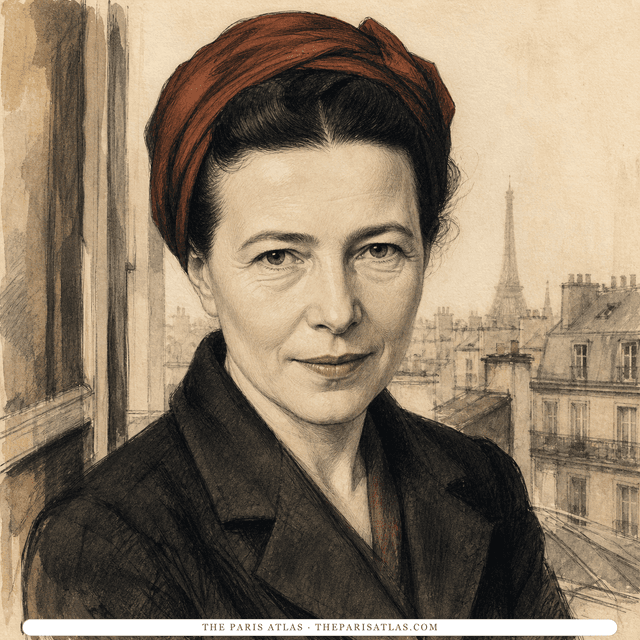
French writer and philosopher whose novels, memoirs, and social analysis examined freedom, gender, responsibility, aging, and the material conditions that shape a life.
View author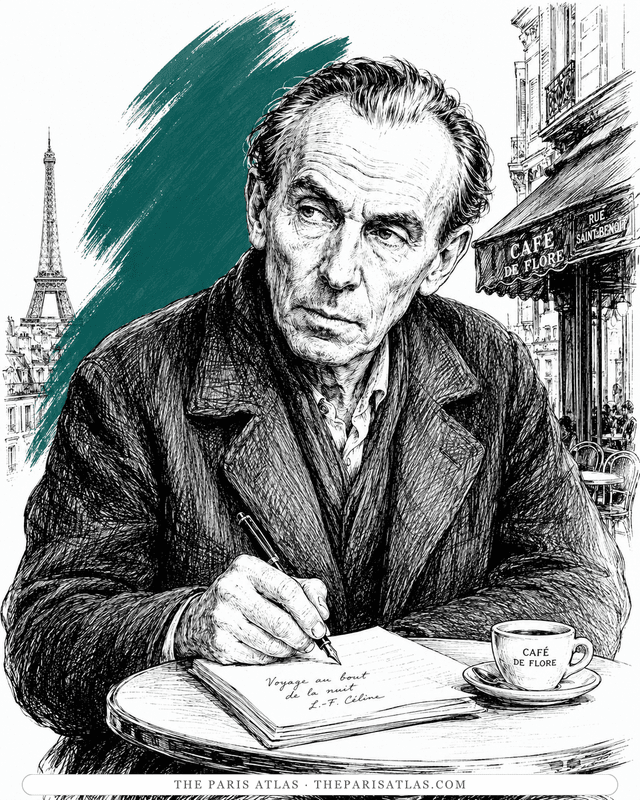
The doctor of the Paris slums who wrote the century's blackest, funniest novel — and changed the sound of French prose.
View author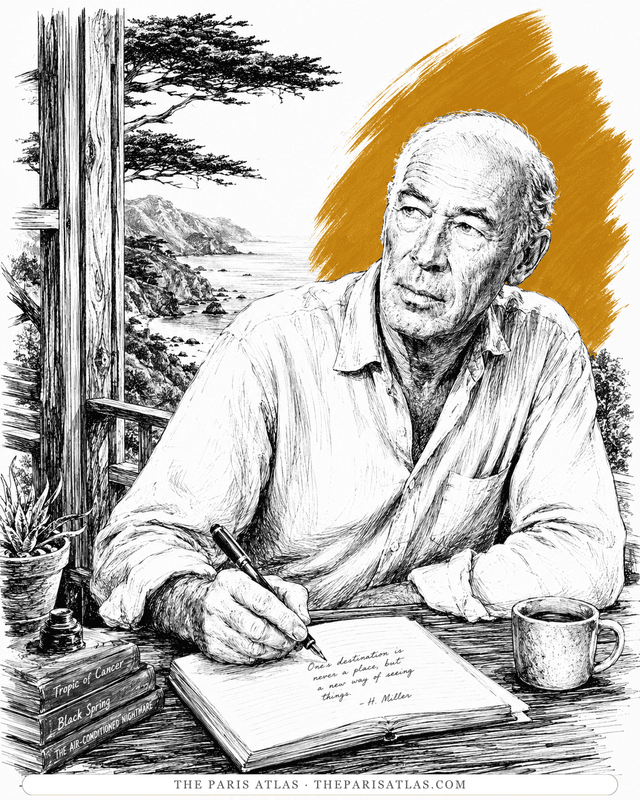
The Brooklyn dropout who arrived in Paris broke at thirty-eight and wrote the exuberant, banned books that ended American censorship.
View authorThe sources below include the primary text, editions, scholarship, archival materials, and other records that informed this page. They document The Sound and the Fury, its publication, and its place in literary history.


Edition records confirming the first edition and every ISBN listed here.
Faulkner on the muddy drawers, Caddy, Dilsey and the 'most splendid failure'.
Asked for his best book, Faulkner names this one.
Faulkner on why Benjy's section comes first, and on going to look at James Joyce in Paris.
Faulkner on the book starting as a thousand-word story.
Dilsey as the good person in the book; Jason bad and Quentin weak.
Faulkner on taking the title from the phrase in Macbeth.
Faulkner on James Joyce's influence.

Donald Kartiganer's reference entry on the novel as Faulkner's breakthrough.
Library of America volume that prints the novel with Faulkner's first three.
Publisher's page for the Vintage International edition: formats, ISBNs, introduction and review quotations.
Richard Hughes's review in The Forum, March 1930.
Title page and copyright page of the 1946 Modern Library edition with the Appendix.
The plaque at 26 rue Servandoni.
BnF record for Maurice-Edgar Coindreau's 1938 translation.
BnF record for Charles Recoursé's 2025 translation.
Jean-Paul Sartre's essay on the novel in La Nouvelle Revue française, June 1939.
The primary text represented by this page, used for descriptions of the work’s contents and for any quoted passages shown here.
The primary text is the baseline reference for every book page. Additional references document publication history, interpretation, and historical context where that evidence is available.
 Explore more resources