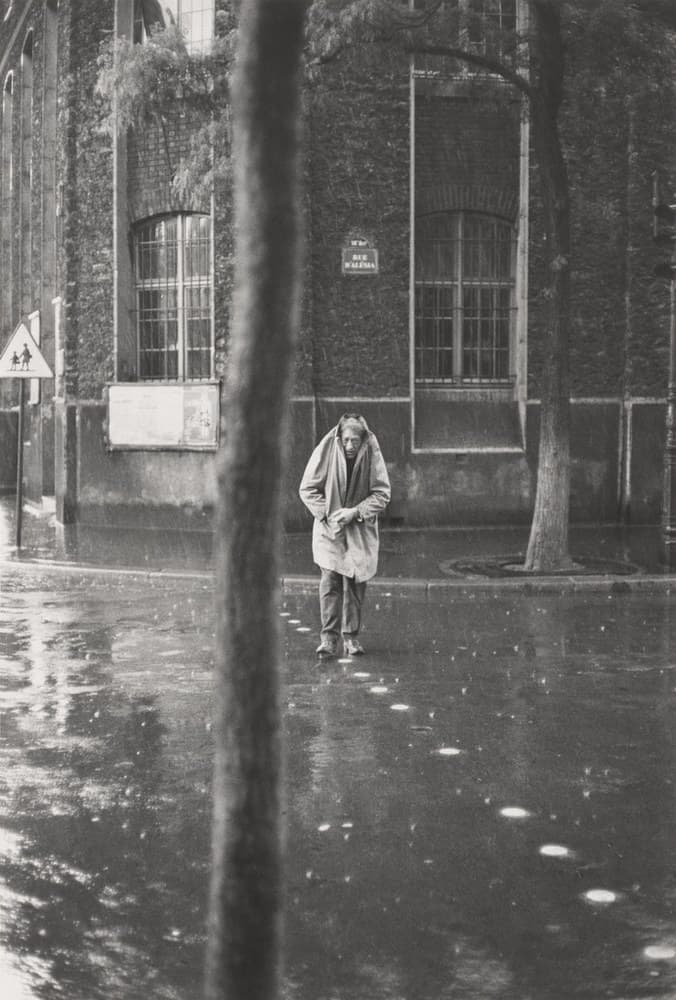
Alberto Giacometti crosses a wet Paris street with his raincoat pulled up over his head, holding it shut in front of him, his head down. Rain is falling hard enough to pock the road with bright splash marks. A street plaque on the wall behind him reads RUE D'ALÉSIA. The Museum of Modern Art titles the photograph Alberto Giacometti Going Out for Breakfast, Paris, dates it 1963, and names Alberto Giacometti as the sitter.
A man walks towards the camera down the middle of a wet road. He has pulled a pale raincoat up over his head and holds it shut in both hands in front of him at waist height, so the coat hangs over him like a tent rather than a hood. His head is bowed and his face is shadowed under the fold. A dark garment shows at his throat, and a round watch face catches the light at one wrist.
His trousers are dark and creased, his shoes are heavy and dark, and he is caught mid-stride with his weight on his left foot. He is the only person in the frame.
The road takes the bottom half and it is running with water. Scattered across it are dozens of small bright ellipses — individual raindrop splashes caught by the shutter, each one a separate white mark on the dark wet tarmac. Fine diagonal streaks of falling rain cross the upper left of the frame.
Behind him is a corner building of brick and stone, almost completely under a dense mat of ivy that grows over the window arches and around a downpipe. Two tall arched windows are fitted with metal grilles. A kerb and pavement run across the middle of the picture, with a tree rising from a round metal grate at the right.
The lettering, transcribed
One sign in the frame is fully legible. A dark enamel street plaque is fixed to the ivy-covered wall at the centre, and it reads, in two lines of white capitals inside a white border: RUE D'ALÉSIA. Above the plaque, in smaller white characters on the wall, is the arrondissement number: 14e Arrᵗ.
A second sign stands at the left edge on a post. It is a triangular warning plate carrying two figures in silhouette — a taller adult in a hat and coat holding the hand of a smaller child who carries a satchel. It is the French children-crossing warning, and it puts a school on that corner.
Nothing else in the frame carries readable text. A glazed noticeboard is mounted on the wall below and left of the street plaque, with printed sheets and columns of type visible inside it. None of that type resolves at the reproduction's scale, and a second blank white panel hangs below it.
The tree trunk down the middle
A bare tree trunk runs the full height of the picture just left of centre, in the immediate foreground and completely out of focus. It is a soft dark column, and it is the first thing the frame does.
Alberto Giacometti walks in the narrow channel to the right of it. The trunk crops his left side at several points as he moves, and it separates him from the left third of the picture, where the warning sign and the noticeboard sit. A second trunk stands at the right, sharper, growing from the pavement grate.
The composition is therefore made through an obstruction rather than around one. Henri Cartier-Bresson has stood behind a street tree and let it into the frame at full strength, which puts the camera across the road from the man and makes it clear he was not asked to pose. The street plaque sits at the top of the same narrow channel, so the name of the street and the man walking down it occupy one vertical strip.
The horizon is the kerb line, and it falls almost exactly halfway up. Above it everything is vertical: trunks, window grilles, the ivy's stems. Below it everything is horizontal and wet. The road answers back, though, because at the left it mirrors the building in long vertical smears of light. He is walking from the vertical half into the horizontal one.
What it is actually called, and when
The photograph circulates widely as Alberto Giacometti, rue d'Alésia, Paris, dated 1961. Neither the title nor the date matches the holding museum's record. The Museum of Modern Art catalogues it as Alberto Giacometti Going Out for Breakfast, Paris, dates the negative 1963, and gives the print as made in 1968.
The street name is not in the museum's title at all. It is in the photograph, on a plaque, which is presumably how the other title came about.
The sign also places the crossing in the 14th arrondissement. That is the arrondissement of the studio at 46 rue Hippolyte-Maindron, which Alberto Giacometti took in 1926 and kept for the rest of his life. He had meant to move as soon as he could afford to. He was fifty-nine or sixty when the photograph was made and had two or three years to live.
The other Giacometti photograph
The Museum of Modern Art holds a second Henri Cartier-Bresson photograph of the same sitter, and it is the opposite picture in almost every way. Alberto Giacometti Outside His Studio, 1962, printed 1963, is object number 1241.1969. It is a horizontal close portrait, with his lined face and swept-back grey hair at the right of the frame. He wears a coarse tweed jacket, a white shirt and a dark tie, and clutches a thick bundle of newspapers against his chest.
One line of that bundle is legible. The top sheet carries the byline ANTOINE BLONDIN in serif capitals — the French novelist who wrote the Tour de France columns for the sports daily L'Équipe. The rest of the print is a weathered plank door with a studded iron escutcheon and a keyhole, and a patched rendered wall.
Set beside each other, the two photographs are a portrait made at arm's length and a portrait made across a street in the rain. The Museum of Modern Art names Alberto Giacometti as the sitter on both records.
How it was made
The exposure is the interesting technical fact, and it is readable from the print. The falling rain registers as streaks, which means the shutter was slow enough to smear a drop over some distance. The splashes on the road, by contrast, are held as discrete bright ellipses, and the walking man's shoes and hands are sharp.
Neither the Museum of Modern Art's record nor the Fondation Henri Cartier-Bresson's chronology names the camera body, the lens or the film behind this frame. He had been working a Leica since 1932, and no more than that is claimed here.
The print measures 58.7 by 39.6 centimetres, which is an exhibition enlargement from a 35mm negative. It was made in 1968 and accessioned by the museum on 2 October 1985 as 232.1985, a gift of the artist.
Henri Cartier-Bresson did not print his own negatives. Pierre Gassmann opened Pictorial Service in the 7th arrondissement of Paris in January 1950, with six enlarger stations. The firm, later Picto, records that Henri Cartier-Bresson, Robert Capa and David Seymour were among its first photographers. They stayed to argue with the printers about how to work a negative. A print of 1968 sits squarely inside that relationship.
Close reading
Reading the work, detail by detail
A man under his own coat, a tree trunk straight down the middle, and a street plaque that names the corner. The close views read the signage, count the rain twice over, and look at what the wet road is doing.
1.The coat as a roof
The raincoat is pulled up over his head and hangs over him like a tent rather than sitting as a hood. His head is bowed and his face is shadowed under the fold. Rain streaks the air on both sides of him.
2.Both hands holding it shut
Both hands grip the coat's front edges together at waist height, holding the whole arrangement closed. A round watch face catches the light at one wrist. A dark garment shows at his throat under the coat.
3.Mid-stride on wet tarmac
His trousers are dark and creased and his shoes are heavy, with the weight on one foot mid-stride. The road around them is running with water. The splashes are held as separate bright ellipses, which means the shutter caught each one individually.
4.RUE D'ALÉSIA, transcribed
The plaque is dark enamel with a white border and reads, in two lines of white capitals, RUE D'ALÉSIA. Above it, in smaller white characters painted on the wall itself, is the arrondissement number: 14e Arrᵗ. This is the only fully legible text in the photograph.
5.The children-crossing warning
A triangular warning plate stands on a post at the left edge. It carries two silhouetted figures: a taller adult in a hat and coat holding the hand of a smaller child with a satchel. It is the French children-crossing sign, and it puts a school on this corner.
6.A noticeboard that will not resolve
A glazed noticeboard is mounted on the wall below and left of the street plaque, holding printed sheets whose columns of type are visible. None of that type resolves at the reproduction's scale. A second, blank white panel hangs below it.
7.The trunk the picture is made through
The bare trunk stands in the immediate foreground, completely out of focus, and runs the full height of the picture. He walks in the narrow channel to the right of it. Henri Cartier-Bresson made the photograph through an obstruction rather than around one.
8.The second tree, in focus
A second trunk stands at the right and this one is sharp, rising in front of the ivy and the grilled window. Having one trunk soft and one sharp fixes exactly where the plane of focus sits. It sits on the far pavement, not on the near one.
9.An arched window behind a grille
The window is tall and arched, set in a stone surround and closed with a metal grille. Ivy grows over the arch and down the jamb. The street plaque sits immediately to its left, which is how the name and the building read as one thing.
10.Ivy over everything
Ivy covers the wall almost completely, growing over the window arch and around a downpipe. It turns a masonry building into a soft dark mass. That mass is what makes the pale coat read at all.
11.Raindrops, frozen
The road is scattered with dozens of small bright ellipses, each one an individual raindrop striking the surface. They are held as separate discrete marks. The same exposure that smeared the falling rain into streaks caught these as points.
12.A tree in a round grate
The right-hand tree rises from a round metal grate set flush into the pavement. The kerb line runs across the photograph at roughly its midpoint and does the work a horizon would normally do. Everything above it is vertical and everything below it is wet.
13.The building, smeared in the road
At the left the wet road carries long vertical smears of pale light, which are the building opposite reflected and pulled out of shape. The verticals of the upper half therefore appear again in the lower one. The rain keeps breaking them with bright points.
14.Rain as diagonal lines
The falling rain is recorded as fine diagonal streaks across the wall, the sign and the noticeboard. A streak means the shutter was open long enough to smear a drop over a measurable distance. The splashes on the road, caught as points, came from the same exposure.
Alberto Giacometti takes the studio at 46 rue Hippolyte-Maindron in the 14th arrondissement of Paris and keeps it for forty years.
1962
Henri Cartier-Bresson photographs him outside that studio with a bundle of newspapers; the Museum of Modern Art holds the print as 1241.1969.
1963
Photographed crossing the rue d'Alésia in the rain, in the same arrondissement.
1966
Alberto Giacometti dies, three years after the photograph.
1968
The print now at the Museum of Modern Art is made.
1985
Accessioned by the Museum of Modern Art on 2 October as 232.1985, gift of the artist.
Where to see it
The Museum of Modern Art
11 West 53 Street, New York, NY 10019, United States
The Museum of Modern Art lists the print as not on view and records Alberto Giacometti as the sitter. It holds a second portrait of him by Henri Cartier-Bresson as 1241.1969.
What does the photograph of Alberto Giacometti in the rain show?
Alberto Giacometti crossing a wet Paris street with his pale raincoat pulled up over his head and held shut in both hands in front of him, head bowed, caught mid-stride. Rain streaks cross the upper frame and dozens of bright splash marks pock the wet road. A street plaque on the ivy-covered wall behind him reads RUE D'ALÉSIA.
Is the photograph called Alberto Giacometti, rue d'Alésia?
Not by the museum that holds it. The Museum of Modern Art catalogues the print as Alberto Giacometti Going Out for Breakfast, Paris, and names Alberto Giacometti as the sitter. The rue d'Alésia title almost certainly comes from the street plaque visible in the picture rather than from any caption the photographer supplied.
What year was it taken?
1963, according to the Museum of Modern Art's record, which also dates the print to 1968. The photograph is frequently published as 1961, and that date does not match the holding museum. The companion photograph of Alberto Giacometti outside his studio is dated 1962 by the same museum.
What signs are legible in the photograph?
Two. A dark enamel plaque on the wall reads RUE D'ALÉSIA in white capitals, with 14e Arrᵗ above it in smaller characters. At the left edge a triangular road sign carries the French children-crossing symbol, a coated adult in a hat leading a smaller child with a satchel. A glazed noticeboard on the wall below the plaque holds printed sheets whose type does not resolve.
Why is there a tree trunk across the middle of the picture?
Because Henri Cartier-Bresson stood behind a street tree on the other side of the road. The bare trunk runs the full height of the frame just left of centre, completely out of focus, and Alberto Giacometti walks in the narrow channel to the right of it. The obstruction is in the picture at full strength, which shows the photograph was made unobserved rather than posed.
Where was Alberto Giacometti's studio?
At 46 rue Hippolyte-Maindron in the 14th arrondissement of Paris, about twenty-three square metres with a dirt floor. He took it in 1926 meaning to move as soon as he could afford to and kept it for forty years. The street plaque in the photograph places the crossing in the same arrondissement.
Is there another Cartier-Bresson photograph of Alberto Giacometti?
Yes. The Museum of Modern Art also holds Alberto Giacometti Outside His Studio, 1962, printed 1963, object number 1241.1969 — a close horizontal portrait against a studded plank door, with the sitter clutching a bundle of newspapers. The byline ANTOINE BLONDIN is legible on the top sheet, the novelist who wrote the Tour de France columns for L'Équipe.
In the atlas
What the graph records about this work — every claim carries its citation.
The Museum of Modern Art records Alberto Giacometti as the sitter on its object page and names him in the title. He crosses the rue d'Alesia in the rain with his raincoat pulled over his head, in the 14th arrondissement, the arrondissement of the studio at 46 rue Hippolyte-Maindron he took in 1926 and kept for forty years. The same museum holds a second Henri Cartier-Bresson portrait of him, made outside that studio in 1962.
— Henri Cartier-Bresson, Alberto Giacometti Going Out for Breakfast, Paris, 1963, 232.1985; Henri Cartier-Bresson, Alberto Giacometti Outside His Studio, 1962, 1241.1969; Alberto Giacometti: Biography — Fondation Giacometti
The sources below include collection records, catalogues, scholarly research, and primary materials that informed this page. They document Alberto Giacometti Going Out for Breakfast, Paris, its making, and its place in cultural history.
1Henri Cartier-Bresson, Alberto Giacometti Going Out for Breakfast, Paris, 1963
Website
The Museum of Modern Art, New York
Used for
Web source consulted for documented facts and historical context presented on the Alberto Giacometti Going Out for Breakfast, Paris page.
These references provide the documented foundation for this work's history and interpretation. Claim-level citations remain attached to the specific claims they support.


 View source