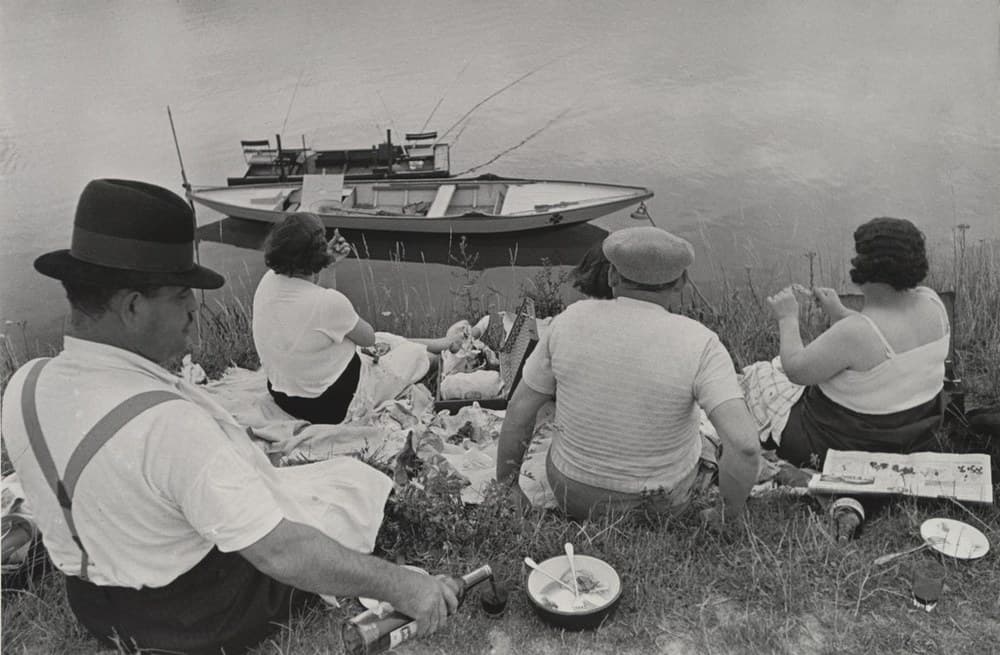
Sunday on the Banks of the Marne
Five people sit on a grass bank with their backs to the camera, eating, while a moored boat waits on flat water behind them. The Metropolitan Museum of Art catalogues the photograph as Sunday on the Banks of the Marne and dates it 1936–38. The Museum of Modern Art, which received its print from Henri Cartier-Bresson himself in 1947, catalogues the same picture as Juvisy, France, 1938 — and Juvisy-sur-Orge stands on the Seine.
- 1936–1938
- Gelatin silver print
- The Metropolitan Museum of ArtNew York, United States
About Henri Cartier-Bresson

What the photograph shows
Five people are seated on a grass bank that runs diagonally across the lower half of the frame. Every one of them has their back to the camera. The nearest, at the left, is turned just far enough to show an ear and the tip of a nose past his cheek, and even he is looking away from the water.
That man wears a dark fedora with a broad ribbon band and a white short-sleeved shirt, with pale braces crossing his back in a clear X. His right arm reaches down to the bottom edge of the frame, and his hand has a bottle by the neck. A printed carton lies in the grass beside it. Behind him a woman with short dark hair sits in a white short-sleeved top and a dark skirt, one hand raised in front of her.
At the centre a heavier man sits in a peaked flat cap and a pale ribbed short-sleeved shirt, one arm braced on the ground behind him. A dark-haired head shows just past his shoulder — a fifth person, almost entirely hidden by him. At the right a woman in a white sleeveless top and a dark skirt holds both hands up in front of her, working at something small. Her dark hair is set in deep, regular waves.
The ground between them is covered. A white cloth is spread out with food on it, and a woven basket stands at the left of the central man with its hinged lid propped open and paper-wrapped parcels inside. An open newspaper lies flat on the grass at the right. A dark enamel bowl with a utensil in it sits at the bottom centre, with a white plate and a fallen bottle beyond it. A shoe rests on the grass at the right edge, and a bottle lies on its side near the plate.
A picture with no horizon
The water occupies the entire upper half and runs clean off the top edge. There is no far bank, no skyline and no sky. Removing the horizon removes the usual way of reading depth, so the river reads as a flat pale field rather than as distance, and the picnic is pressed forward against it.
A single wooden boat is moored across the upper middle, lying almost exactly on the picture's horizontal centre line and pointing right. It is long, low and open, with a light-painted hull and a dark clutter of slatted frames and boxes amidships. A dark four-lobed motif is painted on the hull near the bow, and a mooring fitting hangs over the side. Two thin fishing rods angle up and out to the right, their lines drawn as fine scratches on the water, and a tall pole rises at the left.
The bank cuts the other way. It runs from the lower left corner up to the right, so the composition is a shallow X: the boat's long horizontal against the bank's diagonal, with the five backs strung along the join.
Nobody in the picture looks at the river, and nobody looks at the camera. The nearest man is reaching for a bottle instead. A photograph titled for a Sunday by the water contains no one enjoying the water.
Two titles, two rivers
The Metropolitan Museum of Art catalogues its print as Sunday on the Banks of the Marne, dates it 1936–38, describes the print as made in the 1950s, and gives the image as 24.5 by 37 centimetres. Its accession number is 2002.614.1, the gift of Grace and Andrew Schoelkopf in 2002. That is the title under which the photograph is known.
The Museum of Modern Art holds a print of the same photograph and does not use that title. Its record reads Juvisy, France, 1938, printed 1947, 23.3 by 34.8 centimetres, object number 286.1947. The museum's credit line is Gift of the artist, and it accessioned the print on 16 October 1947 — while Henri Cartier-Bresson was alive, working, and had just had his first solo exhibition there.
The two titles do not describe the same geography. Juvisy-sur-Orge lies about eighteen kilometres south of Paris on the Seine, at the confluence with the Orge. The Marne joins the Seine on the other side of the city, east of Paris, and the riverside guinguettes of the Marne at Joinville-le-Pont and Nogent are the setting the French title conjures. Both cannot be right.
The earlier and better-provenanced record is the Museum of Modern Art's. Its print came from the photographer nine years after the negative, at a moment when he was choosing what to send to New York, and it says Juvisy. The Marne title is the one the picture travels under, and the atlas keeps it as the title of record because it is the Metropolitan Museum of Art's own wording and the name readers search for.
How it was made
Henri Cartier-Bresson had been working a Leica for six years by 1938. Neither museum's record names the camera body, the lens or the film for this negative, and no model is claimed here.
The camera position is unusually low and very close. The foreground man's hat brim is only just below the top of the boat, which means the lens sat at roughly the height of a person seated on the same bank. Getting there without disturbing five people mid-meal is the whole technical content of the picture, and it is what the small camera existed to do.
Depth of field carries almost everything. The grass stems at the bottom edge, the braces on the man's back, the weave of the basket, the columns of the newspaper and the planking of the boat are all held. Only the far water goes soft, and it goes soft because there is nothing in it to resolve.
The newspaper is open and its columns of type are visible, but no headline is legible at the reproduction's resolution. Nor is any label on the bottles or the packet at the lower right. The frame carries printed matter and yields no words.
The 1947 print, and what it predates
The Museum of Modern Art's print is dated 1947 and was accessioned that October. That date matters for the printing history, because it falls before the laboratory that printed most of Henri Cartier-Bresson's later work existed.
Pierre Gassmann opened Pictorial Service in the 7th arrondissement of Paris in January 1950. The firm, later Picto, records that its earliest customers came from the young Magnum Photos agency. It names Henri Cartier-Bresson, Robert Capa and David Seymour among the photographers who lingered in the darkroom to talk their negatives through with the printers. A 1947 print of this negative therefore comes from before that arrangement, and the Metropolitan Museum of Art's print, made in the 1950s, comes from after it.
Both prints were made long after the exposure, which is normal for his work and worth stating plainly. A photograph of 1938 surviving in prints of 1947 and the 1950s is an object made twice.
Where it has been shown
The Museum of Modern Art identifies its print in installation photographs of five of its own exhibitions. The earliest is The Photographs of Henri Cartier Bresson, 4 February to 6 April 1947, the show whose catalogue Lincoln Kirstein wrote and the first book of his work in the Fondation Henri Cartier-Bresson's bibliography.
It reappears in Masterpieces from the Collection, which ran from March 1982 to March 1983. It shows up twice in Photography Collection: Rotation 3, from 15 March to 27 November 2006, and again in Henri Cartier-Bresson: The Modern Century, 11 April to 28 June 2010.
In 1952 Tériade published Images à la sauvette at Éditions Verve in Paris, with a cover drawn by Henri Matisse, and Simon and Schuster retitled the American edition The Decisive Moment. The English phrase has attached itself to this picture as firmly as to any of his, although nothing in the frame is decided at speed. Five people are eating slowly on a bank and the camera has simply arrived.
Close reading
Reading the work, detail by detail
Five backs, one boat, and no horizon. The close views count the people, read the meal laid out on the grass, and look at the water at the top of the frame, which has nothing in it whatever.
1.A hat, an ear, no face
The nearest man wears a dark fedora with a broad ribbon band. He is turned just far enough for his ear to be clear and the tip of his nose to show past his cheek. Even the one head that turns does not show a face.
2.Braces crossed in an X
Two pale braces cross between his shoulder blades in a clear X. The shirt is white and short-sleeved, creased across the back. The X is the largest single piece of drawing in the lower half of the picture, and it sits directly under the boat's long horizontal.
3.A bottle taken by the neck
His hand has a bottle by the neck, low in the grass at the bottom edge of the frame. A printed carton lies beside it and a dark bottle stands behind. The print on the carton does not resolve.
4.The second back
The woman behind him sits with her back fully turned, in a white short-sleeved top and a dark skirt, her hair short and dark. One hand is raised in front of her. The boat's hull passes directly behind her head.
5.What is actually on the boat
The boat is long, low and open, with a light-painted hull. Amidships it carries a clutter of dark slatted frames, boxes and a small upright. It is a working river boat rather than a pleasure cruiser, and nobody is aboard it.
6.Two rods and their lines
Two thin rods angle up and out to the right from the boat, and their lines are drawn across the water as fine scratches. They are the only diagonals in the upper half of the picture. The lines run right to the edge of the frame without meeting anything.
7.A four-lobed motif on the bow
A dark four-lobed motif is painted on the hull near the bow, and a mooring fitting hangs over the side beneath it. The prow is sharp and the boat sits low. This decoration is the only ornament anywhere in the photograph.
8.The flat cap at the centre
The man at the centre wears a pale peaked flat cap and a ribbed pale short-sleeved shirt, and he is braced back on one arm. He is the largest mass in the lower half of the picture. His back blocks the middle of the bank entirely.
9.The fifth person, almost hidden
A dark-haired head appears just past the flat-capped man's shoulder and nothing else of that person is visible. Counting the picnic depends on noticing it. Five people are on the bank, not four.
10.The basket with its lid propped open
A woven basket stands open on the grass, its hinged lid propped up, packed with parcels wrapped in white paper. A hand reaches across the cloth towards it. The weave of the basket is held sharp, which says how much depth of field this frame has.
11.Deep waves, and both hands busy
Her dark hair is set in deep, regular waves that catch the light along each ridge. She wears a white sleeveless top with a narrow strap. Both hands are up in front of her, working at something small, and her back is as fully turned as everyone else's.
12.A newspaper with no headline
The newspaper is open flat on the grass and its columns of type are plainly visible. Not one word of it resolves. The frame carries printed matter in three places and yields no legible text anywhere.
13.A bowl with a spoon and a fork
A pale bowl with a dark rim sits in the grass at the bottom centre with a spoon and a fork standing in it. A hand and a bottle come in from the left, and a dark glass stands beside them. This is the point of the whole picture, laid out at the reader's feet.
14.The top of the frame is water
The upper edge of the photograph is water and nothing else. There is no far bank, no skyline and no sky. Without a horizon the river stops reading as distance and becomes a flat pale field, which pushes the whole picnic forward against it.
Timeline
1936–38
Made on a French riverbank. The Metropolitan Museum of Art dates the negative to this range; the Museum of Modern Art dates it 1938.
1947
The Museum of Modern Art's print is made and accessioned on 16 October as 286.1947, gift of the artist, under the title Juvisy, France.
1947
Identified by the Museum of Modern Art in installation views of The Photographs of Henri Cartier Bresson, 4 February to 6 April.
1950
Pierre Gassmann opens Pictorial Service in Paris in January; the Metropolitan Museum of Art's print, made in the 1950s, falls after this.
1982–83
Identified in installation views of Masterpieces from the Collection at the Museum of Modern Art, 2 March 1982 to 1 March 1983.
2002
The Metropolitan Museum of Art receives its print as 2002.614.1, the gift of Grace and Andrew Schoelkopf, under the title Sunday on the Banks of the Marne.
2006
Identified twice in installation views of Photography Collection: Rotation 3 at the Museum of Modern Art, 15 March to 27 November.
2010
Identified in installation views of Henri Cartier-Bresson: The Modern Century, 11 April to 28 June.
Where to see it
The Metropolitan Museum of Art
1000 Fifth Avenue, New York, NY 10028, United States
The Museum of Modern Art holds a second print of the same photograph, made in 1947 and given by the artist, catalogued as Juvisy, France under object number 286.1947. The reproduction shown here is that print.
Plan your visit on the museum’s official website (opens in a new tab)Frequently asked questions
What is Sunday on the Banks of the Marne?
A photograph by Henri Cartier-Bresson of five people picnicking on a grass riverbank with a moored boat behind them, made in the late 1930s. The Metropolitan Museum of Art holds a 1950s print as 2002.614.1 under that title, dated 1936–38, with the image measuring 24.5 by 37 centimetres.
Was Sunday on the Banks of the Marne taken on the Marne?
Probably not. The Museum of Modern Art, which received its print directly from Henri Cartier-Bresson in 1947, catalogues the same photograph as Juvisy, France, 1938. Juvisy-sur-Orge lies about eighteen kilometres south of Paris on the Seine, while the Marne joins the Seine on the eastern side of the city. The famous title and the artist's own museum record point at two different rivers.
Which museums hold this photograph?
The Metropolitan Museum of Art holds a 1950s print as 2002.614.1, the gift of Grace and Andrew Schoelkopf in 2002. The Museum of Modern Art holds a 1947 print as 286.1947, the gift of the artist. The J. Paul Getty Museum holds 110 Henri Cartier-Bresson objects and none of them is this picture.
How many people are in Sunday on the Banks of the Marne?
Five. Nearest the camera is a man in a dark fedora with pale braces crossed in an X, with a woman in a white top behind him. A man in a pale flat cap sits at the centre, and a fifth person's dark-haired head shows past his shoulder. A woman in a white sleeveless top sits at the right. All five have their backs to the camera, and the nearest is turned only far enough to show an ear and the tip of his nose.
Why is there no horizon in the photograph?
Because the water runs off the top edge of the frame. There is no far bank and no sky, so the river reads as a flat pale field rather than as receding distance, and the picnic is pressed forward against it. The moored boat sits almost exactly on the picture's horizontal centre line, crossing the diagonal of the bank.
When was the print made?
Both known prints were made long after the negative. The Museum of Modern Art's dates from 1947, nine years on, and predates Pierre Gassmann's Pictorial Service laboratory, which opened in Paris in January 1950. The Metropolitan Museum of Art's print is dated to the 1950s and falls after it.
Is the title The Decisive Moment connected to this picture?
Only through the book. Henri Cartier-Bresson's 1952 volume was published in Paris by Tériade at Éditions Verve as Images à la sauvette, with a cover by Henri Matisse, and Simon and Schuster retitled the American edition The Decisive Moment. The English phrase was the American publisher's, not the photographer's, and nothing in this frame happens quickly.
More by Henri Cartier-Bresson
References
The sources below include collection records, catalogues, scholarly research, and primary materials that informed this page. They document Sunday on the Banks of the Marne, its making, and its place in cultural history.

1Henri Cartier-Bresson, Sunday on the Banks of the Marne, 1936-38
WebsiteThe Metropolitan Museum of Art, New YorkUsed forWeb source consulted for documented facts and historical context presented on the Sunday on the Banks of the Marne page.
2Henri Cartier-Bresson, Juvisy, France, 1938
WebsiteThe Museum of Modern Art, New YorkUsed forWeb source consulted for documented facts and historical context presented on the Sunday on the Banks of the Marne page.

3The Museum of Modern Art collection dataset (Artworks.csv)
ArchiveThe Museum of Modern Art, New YorkUsed forThe Museum of Modern Art's own published record of the Juvisy print.
4Bibliographie: the books by and about Henri Cartier-Bresson
WebsiteFondation Henri Cartier-Bresson, ParisUsed forThe 1947 Lincoln Kirstein catalogue and Images à la sauvette, 1952.
5Historique: the chronology of Pictorial Service, founded January 1950
WebsitePicto, ParisUsed forPictorial Service opens January 1950, after the 1947 print and before the 1950s print.
6Museum Collection search: Henri Cartier-Bresson
WebsiteThe J. Paul Getty Museum, Los AngelesUsed forChecked and holds no print of this photograph.
These references provide the documented foundation for this work's history and interpretation. Claim-level citations remain attached to the specific claims they support.
 Explore more resources