Behind the Gare St. Lazare
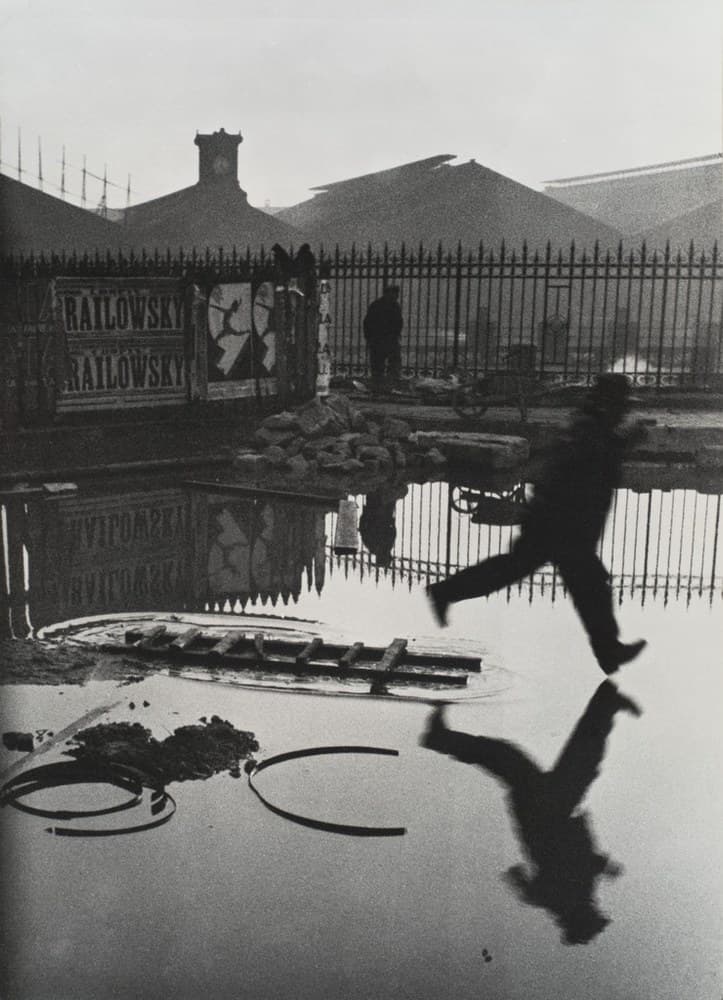
A man in a dark suit and hat leaps across a flooded yard, his heel a few centimetres above the water, and his reflection leaps with him. Henri Cartier-Bresson made the photograph in Paris in 1932, the year he bought his first Leica. The Museum of Modern Art catalogues it as Behind the Gare St. Lazare and holds a print made in the 1950s.
- 1932
- Gelatin silver print, printed 1950s
- The Museum of Modern ArtNew York, United States
About Henri Cartier-Bresson
What the photograph shows
A flooded yard fills the lower half of the frame, its surface unbroken enough to work as a mirror. A man crosses it from right to left in mid-stride. His forward foot is down but not landed, his rear leg trails behind him, and his arms are out. He wears a dark suit, dark shoes and a hat, and his face is turned away.
The water carries his double. The reflection is inverted below him, legs meeting legs, and it is very slightly softer than he is. A ladder lies half-submerged in the water ahead of him, its rungs breaking the surface, ringed by an oval of ripple. Two metal hoops rest on the wet ground at the lower left, one near-complete circle and one broken arc, with a straight dark bar below them.
A tall iron railing runs the full width of the picture at the midpoint, its uprights finished in spearheads, its lower rail banded with a row of forged rings. One man stands behind it in a dark coat, facing away, and a two-wheeled handcart sits beside him. Broken stone and a long timber are heaped in front of the railing.
Above the railing are the roofs of the Gare Saint-Lazare: three broad triangles of train shed, a ridge ventilator running along one of them, and a square clock tower with a pyramidal cap and a round dial. A lattice mast rises at the far left. The sky is a flat pale grey with no detail in it at all.
The lettering on the hoarding
A billboard stands against the railing at the left, and it is legible. The name RAILOWSKY is printed on it twice in heavy condensed capitals, once above the other, each line under a smaller line of type too small to read. The frame cuts the first letter of both lines.
The poster immediately to the right carries a figure rather than a word. A dark silhouette leaps with one leg thrown forward and both arms out, and the sheet has been torn in two down the middle, so the leap is split. A narrow strip of older poster survives on the post between the two, showing stacked capital As.
The water repeats all of it. RAILOWSKY reads backwards in the reflection, the torn leaper leaps again upside down, and the spearheads of the railing point down instead of up. Two leaping figures therefore stand in the frame before the man enters it, one printed and one reflected.
How it was made
Henri Cartier-Bresson bought his first Leica in Paris in 1932, the year of the photograph, and the Fondation Henri Cartier-Bresson dates the purchase to that year in its chronology. The Leica was a 35mm rangefinder small enough to work in one hand and quick enough to use unnoticed. Neither the Museum of Modern Art's record nor the Foundation's chronology states which Leica body, which lens or which film stock produced this particular negative, and none is asserted here.
The exposure is legible in the print itself. The standing man behind the railing, the cart, the posters and the roofs are all sharp, while the leaping man's legs and arms are smeared and his hat is doubled. A shutter fast enough to hold the static parts of the yard was not fast enough to hold him, which is why he reads as motion and everything else reads as fact.
The left edge truncates the hoarding mid-letter, and the bottom edge cuts the reflection off before it finishes. The account that Henri Cartier-Bresson made the exposure through a gap in a boarded fence, and that the gap rather than a decision set the left edge, is repeated everywhere and is attributed to him. It appears in neither the Museum of Modern Art's object record nor the Foundation's published chronology, and it is reported here as an attributed account rather than a documented one.
The print is also evidence against the habit the photographer is best known for. He is routinely described as printing the whole negative with its black rebate showing, as proof that nothing was cut. The Museum of Modern Art's print carries no black border on any side.
Who made the print
The Museum of Modern Art dates its print to the 1950s, two decades after the negative. Henri Cartier-Bresson did not do his own darkroom work for most of his career, and the laboratory that did it is documented. Pierre Gassmann opened Pictorial Service in the 7th arrondissement of Paris in January 1950, with his wife France Gassmann on retouching and six enlarger stations around a single long row of tanks.
Picto, as the firm became, records that its first customers were friends and members of the young Magnum Photos agency. It names Henri Cartier-Bresson, Robert Capa, David Seymour, William Klein, Willy Ronis, Robert Doisneau and Édouard Boubat among the photographers who got into the habit of lingering in the laboratory. They stayed to argue with the printers about how best to work a negative. A print dated to the 1950s is therefore a print from the first years of that arrangement.
One picture, several titles
The Museum of Modern Art prints the title as Behind the Gare St. Lazare, abbreviating the saint. The photograph also circulates as Behind the Gare Saint-Lazare, as Derrière la gare Saint-Lazare, and as Place de l'Europe, Gare Saint-Lazare. The last of those is not a second photograph. The place de l'Europe is the square built over the throat of the station's tracks, and the yard in the picture lies behind the station beside it.
The Museum of Modern Art's collection holds no work by Henri Cartier-Bresson titled Place de l'Europe. The J. Paul Getty Museum, which holds 110 of his objects, holds none of that title either; its single Paris 1932 print, 84.XM.233.1, is described in its own record as two dogs on a pavement.
Publication and afterlife
The photograph reached a New York audience early. The Museum of Modern Art identifies the print in installation photographs of The Photographs of Henri Cartier Bresson, which ran from 4 February to 6 April 1947, the exhibition whose catalogue Lincoln Kirstein wrote. The Foundation's bibliography lists that catalogue as the first book of his work.
In 1952 the Paris publisher Tériade brought out Images à la sauvette at Éditions Verve, with text and photographs by Henri Cartier-Bresson and a cover drawn by Henri Matisse. Simon and Schuster retitled the American edition The Decisive Moment, and the English title became the name of the working method. The French title means something closer to pictures snatched on the run, the way an unlicensed hawker sells goods on a street corner.
The Museum of Modern Art has gone on identifying the print in its own installation views since. It appears in The Photographer's Eye in the summer of 1964 and in Henri Cartier-Bresson: The Early Work in the autumn of 1987. It appears again in Photography Collection: Rotation 4 from December 2006 to July 2007, and in Henri Cartier-Bresson: The Modern Century from April to June 2010.
Close reading
Reading the work, detail by detail
The frame divides on the waterline. Above it are the station roofs, a railing and a hoarding; below it the same things again, upside down, with a leaping man crossing the join. The close views take the two halves apart and read the lettering, which is legible.
1.RAILOWSKY, printed twice
The name RAILOWSKY is printed twice on the hoarding, one line above the other, in heavy condensed capitals. Each line sits under a smaller line of type too fine to read. The left edge of the photograph cuts the first letter of both lines.
2.A torn poster of a leaping figure
The poster beside the lettering carries a leap of its own. A dark silhouette is thrown forward with one leg out and both arms raised, on a pale ground. The sheet has been torn straight down the middle, so the figure is split between two halves that no longer line up.
3.Torn paper and a column of capitals
A mass of torn dark paper hangs on the hoarding with two ragged peaks and a pale strip curving across it. It is paper, not a person. Beside it a narrow column of older poster survives on the post, reduced to three stacked fragments in which a capital A is legible each time.
4.The clock tower over the sheds
A square tower rises behind the sheds with a stepped, crocketed cap and a round clock dial set into its face. The dial reads as a pale disc; no hands can be made out. Everything above the railing is silhouette against a sky with no tone in it at all.
5.A lattice mast and three shed roofs
A lattice mast with regularly spaced cross-arms stands at the far left, above the roofs. The sheds behind the railing make three broad triangles, and a pale strip of glazing or ventilator runs along one ridge. The word RAILOWSKY appears at the bottom of this corner of the frame.
6.One man behind the railing
One man stands behind the railing in a dark coat and hat, turned away. He is the only other person in the photograph. A wheeled cart stands beside him on the far side of the bars, and a band of forged rings runs along the railing's lower rail.
7.Spearheads and bosses
The railing is made of closely spaced uprights finished in spearheads, with a row of small oval bosses under the points. It crosses the entire width of the photograph at the midpoint. Where it meets the water it is repeated exactly, pointing downwards.
8.The heap of broken stone
Broken stone is heaped against the base of the railing, with a long timber lying across it. This is a works yard rather than a street, and the flood is standing on ground that has been dug up. The reflection of the torn poster begins immediately below the rubble.
9.The hat that doubled
His head, hat and arms are smeared into a double outline by the exposure. The railing directly behind him is sharp, upright by upright. The same shutter held one and lost the other, which is the plainest possible demonstration of how fast he was moving.
10.The heel above the water
The forward foot is down but has not landed. A clear gap of water separates the heel from the surface, and the rear leg is still trailing. The ripple ring in the water beneath him was made by something else, because he has not broken the surface yet.
11.The leap, upside down
The reflection is a complete second figure, inverted, legs meeting legs at the waterline. It is very slightly softer than he is, because the water is not perfectly still. Two men leap in the photograph and only one of them exists.
12.A ladder inside a ring of ripple
A wooden ladder lies flat in the water with its rungs breaking the surface, ringed by an oval of ripple. Above it the mirrored lettering of the hoarding runs across the water. The ripple is the only evidence in the picture that anything has recently moved.
13.Two metal hoops on wet ground
Two dark metal bands lie on the wet ground at the lower left. The left one is a near-complete circle with a second, thinner arc nested inside it; the right one is a broken arc. A clump of dark debris sits between them and a straight bar lies below.
14.RAILOWSKY, read backwards
The hoarding reappears in the water with its lettering reversed. RAILOWSKY reads backwards, twice over, as clearly as it reads the right way up above. The water is doing the same work as the railing and the posters: repeating a thing so the eye has to look twice.
Timeline
1932
Made in Paris, the year Henri Cartier-Bresson bought his first Leica.
1947
Identified by the Museum of Modern Art in installation views of The Photographs of Henri Cartier Bresson, 4 February to 6 April, with a catalogue text by Lincoln Kirstein.
1950
Pierre Gassmann opens Pictorial Service in Paris in January; Henri Cartier-Bresson is among its first customers, and the Museum of Modern Art's print dates from this decade.
1952
Images à la sauvette published by Tériade at Éditions Verve, with a cover by Henri Matisse; the American edition is retitled The Decisive Moment.
1964
Identified in installation views of The Photographer's Eye, 27 May to 23 August.
1987
Identified in installation views of Henri Cartier-Bresson: The Early Work, 10 September to 29 November.
2005
Acquired by the Museum of Modern Art as 249.2005, gift of the artist, by exchange.
2010
Identified in installation views of Henri Cartier-Bresson: The Modern Century, 11 April to 28 June.
Where to see it
The Museum of Modern Art
11 West 53 Street, New York, NY 10019, United States
The Museum of Modern Art lists the print as not on view. It has identified the object in installation views of five of its own exhibitions between 1947 and 2010.
Plan your visit on the museum’s official website (opens in a new tab)Frequently asked questions
What is Behind the Gare Saint-Lazare?
A photograph Henri Cartier-Bresson made in Paris in 1932, showing a man leaping across a flooded yard behind the Gare Saint-Lazare with his reflection leaping under him. The Museum of Modern Art titles it Behind the Gare St. Lazare and holds a 1950s print as object number 249.2005, measuring 35.2 by 24.1 centimetres.
Is Place de l'Europe, Gare Saint-Lazare a different photograph?
No. It is the same picture under another title. The place de l'Europe is the square over the station's tracks, and the flooded yard lies behind the station beside it. The Museum of Modern Art holds no separate work by Henri Cartier-Bresson under that title, and neither does the J. Paul Getty Museum.
What does the poster in Behind the Gare Saint-Lazare say?
RAILOWSKY, printed twice in heavy condensed capitals on a hoarding at the left, each line cut by the frame edge and each under a smaller line of type too small to read. The poster beside it shows a torn silhouette of a leaping figure. Both are repeated backwards in the water.
Did Henri Cartier-Bresson crop Behind the Gare Saint-Lazare?
The Museum of Modern Art's print carries no black negative border on any side, so nothing in the object itself demonstrates an uncropped full frame. The photographer is widely reported to have said that he shot through a gap in a boarded fence and that the gap cut the picture at the left. That account appears in neither the museum's record nor the Fondation Henri Cartier-Bresson's chronology.
What camera was used for Behind the Gare Saint-Lazare?
A Leica, almost certainly the one he bought in Paris in 1932, the year of the negative. Neither the Museum of Modern Art nor the Fondation Henri Cartier-Bresson records which body, which lens or which film produced this frame, so no model is claimed. The blur on the leaping man and the sharpness of everything behind him show the shutter speed's effect directly.
Who printed Behind the Gare Saint-Lazare?
The Museum of Modern Art's print is dated to the 1950s and Henri Cartier-Bresson did not print his own negatives. Pierre Gassmann's Pictorial Service, which opened in Paris in January 1950 and became Picto, printed for Magnum Photos from the start, and its own history names Henri Cartier-Bresson among the photographers who worked with its printers.
Where can you see Behind the Gare Saint-Lazare?
The Museum of Modern Art in New York owns the print discussed here, 249.2005, and lists it as not on view. Prints of the photograph are held in several collections. The Fondation Henri Cartier-Bresson names four holders of the 385-print Master Collection he chose in 1979. They are the Bibliothèque nationale de France, the Menil Collection in Houston, the University of Fine Arts in Osaka, and the Victoria and Albert Museum in London.
More by Henri Cartier-Bresson
References
The sources below include collection records, catalogues, scholarly research, and primary materials that informed this page. They document Behind the Gare St. Lazare, its making, and its place in cultural history.

1Henri Cartier-Bresson, Behind the Gare St. Lazare, 1932
WebsiteThe Museum of Modern Art, New YorkUsed forWeb source consulted for documented facts and historical context presented on the Behind the Gare St. Lazare page.

2The Museum of Modern Art collection dataset (Artworks.csv)
ArchiveThe Museum of Modern Art, New YorkUsed forThe museum's own published record of title, date, medium, dimensions, credit line and object number.
3Henri Cartier-Bresson (1908–2004): Biography, Bibliography, Exhibitions, Filmography and Collections
WebsiteFondation Henri Cartier-Bresson, ParisUsed forThe 1932 Leica purchase.
4Collections: the Master Collection and the museums holding Henri Cartier-Bresson's work
WebsiteFondation Henri Cartier-Bresson, ParisUsed forThe four institutions holding the 385-print Master Collection chosen in 1979.
5Bibliographie: the books by and about Henri Cartier-Bresson
WebsiteFondation Henri Cartier-Bresson, ParisUsed forImages à la sauvette, Tériade, Éditions Verve, 1952, cover by Henri Matisse.
6Historique: the chronology of Pictorial Service, founded January 1950
WebsitePicto, ParisUsed forPierre Gassmann opens Pictorial Service in January 1950; Henri Cartier-Bresson among its first photographers.
7Museum Collection search: Henri Cartier-Bresson
WebsiteThe J. Paul Getty Museum, Los AngelesUsed forChecked for a Place de l'Europe print; the Getty's 110 objects include none.
These references provide the documented foundation for this work's history and interpretation. Claim-level citations remain attached to the specific claims they support.
 Explore more resources