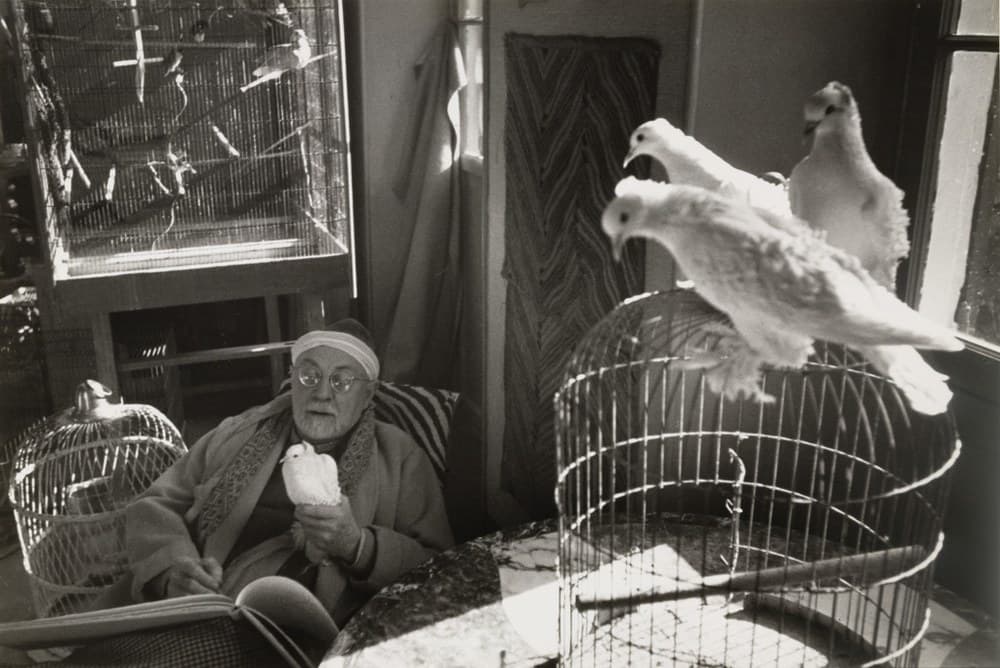
Henri Matisse sits among his birdcages in a heavy robe and a white knitted cap, a white dove cupped in one hand, an open album across his lap. Three more doves stand loose on a cage beside him. Henri Cartier-Bresson made the photograph at Vence in 1944, in the last year of the German occupation of France, and the Museum of Modern Art holds a print made in 1968.
Henri Matisse sits left of centre, facing a little to his right. He wears round wire-rimmed spectacles that catch the light, a white knitted cap pushed back on his head, and a heavy pale robe with a broad band of geometric embroidery running down the shawl collar. His beard and moustache are white. His mouth is slightly open.
A small white dove is cupped in his right hand at chest height. Its dark eye and short beak are clear, and a ruff of feathering covers its feet where they hang over his fingers. His left hand rests flat on an open album across his lap, fingers together. No pencil, brush or drawing implement is visible anywhere in the frame.
A cushion in bold black and white stripes is wedged behind his shoulder. A white wire cage with a domed top stands at the far left, and a white bird is perched on its dome rather than inside it. Above and behind him a large rectangular mesh aviary sits on a dark wooden stand. Three birds can be picked out on its crossing wooden perches, and a small feeder is fixed near its top corner.
The right half of the picture belongs to a second cage and three more doves. The cage is tall and cylindrical with a domed wire top and stands on a veined stone tabletop. It is empty apart from a wooden stick lying across its floor. All three doves are outside it. One stands upright on the dome with its head raised and turned left, one is beside it with its beak open, and a third is lower and larger with its wings partly spread. All three have heavily feathered legs and ruffed flanks. A window with a painted timber frame closes the right edge.
How the frame is built
The picture is a horizontal divided almost exactly down the middle. The left half is the man: dark, dense, full of cloth and wicker and shadow, with his face the only bright point. The right half is the birds: high-key, open, nearly white, against a pale wall.
The two halves are tied by one small thing. The dove in his hand is the same white as the doves on the cage, and it sits at the same height as the lowest of them. The eye crosses the frame along that line and back again.
Cage geometry organises everything else. Vertical wires run down the right-hand cage, vertical wires run down the aviary behind him, and the striped cushion behind his shoulder repeats the stripe a third time. A tall dark panel with a bold chevron grain stands between them at the centre, striping the frame a fourth time. Henri Matisse's head is the only large curved form in a picture otherwise built of parallel lines.
The birds outside the cages and the cages standing open is the photograph's single structural joke, and it is a fact of the frame rather than an interpretation of it. The tall cylindrical cage on the stone table holds nothing but a stick, and the bird belonging to the domed cage at the left is sitting on its roof.
Vence, 1944
The date is the hard part of the picture. The Museum of Modern Art gives 1944, and in 1944 France was still under German occupation and Henri Cartier-Bresson had been free for barely a year. He was taken prisoner by the German army on 23 June 1940, spent nearly three years in captivity, and escaped on his third attempt in February 1943.
Back in occupied France he worked for the MNPGD, the clandestine organization helping prisoners of war and escaped prisoners, and photographed a series of portraits of French artists and writers for the publisher Éditions Braun. The Fondation Henri Cartier-Bresson's chronology names Henri Matisse, Pablo Picasso, Georges Braque, Pierre Bonnard, Paul Claudel and Georges Rouault among the sitters. The Museum of Modern Art holds his Georges Braque of 1944 and two portraits of Georges Rouault of the same year.
Henri Matisse was then in his mid-seventies and living in the south, away from Paris. The photograph shows no studio, no canvas and no work in progress. It shows an elderly man in a dressing gown with an album on his knees and a house full of birds.
The other Vence photograph, and the Met's third
The Museum of Modern Art holds a second print under exactly the same title. Object 293.1947, Henri Matisse, Vence, France, 1944, printed 1947, is a different photograph. It is a vertical measuring 48.2 by 30.7 centimetres, and it shows Henri Matisse from behind at an easel, working on an outline drawing of a seated nude. A young woman in a fur stole and a long skirt sits smiling at the left, under a large figured tapestry.
The Metropolitan Museum of Art holds a third picture from the same encounter. Its record reads [Henri Matisse and Model in Chair, Vence], 1944, gelatin silver print, 10.3 by 14.8 centimetres, object number 1989.1068 — the square brackets marking a title the museum supplied rather than one the artist gave.
Two museums, three photographs, one afternoon. The title Henri Matisse, Vence, France identifies a sitting rather than a single frame, which is why the object numbers matter more than the words.
The cover Henri Matisse drew
The two men's connection did not end with the sitting. In 1952 the Paris publisher Tériade brought out Henri Cartier-Bresson's first book, Images à la sauvette, at Éditions Verve, with text and photographs by the photographer and a cover drawn by Henri Matisse. The Fondation Henri Cartier-Bresson's bibliography records the credit in exactly those terms.
Simon and Schuster retitled the American edition The Decisive Moment, and that English phrase, invented in a New York publishing office, has been attached to Henri Cartier-Bresson ever since. The French title means something nearer to pictures taken on the sly.
Three years later Joan Miró drew the cover of his second book, Les Européens, again for Éditions Verve. Both books were made by painters and a photographer who had trained as a painter under André Lhote before a camera changed the plan.
The print and who made it
The Museum of Modern Art's print dates from 1968, twenty-four years after the negative, and measures 25.9 by 38.6 centimetres. It was a gift of the artist and was accessioned on 9 February 2009. The museum identifies the object in installation views of Henri Cartier-Bresson: The Modern Century, 11 April to 28 June 2010.
Henri Cartier-Bresson did not print his own negatives. Pierre Gassmann opened Pictorial Service in the 7th arrondissement of Paris in January 1950, with his wife France Gassmann on retouching and six enlarger stations around a single long row of tanks. The firm, later Picto, names Henri Cartier-Bresson, Robert Capa, David Seymour, William Klein, Willy Ronis, Robert Doisneau and Édouard Boubat among the photographers who got into the habit of working through their negatives with its printers.
Neither museum records the camera body, the lens or the film behind this frame, and none is claimed here. What the print shows is that the exposure held both halves of a very difficult subject at once. One half is a dark interior with a man in it; the other is three white birds against a lit wall. Detail survives in the doves' feathers and in the shadowed weave of his robe.
Close reading
Reading the work, detail by detail
A dark half and a light half, joined by one small white bird. The close views read the man on the left, count the birds on the right, and establish that almost none of them is in a cage.
1.Spectacles, cap and beard
Round wire-rimmed spectacles sit low on his nose and both lenses catch the light. A white knitted cap is pushed back off his forehead. The beard and moustache are white and the mouth is slightly open. This is the only face in the photograph and it occupies very little of it.
2.The dove in his hand
The dove is cupped in his right hand at chest height, not gripped. Its dark eye and short pale beak are clear, and a ruff of feathering covers the feet where they hang over his fingers. The bird is entirely calm.
3.The band down the robe
A broad band of geometric embroidery runs down the shawl collar of the robe in repeating lozenge and stepped motifs. It is the densest pattern on the left-hand side of the picture. The robe itself is heavy, soft and creased across the chest.
4.An open album, and no pencil
A large album lies open across his lap with its pages curving under their own weight. His hand rests flat on it. No pencil, brush, charcoal or other implement appears anywhere in the frame, which makes this a photograph of a painter not working.
5.The striped cushion
A cushion in bold black and white stripes is wedged behind his shoulder. It is the third set of parallel lines in the picture, after the aviary's mesh and the cage's wires. Set against it, his head is the only large curved form in the frame.
6.Three birds in the mesh cage
The aviary behind him is a large rectangular cage of fine vertical wires with wooden perches crossing inside it, one pair meeting as a cross. Three birds can be picked out on the perches. A small feeder is fixed near the top corner, and the rest of the interior is too dark to read.
7.A bird on the roof of its cage
A white wire cage with a domed top stands at the far left, and a white bird is perched on the outside of the dome. It is sitting on its own roof. The pattern the whole photograph turns on is established here, in the corner, before the eye reaches the three doves.
8.Three doves, feathered to the feet
The three doves are white with heavily feathered legs and ruffed flanks, which makes them fancy pigeons rather than street birds. Their eyes read as small dark dots. Detail survives in the feathers even at the brightest part of the print.
9.The one with its head up
One dove stands fully upright with its head raised and turned to the left, beak dark at the tip. It is the highest point of the right-hand half. Nothing in the photograph is looking at anything else, this bird included.
10.The cage is empty
The tall cylindrical cage is empty. Its wires are evenly spaced and the interior is plainly visible through them. A dove's feathered underside hangs over the outside of the dome, which is the whole arrangement in one detail: the cage open, the bird on top of it.
11.A stick where a bird should be
A wooden stick lies diagonally across the floor of the cage, above a wire mesh tray. It is the only thing inside. Whatever the cage was for is not in it.
12.The window frame at the edge
A painted timber window frame with a glazing bar closes the right edge of the photograph. The light in the whole right half comes from it. The nearest dove stands directly against the frame, which is why its outline reads so cleanly.
13.A chevron grain down the middle
A tall dark panel with a bold chevron grain stands between the two halves of the room. It is the darkest vertical in the picture and it marks where the light half begins. Counting it, the frame carries four separate systems of stripes.
14.The veined stone tabletop
The cage stands on a veined stone tabletop whose dark marbling catches the light along the front edge. It gives the right-hand half a hard base, against the soft cloth and wicker on the left. The two halves of the photograph do not share a single material.
Henri Cartier-Bresson escapes German captivity in February on his third attempt and returns to occupied France.
1944
Photographs Henri Matisse at Vence, one of a series of portraits of French artists and writers made for Éditions Braun.
1947
The Museum of Modern Art's other Vence print, 293.1947, is made and given by the artist; the museum's first solo show of his work runs from February to April.
1952
Henri Matisse draws the cover of Images à la sauvette, published by Tériade at Éditions Verve; the American edition is retitled The Decisive Moment.
1955
Joan Miró draws the cover of Les Européens, the second Verve book.
1968
The print now at the Museum of Modern Art is made.
1989
The Metropolitan Museum of Art acquires a third photograph from the sitting, [Henri Matisse and Model in Chair, Vence], as 1989.1068.
2009
The 1968 print is accessioned by the Museum of Modern Art on 9 February as 121.2009.
2010
Identified in installation views of Henri Cartier-Bresson: The Modern Century, 11 April to 28 June.
Where to see it
The Museum of Modern Art
11 West 53 Street, New York, NY 10019, United States
The Museum of Modern Art lists the print as not on view, and holds a second, different photograph under the same title as 293.1947. The Metropolitan Museum of Art holds a third from the same sitting as 1989.1068.
What does Henri Cartier-Bresson's photograph of Henri Matisse show?
Henri Matisse seated among his birdcages at Vence in 1944, in a heavy embroidered robe and a white knitted cap, round spectacles on, a white dove cupped in his right hand and an open album across his lap. Three more doves stand loose on the domed wire cage beside him, a fourth is perched on the roof of a cage at the far left, and a mesh aviary with three birds in it sits behind his shoulder.
Are the birds in cages?
Mostly not. The tall cylindrical cage on the stone table at the right is empty apart from a wooden stick lying across its floor, and the three large doves are perched on and above its dome rather than inside it. A fourth white bird sits on the roof of the domed cage at the far left. Only the rectangular mesh aviary behind Henri Matisse holds birds, and the dove in his hand is loose in the room.
Is Henri Matisse drawing in the photograph?
No. His left hand rests flat on an open album on his lap and no pencil, brush or other implement is visible anywhere in the frame. A second Museum of Modern Art photograph under the same title, object 293.1947, does show him at an easel working on a drawing of a seated nude, but that is a different picture.
Why was Henri Cartier-Bresson photographing artists in 1944?
He had escaped German captivity in February 1943 on his third attempt and was working in occupied France with the MNPGD, the clandestine organization helping prisoners of war. In 1944 he made a series of portraits of French artists and writers for the publisher Éditions Braun. The Fondation Henri Cartier-Bresson names Henri Matisse, Pablo Picasso, Georges Braque, Pierre Bonnard, Paul Claudel and Georges Rouault among the sitters.
How many photographs of Henri Matisse at Vence exist in these collections?
Three, across two museums. The Museum of Modern Art holds the dove picture as 121.2009, printed 1968, and a vertical of Henri Matisse at his easel as 293.1947, printed 1947, both under the title Henri Matisse, Vence, France. The Metropolitan Museum of Art holds a third, catalogued as [Henri Matisse and Model in Chair, Vence], object 1989.1068.
Did Henri Matisse work with Henri Cartier-Bresson afterwards?
Yes. In 1952 Henri Matisse drew the cover of Images à la sauvette, the photographer's first book, published by Tériade at Éditions Verve in Paris. Simon and Schuster retitled the American edition The Decisive Moment. Joan Miró drew the cover of the next Verve book, Les Européens, in 1955.
Where is the print?
The Museum of Modern Art in New York holds the 1968 print as object number 121.2009, gift of the artist, and lists it as not on view. It measures 25.9 by 38.6 centimetres. The museum has identified the object in installation views of its 2010 exhibition Henri Cartier-Bresson: The Modern Century.
In the atlas
What the graph records about this work — every claim carries its citation.
The Museum of Modern Art names Henri Matisse in the title of the photograph. He sits among his birdcages at Vence in a heavy embroidered robe and a white knitted cap, a white dove cupped in one hand and an open album on his lap. Henri Cartier-Bresson made the picture in 1944 as part of a series of portraits of French artists and writers for the publisher Editions Braun. Eight years later Henri Matisse drew the cover of his first book, Images a la sauvette.
— Henri Cartier-Bresson, Henri Matisse, Vence, France, 1944 (print of 1968), 121.2009; Henri Cartier-Bresson, Henri Matisse, Vence, France, 1944 (print of 1947), 293.1947; Henri Cartier-Bresson (1908–2004): Biography, Bibliography, Exhibitions, Filmography and Collections
The sources below include collection records, catalogues, scholarly research, and primary materials that informed this page. They document Henri Matisse, Vence, France, its making, and its place in cultural history.
1Henri Cartier-Bresson, Henri Matisse, Vence, France, 1944 (print of 1968)
Website
The Museum of Modern Art, New York
Used for
Web source consulted for documented facts and historical context presented on the Henri Matisse, Vence, France page.
These references provide the documented foundation for this work's history and interpretation. Claim-level citations remain attached to the specific claims they support.


 View source