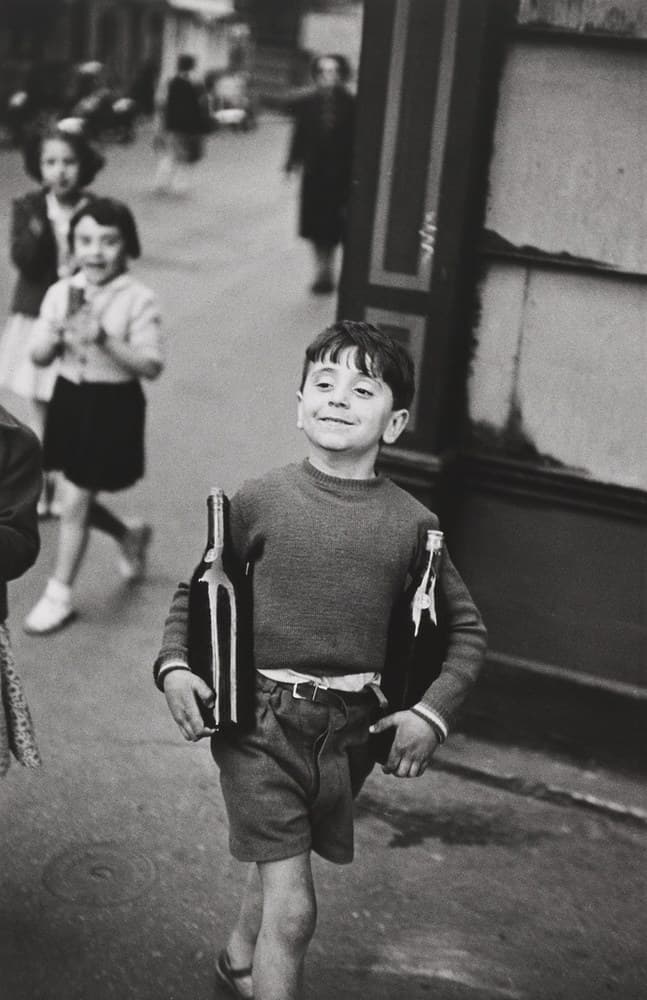
Rue Mouffetard, Paris
A boy walks towards the camera with a large bottle clamped under each arm, chin lifted, grinning. Two girls behind him are laughing, and neither of them is laughing at him. Henri Cartier-Bresson made the photograph in the rue Mouffetard in the 5th arrondissement of Paris in 1954, and the Museum of Modern Art holds a print made in 1968.
- 1954
- Gelatin silver print, printed 1968
- The Museum of Modern ArtNew York, United States
About Henri Cartier-Bresson

What the photograph shows
A boy of perhaps seven or eight walks straight down the middle of the frame towards the camera. He carries a tall dark bottle clamped under each arm, necks up, and the two arms are not doing the same job. His right hand is curled under the base of the bottle on that side, steadying it. His left hand hangs loose and half-closed at his side, and the bottle on that side is held by the arm alone.
He wears a dark ribbed crew-neck jumper with pale-striped cuffs, a pale shirt tucked in at the waist, dark pleated shorts and open sandals. A dark leather belt with a bright rectangular metal buckle crosses the shirt, and a thin cord hangs loose from the waistband down the front of the shorts.
His head is tipped back and slightly to one side and he is grinning with his mouth closed. He is the only sharp thing in the picture.
Two girls follow a few paces behind him on his right. The taller one has dark bobbed hair with a pale clip, a dark jacket and a pale collar, and her mouth is open in a laugh. The smaller one wears a pale cardigan over a dark skirt, white ankle socks and white shoes, and she is caught mid-step with her hands clasped together at her chest. A fourth person is cut by the left edge, leaving a sliver of a spotted garment and a dark coat.
Three more figures are visible up the street behind them, all out of focus. There is an adult walking away in a dark coat, a pale rounded shape that reads as a pram or a basket, and a woman near the right-hand building with one arm extended. Beyond them the street dissolves entirely.
How the frame is built
The picture is a vertical, and the right third of it is a wall. A dark-painted wooden shopfront pilaster runs from the top edge to about two-thirds of the way down, panelled with recessed rectangles and catching a hard vertical highlight along its edge. To its right is rendered wall in two courses, cracked and stained, with a dark run of water damage descending through both.
That wall does two things. It shuts the right side of the frame so the eye cannot leave that way, and it throws the boy forward by giving him a blank field to stand against. The left third is the opposite: open street, receding figures, no edge at all.
The road itself takes the bottom third, pale and empty, sloping up towards the top left. A round utility cover with a spiral pattern sits in it at the lower left. The boy's own shadow is short and beneath him, which puts the sun high.
There is not one legible word anywhere in the frame. For a photographer whose Paris pictures are usually thick with shop signs, posters and painted lettering, the blankness of that right-hand wall is the unusual fact, and it is what makes the boy's face carry the whole picture.
What is in the bottles
The photograph is known everywhere as the boy with two bottles of wine. Nothing in the frame says wine. The bottle under his right arm is dark glass, with a foil capsule and a small pale label at the shoulder. The one under his left has a capsule, a torn paper wrapping trailing down the side and a round pale seal. No text on either is legible at any magnification of the reproduction.
The Museum of Modern Art's record gives the title as Rue Mouffetard, Paris and says nothing about the contents. The shape and size of the bottles, and the errand they imply, are as far as the object itself goes.
The street supports the reading without proving it. The rue Mouffetard runs south from the place de la Contrescarpe in the 5th arrondissement and has held a food market for centuries. A child sent out for two bottles is an ordinary sight there rather than a staged one.
How it was made
Henri Cartier-Bresson worked a Leica from 1932 onwards, and by 1954 he had been carrying one for twenty-two years. The Museum of Modern Art's record names no body, no lens and no film for this negative, and the Fondation Henri Cartier-Bresson's chronology names none either, so none is claimed here.
What the print shows is a wide aperture and a short working distance. The boy is sharp from his hair to his sandals, the girls a few paces behind him are already soft, and everything past them is unreadable. That depth of field puts the camera close — close enough that the boy has seen it, which is why he is performing.
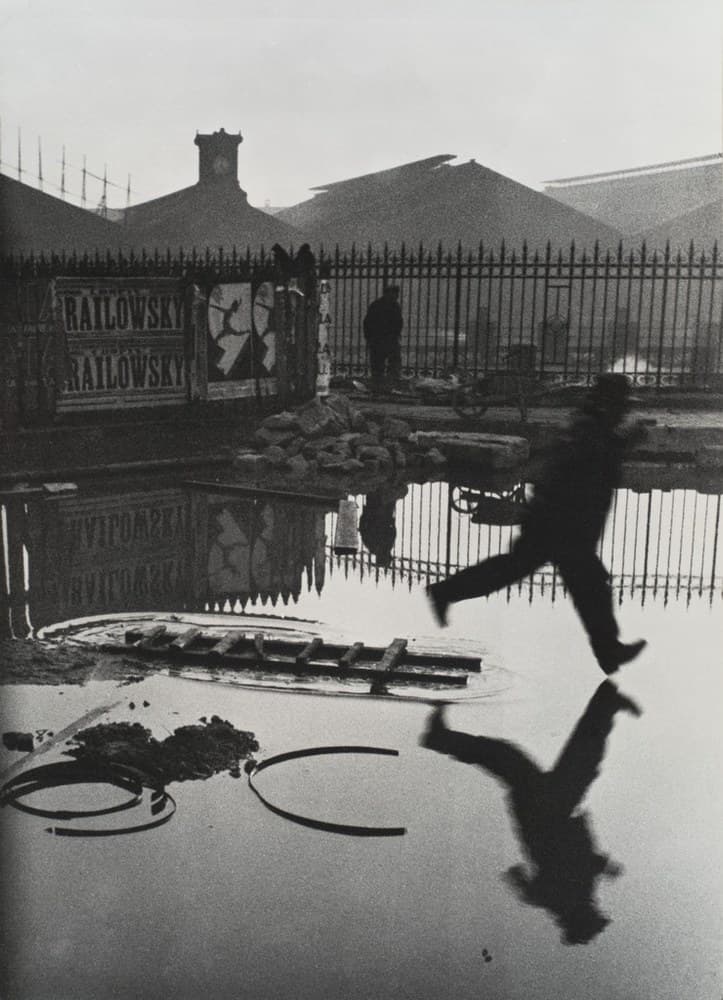
The negative also caught the two girls at the peak of a laugh, with the smaller one's leg still swinging. The exposure froze all three children cleanly. The blur in the picture is optical rather than motional, which is the reverse of the arrangement in the Gare Saint-Lazare photograph of 1932.
A 1968 print, and how big it is
The Museum of Modern Art's print measures 89.4 by 58.9 centimetres, which is about thirty-five inches by twenty-three. That is an exhibition print, not a reading print, and it is more than twice the size of the museum's print of Behind the Gare St. Lazare. A 35mm negative enlarged to that scale shows its grain, and the grain is part of what a viewer sees.
The print was made in 1968 and given to the museum by the photographer, who was then still working. It entered the collection in February 2009 as object number 144.2009.
Henri Cartier-Bresson did not print his own negatives. Pierre Gassmann opened Pictorial Service in the 7th arrondissement of Paris in January 1950 with six enlarger stations and his wife France Gassmann on retouching. The firm, later Picto, records that its first customers came from the young Magnum Photos agency and names Henri Cartier-Bresson among the photographers who argued with its printers over how to work a negative. A print of 1968 falls well inside that working relationship.
Close reading
Reading the work, detail by detail
One sharp child in a street that dissolves behind him. The close views follow the errand — two bottles, two arms doing different jobs — and then look at what is not in the frame, which is any lettering at all.
1.The grin, chin up
His chin is up and his head is tipped a little to one side. He is grinning with his mouth closed, which is a held expression rather than a caught one. He is the only sharply focused thing in the photograph, and he knows the camera is there.
2.The bottle he is holding up
The bottle on this side is tall and dark, with a foil capsule and a small pale seal at the neck, and a long vertical highlight running down the glass. His hand is curled underneath the base, taking the weight. No text on the label resolves.
3.The bottle with torn paper
The second bottle has torn white paper trailing from its capsule and a round pale seal below the neck. The seal carries printing, and none of it is legible at any magnification. The photograph is famous for two bottles of wine and never once says wine.
4.The hand that is working
The fingers are curled and cupped under the bottle's base, steadying it. A pale stripe runs round the cuff of his jumper at the wrist. This arm has a job to do and is doing it carefully.
5.The hand that is not
The other hand hangs loose and half-closed at his side, well clear of the bottle above it. That bottle is held by the arm alone, clamped against his ribs. The asymmetry is the whole performance: one side is careful, the other is casual.
6.The belt, the shirt and the cord
A pale shirt is tucked in at the waist under a dark leather belt with a bright rectangular buckle. The shorts are dark and pleated at the front. A thin cord hangs loose from the waistband down the front of the shorts.
7.Bare legs and open sandals
His legs are bare below the shorts and he is caught mid-stride, one foot forward. The sandals are open, with a strap across the toes. The road beneath him is pale, empty and slightly tilted, sloping up to the left.
8.Two girls, both laughing
The taller girl has dark bobbed hair with a pale clip, a dark jacket and a pale collar. The smaller one is in a pale cardigan, mouth open, laughing. Both are already soft; they stand only a few paces behind the boy, and the lens has let them go.
9.White socks in mid-step
The smaller girl's legs are bare below a dark skirt, and she wears white ankle socks with white shoes. One leg is swung forward in mid-step. A panel of spotted fabric belonging to a fourth person cuts in at the left edge.
10.A fourth person, mostly outside
A strip of leopard-spotted fabric and a white shoe are all that survive of a fourth person at the left edge. The frame has cut the rest away. Nothing about the composition tries to hide it.
11.The shopfront that shuts the frame
A dark-painted wooden pilaster, panelled with recessed rectangles, runs down the right side of the picture and catches a hard highlight along its edge. It closes that side of the frame completely. The eye cannot leave the photograph to the right.
12.Cracked render, and no words
The render is laid in two courses with a crack along the joint and a dark run of water damage descending through both. There is no sign here, no poster, no painted lettering. For a Paris photograph by Henri Cartier-Bresson that blankness is the unusual thing.
13.A woman with one arm out
Further up the street a woman in a dark coat has one arm extended down and away from her. She is beyond the depth of field and reads as shape and gesture only. Whatever she is doing is not connected to the boy in the foreground.
14.A spiral in the road
A round utility cover is set into the road at the lower left, cast with a spiral pattern. It is the only incident in an otherwise empty third of the picture. At the enlargement the museum's print is made to, the grain of the road is as visible as the spiral.
Timeline
1954
Made in the rue Mouffetard in the 5th arrondissement of Paris.
1955
First exhibition in France opens in October at the Pavillon de Marsan in the Palais du Louvre, a year after the negative.
1968
The print now at the Museum of Modern Art is made, fourteen years after the exposure.
2009
Accessioned by the Museum of Modern Art on 9 February as 144.2009, under the credit line Gift of the artist — five years after Henri Cartier-Bresson's death in 2004.
Where to see it
The Museum of Modern Art
11 West 53 Street, New York, NY 10019, United States
The Museum of Modern Art lists the print as not on view.
Plan your visit on the museum’s official website (opens in a new tab)Frequently asked questions
What is Rue Mouffetard, Paris by Henri Cartier-Bresson?
A photograph made in 1954 in the rue Mouffetard in the 5th arrondissement of Paris, showing a grinning boy walking towards the camera with a large bottle clamped under each arm and two laughing girls behind him. The Museum of Modern Art holds a print made in 1968, object number 144.2009, measuring 89.4 by 58.9 centimetres.
Is the boy in Rue Mouffetard carrying wine?
Nothing in the photograph proves it. Both bottles have foil capsules and paper labels, but no lettering is legible at any magnification, and the Museum of Modern Art's record says nothing about the contents. The rue Mouffetard has been a market street for centuries, so a child sent out for two bottles is ordinary there, and wine is a reasonable inference rather than a documented fact.
Are the girls laughing at the boy?
They are laughing, and they are looking towards the camera rather than at him. The taller girl's mouth is open and the smaller one is caught mid-stride with her leg swung forward. The boy's head is tipped back and he is grinning with his mouth shut, which reads as a child who knows he is being photographed.
Where is the rue Mouffetard?
In the 5th arrondissement of Paris, running south from the place de la Contrescarpe towards the église Saint-Médard. It is one of the oldest streets in the city and has carried a food market along it for centuries, which is the setting the photograph takes for granted.
How big is the Museum of Modern Art's print?
89.4 by 58.9 centimetres, roughly thirty-five inches by twenty-three. That is an exhibition-scale enlargement from a 35mm negative, and more than twice the size of the museum's print of Behind the Gare St. Lazare. At that magnification the film grain is visible as part of the image.
Is there any writing in the photograph?
No. The right third of the frame is a blank rendered wall beside a dark panelled shopfront pilaster, cracked and water-stained but carrying no sign, poster or painted lettering. That is unusual for Henri Cartier-Bresson's Paris pictures, which are normally full of legible signage, and it leaves the boy's face carrying the frame.
When was the print made, and who printed it?
The print was made in 1968, fourteen years after the negative. Henri Cartier-Bresson did not print his own work; from January 1950 Pierre Gassmann's Pictorial Service in Paris, later Picto, printed for Magnum Photos, and its own history names Henri Cartier-Bresson among the photographers it worked with from the start.
More by Henri Cartier-Bresson
References
The sources below include collection records, catalogues, scholarly research, and primary materials that informed this page. They document Rue Mouffetard, Paris, its making, and its place in cultural history.


1Henri Cartier-Bresson, Rue Mouffetard, Paris, 1954
WebsiteThe Museum of Modern Art, New YorkUsed forWeb source consulted for documented facts and historical context presented on the Rue Mouffetard, Paris page.

2The Museum of Modern Art collection dataset (Artworks.csv)
ArchiveThe Museum of Modern Art, New YorkUsed forThe museum's own published record of title, date, medium, dimensions, credit line and object number.
3Henri Cartier-Bresson (1908–2004): Biography, Bibliography, Exhibitions, Filmography and Collections
WebsiteFondation Henri Cartier-Bresson, ParisUsed forThe 1932 Leica purchase and the October 1955 Pavillon de Marsan exhibition.
4Historique: the chronology of Pictorial Service, founded January 1950
WebsitePicto, ParisUsed forPierre Gassmann's Pictorial Service, opened January 1950, printing for Henri Cartier-Bresson and Magnum Photos.
5Henri Cartier-Bresson, Behind the Gare St. Lazare, 1932
WebsiteThe Museum of Modern Art, New YorkUsed forCompared for print size.
These references provide the documented foundation for this work's history and interpretation. Claim-level citations remain attached to the specific claims they support.
 Explore more resources