The Little Mermaid
Den lille Havfrue. A sea princess trades her voice for legs to win a prince and an immortal soul. Pages 5 to 51 of the first edition.
Fairy Tales Told for Children: Third Booklet
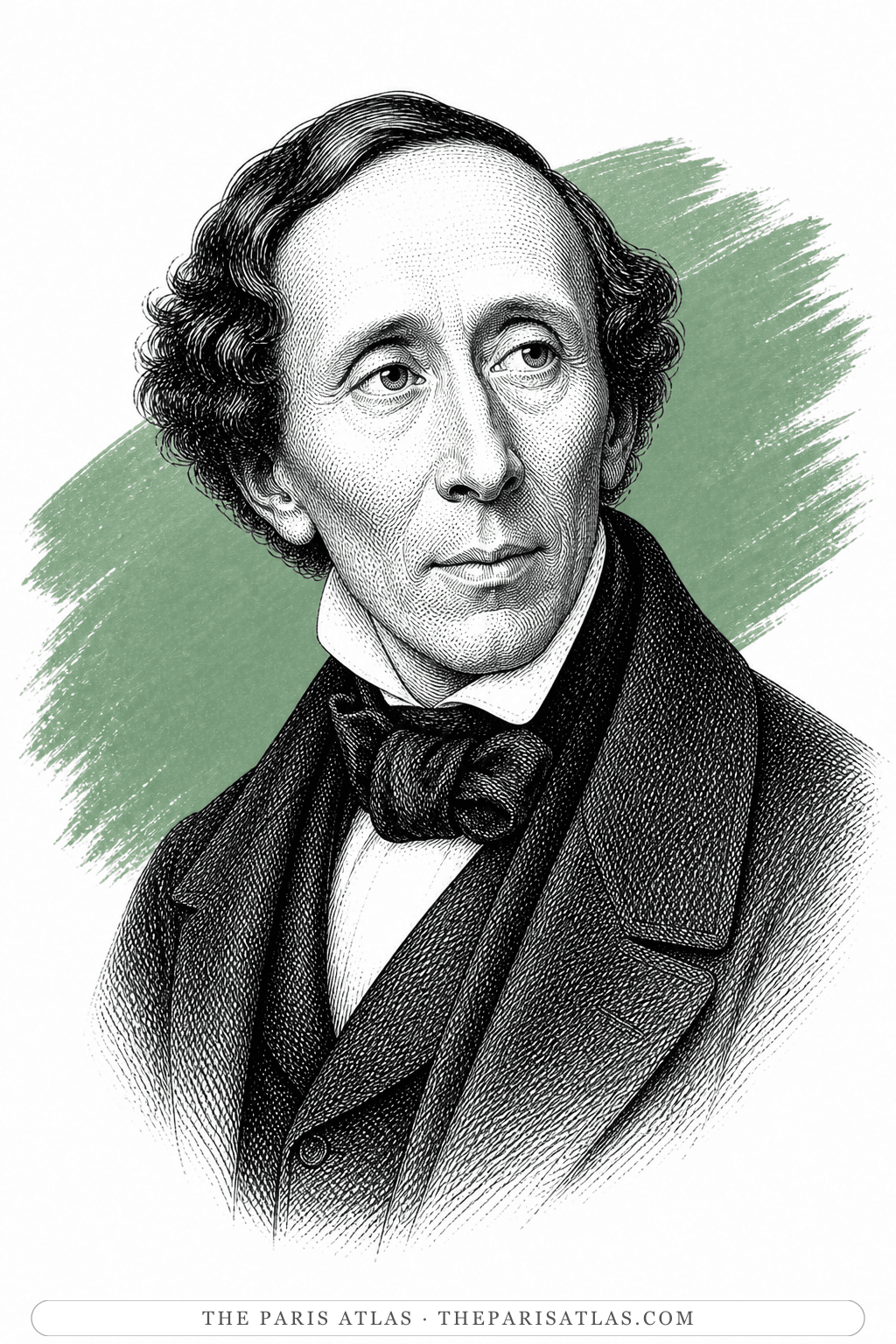
Hans Christian Andersen
Two tales in one thin booklet: a mermaid who trades her voice for legs, and an emperor who walks through town in clothes that are not there.
The third booklet of Hans Christian Andersen's Fairy Tales Told for Children came out in Copenhagen on 7 April 1837. The bookseller C. A. Reitzel published it at 24 skilling, and it ran to 60 pages. The booklet held only two tales, and both became world famous. The Little Mermaid fills most of the booklet: a sea king's youngest daughter gives up her voice to become human for the prince she loves. The Emperor's New Clothes starts on page 52: two swindlers sell a vain emperor cloth that does not exist.
Andersen was working on The Little Mermaid by early 1836. The earliest mention of it, in a letter from his friend Henriette Hanck in February, gives it another title, Daughters of the Air. The Andersen Centre notes that it drew partly on Undine, the 1811 tale of a water spirit by the German writer Friedrich de la Motte Fouqué.[1]
Andersen was proud that he had made the story up. In his autobiography he called The Little Mermaid the longest tale in the booklet and his own invention. He said it created a special interest in the tales, which the later booklets only increased.[2]
The Emperor's New Clothes was not his own idea. The plot comes from a Spanish story of 1335 by Don Juan Manuel, in his book of moral tales called Count Lucanor. Andersen knew it in a German translation. In the Spanish original, the cloth is invisible to any man who is not really his father's son.[3]
The Little Mermaid is the youngest of six sea princesses. Her grandmother tells her that mermaids live for three hundred years and then become foam on the sea. Human beings live shorter lives but have a soul that lives for ever. At fifteen the little mermaid rises to the surface, sees a prince on a ship, and saves him from drowning in a storm.[4]
She goes to the sea witch, whose house is built from the bones of shipwrecked sailors. The witch gives her a potion that will turn her tail into legs. The price is her voice, and every step she takes will feel like treading on sharp knives. If the prince marries someone else, her heart will break on the first morning after the wedding, and she will turn into foam.[4]
In The Emperor's New Clothes, an emperor cares about nothing but clothes. Two swindlers say they can weave a cloth that is invisible to anyone unfit for his office, or very dull. The emperor's ministers cannot see anything on the looms, and nor can the emperor. Nobody dares say so. The emperor walks through the town in his new clothes, under a canopy, while the whole crowd praises them.[4]
The prince loves the little mermaid like a child but marries a princess he believes saved him. On the wedding night her sisters bring her a knife from the sea witch. If she kills the prince, she can be a mermaid again. She throws the knife into the waves and turns to foam. She rises instead among the daughters of the air, who can earn an immortal soul in three hundred years of good deeds.
A little child in the crowd says the emperor has got nothing on. The whole town takes up the cry. The emperor knows it is true, but he holds himself stiffer than ever and finishes the procession. His chamberlains go on carrying a train that is not there.
Thirty years later, Andersen came back to The Little Mermaid in a tale set in Paris. The Andersen Centre traces several of his later tales back to The Little Mermaid, and names The Dryad of 1868 as one. The Dryad is his tale of the Paris world's fair of 1867. A tree spirit comes to the city with a chestnut tree and gives up her long life for a single night among the crowds.
Andersen was in Paris twice in 1867, in the spring and in September, and went to the fair on both stays. The fair was held on the Champ de Mars, the open ground by the Seine where the Eiffel Tower now stands. He wrote The Dryad the following year. Like the little mermaid, the tree spirit trades a long life for one short chance at something she longs for.
By 1847 The Little Mermaid was known in England. Lucie Duff Gordon had translated it for Bentley's, a London magazine. That summer Andersen met Charles Dickens at Lady Blessington's house in London. Andersen wrote that among his stories, Dickens mentioned The Little Mermaid.
At home, actors performed the tales aloud. Andersen singled out the comic actor Ludvig Phister, who in his words made a complete dramatic work out of telling The Emperor's New Clothes.
In Paris, David Soldi's French translation, Contes d'Andersen, came out with Hachette in 1856. The 1862 second edition has both tales. The Little Mermaid is La Petite sirène. The emperor became a grand duke, and the tale is called Les Habits neufs du Grand-Duc, The Grand Duke's New Clothes.
I would give all my three hundred years to be a human being for one day, and afterwards to have a share in the heavenly kingdom.
We may live here for three hundred years, but when we cease to exist, we become mere foam on the water and do not have so much as a grave among our dear ones.
It is as light as a spider's web. One might think one had nothing on, but that is the very beauty of it!
The tale as Andersen published it in 1837, with its sea witch, its knives and its daughters of the air.
A whole court talks itself into seeing clothes that are not there, until a child speaks up.
The Andersen Centre traces The Dryad, his 1868 tale of the Paris world's fair, back to The Little Mermaid.
The Danish text is in the public domain, and so is the 1899 English translation by Mrs. E. Lucas.
The youngest of six sea princesses. Quiet and dreamy, she keeps a marble statue of a boy in her garden before she ever sees the prince. She has no name in the tale.
Saved from the sea by the little mermaid, he never learns who rescued him.
Lives in a house of drowned men's bones and takes the little mermaid's voice as payment.
Has a costume for every hour of the day and cares nothing for his soldiers except as a chance to show off his clothes.
Pretend weavers who set up empty looms, demand silk and gold thread, and keep it.
The sea king's mother, who explains to the little mermaid that humans have souls and mermaids do not.
The one person in the crowd who says what everyone can see.
Den lille Havfrue. A sea princess trades her voice for legs to win a prince and an immortal soul. Pages 5 to 51 of the first edition.
Keiserens nye Klæder. Two swindlers, an invisible cloth, and a child who says what everyone can see. Starts on page 52.
1335
Don Juan Manuel writes the Spanish tale of the invisible cloth that Andersen will later adapt.
February 1836
The earliest mention of The Little Mermaid, then called Daughters of the Air, in a letter from Henriette Hanck.
7 April 1837
C. A. Reitzel publishes the third booklet in Copenhagen: The Little Mermaid and The Emperor's New Clothes, 60 pages.
1846
The booklet is reprinted.
1847
In London, Charles Dickens mentions The Little Mermaid to Andersen. Lucie Duff Gordon's translation had appeared in Bentley's magazine.
1856
Hachette in Paris publishes David Soldi's Contes d'Andersen.
1868
Andersen publishes The Dryad, his tale of the 1867 Paris world's fair, which the Andersen Centre traces back to The Little Mermaid.


Fairy Tales Told for Children: First Booklet
Hans Christian Andersen
The first booklet of 1835, with The Tinderbox and The Princess and the Pea.
Read our takeFairy Tales Told for Children: Second Booklet
Hans Christian Andersen
The second booklet, whose Thumbelina also leaves home for a husband.
Read our takeNew Fairy Tales
Hans Christian Andersen
The collection that followed in 1843 to 1845, with The Ugly Duckling and The Snow Queen.
Read our takeThe Fairy Tale of My Life
Hans Christian Andersen
Andersen's autobiography, where he calls The Little Mermaid his own invention and describes meeting Charles Dickens.
Read our take
Oscar Wilde's fairy tales, whose Nightingale and the Rose also dies for a love that is not returned.
Read our takeOn 7 April 1837, in Copenhagen, in the third booklet of Hans Christian Andersen's Fairy Tales Told for Children. The Danish title is Den lille Havfrue. The tale fills pages 5 to 51 of the 60-page booklet.
In the same booklet, on 7 April 1837, starting on page 52. The Danish title is Keiserens nye Klæder.
Yes. He called it his own invention. The Andersen Centre notes that it drew partly on Undine, an 1811 tale of a water spirit by Friedrich de la Motte Fouqué.
From a Spanish tale of 1335 by Don Juan Manuel, which Andersen read in German. In the Spanish version, the cloth is invisible to any man who is not his father's true son.
The prince marries someone else. The little mermaid refuses to kill him to save herself, and turns to foam. She rises among the daughters of the air, who can earn a soul through three hundred years of good deeds.
Yes, through The Dryad. The Andersen Centre traces that 1868 tale back to The Little Mermaid. The Dryad is set at the 1867 world's fair on the Champ de Mars, which Andersen visited twice that year.
In David Soldi's translation for Hachette, the emperor became a grand duke: Les Habits neufs du Grand-Duc.
Explore authors with a similar voice, perspective, and influence.
The doctor of the Paris slums who wrote the century's blackest, funniest novel — and changed the sound of French prose.
View author
French writer and philosopher whose novels, memoirs, and social analysis examined freedom, gender, responsibility, aging, and the material conditions that shape a life.
View author
The Brooklyn dropout who arrived in Paris broke at thirty-eight and wrote the exuberant, banned books that ended American censorship.
View authorThe sources below include the primary text, editions, scholarship, archival materials, and other records that informed this page. They document Fairy Tales Told for Children: Third Booklet, its publication, and its place in literary history.

The early title of The Little Mermaid, its debt to Undine, its link to The Dryad, and Andersen's 1867 Paris visits.
Andersen on The Little Mermaid, meeting Charles Dickens, and Ludvig Phister's readings.
D. L. Ashliman's collection of tales of this type, with Don Juan Manuel's Spanish source in translation.
The public-domain English translation used for the plots and quotations.
The Andersen Centre's record of the booklet: contents and publication date.
Title page, page count, price, reprint and the page where each tale starts.
The text of The Dryad, Andersen's 1868 tale of the Paris exhibition.

The Bibliothèque nationale de France record of the first Hachette edition, Paris, 1856.
The 1862 second edition, with La Petite sirène and Les Habits neufs du Grand-Duc.
Library record for ISBN 9780385189514.
Library record for ISBN 9780393060812, with contents.
Publisher page for ISBN 9780143039525.
The primary text represented by this page, used for descriptions of the work’s contents and for any quoted passages shown here.
The primary text is the baseline reference for every book page. Additional references document publication history, interpretation, and historical context where that evidence is available.
 Explore more resources