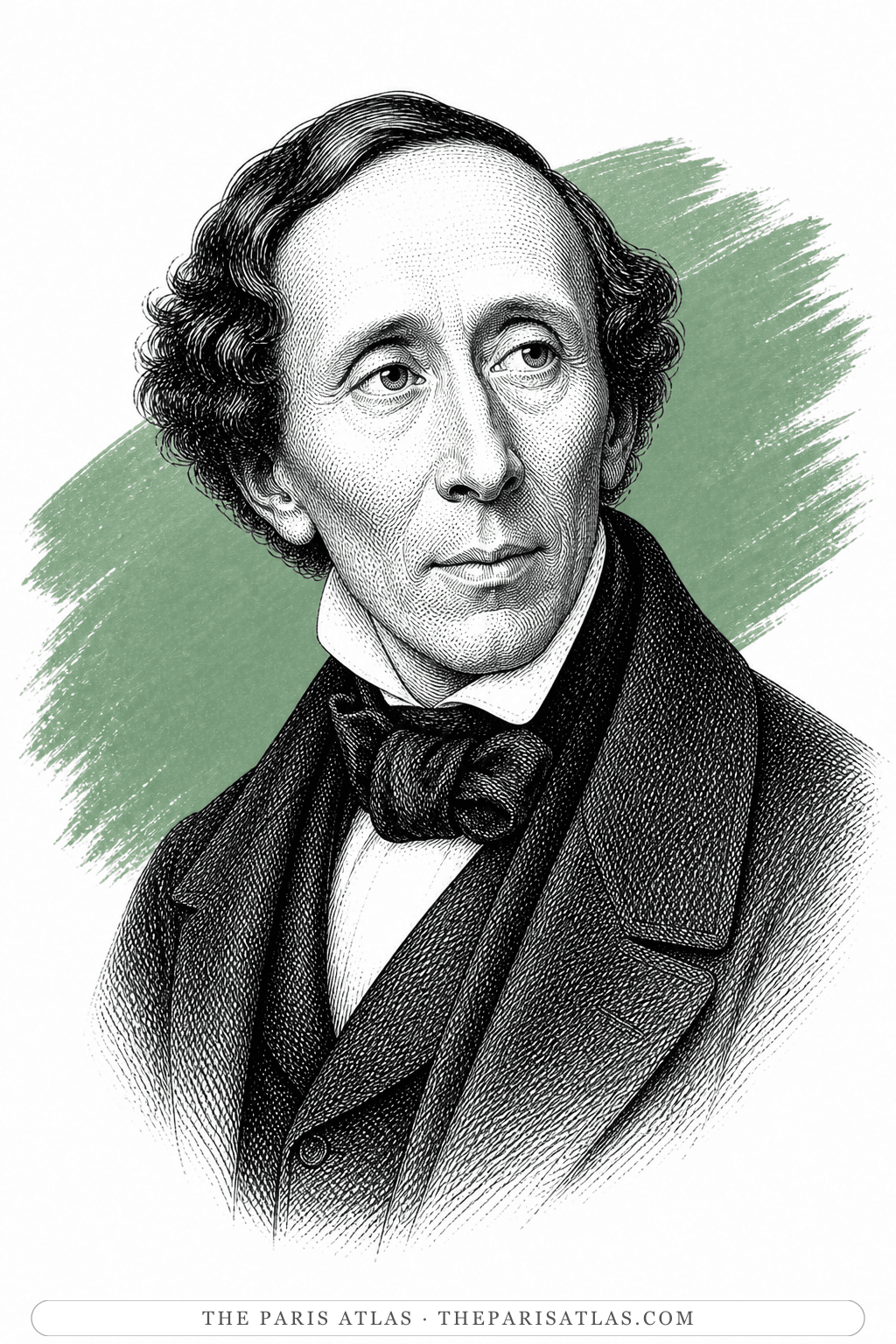
The Angel
Engelen. An angel carries a dead child to heaven, gathering flowers on the way. The first tale in the first part, 1843.
New Fairy Tales
Hans Christian Andersen
The collection that made Andersen famous: an ugly duckling, a nightingale in China, and a girl who walks to Lapland to bring her friend home from the Snow Queen.
New Fairy Tales is the collection that turned Hans Christian Andersen into Denmark's leading writer of fairy tales. The collection came out in Copenhagen in three parts. The first, on 11 November 1843, held The Angel, The Nightingale, The Sweethearts and The Ugly Duckling, and sold out at once. The second, on 21 December 1844, held The Fir Tree and The Snow Queen. The third, on 7 April 1845, held five more, including The Red Shoes. In 1845 the three parts were issued together as a first volume.
Andersen dropped the words "told for children" from the title this time. He wrote in his autobiography that all the new tales were his own invention.[1] The bookseller C. A. Reitzel published each part at 32 skilling. Andersen dedicated each one to a fellow poet: Carl Bagger, Frederik Høegh-Guldberg and Henrik Hertz.[2]
The first part was a hit. Its first printing of 850 copies sold out immediately, and a second printing followed in December. That month Andersen wrote in a letter that none of his books had ever given him so much joy. People were buying the tales, he said, not borrowing them from the neighbours.[3] Reitzel printed 2,000 copies of the second part.[3]
Two of the tales grew out of real places. The Nightingale, set in China, came from the Chinese buildings in Tivoli, the Copenhagen pleasure garden that opened in August 1843. Andersen wrote it in two days after a visit there on 11 October.[3] The Snow Queen borrows from his childhood in Odense. A box of earth on the roof gutter was his mother's only garden. In The Snow Queen, he wrote, that garden still blooms.[1]
The Ugly Duckling hatches last and biggest from a clutch of duck eggs, and he is grey and awkward. The other ducks and hens peck him, and even his mother wishes him gone. He runs away and spends a hard winter alone. In spring he sees the swans he has always admired and flies to them, expecting to be killed.[4]
In The Nightingale, the Emperor of China learns from a book that the most wonderful thing in his empire is a small grey bird in his own forest. The court brings the nightingale to the palace, and its song makes the emperor cry. Then the Emperor of Japan sends him a jewelled mechanical bird, and the real one flies away.[4]
The Snow Queen is told in seven stories. A demon makes a mirror that shrinks everything good and swells everything bad, and it shatters into splinters. One lodges in the eye of a boy called Kay, and one in his heart. He turns cold and mocking and rides off with the Snow Queen. His friend Gerda sets out alone to find him, through a sorceress's flower garden, a palace, a robbers' castle and the far north.[4]
The other tales are shorter. In The Fir Tree, a young tree cannot wait to grow up, and is at last taken indoors as a Christmas tree. In The Red Shoes, a poor girl called Karen cares more for her red shoes than for church. The Sweethearts is a comic love story between a spinning top and a ball.[4][1]
Looking down at the water, the duckling sees that he has grown into a swan. The other swans welcome him, and children in the garden say the new one is the most beautiful of all.
When the mechanical bird breaks, the emperor falls ill, and Death sits on his chest. The real nightingale comes back and sings until Death leaves. The emperor recovers.
Gerda finds Kay in the Snow Queen's palace of ice. Her tears melt the splinter in his heart, and they walk home together. They find they have grown up, though they are still children at heart.
Andersen spent the spring of 1843 in Paris, from 8 March to 8 May. He came as a writer people had heard of. The critic Xavier Marmier had written about him in the Revue de Paris, a leading literary magazine, and his name, he said, had carried like a sound. He stayed at the Hotel Valois on the rue de Richelieu, opposite the library.
That spring he called on Victor Hugo twice and saw Alexandre Dumas, who took him backstage to meet the actress Rachel. He visited the German poet Heinrich Heine three times. While he was away, his dramatic poem Agnete and the Merman was staged in Copenhagen and failed after two performances. Six months after he left Paris, the first part of New Fairy Tales appeared and sold out.
The Ugly Duckling had a rough start abroad. Andersen complained in his autobiography that one German translation called it The Green Duck. The mistake, he wrote, carried over into French as "Le petit Canard vert".
That French title is in a book printed in Paris in 1848. Contes pour les enfants, translated from the Danish by V. Caralp and published by Belin-Leprieur et Morizot, ends with Le petit Canard Vert. The book also has Le Rossignol de l'Empereur, the Emperor's Nightingale, and Le Sapin, The Fir Tree. Les Souliers Rouges, L'Ange and La petite paire d'Amants, the Sweethearts, are in it too.
Hachette's Paris edition of David Soldi's translation got the title right. Its 1862 second edition has Le Vilain petit canard, along with Le Rossignol and La Bergère et le Ramoneur, The Shepherdess and the Chimney-Sweep.
Andersen read his tales aloud to friends. At Nysø, a country house where he stayed with the sculptor Bertel Thorvaldsen, Thorvaldsen would come up behind him in the twilight and ask whether the little ones were going to hear any tales that night. Andersen wrote that Thorvaldsen liked to hear the same stories again and again. He would stand laughing, in the middle of his work, and listen to The Top and the Ball and The Ugly Duckling.
It does not matter in the least having been born in a duckyard, if only you come out of a swan's egg!
I never dreamt of so much happiness when I was the Ugly Duckling!
The most beautiful landscapes reflected in it looked like boiled spinach, and the best people became hideous, or else they were upside down and had no bodies.
In my story of the Snow Queen that garden still blooms.
The Ugly Duckling, The Nightingale, The Snow Queen and The Red Shoes all first appeared here.
The first part sold out its 850 copies at once. For the second part, Reitzel printed 2,000.
The Chinese buildings of Tivoli gave him The Nightingale. His mother's rooftop garden in Odense went into The Snow Queen.
A Paris book of 1848 called The Ugly Duckling Le petit Canard Vert, a mistake Andersen grumbled about.
The last and biggest egg in the clutch. Bullied in the duckyard, alone through the winter.
The Snow Queen. A small girl who sets out barefoot to find her friend Kay and does not give up.
The Snow Queen. Gerda's friend and neighbour, turned cold by splinters of the demon's mirror.
A tall woman made of ice, who carries Kay off in her sleigh to her palace in the far north.
A small grey bird whose song makes the Emperor of China cry. Pushed aside for a jewelled machine, it still comes back when the emperor is dying.
The Red Shoes. A poor girl who wears her red shoes to church and cannot stop dancing.
Engelen. An angel carries a dead child to heaven, gathering flowers on the way. The first tale in the first part, 1843.
Nattergalen. The Emperor of China, a real bird and a mechanical one. Written in two days in October 1843.
Kjærestefolkene. Also called The Top and the Ball. A spinning top proposes to a ball, who has other plans.
Den grimme Ælling. The last tale in the first part, 1843.
Grantræet. A young tree longs to grow up and see the world. The second part, 1844.
Sneedronningen. A tale in seven stories, and the longest in the volume. The second part, 1844.
Elverhøi. The elves prepare for a visit from the troll king of Norway. The third part, 1845.
De røde Skoe. A girl who cannot stop dancing. The third part, 1845.
Springfyrene. A flea, a grasshopper and a jumping toy compete to see who can jump highest, for a princess's hand. Also translated as The Leap-Frog.
Hyrdinden og Skorsteensfeieren. Two china figures run away together to escape a carved man on an old cabinet who wants to marry the shepherdess.
The Danish hero who sleeps under Kronborg Castle until Denmark needs him. The last tale in the volume.
March–May 1843
Andersen spends the spring in Paris, seeing Victor Hugo, Alexandre Dumas and Heinrich Heine.
11 October 1843
After a visit to Tivoli's Chinese buildings, Andersen writes The Nightingale in two days.
11 November 1843
The first part of Nye Eventyr appears, with The Ugly Duckling and The Nightingale. The 850 copies sell out.
21 December 1844
The second part appears, with The Fir Tree and The Snow Queen, in 2,000 copies.
7 April 1845
The third part appears, with The Red Shoes. The three parts are reissued as a first volume later that year.
1848
Belin-Leprieur et Morizot in Paris publishes V. Caralp's French translation, with Le petit Canard Vert.
1862
Hachette's second edition of David Soldi's translation includes Le Vilain petit canard.


Fairy Tales Told for Children: First Booklet
Hans Christian Andersen
Where the fairy tales began, in 1835, with The Tinderbox and The Princess and the Pea.
Read our takeFairy Tales Told for Children: Second Booklet
Hans Christian Andersen
The 1835 booklet with Thumbelina, whose heroine also survives a hard winter.
Read our takeFairy Tales Told for Children: Third Booklet
Hans Christian Andersen
The 1837 booklet with The Little Mermaid and The Emperor's New Clothes.
Read our takeThe Fairy Tale of My Life
Hans Christian Andersen
Andersen's autobiography, which tells how the new tales were received and covers his 1843 stay in Paris.
Read our take
Oscar Wilde's fairy tales of 1888, whose nightingale also sings for someone who does not deserve it.
Read our takeOn 11 November 1843, in Copenhagen, in the first part of Hans Christian Andersen's New Fairy Tales. The Danish title is Den grimme Ælling. The first printing of 850 copies sold out immediately.
On 21 December 1844, in the second part of New Fairy Tales, together with The Fir Tree. The Danish title is Sneedronningen.
The Chinese buildings in Tivoli, the Copenhagen pleasure garden that opened in August 1843. Andersen wrote the tale in two days after a visit there on 11 October 1843.
Partly. He wrote that the rooftop garden where Kay and Gerda grow roses came from his mother's box of vegetables in the roof gutter of their house in Odense.
Because of a mistake in an early German translation. Andersen wrote that it passed into French as Le petit Canard vert. A French book printed in Paris in 1848 uses that title.
Yes. The Danish title, Nye Eventyr, is translated both ways. The 1871 English edition of Andersen's autobiography calls it New Stories.
He spent March to May 1843 in Paris, and the first part came out six months later. The Nightingale was written in Copenhagen that October. No tale in the volume is set in Paris.
Explore authors with a similar voice, perspective, and influence.
The doctor of the Paris slums who wrote the century's blackest, funniest novel — and changed the sound of French prose.
View author
French writer and philosopher whose novels, memoirs, and social analysis examined freedom, gender, responsibility, aging, and the material conditions that shape a life.
View author
The Brooklyn dropout who arrived in Paris broke at thirty-eight and wrote the exuberant, banned books that ended American censorship.
View authorThe sources below include the primary text, editions, scholarship, archival materials, and other records that informed this page. They document New Fairy Tales, its publication, and its place in literary history.

Title pages, dedications, prices, page counts, printings and the 1845 first-volume title page.
The public-domain English translation used for the plots and quotations from the tales.
The Andersen Centre's record of the first part, 1843.
The Andersen Centre's record of the second part, 1844.
The Andersen Centre's record of the third part, 1845.
Mary Howitt's translation of the autobiography, used for the quotation about the Snow Queen's garden.

The 1848 Paris translation, whose table of contents includes Le petit Canard Vert.
The 1862 Hachette edition, with Le Vilain petit canard.
Library record for ISBN 9780385189514.
Library record for ISBN 9780393060812, with contents.
The primary text represented by this page, used for descriptions of the work’s contents and for any quoted passages shown here.
The primary text is the baseline reference for every book page. Additional references document publication history, interpretation, and historical context where that evidence is available.
 Explore more resources