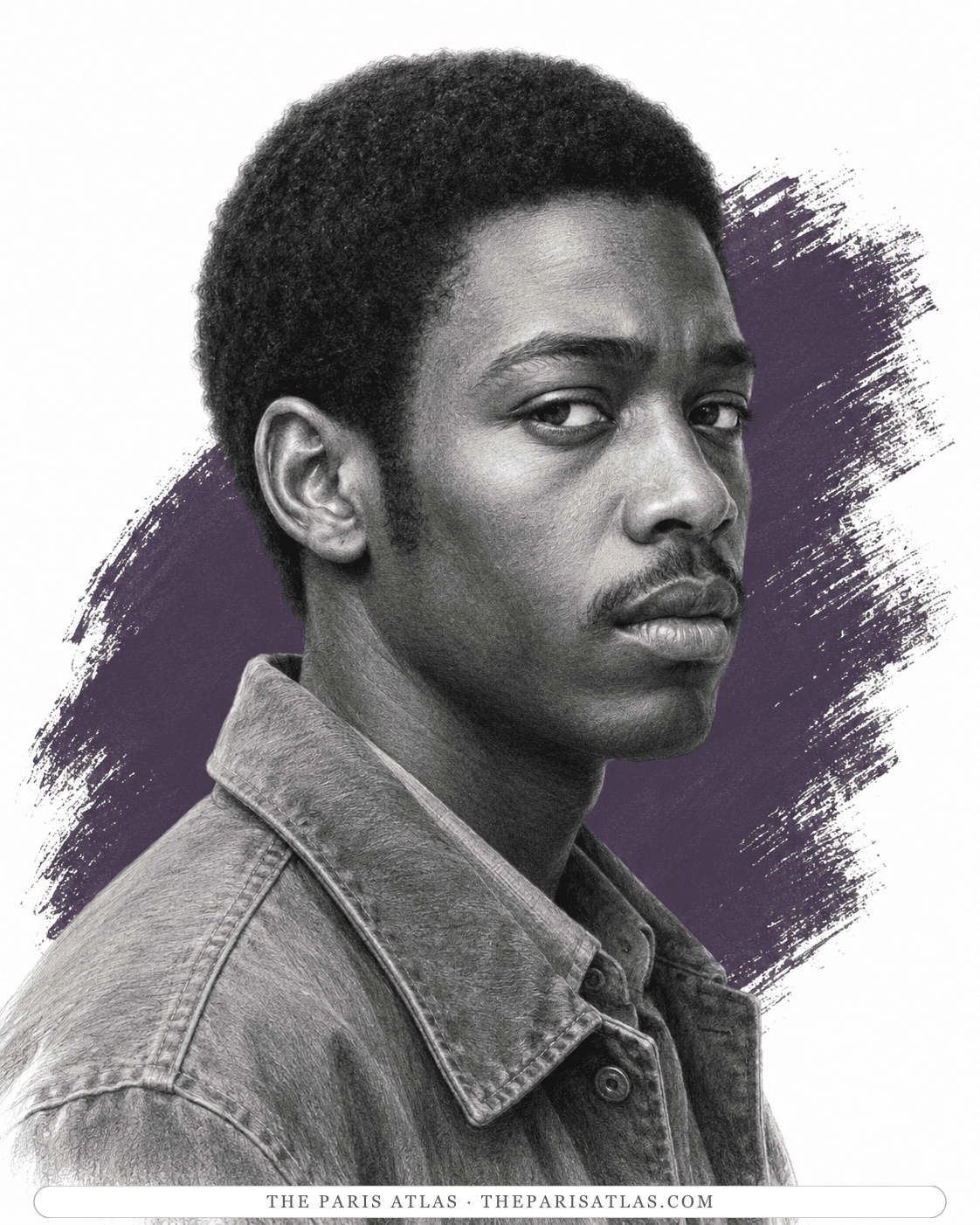
Daniel Carty
Fonny's friend, out of prison himself, and one of the people whose word the court has no interest in believing.
To get past what happened to him inside, which he does by turning up at Bank Street evening after evening and asking whether he can come more often.
The book

At a glance
- Twenty-three, a little older than Fonny
- Harlem, with his mother; his father is dead
- Two years for a car theft, entered as a guilty plea after a narcotics arrest
- The one witness besides Tish who can place Fonny on Bank Street that night
Who they are in the book
Spoiler-freeDaniel Carty is Fonny Hunt's oldest friend in James Baldwin's novel If Beale Street Could Talk, and the third person in the room on the night Fonny is supposed to have committed a rape across the city. He is invented, as everyone in the book is. He is twenty-three, a little older than Fonny, and he has just finished two years in prison for a car theft he says he could not have committed.
They grew up on the same block. Tish Rivers, who narrates, first mentions him as the boy who started the fight in which she opened Fonny's cheek with a nail, and who later fell out with Fonny for years over the crime of playing with girls. They meet again by accident on Seventh Avenue on a Saturday afternoon and go straight to a bar, although Fonny does not like bars.
For the weeks that follow he is at the Bank Street room most evenings, eating what Tish cooks and talking. What he wants to talk about is prison, and he can only get at it in pieces. Baldwin gives him the longest continuous speech in the novel, an account of being picked up off his own stoop with a little marijuana in his pocket and coming out of it two years later as a convicted car thief.
As an alibi witness he is worth nothing to the court, and the prosecution makes sure of it. What he is worth to the novel is the demonstration that Fonny's case is not exceptional. Daniel has been through the identical machinery already, without a family with money to raise or a lawyer willing to be isolated for him.
How Daniel Carty Is Portrayed
- The boy on the blockBig and black, in Tish's phrasing, and preoccupied with her friend Geneva in the way Geneva was preoccupied with Fonny. He had Geneva on the ground the day the fight started. Afterwards he called Fonny a sissy for playing with girls, they fought, and Fonny lost another tooth over it.
- Meeting againSeventh Avenue, a Saturday afternoon, after years without seeing each other. They beat each other about the head and shoulders and laugh like children, then sit down over two beers. Tish's verdict is that time has not improved him: still big and black and loud, and at twenty-three already running out of familiar faces.
- HomeHis father died some while ago. He still lives in the same place with his mother, whose varicose veins have come down on her. When he is arrested and allowed one call, he works out that he has nobody to call but her, and nobody she could call at that hour.
- The two yearsPicked up off his stoop around midnight with a little marijuana in his pocket, and booked on a narcotics charge. In the lineup the next morning somebody identified him as the man who stole a car he has never seen and could not drive. His lawyer worked for the city. Offered a lighter sentence for a guilty plea and the book for a trial, he pleaded guilty, and says now that he let them do it because he was frightened and ignorant and that he is sorry.
- What he cannot say all at onceOver many evenings he tries to tell Fonny what happened inside, and Tish describes him tearing it out of himself like a man trying to be cured. Sometimes he cries; sometimes Fonny holds him and sometimes Tish does. He had seen nine men rape one boy, and he had been raped himself. Tish writes that he will never again be the Daniel he was.
- In the Bank Street roomSquatting on the floor with a beer while Fonny rolls cigarettes and the record player runs. He asks whether they are really going to get married, wistfully and mockingly at once. He tells Fonny he is lucky and that he has nothing like it himself. He asks whether he can drop by more often, at about this time, and Tish notices he is afraid to go out into the streets at midnight.
- The alibiHe was with Tish and Fonny in the room on Bank Street on the night of the assault, and he was in the house on the night of the arrest, drunk and crying, with Fonny holding him up. Tish's testimony counts for nothing because she is the girlfriend. Daniel's counts for nothing because he has a record.
Once Hayward takes the case, the district attorney's office arrests Daniel and holds him incommunicado. Hayward is refused access for a long time, and when he finally sees him Daniel has been beaten. He cannot be got out, because he has been booked on a narcotics charge, and he cannot be represented without Hayward becoming his lawyer, which Daniel is too frightened and evasive to agree to. Hayward suspects he has also been drugged, and does not know whether he dares put him on a witness stand at all.
He is then transferred to a prison upstate. Nobody in either family can reach him, and he never testifies. The last the reader hears, Hayward is still trying to find out where he is.
If you like If Beale Street Could Talk


If you like James Baldwin
Explore authors with a similar voice, perspective, and influence.

Louis-Ferdinand Céline
The doctor of the Paris slums who wrote the century's blackest, funniest novel — and changed the sound of French prose.
View author
Henry Miller
The Brooklyn dropout who arrived in Paris broke at thirty-eight and wrote the exuberant, banned books that ended American censorship.
View author
Ernest Hemingway
Author of The Sun Also Rises and A Moveable Feast; his pared-down style, developed in 1920s Paris, became the most imitated in American prose.
View author