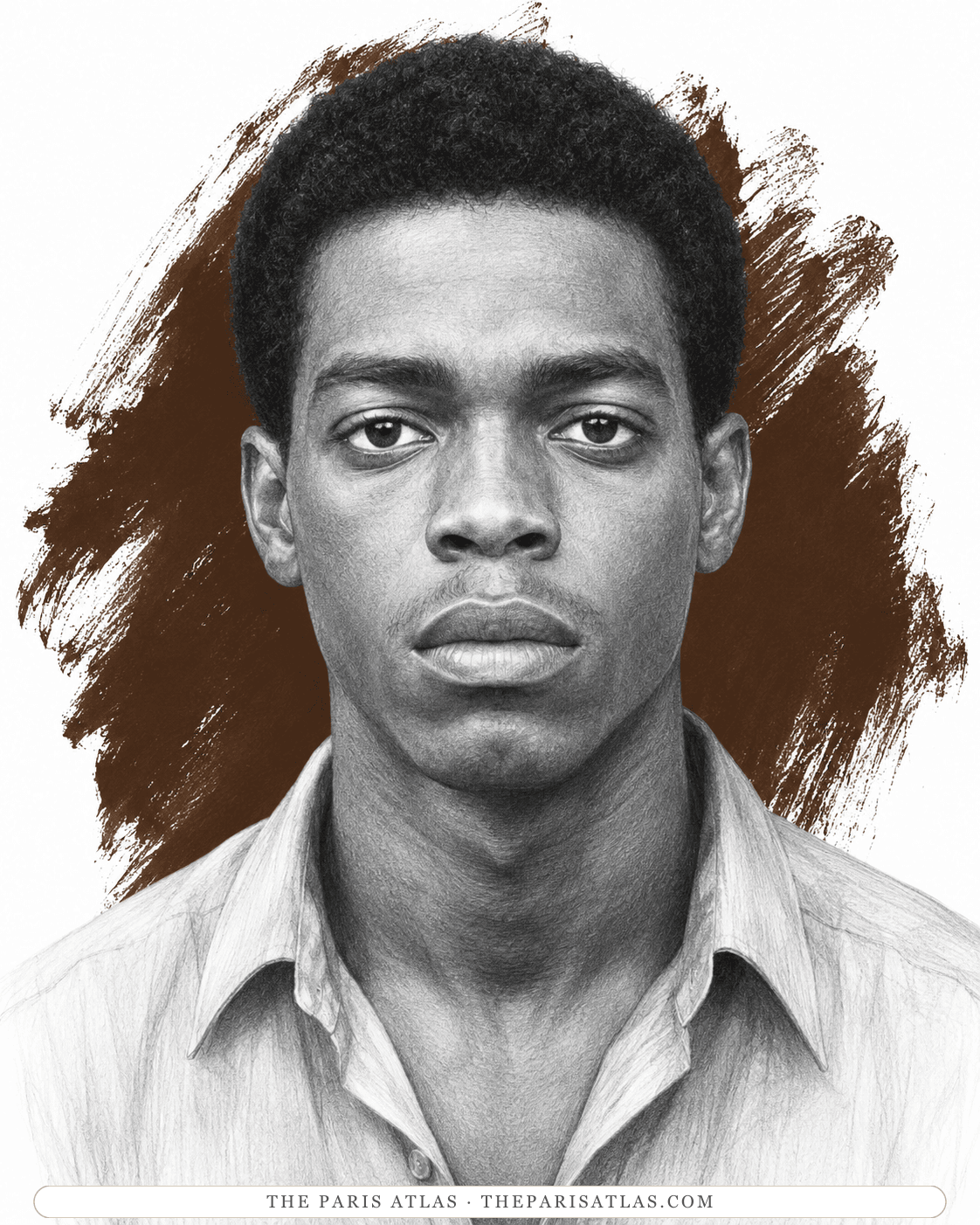
Fonny Hunt
Alonzo, twenty-two, a sculptor, and in the Tombs awaiting trial on a charge built from an identification he had nothing to do with.
To hold on to the two things he tells Daniel are his whole life, his wood and stone and Tish, and to get all three of them out of the country if he can find the money.
The book

At a glance
- Alonzo Hunt, called Fonny
- Twenty-two
- Sculpts in wood and stone; cooked short order in a barbecue joint to eat
- A basement room on Bank Street, in the West Village
- Frank and Alice Hunt; two older sisters, Adrienne, twenty-seven, and Sheila, twenty-four
- Rape; arrested in March and held in the Tombs, unable to make bail
Who they are in the book
Spoiler-freeAlonzo Hunt, called Fonny, is the second of the two central characters in James Baldwin's novel If Beale Street Could Talk, and the only one who is not there for most of it. He is twenty-two, he carves in wood and stone, and he spends the book in the Tombs on a rape charge. The complainant identified him at a police lineup, and Sharon Rivers, meeting her months later in Puerto Rico, tells her that the lineup was the first and the only time she had seen him. Tish Rivers, who narrates, has known him since they were children on the same Harlem block, and she only calls him Alonzo when she has something heavy to tell him.
He grew up across the street from her, in a household split down the middle. His mother, Alice Hunt, is a Sanctified woman who took him to church on Sundays and, by Tish's account, did not much like him. His two older sisters took after their mother. His father Frank ran a tailor shop, was not religious, and had him the rest of the week. Fonny was a street kid who kept losing teeth in fights, and was sent down to his mother's people in the country for a while because he got into too much trouble in the city.
The work saved him, in Tish's reading of it. He was put in a vocational school that taught boys to make card tables and chests of drawers, walked out of it, and took most of the woodwork shop with him over the course of a week. He cooked short order in a barbecue joint so he could eat, found a basement to carve in, and later a room on Bank Street. The two of them had been hunting for a loft they could afford, which in New York in the early 1970s meant being turned down by landlords who found reasons that were not the reason.
The charge against him rests on an identification made by Victoria Rogers, a Puerto Rican woman who had never seen him before he was put in a police lineup, and on the sworn statement of a patrolman named Bell who had crossed him in the street some months earlier. Fonny was on Bank Street with Tish and his friend Daniel Carty on the night of the assault. The novel spends very little time arguing about his innocence and a great deal on the machinery that makes the argument irrelevant.
How Fonny Hunt Is Portrayed
- Christened AlonzoLonnie would make sense and nobody uses it. He has been Fonny since childhood, and Tish reserves Alonzo for the moments when she has to say something serious to him. The court papers and the prosecution use Alonzo Hunt throughout.
- TeethHe had just lost one in a street fight when Tish opened his cheek with a nail, and he spat at her through the gap. He lost another fighting Daniel, who had called him a sissy for playing with girls. Tish says anyone watching him then would have expected him to grow up without a tooth in his head. In jail, in solitary, he loses another one.
- His father's faceLarge dark eyes slanting upward, and Frank Hunt's smile: Tish says she only understood where the smile came from once she knew both men. He is lighter than Tish and much darker than his mother and sisters, who are fair and long-haired, and his hair stayed nappy through every Sunday his mother greased it. He never had it conked.
- The wood and the stoneHe emptied the school woodwork shop over about a week, tools first, then the timber, which was harder because you cannot put it under a coat. Some of it is still under Tish's bed. The first piece he gave the Rivers family is a small figure in black wood of a naked man, one hand at his forehead and the other half covering his sex, legs long and wide apart, one foot planted as though it cannot move. Sharon keeps it on its own table in the living room.
- The room on Bank StreetA basement, down four steps behind a black iron railing. Raw wood all over the floor, tools on a big table, beer cans, a mattress in the corner under a Mexican shawl, pencil sketches pinned to the wall and a photograph of his father. It is where he works, where he and Tish first sleep together, and where Officer Bell comes to arrest him.
- Church, onceHis mother took the two of them to a Sanctified service one Sunday morning when they were children. Tish remembers him walking beside her like a prisoner, hair slicked and parted, in a blue suit, holding her hand and refusing to look at her while the congregation went up around them. They never went again, and they have never talked about it.
- Where he is easyA small Spanish restaurant west of Greenwich Avenue, where he knows every waiter and they tease him about Tish. He speaks a little Spanish. Tish says it was the first time she had seen him anywhere outside the world she moved in, and the first time she had watched men treat him with respect. He does not like bars.
- Looking for a loftThe lofts stand empty all over the East Side and nobody will rent them to him. One landlord promised Tish a loft when she came alone, then discovered relatives arriving from Romania within the half hour once he saw who she was living with. After that Fonny stopped letting her look on her own.
- What he says to DanielSitting in the Bank Street room with an old friend just out of prison, he says he might seem a strange kind of man, but that he has two things, his wood and stone and Tish, and that if he loses them he is lost. He also says he is frightened, and that what is in him he did not put there and cannot take out.
- After the vegetable standThat night, over dinner, he tells Tish flatly that the policeman is going to try to get him, and explains why: a white woman took a Black man's side in front of a crowd and the officer could do nothing about it. He does not raise his voice about it. A patrol car is parked opposite the house when they get home, and pulls away as he unlocks the door.
The identification never breaks. Sharon Rivers goes to Puerto Rico and gets nowhere, Victoria Rogers disappears into the hills, and Daniel Carty is arrested, beaten and moved to a prison upstate before he can testify. The trial is postponed indefinitely because the complainant cannot be produced.
In jail Fonny is put in solitary for refusing to be raped. He loses a tooth and comes close to losing an eye. Tish, seeing him after weeks without a visit, finds him skinny and bruised. Baldwin writes the hardening as a decision rather than damage: Fonny has an appointment to keep with his child and intends to be alive for it. Hayward arranges the possibility of bail, set high. The last page has Fonny at work on the wood and the stone, whistling, while a baby cries, and the case still has no verdict.
If you like If Beale Street Could Talk


If you like James Baldwin
Explore authors with a similar voice, perspective, and influence.

Louis-Ferdinand Céline
The doctor of the Paris slums who wrote the century's blackest, funniest novel — and changed the sound of French prose.
View author
Henry Miller
The Brooklyn dropout who arrived in Paris broke at thirty-eight and wrote the exuberant, banned books that ended American censorship.
View author
Ernest Hemingway
Author of The Sun Also Rises and A Moveable Feast; his pared-down style, developed in 1920s Paris, became the most imitated in American prose.
View author