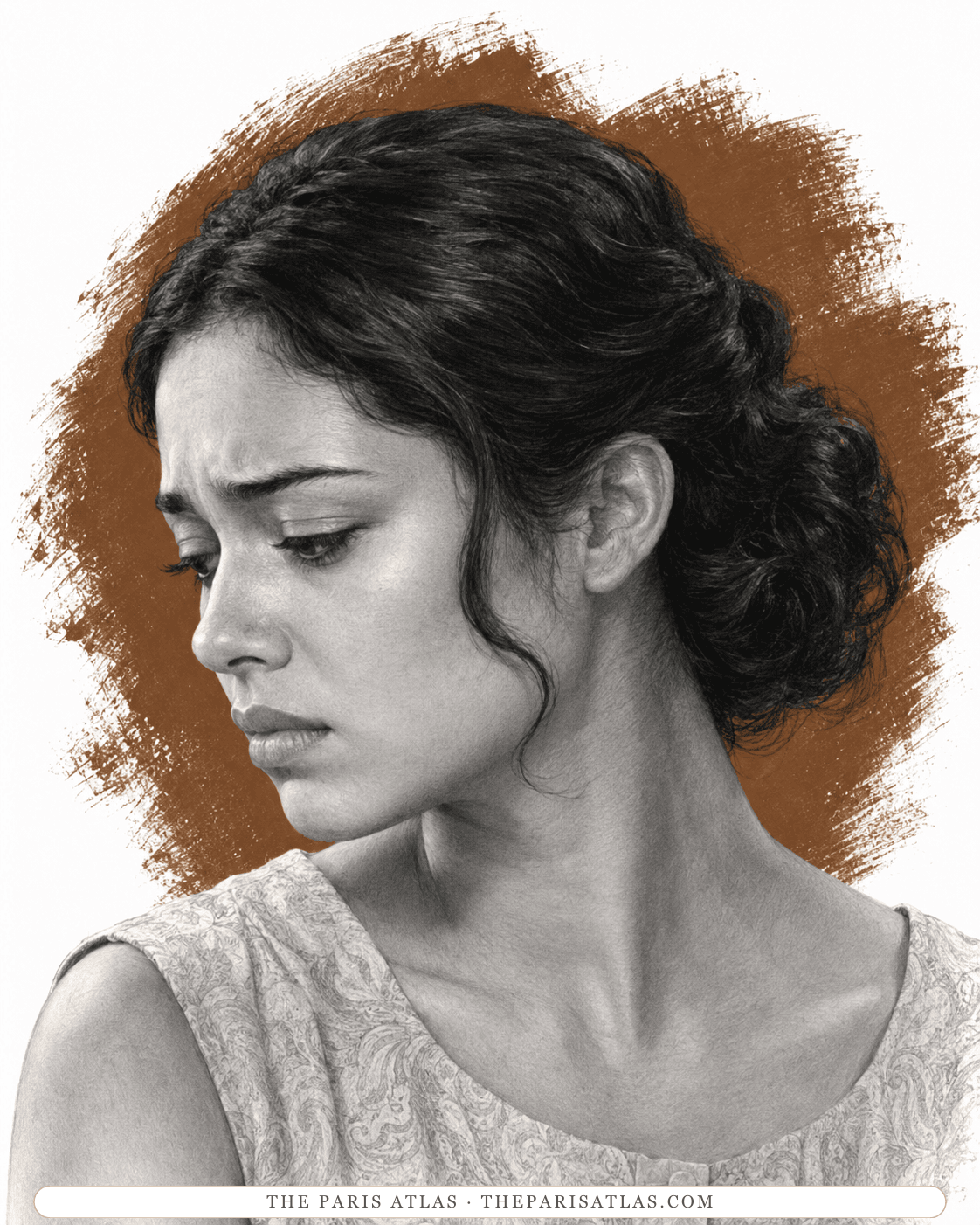
Victoria Rogers
The young Puerto Rican woman whose identification puts Fonny in jail. Baldwin writes her as another person the system is using, not as a liar.
For it to be finished, so that she never has to live through it a second time.
The book

At a glance
- Victoria Rogers, born Victoria Maria San Felipe Sanchez
- About eighteen when she married, some six years before the trial
- A fourth-floor apartment on Orchard Street, on the Lower East Side
- Three children by Gary Rogers, who left; living with Pietro Thomasino Alvarez
- The complainant; the case against Fonny rests on her identification and on Officer Bell
Who they are in the book
Spoiler-freeVictoria Rogers is the woman whose identification puts Fonny Hunt in jail in James Baldwin's novel If Beale Street Could Talk. She is a fictional character, as everyone in the book is. Her deposition states that on the evening of 5 March, between eleven and twelve, she was assaulted in the vestibule of her building by a man she now knows to be Alonzo Hunt. Sharon Rivers, who tracks her down in Puerto Rico, tells her that the police lineup was the first and the only time she had seen the man she named.
Tish Rivers, who narrates, never meets her, and says so. What she can set down is a life reconstructed from the lawyer's papers: born in Puerto Rico, married at about eighteen to an American-born Irish engineer named Gary Rogers who had come out to the island, brought to the mainland, three children, and then abandoned when his career went down and he became bitter. Her home address is a fourth-floor apartment on Orchard Street, on the Lower East Side.
The novel does not treat her as a liar in the ordinary sense. Ernestine puts it to Tish as plainly as it can be put: of course she is lying, and she is not lying. Fonny was presented to her as the man, and saying yes ended the thing where saying no would have meant living through it again in a courtroom. Hayward's own view is that the identification she keeps repeating is not hers but Officer Bell's, and that she has been repeating his testimony back to the court.
The one scene in which she appears is in Puerto Rico, when Sharon Rivers finds her in a room in a favella and asks her to look at a photograph. It is the hardest scene in the book to summarise fairly, because everything in it is happening to two women who have each been handed the other by the same machinery.
How Victoria Rogers Is Portrayed
- The depositionFiled as Mrs. Victoria Rogers, born Victoria Maria San Felipe Sanchez. It states the date, the hour, and the vestibule of her home, and describes an assault of extreme and prolonged violence. Tish reproduces the language of it once and does not comment on it.
- What is known about her lifeGary Rogers, an American-born Irish engineer, went to Puerto Rico about six years earlier and met her when she was about eighteen. He married her and brought her to the mainland, his career declined, and after three children he left. The children are somewhere on the mainland with relatives. Tish gives the account flatly and says she has never seen her.
- The geography of the chargeOrchard Street is near the East River and Bank Street is nearly at the Hudson. It is not possible to run between them with the police behind you. Bell's beat is on the West Side, not the East, so he could only have been where he says he was if he was off duty, and yet he was the officer who arrested Fonny out of the Bank Street house.
- The lineupTish tells Fonny what the family has worked out about the morning she picked him out. There were some white men in the lineup, a Puerto Rican and a couple of light-skinned Black men, and Fonny was the only dark one. Having said she was raped by a Black man, she had one choice to make.
- How Sharon finds herA very thin girl with immense dark eyes in a dark face, barefoot, in a flowered housedress, with a wide mouth, thin lips and high cheekbones. Her curly hair is a muddy blonde and drying out dark at the roots. A gold crucifix hangs at her throat. Sharon's first impression is that she looks like a little girl, and it takes a change in the light for her to recognise the woman in the photograph.
- What she says in the roomThat she has work to do. That there is no Mrs. Rogers there, and that a stranger could look a long time in a place with that many doors. That she is not a North American lady. She offers Sharon a cigarette and lights it for her with a shaking hand. She will not look at the photograph. She tells Sharon that one thing she can tell about her is that she has never been raped, and that plenty of women have said what Sharon is saying to her.
- How the family talks about herNot kindly, and Baldwin lets that stand. Tish, reporting the strategy to Fonny, says their mother thinks Hayward can destroy the testimony, that the woman seems hysterical, and that she is a part-time prostitute, which will not help her in court. The contempt is the family's, and the novel does not endorse it: the case for taking her seriously is made in the same book, by Ernestine and by Sharon.
The interview ends badly. Sharon takes hold of her hand on the crucifix, and she screams a sound Sharon has never heard, breaks away and runs to the door, shouting in English and then in Spanish for the visitor to get out. A neighbour takes her into her arms and leads her away, and the whole building stands and watches Sharon leave.
She disappears into the hills of Puerto Rico soon afterwards. Word reaching New York is that she has lost her own baby and her mind, that she cannot be moved and cannot be seen. The trial is postponed indefinitely, which takes the state's case away and Fonny's chance of an acquittal with it. There is a fear on the defence side that the charge may be made heavier because of what has happened to her. She never appears again.
If you like If Beale Street Could Talk


If you like James Baldwin
Explore authors with a similar voice, perspective, and influence.

Louis-Ferdinand Céline
The doctor of the Paris slums who wrote the century's blackest, funniest novel — and changed the sound of French prose.
View author
Henry Miller
The Brooklyn dropout who arrived in Paris broke at thirty-eight and wrote the exuberant, banned books that ended American censorship.
View author
Ernest Hemingway
Author of The Sun Also Rises and A Moveable Feast; his pared-down style, developed in 1920s Paris, became the most imitated in American prose.
View author