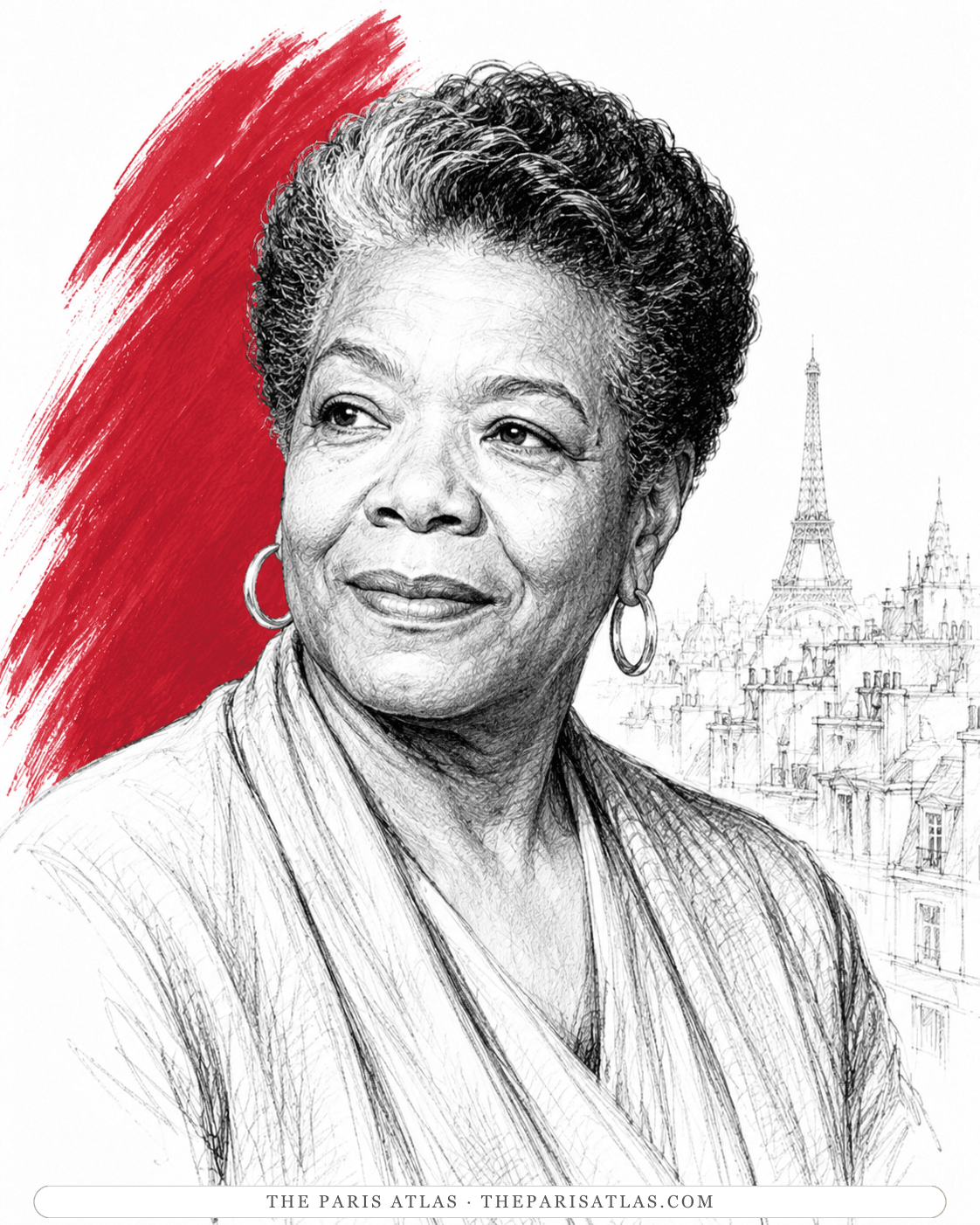

I Know Why the Caged Bird Sings
The first memoir ends with the birth of her son in 1945. Revelations and Giving Birth tell the same months again, nearly forty years after that memoir.
Read our takeLetter to My Daughter
Maya Angelou
by Maya Angelou
Twenty-eight short pieces published at eighty for the daughters Maya Angelou never had, from a Stamps childhood to a dinner in Senegal with a friend she met in Paris.
Letter to My Daughter is a book of short essays that Maya Angelou published with Random House in September 2008, when she was eighty. She had one child, a son, and she addresses the book to the thousands of women who wrote to her as if she were their mother.[1][2] The pieces are short. Some are memories, some are advice, and a few are poems or a commencement address.[3] The first essay, Home, lists Paris among the places she lived.[1]
Maya Angelou explained the book to the Guardian's Gary Younge in 2009. "I had no daughters," she said. She had a son, but young women sent her as many as a thousand letters a week, and she thought of them as her daughters.[2] The publisher describes the book as dedicated to the daughter she never had but sees all around her.[1]
The book opens with a short letter to those readers, then runs through the essays. The first four go in order through her early life. Home describes Stamps, Arkansas, where she grew up with her grandmother Annie Henderson, her Uncle Willie and her brother Bailey. Philanthropy moves her to her mother's house in San Francisco at thirteen. Revelations and Giving Birth tell how she became pregnant at sixteen and had her son.[1]
After that the essays range across her life without keeping to a timeline. Reviewers describe a beating from a lover, a coffee in Morocco she thought had insects in it, and tributes to Coretta Scott King and the Cuban singer Celia Cruz.[4][3] Other essays argue for honesty, against vulgarity, and about what it means to try to live as a Christian.[1][2]
Most pieces end with a lesson. Gary Younge wrote in the Guardian that, depending on taste, the lessons read as homespun or hokey.[2] Kirkus Reviews called the book a slim volume packed with nourishing nuggets of wisdom.[5] The book won the 2009 NAACP award for literary nonfiction, according to its publisher.[1]
An opening letter to the reader comes first, then the essays. The Guardian counted twenty-eight short pieces in all.[2] The first four follow her early life in order: Home, Philanthropy, Revelations and Giving Birth.[1]
Later essays include Senegal, Morocco, Porgy & Bess, Celia Cruz, Fannie Lou Hamer, Mrs. Coretta Scott King, To Tell the Truth, Vulgarity and Keep the Faith. Near the end come a commencement address and a piece called Poetry.[6][3]
The Library of Congress holds the contents list the publisher sent before printing, so some titles may differ slightly in the finished book. Two titles on that list are still marked as not final.[6]
The first essay, Home, starts with a list of the places Maya Angelou lived. She was born in St. Louis, grew up in Stamps from the age of three, joined her mother in San Francisco at thirteen and later studied in New York. Then she adds Paris, Cairo, West Africa and all over the United States.
Angelou does not stay with the list. She calls those places facts, and says facts are just words a child memorizes. The rest of Home argues that people never really leave the home of their childhood. She quotes the title of Thomas Wolfe's novel You Can't Go Home Again and says she never agreed with it.
Paris comes back in an essay called Senegal. On a trip to Senegal, Angelou calls Samia, a friend she had made in Paris years before, and goes to her house for dinner. In one room the guests are pressed against the walls to keep off a rug. Angelou remembers a woman in Egypt who kept her servants off her rugs. Annoyed at her host, she walks back and forth across the rug.
The rug turns out to be the tablecloth. Servants roll it up and lay a fresh one, and everyone sits down on the floor to eat one of Senegal's best-known dishes, served in her honor. Angelou writes that she was on fire with shame. The essay ends with a lesson about not correcting a culture you do not know.
I Know Why the Caged Bird Sings ends in 1945 with the birth of Maya Angelou's son, Guy. Nearly forty years after that memoir, two short essays here tell the same months again in a few pages each.
In Revelations she is sixteen, six feet tall and worried that her body will never look like a woman's. She agrees to sleep with a boy from up the street who is not even her boyfriend, hoping it will change her. The encounter lasts fifteen minutes, and she walks home wanting a long bath. Nine months later she has a baby boy.
Giving Birth picks up the story. Her brother, Bailey, tells her to hide the pregnancy until she has her high school diploma. She graduates on VJ Day, eight months and one week pregnant, and leaves a note on her stepfather's pillow that night. By the next evening her mother has come home to San Francisco.
The Revelations essay ends by looking forward to the man her son became. Angelou lists him as a husband, a father, a poet and a novelist. The older writer knows how the story turned out, which the memoir of 1969 could not.
Angelou's mother is at the center of two of the first four essays. In Philanthropy, Angelou arrives in San Francisco at thirteen, still copying her grandmother. She walks slowly with her hands clasped behind her back and hums church songs. Her mother wears lipstick, plays blues and jazz on a record player, and fills the house with loud, laughing people.
After two weeks her mother sits her down. She points out that her daughter will smile at strangers at school, and asks for one smile for her own mother too. When the girl finally smiles, her mother cries and calls her beautiful. Angelou writes that nobody had ever called her beautiful or called her daughter before.
In Giving Birth the same mother, a registered nurse, takes over the delivery room before the doctor arrives. She climbs onto the table, props her shoulder against her daughter's knee and tells her dirty stories between the pains. She catches the baby herself.
Maya Angelou told Gary Younge why the book gives so much advice. She wanted to warn young women about the holes in the road she had fallen into herself, and she said she had paid for her own mistakes.
Victoria Brownworth, reviewing the book for the Baltimore Sun, singled out one of the hardest stories. Angelou comes home from a European tour of Porgy and Bess and nearly has herself committed, afraid she might kill herself and her eight-year-old son. The contents list includes an essay titled Porgy & Bess.
Brownworth also noted an argument that goes against a common view. Angelou, herself a survivor of rape, says that calling rape a crime of power and not of sex lets rapists off the hook. Brownworth did not find the prose erudite, and did not mean that as a complaint. She called it colloquial and from the heart, like stories heard from a grandmother or an older aunt.
Gary Younge thought parts of the book read like a long goodbye. The introduction of about five hundred words mentions death twice. When he put this to Angelou at eighty-one, she shrugged it off. She said she had no plans to stop working. She died in May 2014, four and a half years later.
Throughout the years I have lived in Paris, Cairo, West Africa, and all over the United States.
I believe that one can never leave home.
I had never been called beautiful and no one in my memory had ever called me daughter.
Stamps, San Francisco at thirteen, a son at sixteen, Senegal and Morocco: the essays cover in a few pages each what the seven memoirs tell at book length.
Vivian Baxter asks her daughter to smile for strangers, then delivers her grandson herself, telling dirty stories between the pains.
Angelou walks across a rug to make a point about how servants are treated, then finds out it was the tablecloth. She tells the story against herself.
Try to be a rainbow in someone's cloud comes from the book's opening letter. Readers can see it next to the other advice around it.
1945
Angelou graduates from high school in San Francisco on VJ Day, eight months pregnant. Her son is born weeks later. Revelations and Giving Birth tell the story.
2008
Random House publishes the hardcover, ebook and audiobook on September 23.
2008
TODAY runs an excerpt on October 29. Reviews appear in Kirkus Reviews, the Baltimore Sun and the Rocky Mountain News.
2009
The book wins the NAACP award for literary nonfiction, according to the publisher.
2009
Random House Trade Paperbacks publishes the paperback on October 27. Virago publishes the book in Britain, and Angelou talks about it to the Guardian.
2014
Maya Angelou dies in Winston-Salem, North Carolina, on May 28.


The first memoir ends with the birth of her son in 1945. Revelations and Giving Birth tell the same months again, nearly forty years after that memoir.
Read our take
The second memoir follows the years of young motherhood that the essays here only touch.
Read our take
James Baldwin, Maya Angelou's friend since the 1950s, also wrote advice as a letter to a young relative, in My Dungeon Shook, the letter to his nephew.
Read our takeLetter to My Daughter is a book of short essays by Maya Angelou, published in 2008. She writes about her childhood in Stamps, Arkansas, having her son at sixteen, her mother and grandmother, and lessons from later travels. The book is addressed to young women who looked to her as a mother.
No. She had one child, a son, Guy Johnson. She told the Guardian that young women wrote to her by the thousand as if she were their mother, and she wrote the book for them.
The Guardian's 2009 interview counts twenty-eight short pieces after a brief opening letter. A few are poems, and one is a commencement address. The contents list the publisher sent before printing has twenty-nine titles, two of them marked as not final.
Random House published the hardcover on September 23, 2008. The paperback followed on October 27, 2009. Virago published it in Britain in 2009.
Yes. The first essay, Home, lists Paris among the places she lived. In the Senegal essay she has dinner with Samia, a friend she had made in Paris years before.
The line is in the short opening letter of Letter to My Daughter. The Guardian quoted it from the book's introduction in 2009, next to her instructions not to complain and never to whine.
Partly. The publisher calls it guidebook, memoir and poetry at once, and the Library of Congress catalogues it as biography. Only the first four essays follow her life in order.
Explore authors with a similar voice, perspective, and influence.
French writer and philosopher whose novels, memoirs, and social analysis examined freedom, gender, responsibility, aging, and the material conditions that shape a life.
View author
The doctor of the Paris slums who wrote the century's blackest, funniest novel — and changed the sound of French prose.
View author
The Brooklyn dropout who arrived in Paris broke at thirty-eight and wrote the exuberant, banned books that ended American censorship.
View authorThe sources below include the primary text, editions, scholarship, archival materials, and other records that informed this page. They document Letter to My Daughter, its publication, and its place in literary history.
Victoria Brownworth's review: the Morocco coffee, the return from the Porgy and Bess tour, the argument about rape, and the prose style.
Contemporary review, with the verdict on the book as a whole.
A second authorized printing of the Home, Revelations and Giving Birth excerpt, used to confirm the Paris line.
Library of Congress record: Random House, New York, 2008, xii plus 166 pages, both ISBNs, and the biography subject headings.
Edition records used to check that each ISBN resolves to this book.
The author's estate lists the book among her titles.
The primary text represented by this page, used for descriptions of the work’s contents and for any quoted passages shown here.
The primary text is the baseline reference for every book page. Additional references document publication history, interpretation, and historical context where that evidence is available.
 Explore more resources