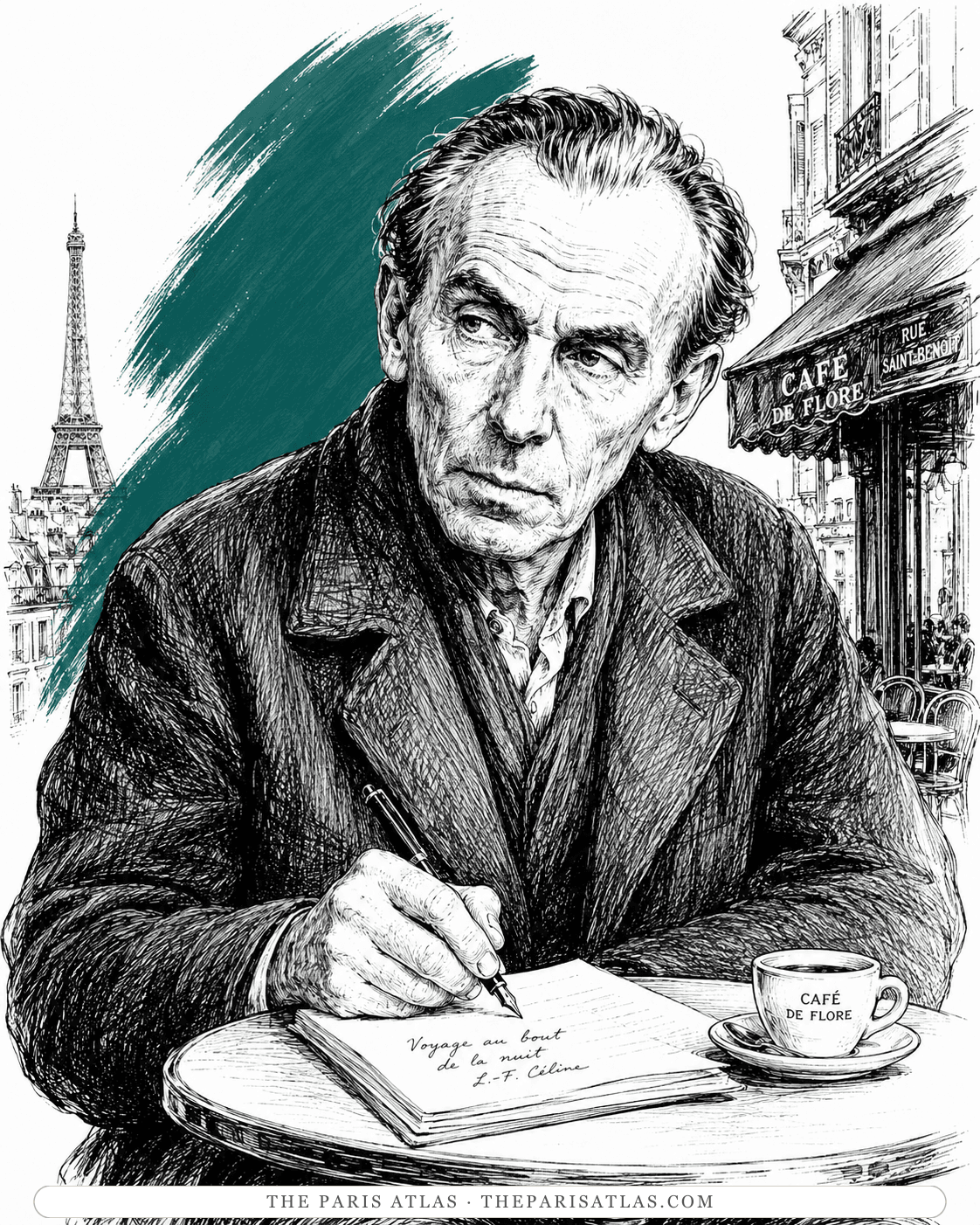

Journey to the End of the Night
The letters document the 1932 debut's sudden arrival and its consequences.
Read our take
The central single-volume selection of Céline's correspondence — 2,080 pages, five decades, and a private voice that changes with every recipient.
The 2009 Pléiade Lettres is the central single-volume edition of Louis-Ferdinand Céline's correspondence. Edited by Henri Godard and Jean-Paul Louis, it runs to 2,080 pages and presents a chronological selection of letters by Céline and several of his correspondents covering 1907 to 1961. It is not a complete edition of every surviving letter: it is a very large selection, incorporating previously published correspondence alongside many letters that had not previously appeared.
The letters themselves occupy pages 1–1583; almost 450 additional pages provide notes, indexes and a table of correspondents. The earliest correspondence precedes Céline entirely. We first encounter Louis Destouches as a young man sent abroad by his parents, then follow him into the cuirassiers, the First World War, travel, Africa, medical work and the League of Nations. The novelist emerges gradually rather than retrospectively.
After 1932, the letters document publishing, literary success, criticism, political writing and relationships with editors and friends. Exile and imprisonment make correspondence more necessary because the writer is physically separated from people with whom he would otherwise speak. The final sequence follows his return to France, the difficult reception of Féerie, his relationship with Gallimard and the composition of his last novels.
A chronological selection spanning 1907–1961: adolescence and early travel; cavalry service and the First World War; Africa, medicine and international public-health work; the emergence of a major novelist after 1932; wartime France; German flight, Danish imprisonment and exile; and the return to France for the final books.
Among many others, the correspondents include Marie Canavaggia, Albert Paraz, Milton Hindus, Gaston Gallimard, Robert Denoël, Lucette Destouches, Joseph Garcin, Henri Mondor, Pierre Monnier, Antonio Zuloaga and the Danish lawyer Thorvald Mikkelsen. Recipient-specific editions often provide fuller sequences; the Pléiade is the chronological hub that lets those voices be read side by side.
Chronology makes the contradictions immediate. As Camille Koskas observes, letters sent on 7 February 1935 address poetry and a life's continuity to Karen Jensen, then switch to a crude sexual request to John Marks. The date stays fixed while the speaking role changes. These are not simply successive stages in a developing personality. Their proximity makes the reader ask what each addressee permits or encourages, and prevents either the elegiac voice or the swaggering one from standing in for the whole correspondent.
Letters about writing turn artistic intention into physical work. In the passages Koskas quotes, prose is a tangled forest to clear or a buried statue to uncover. Both images imagine form as something resistant, not a thought ready to be copied onto paper. Clearing and excavation give the reader a way to understand the effort behind the apparently eruptive voice. They also make these letters part of the literary workshop: Céline tries out concrete models for the process he is explaining to another person.
One of the Pléiade's major advantages is chronological integration: letters previously published in separate books around one recipient can now be read beside letters written to entirely different people on the same dates. The result makes visible how dramatically Céline changes tone according to whom he is addressing.
The correspondence shows that there is no single "private Céline voice." He modifies himself according to recipient: intimate, comic, flattering, angry, tactical, professional, desperate, literary or practical. That variability is one of the primary reasons the chronological Pléiade is so useful.
The letters are also indispensable for textual history. They allow researchers to date works, watch titles change, track manuscripts, reconstruct relationships with publishers and see Céline explaining his stylistic intentions outside the formal setting of an interview.
The end has an unusual documentary force because it does not feel retrospectively composed. Céline is still writing, arguing about publication and thinking about the next book. The correspondence reaches the period in which he announces the manuscript of his final novel to Gaston Gallimard, shortly before his death on 1 July 1961.
Recipient-specific editions go deeper, but no other single volume integrates so much of the surviving correspondence chronologically.
Reading letters from the same week side by side reveals how rapidly Céline moves between intimate, tactical, comic, professional and defensive registers.
Titles change, manuscripts move, publishers negotiate and stylistic intentions are explained before later histories tidy the process up.
1907
The selected correspondence begins with Louis Destouches's adolescence.
1932
Journey to the End of the Night turns Destouches into the public novelist Céline; publishing and literary correspondence intensify.
1944–1951
Flight through Germany, imprisonment in Denmark, legal defence and exile make letters an essential working medium.
1951
Céline returns to France and resumes the correspondence around Gallimard, Féerie and the late novels.
1961
The selection reaches Céline's final manuscript announcements shortly before his death on 1 July.
2009
Gallimard publishes Henri Godard and Jean-Paul Louis's 2,080-page Pléiade selection on 13 November.

The letters document the 1932 debut's sudden arrival and its consequences.
Read our take
The Danish and post-exile correspondence tracks the difficult making and reception of Féerie.
Read our take
The prison notebooks are the private workshop beside the letters of the same Danish years.
Read our take
Late letters to Gallimard accompany the composition of the German trilogy.
Read our takeNo. Its own title describes it as a choix de lettres — a selection — of roughly 2,080 pages drawn from an even larger surviving body of correspondence.
2,080 pages. The letters themselves occupy pages 1–1583; almost 450 additional pages provide notes, indexes and a table of correspondents.
1907 to 1961, from Louis Destouches's adolescence to Céline's death.
Henri Godard and Jean-Paul Louis, with a preface by Godard.
Yes, selected letters from some correspondents are also included.
Because many recipient-specific editions provide fuller sequences, additional contextual material or letters omitted from the selective Pléiade. The Pléiade works best as the central hub, not a replacement for every correspondence edition.
Explore authors with a similar voice, perspective, and influence.

Miller read Journey in manuscript while writing Tropic of Cancer and never recovered — the two books are the era's twin gutter-testaments.
View author
The other French modernist Céline could not look away from: a war-wounded amputee whose spoken prose ran ahead of grammar and whose Moravagine anticipates Bardamu's tour of the century's slaughterhouses.
View author
The same war, the same refusal of the big words — delivered in whispers where Céline delivers it in screams. Both writers died in the same week of July 1961.
View authorThe sources below include the primary text, editions, scholarship, archival materials, and other records that informed this page. They document Lettres, its publication, and its place in literary history.


The primary text represented by this page, used for descriptions of the work’s contents and for any quoted passages shown here.

Published analysis and historical context used in preparing the Lettres page.
Official Pléiade catalogue record for the editors, date, extent and chronological coverage.
Contemporary bibliographic notice describing the contents and editorial scope.
English-language selection demonstrating the range and changing registers of Céline's correspondence.
Used to verify Louis-Ferdinand Céline's bibliography and place Lettres within the broader chronology of Louis-Ferdinand Céline's career.
The primary text is the baseline reference for every book page. Additional references document publication history, interpretation, and historical context where that evidence is available.
 Explore more resources