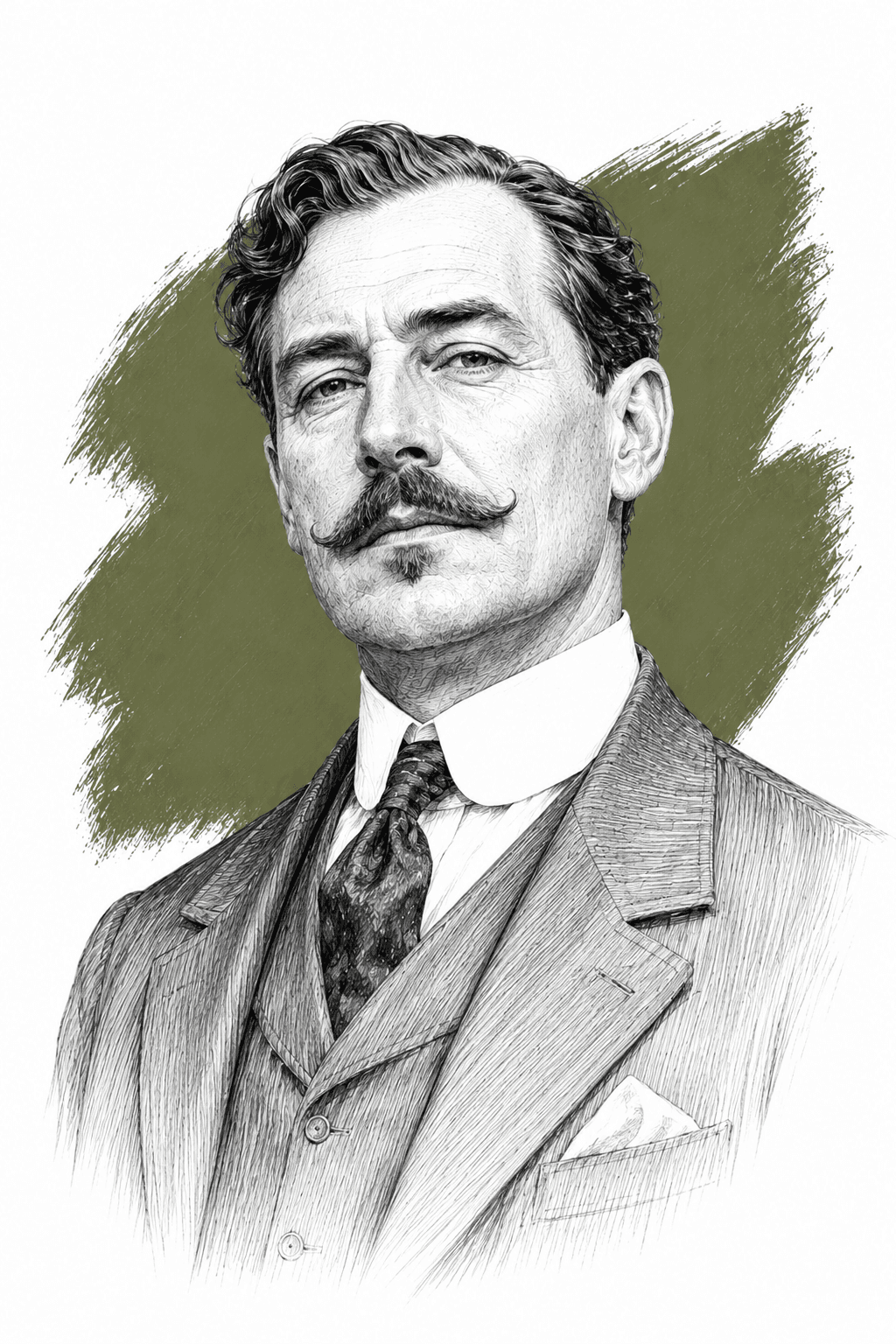
Marc Royer
The richest white man on Saint Boniface, and the most disliked. He marries Liana partly to punish the woman who would not marry him.
Marie, who will not have him, and the standing among the island's men that wanting her has cost him. Alone in the dark he puts a different ambition to himself, knowing he would never be reckless enough to say it aloud: this island is mine and I am going to take care of it.
The book

At a glance
- The richest white man on Saint Boniface, and Liana's husband
- Land, schooners, and trade — the only man on the island who gets rich
- A large house of imported furniture, with a butler, a cook and a maid
- His late brother's widow, the woman he wanted to marry; he visits her farm three nights a week
- Julie
Who they are in the book
Spoiler-freeMarc Royer has more money than anyone on an island where nobody is hungry and nobody else manages to get rich, and he keeps making more of it. He owns schooners and land and has ideas that pay. He is loud, hearty and open, and the men of Saint Boniface cannot decide whether he is genuinely clever or simply lucky, which is its own kind of insult. He built himself a large house and filled it with expensive imported furniture, and he owns the biggest radio on the island.
The one thing he wants is not for sale. Marie married his brother, who is dead now, and she is the woman Marc had wanted to marry himself. She will have him three nights a week on her own terms and will not be moved past that. Liana is sixteen when he takes her into his house. The marriage that follows, years later, is aimed at Marie as much as at anyone.
How Marc Royer Is Portrayed
- Rich, and resented for itThe other white men find it amazing and disgusting that anyone should be so successful on so small an island. They envy him the money, the house, the furniture and the radio, and each of them privately wonders whether anyone is as clever as Marc Royer. He does not seem clever. He has a loud, vulgar voice and he is friendly to everyone.
- Three nights a week at Le ParadisMarie's farm is called Le Paradis, over the hill from his own land. He drives up three nights a week. Every afternoon he stops the car at the same unmarked frontier on the first hill and looks across at it. She once told him that, after all, he is really no relation of hers, and it never occurs to her that anything he does could insult her.
- How he proposesHe does not plan it. He rides up to Lucie's shack to fetch Liana back after she has left him, sees her sitting on the floor against the wall, wants her, and realises in the same moment that marrying her would end Marie's triumph for good. So he negotiates with the mother — the priest, the farm, an annuity for life — while Liana sits on the floor of the shack, frightened, and is not asked.
- What the polish is forHe is not fooled by the acquired voice and the acquired blank face and the expensive clothes, but he finds the pose decent, because it separates his wife from the servants and gives him a feeling of dignity inside his own home. The improvements are for indoors. They are not enough for him to risk taking her out among white people.
- Cut off from the caféThe marriage costs him the company of men, which is the thing he actually likes. He sits at home with a glass of whisky telling himself there is no reason at all he could not walk down to the café for a game of dominoes, and does not go. His servants learn to leave the house when he drinks.
- Working it out on paperWhen he finally understands about Pierre and Liana, he treats it as a business problem and admires his own calm while he works through it. He concludes that the difficulty is Pierre, who is an educated European and probably believes he is in love. Of his wife he decides: “The problem is really Pierre since Liana does not count.”
Marc never confronts either of them. He decides that Pierre is noble enough to leave on his own once the war gives him a reason, and that waiting is cleverer than a scene. He is right about the leaving. He is wrong about everything that follows from it, having assured himself that Liana is the part of the problem that does not need solving.
On the last night of the book he is not thinking about her at all. He works late on his plans for the island, feels well tired, looks forward to another hard day tomorrow, and goes up to bed while his wife is bleeding to death down the hall.
If you like Liana


If you like Martha Gellhorn
Explore authors with a similar voice, perspective, and influence.
Manuel Chaves Nogales
The other great journalist of the Spanish Civil War, reporting the same conflict with the same refusal to flatter the side he preferred.
View author
Ernest Hemingway
They covered Spain together and he dedicated a novel to her. Read them side by side for how differently the same war lands in fiction and in dispatch.
View author
Henry Miller
The Brooklyn dropout who arrived in Paris broke at thirty-eight and wrote the exuberant, banned books that ended American censorship.
View author