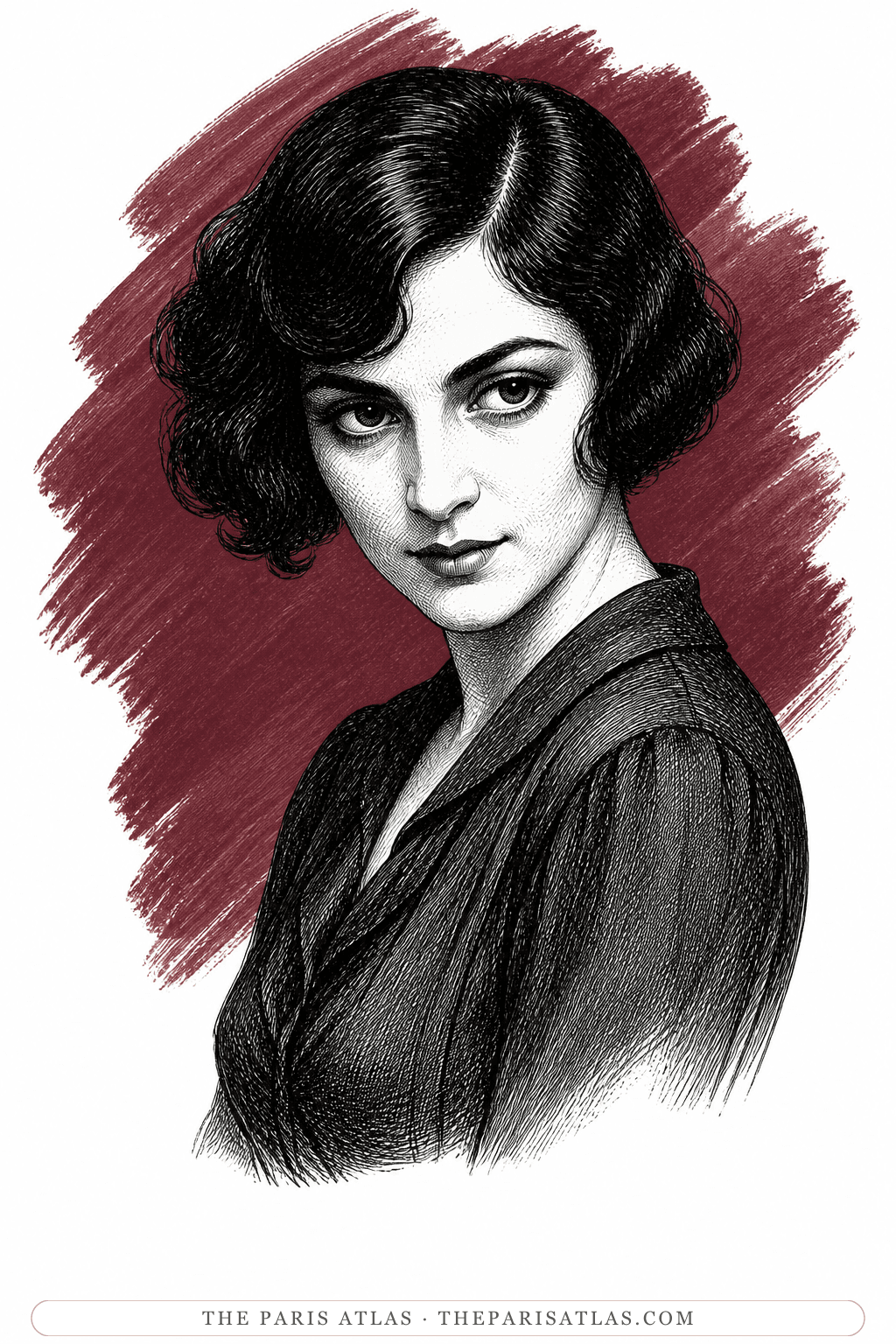
Mona
The wife at the marriage's last act — the Brooklyn ménage and the 1927 departure for Paris. June Miller, renamed.
She wants to get the two of them out of New York and to Europe, where she is sure he will finally write.
The book

At a glance
- "Mona" — the narrator's wife, who calls him Val
- Throughout, mostly in the Brooklyn flat she shares with the narrator and Stasia
- Waiting tables at the Iron Cauldron in Greenwich Village; she gives her profession as actress to one landlady and as writer to her benefactor
- Parents born in a village in the Carpathians, with a house in Vienna before Brooklyn; a father who adored her, and a sister the narrator calls the better-looking of the two
- Admirers, and an elderly man the book calls Pop who pays her for a novel her husband writes
- June Miller · 1902–1979 · New York, by way of Bukovina
Who they are in the book
Spoiler-freeMona is the narrator's wife in Nexus, the last novel of Henry Miller's three-part Rosy Crucifixion. The books are Miller's own life with the names changed. The narrator is a Brooklyn man in his thirties who intends to be a writer and has so far written almost nothing; Mona is the woman he married, and she calls him Val. When the book opens the two of them are sharing a flat with a young artist named Stasia, and the marriage has become a household of three.
Mona keeps all three of them fed. She waits tables in a Greenwich Village restaurant, and past that the money comes from men: admirers who hand over cash, dresses, dinners and steamship fares and get very little back. Her husband is told not to look too closely at how the rent is made. The largest of those arrangements is also the strangest. An elderly, cultivated man the book calls Pop offers to pay Mona to write a novel, and Mona, who has never written anything, brings the job home to her husband, who writes every page of it.
Miller's narrator is not a fair witness about his wife. He follows her, listens at doors, and reads invented gossip back to the two women to see what they will let slip; Mona's own dig at him is that he pries into women's purses looking for names and addresses. What he reports is someone who lies about small things as readily as large ones, who will not say a word about her own childhood, and who is performing at all hours. He reports one other thing, in a rare moment of clarity: of the three people in that flat, she is the only one who knows what she wants.
The book is explicit about the marriage and about her body in particular. Nexus was published in Paris in 1960, and the American edition did not follow until 1965. Sleeping with another woman while Mona is abroad, the narrator decides the difference is that the other woman is only what you can see and touch, while any part of Mona sets him off. "Her body echoed her moods."
She is June Miller, Henry Miller's second wife, renamed. This profile is drawn from the Grove Press text, read in the Internet Archive's scan.
How Mona Is Portrayed
- Watched from the streetThe narrator spends much of the book following his wife. At four in the morning he walks to the subway station to look for her and finds her strolling through the drifting snow with a wrestler friend named Jim Driscoll, both of them laughing and humming. "You would think, to see them, that they were looking for violets in a golden meadow." Other nights he stands at the railing outside the Iron Cauldron, the Greenwich Village restaurant where she waits tables, and watches her through the window. The two tables nearest the glass are hers. She trots back and forth in the candlelight with a cigarette glued to her lips, smiling at her customers.
- Everyone is either mad or a foolBy the narrator's account, every person Mona admires is "mad" and everyone she dislikes is a "fool" — and when she means to pay her husband a compliment she calls him a fool too. "You're such a dear fool, Val." She means that he is complicated enough to belong in a Dostoevsky novel. When she is carried away she tells him he is another Dostoevsky.
- She will not talk about her childhoodThe narrator cannot get a single childhood story out of her. She never mentions a street she played on, a game she liked or a friend she had. Asked point blank whether she can skate or swim, she says yes, of course, and moves on; details bore her. He steers the conversation toward Russia, Roumania and Vienna to see whether anything registers, and she talks about those places as though she had read them in a travel book.
- Arguing with his mother at Christmas dinnerHe brings Mona and Stasia to Christmas dinner at his parents' house. His mother has no time for his writing and calls it scribbling, and Mona takes her on across the table. "He works harder at his writing than he possibly could at any job. That is his job, scribbling, as you call it. It's what he was born to do." Then she says a thing her husband has not heard from her before: "I wish to God I had a vocation, something I could pursue with all my heart, something I believe in absolutely."
- The novel she is paid to writePop, the elderly admirer, pays Mona for a novel her husband is actually writing. She carries the pages to him and comes home with the money, the wine and the praise, and she asks her husband to coach her so she can answer Pop's questions about her own book. When Pop wonders aloud how a young woman came by such strange images, she has no answer ready. Some of them, the narrator admits, were lifted out of almanacs.
- Kneeling to keep Stasia in the houseWhen Stasia threatens to move out, Mona kneels at her chair, puts her head in her lap and begs her to stay. "I'm nothing without you. And now that you're friends at last, why can't we all live together in peace and harmony? I'll do anything you ask. But don't leave me, please!" Watching, her husband decides she has been taken in by her own acting, and then that she may be the most sincere of the three of them, because at least she knows what she wants.
- The night he sees where she comes fromYears earlier the narrator had gone to Mona's Brooklyn address to find out whether she really lived there or had given him a false one, and her brother shut the door in his face. Now he is invited in. He writes down the name of the village in the Carpathians where her parents were born, studies a photograph of the house they lived in in Vienna, and goes through her pictures: the baby in swaddling clothes, the foreign-looking child with long black ringlets, and the fifteen-year-old in clothes he calls grotesque, whom he compares to the stage actresses Réjane and Modjeska.
- The man who hanged himself over herMarco sold jokes to magazines for a living and turned every penny over to Mona, who took the money without thanking him. He told her many times that he loved her and many times that he would kill himself if she would not have him, and she laughed at him and sent him away. One morning he was found hanging from a rafter in his garret. He left no note.
- Europe as the answer to everythingLeaving for Europe is Mona's idea. She puts it to the table one evening — "Why don't we all go to Europe?" — and when her husband asks how they would live there she says, "Like we do here," and then, "It's simple." He tells her she is dangling the word in front of him like bait. Later she says it straight: "All I live for is to see you do what you want to do. You should trust me, trust me to do what's best for you. Once we get to Europe things will work out differently. You'll blossom there, I know it."
Mona and Stasia sail for Europe without him. He finds out from a note: "Dear Val," it ran. "We sailed this morning on the Rochambeau. Didn't have the heart to tell you. Write care of American Express, Paris. Love." The letters that follow are short and happy — a clean, cheap hotel on the rue Princesse, new American friends, no word on how they are paying for any of it — and then come the cables asking for money.
She comes back alone. She wires that her boat arrives Thursday; he is at the pier an hour early, and neither her name nor Stasia's is on the passenger list. When she does turn up, this is her account of the delay: "Yes, Val, to get back to you I had to promise Roland, the man who took me to Vienna, that I would sail with him. I agreed on condition that he would wire Stasia the money to leave Africa. He didn't do it." Stasia is never heard from again, and the narrator catches himself wondering whether she is in Paris, waiting.
After that the marriage settles. They take rooms in a brownstone, Mona shops and cooks and they play bad chess in the evenings, and the novel for Pop gets written. The money arrives, and Nexus ends with the two of them leaving for Europe. That crossing is what puts the narrator in the Paris of Tropic of Cancer. Miller planned a further volume of Nexus and never wrote it, so the departure is where he left the marriage.
If you like Nexus


If you like Henry Miller
Explore authors with a similar voice, perspective, and influence.

Louis-Ferdinand Céline
Miller's acknowledged master at making literature out of the gutter. Journey gave him permission; Cancer is what he did with it.
View author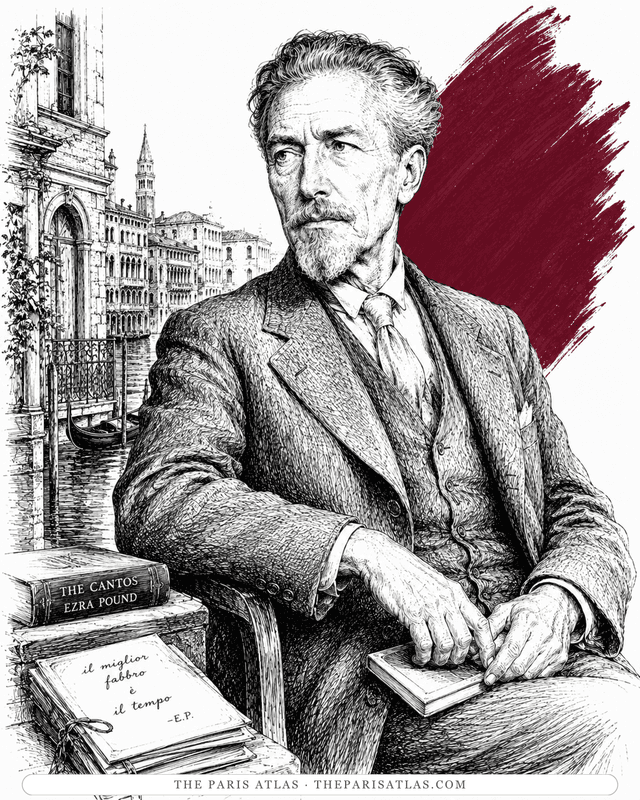
Ezra Pound
Pound read Cancer and sent Miller a famously backhanded postcard. Both believed literature's job was to wake the reader by any means necessary.
View author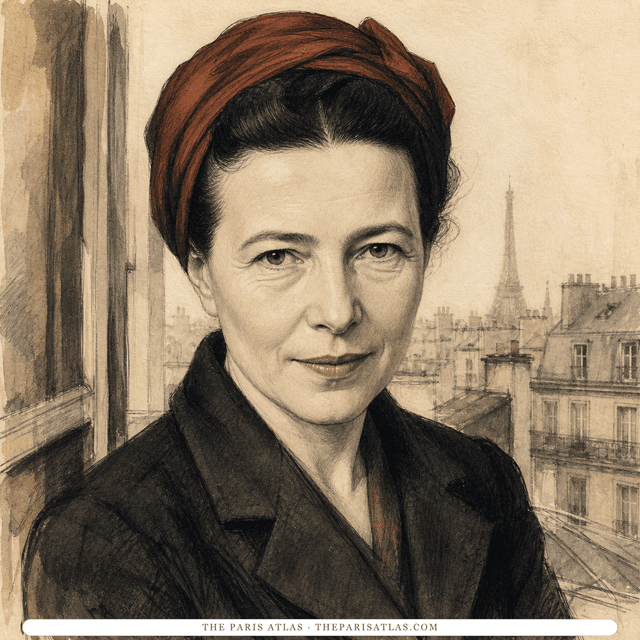
Simone de Beauvoir
French writer and philosopher whose novels, memoirs, and social analysis examined freedom, gender, responsibility, aging, and the material conditions that shape a life.
View author