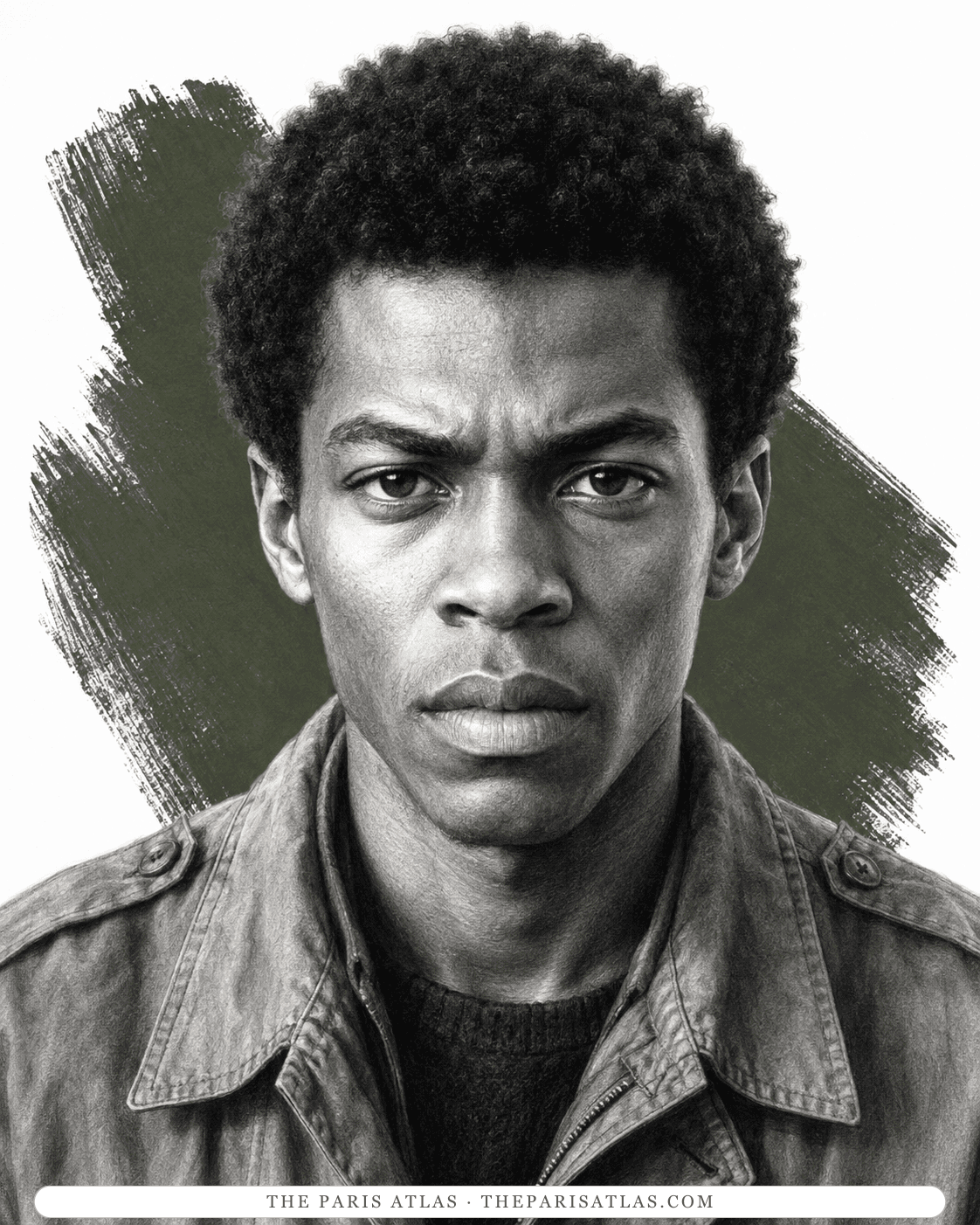
Christopher
A young Black activist, and the newer attachment. The argument he brings about how change actually happens is the one the novel takes most seriously.
Not to be out in the cold on his own. He puts it to Leo in exactly those words: he does not want to be out there hungry and cold and alone, and he tells him to stop worrying about what people will say and love him.
The book

At a glance
- A young Black man in New York; Leo's lover
- Christopher Hall
- Nearly twenty years younger than Leo, who is thirty-nine
- Partly at Leo's apartment, with his own key; partly with a sister Leo has not met
- In the streets, in lofts, in basements, on rooftops — Leo did not ask
- Camus, Fanon, Mao; Muhammad Speaks
- Big Daddy
- Two, and he did not like them much
Who they are in the book
Spoiler-freeChristopher Hall is an invented character in James Baldwin's fourth novel: a young Black man in New York, nearly twenty years younger than the narrator, Leo Proudhammer, and by the time the book opens his lover.
They met at a party while Leo was in rehearsal and did not see each other again until the play had opened and settled into its run. At the second party Leo had eyes for nobody else, and Christopher, who had been about to leave, waited. Leo's account of what followed is unsentimental: a double-minded man is no match for a single-minded boy. Christopher decided he needed him and said so, and was entirely untroubled by what anyone would call it.
He lives partly at Leo's apartment and partly with a sister Leo has not met, has his own key and the run of the place, and treats Leo's possessions with far more care than Leo does. Most of his life before this took place in the streets, in lofts, in basements and on rooftops, and Leo says he did not want to know the details. His friends are all Black, young, broke and reading: Camus, Fanon, Mao, Muhammad Speaks under the arm, Castro berets and beards, and, in Leo's reading of them, a good deal younger and shyer than they think.
He calls Leo Big Daddy, nurses him, guards him, and argues with him. Leo is nearly twenty years older and says plainly that none of his own work, and none of the work of all the people who came before him, has made Christopher's life any less dangerous. That is what they argue about, and the novel gives Christopher's side of it as much room as Leo's.
How Christopher Is Portrayed
- How he looksLong and black, in a black suit, with a big face and big hands. Leo notes the hand that grasps his the first time, very large and dry, and a nervous alertness in the way he stands that makes him look poised to run. Leo calls him black in colour, black in pride and black in rage.
- Big DaddyWhat he calls Leo, from early on. Arriving in California he tells Leo off for falling flat on his face in front of umpteen million people, announces that he is not letting him out of his sight again, and takes the coffee away because it is bad for his heart, returning with milk to put in it and instructions about how much.
- The fruit basketIt reaches Leo's hospital room in California with a telegram instead of a card, telling him to stop jiving the people and get himself back, signed with love. Christopher and his friends have no money. Leo works out that arranging it from New York must have taken real ingenuity, and finds that he cannot feel anything about it.
- At the rallyLeo speaks at a protest in a park near City Hall and is then trapped on the platform by the crowd and pushed off it by police. Christopher leaps up, puts his body in front of Leo's with his arms out, signals five friends who join hands into a human barricade, walks him to the car and gets him inside. In the car he turns his fury on Leo, because the two people in the front are white.
- What he thinks of the churchTending bar at a brunch for Barbara's Kentucky family, he says that so many Black Americans come out of the church because the church was the only thing the white man let them have. Pressed on why he says it, he answers that he says it because it is true.
- The account he gives the KingsHe lays it out for Barbara's family from the middle of the floor: the Indians killed and their land taken, people kept apart so they could not talk to each other and work out how to be rid of their owners, and Jesus handed down with the message that the arrangement was the Lord's will. He asks whether anyone wants to tell him different, then goes into the kitchen and asks how they all like their eggs.
- What he reads and who he brings homeFriends in Castro berets and beards, parkas and thin jeans and heavy boots, carrying Camus or Fanon or Mao, or Muhammad Speaks. They are proud of Christopher for knowing Leo and pleased with Leo for knowing Christopher, and, Leo thinks, fighting an impulse to trust rather than incapable of it.
- AfricaHe had always wanted to see it, and part of what drew the two of them together was that Leo had. Leo once told him the structure of his face reminded him of faces he had seen in Dakar, which delighted him, and which Leo came to regret, because it handed him a power over the boy that he did not want.
- With Leo's fatherThe old man adored him. The two of them spent hours together reconstructing the Black empires of the past and planning the demolition of the white empires of the present, which was good for Leo's father and good for Christopher, who had found somebody old he could trust.
The argument he has been building all book arrives at the end.
If you like Tell Me How Long the Train's Been Gone


If you like James Baldwin
Explore authors with a similar voice, perspective, and influence.

Louis-Ferdinand Céline
The doctor of the Paris slums who wrote the century's blackest, funniest novel — and changed the sound of French prose.
View author
Henry Miller
The Brooklyn dropout who arrived in Paris broke at thirty-eight and wrote the exuberant, banned books that ended American censorship.
View author
Ernest Hemingway
Author of The Sun Also Rises and A Moveable Feast; his pared-down style, developed in 1920s Paris, became the most imitated in American prose.
View author