Albert de Morcerf
Fernand and Mercédès's son, kidnapped by bandits in Rome, who brings the count into Paris and then challenges him.
He wants to be seen as a man of honour, and the newspaper article about his father takes that away.
The book
The Count of Monte Cristo
Alexandre Dumas
At a glance
- No. 27 Rue du Helder, Paris
- Not yet twenty-two in 1838
Who they are in the book
Spoiler-freeAlbert is a young viscount not yet twenty-two, good-natured and idle, whom the count meets at the Roman carnival. Bandits take him, the count gets him back, and Albert repays the favour by introducing the count to everyone in Paris. He is the only member of the Morcerf family the count does not want to destroy.
How Albert de Morcerf Is Portrayed
- Carnival in RomeIn Chapters 36 and 37 he chases a masked woman through the carnival and is kidnapped by Luigi Vampa's men. The count walks into the catacombs and has him released without a ransom.
- The breakfastIn Chapter 40 he hosts the count at No. 27 Rue du Helder on 21 May, with his friends Beauchamp, Debray, Château-Renaud and Maximilien Morrel at the table.
- The insultIn Chapter 88 he enters the count's box at the Opera and challenges him in front of the house, believing the count arranged his father's disgrace.
- The meetingIn Chapter 90 he arrives at the Bois de Boulogne, and instead of fighting, apologises to the count in front of the seconds. His mother has told him what his father did.
Albert de Morcerf quotes
Edmond, you will not kill my son!
He renounces his father's name and fortune, leaves with his mother, and enlists as a soldier in Africa under the name Herrera, his mother's maiden name.
If you like The Count of Monte Cristo


If you like Alexandre Dumas
Explore authors with a similar voice, perspective, and influence.
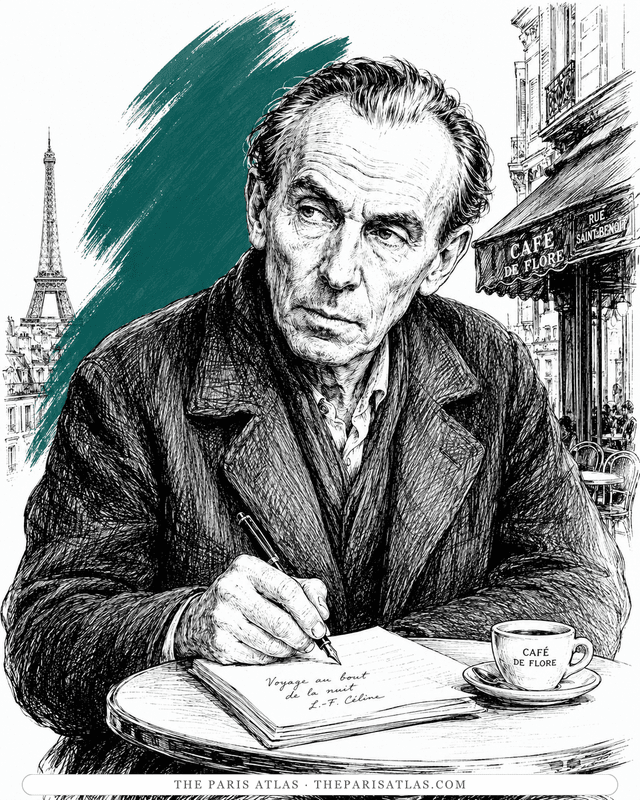
Louis-Ferdinand Céline
The doctor of the Paris slums who wrote the century's blackest, funniest novel — and changed the sound of French prose.
View author
Charles Dickens
The most popular English novelist of the nineteenth century, who was never a Paris resident in the ordinary sense but kept coming back for twenty-five years: one winter in a rented mansion on the rue de Courcelles, a second winter on the Champs-Élysées writing Little Dorrit, repeated compulsive visits to the Paris Morgue — the riverside building where the city displayed its unidentified dead to the public — and a novel of the French Revolution, A Tale of Two Cities, that has shaped how English readers picture Paris ever since.
View author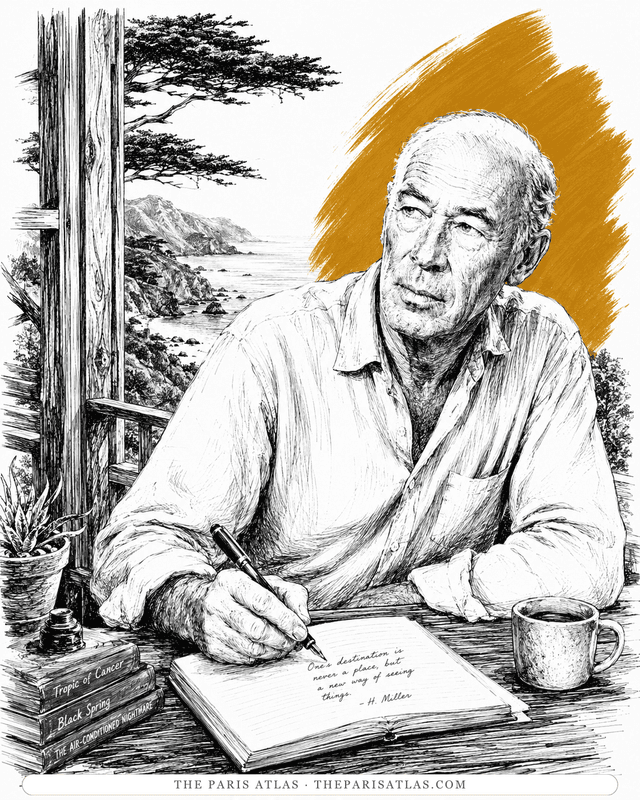
Henry Miller
The Brooklyn dropout who arrived in Paris broke at thirty-eight and wrote the exuberant, banned books that ended American censorship.
View author