Maximilien Morrel
The shipowner's son, an army captain, whom the count treats as the one person in Paris he owes something to.
He wants to marry Valentine, whose father has promised her to someone else.
The book
The Count of Monte Cristo
Alexandre Dumas
At a glance
- Captain of Spahis
- No. 14 Rue Meslay, Paris
Who they are in the book
Spoiler-freeMaximilien is the son of Morrel, the Marseille shipowner who tried to save Dantès in 1815 and whom Dantès in turn saved from ruin. In Paris he is a captain of Spahis, in love with Valentine de Villefort, and the count's most trusted friend. The count's promise to him is the thread the last quarter of the book hangs on.
How Maximilien Morrel Is Portrayed
- The fifth of SeptemberIn Chapter 30 he arrives from his regiment on the day his father means to shoot himself, and is there when the Pharaon, rebuilt and paid for by an unknown hand, sails into the harbour.
- The Rue MeslayIn Chapter 50 the count visits the Morrels at No. 14 Rue Meslay and finds the red silk purse from 1829 kept under glass like a relic.
- The gate in the wallIn Chapter 51 he and Valentine meet through the iron fence of the Villefort garden in a lucerne field, a courtship conducted entirely through bars.
- The avowalIn Chapter 94, after Valentine is poisoned, he tells the count everything and threatens to kill himself if she dies. The count makes him promise to wait one month.
Maximilien Morrel quotes
until the day when God shall deign to reveal the future to man, all human wisdom is summed up in these two words,—‘Wait and hope.’
Valentine's death is staged by the count. On 5 October Maximilien comes to the island of Monte Cristo expecting to die and finds her alive. The count leaves the couple his island, his fortune and the letter that ends the book.
If you like The Count of Monte Cristo


If you like Alexandre Dumas
Explore authors with a similar voice, perspective, and influence.
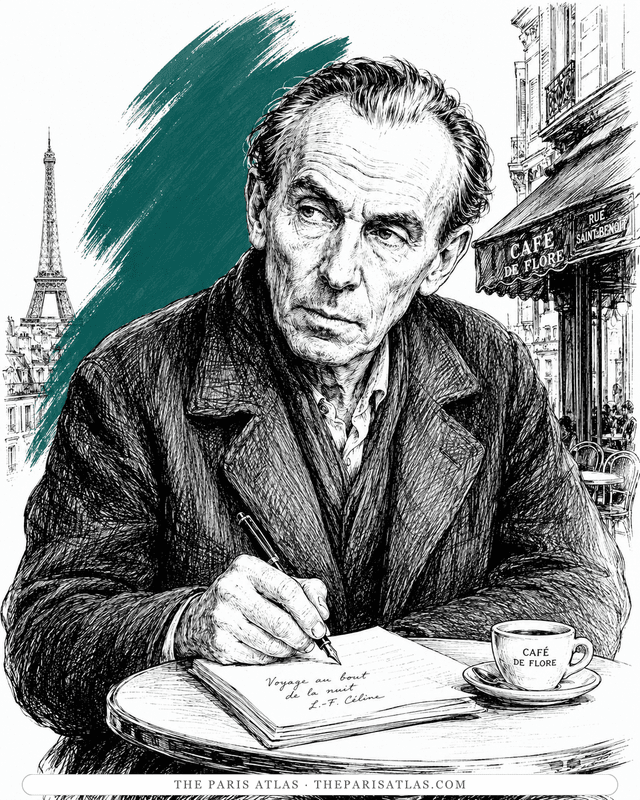
Louis-Ferdinand Céline
The doctor of the Paris slums who wrote the century's blackest, funniest novel — and changed the sound of French prose.
View author
Charles Dickens
The most popular English novelist of the nineteenth century, who was never a Paris resident in the ordinary sense but kept coming back for twenty-five years: one winter in a rented mansion on the rue de Courcelles, a second winter on the Champs-Élysées writing Little Dorrit, repeated compulsive visits to the Paris Morgue — the riverside building where the city displayed its unidentified dead to the public — and a novel of the French Revolution, A Tale of Two Cities, that has shaped how English readers picture Paris ever since.
View author
Henry Miller
The Brooklyn dropout who arrived in Paris broke at thirty-eight and wrote the exuberant, banned books that ended American censorship.
View author