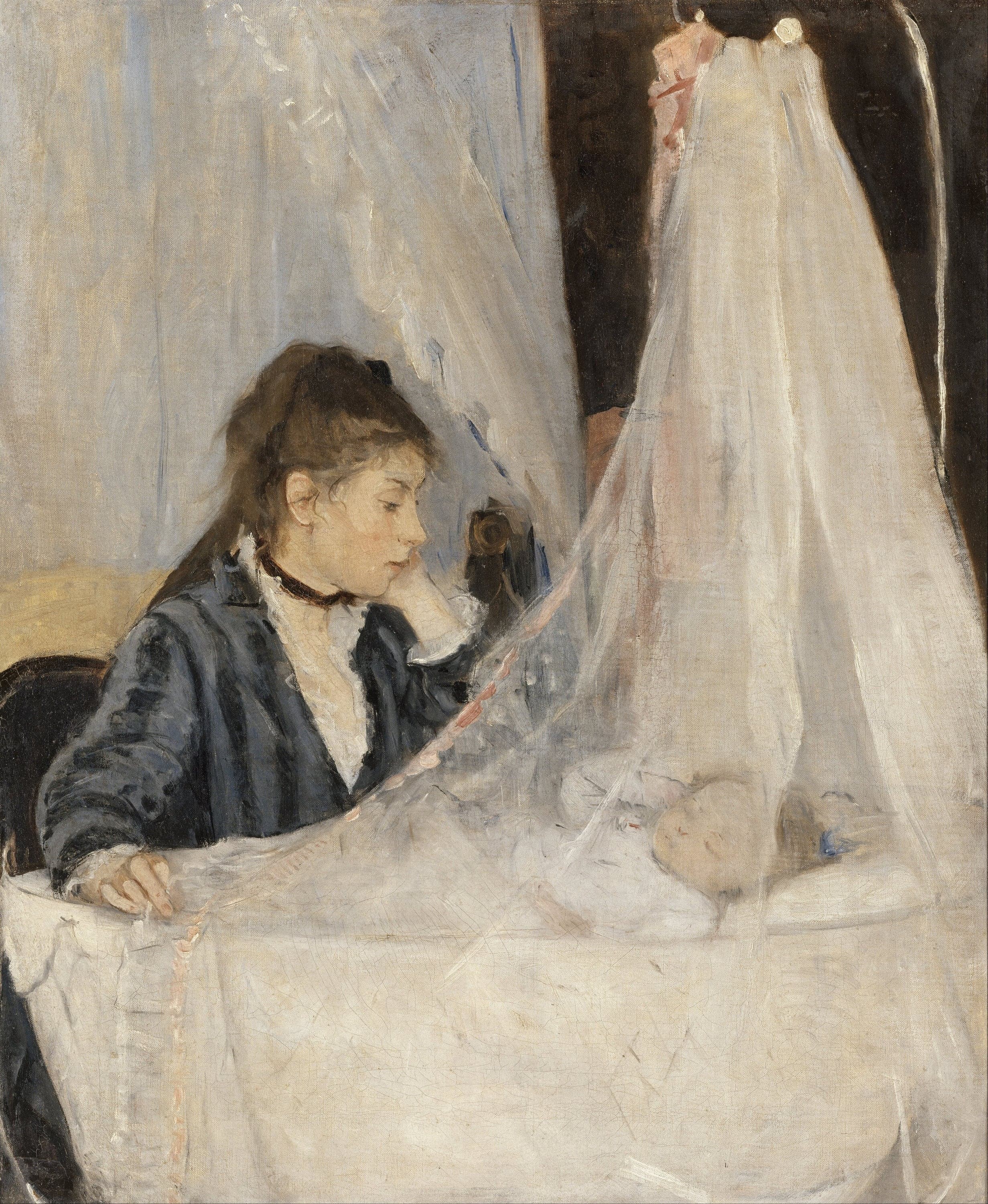
The Cradle
A woman in dark blue leans on one hand and watches a baby asleep behind a veil of white muslin. Berthe Morisot painted her sister Edma Pontillon and Edma's daughter Blanche in Paris in 1872, and showed the canvas as number 104 at the first Impressionist exhibition in April 1874. Nobody bought it. The French state acquired it in 1930, and it has been at the Musée d'Orsay since 1986.
- 1872
- Oil on canvas
- Musée d'OrsayParis, France
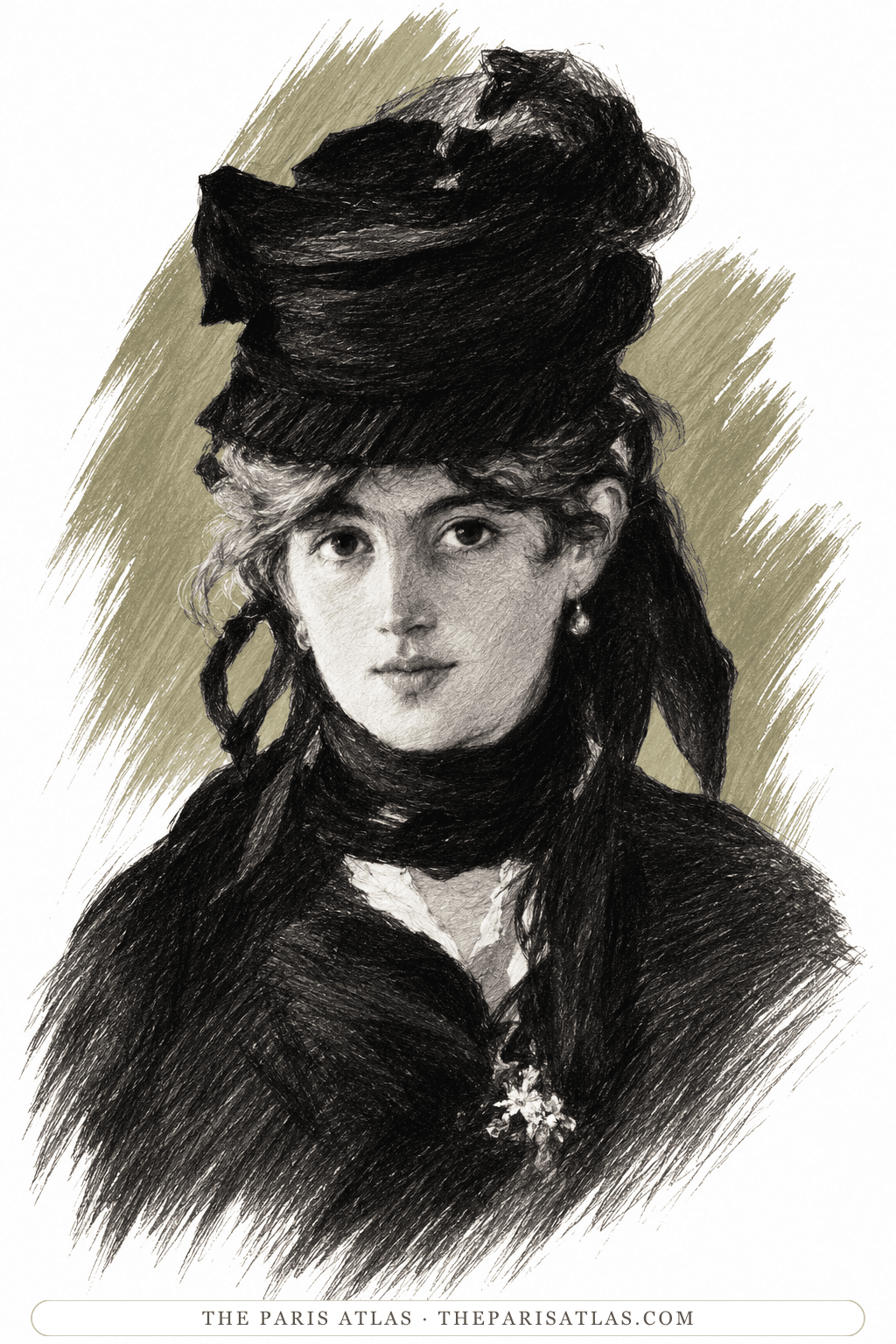
About Berthe Morisot
What the painting shows
A young woman sits at the left in a dark blue-black jacket with a white lace collar and a thin dark brown ribbon at her throat. Her brown hair is pinned up with a black bow at the crown. Her left elbow rests on the edge of the cradle and her cheek leans into that bent hand. She is looking down and to the right, at a baby asleep beneath a canopy of white gauze.
The gauze does most of the work. It falls from a knot of pink ribbon and a cream rosette near the top of the canvas and crosses the whole right half. Its near edge passes across the child's body rather than over the face, which stays the most clearly drawn passage on that side. The woman's right hand rests at the lower left, fingers closed over the cradle's near rim.
Almost everything else is white on white: the canopy, the cradle skirt, the collar, the curtain behind her. The background at the upper right is a dark brown close to black, broken only by one pale vertical stroke near the edge. A pale blue-gray curtain hangs behind her head. The Musée d'Orsay records the canvas as 56 by 46.5 centimeters.[1]
Edma and Blanche
The woman is Edma Pontillon, Berthe Morisot's older sister, who had trained as a painter alongside her and gave it up after her marriage in 1869 to Adolphe Pontillon, an acquaintance of Édouard Manet's.[2] The baby is Edma's daughter Blanche, born on 23 December 1871.[3] The painting was made a few months later.
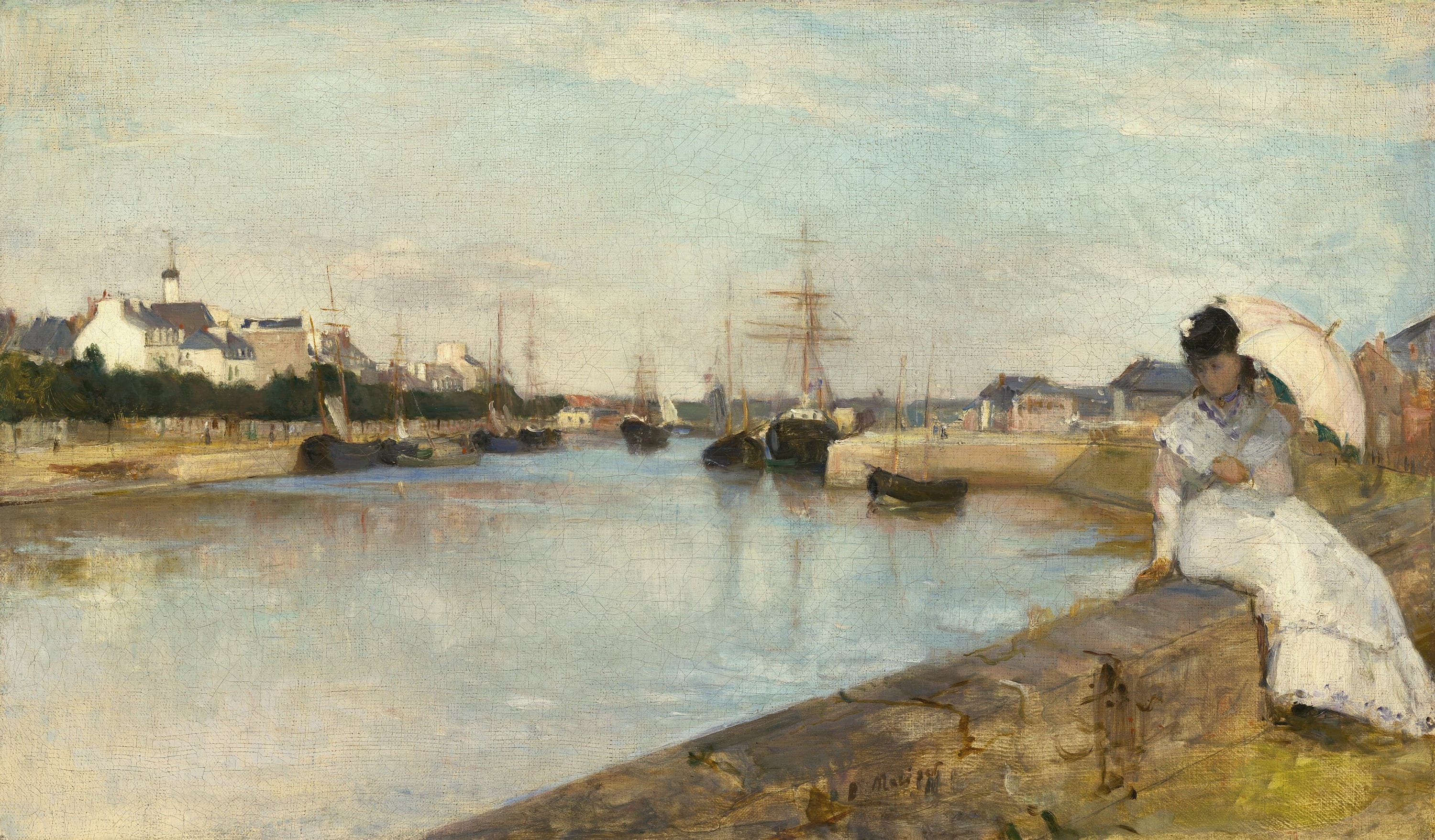
It is the first picture of motherhood in Morisot's work, and the subject came back for the rest of her career.[1] Edma sat for her sister more than once. In the summer of 1869 Morisot visited her at Lorient and painted The Harbor at Lorient, which shows Edma on a parapet in the foreground, and Young Woman at a Window.[2]
The Musée d'Orsay reads the composition as a line rather than a pair of figures. Edma's gaze, her bent left arm, the baby's answering arm and its closed eyes fall along one diagonal, picked up again by the movement of the curtain behind her. Drawing the net between the viewer and the child is the gesture that closes the picture off.[1]
Number 104 in 1874
On 15 April 1874 the Société Anonyme des Artistes Peintres, Sculpteurs, Graveurs, etc. opened its first exhibition in the photographer Nadar's studio at 35 boulevard des Capucines. Around thirty artists hung roughly 200 works, with no jury and no prizes.[4] The Cradle was catalogue number 104.[1]
The show did not work by the measures of the day. It drew about 3,500 visitors in a month against half a million at the official Salon, sold very little, and gave the critic Louis Leroy the opening to use the word impression as an insult.[4]
“That young lady does not waste time on reproducing a host of boring details. When she has a hand to paint, she simply applies as many brushstrokes as there are fingers and the job is done!”
Accounts differ on how many works Morisot sent and on how to describe her place in the group. The Musée d'Orsay calls her the first woman to exhibit with the Impressionists.[1] The biographical entry in Women in World History says she was the only woman among the thirty artists in the 1874 show, and that she hung ten works there, possibly more.[2]
Unsold, and then bought by the state
According to the Musée d'Orsay, the painting was barely noticed in 1874, though several serious critics remarked on its grace and elegance. Morisot tried to sell it, failed, and withdrew it from view. It stayed with Edma's family until the French state bought it in 1930.[1]
The museum's ownership chain runs from the Pontillon collection to Madame Forget, née Blanche Pontillon — the sleeping child in the picture — and then to the Musées nationaux, which bought it in 1930 for the Musée du Louvre. It hung in the Louvre's galerie du Jeu de Paume from 1947 to 1986, and moved to the Musée d'Orsay when that museum opened.[1]
Why a mother and a cradle in 1872
Maternal tenderness was a favorite nineteenth-century French subject, and the historian Ivan Jablonka groups The Cradle with other paintings of the period as a modern version of the Virgin and Child.[5]
Jablonka also notes what the pictures leave out. Large numbers of French infants were still sent away to wet nurses in these decades, and mothers feeding their own babies remained uncommon, so the imagery ran ahead of the practice.[5] The two people in this canvas were Morisot's own sister and niece.
Close reading
Reading the work, detail by detail
Almost the whole canvas is white cloth. These six views follow the mother's face and hands, the sleeping child, and the places where Berthe Morisot lets one white sit against another.
1.The mother's face
Edma Pontillon looks down and to the right, at the child. The face is the most finished passage in the painting: firm along the nose and jaw, with the eyelid drawn in a single dark line. Only one eye shows, and nothing else in the picture is described this closely.
2.The hand under the chin
Her left elbow rests on the edge of the cradle and her cheek leans into that bent hand. The pose is the one that holds the picture still. The Musée d'Orsay reads the bent left arm as part of a diagonal that runs from her eyes down to the baby's.
3.The sleeping child
Blanche Pontillon lies with her head to the left and her eyes closed. The veil's near edge passes across her body rather than over her face, so the head is the clearest drawing in that half of the canvas. Small touches of red mark the nose and mouth.
4.The pink ribbon
The canopy is gathered at the top and tied with ribbon that runs from pale pink to terracotta, with a cream rosette beside it. The brown ground behind is warm too, but the ribbon is the only clear pink in the canvas. Everything below hangs from that point.
5.The hand on the cradle rim
Her right hand rests on the cradle's near rim, fingers closed over the rolled edge rather than gripping a fold. A pale pink ribbon hangs from beside it down the cradle skirt. The hand keeps her in contact with the cradle while her weight goes into the other arm.
6.White against white
The cradle skirt, the canopy and the sheet are all white, separated only by temperature. Morisot works in cream, gray-green and pale blue, and the drawn line disappears completely in this part of the canvas.
Timeline
1869
Edma Morisot marries Adolphe Pontillon and gives up painting. Berthe Morisot visits her at Lorient that summer and paints her twice.
1871
Blanche Pontillon, Edma's daughter, is born on 23 December.
1872
Morisot paints The Cradle in Paris.
1874
Shown as catalogue number 104 at the first Impressionist exhibition, which opens on 15 April in Nadar's studio at 35 boulevard des Capucines. It does not sell.
1896
Included in the Morisot memorial exhibition at the galerie Durand-Ruel, Paris, the year after her death.
1930
Bought by the Musées nationaux for the Musée du Louvre, out of the collection of Madame Forget, née Blanche Pontillon — the baby in the cradle. Accession RF 2849.
1947
Displayed in the Louvre's galerie du Jeu de Paume until 1986.
1986
Assigned to the Musée d'Orsay, Paris.
Where to see it

Musée d'Orsay
Esplanade Valéry Giscard d’Estaing, 75007 Paris, France
Collection locations and gallery displays can change. Check the official object record before making a special visit.
Plan your visitFrequently asked questions
Who is the woman in The Cradle?
Edma Pontillon, Berthe Morisot's older sister. The two trained together as painters, and Edma stopped after her marriage in 1869 to Adolphe Pontillon. She sat for several of Morisot's early canvases, including The Harbor at Lorient.
Who is the baby in The Cradle?
Blanche Pontillon, Edma's daughter, born on 23 December 1871. She is the sleeping child behind the gauze. The Musée d'Orsay's ownership chain records her, as Madame Forget, as the owner from whom the painting passed to the French state in 1930.
Where is The Cradle?
The Musée d'Orsay in Paris, accession number RF 2849. It was bought for the Musée du Louvre in 1930, hung in the galerie du Jeu de Paume from 1947, and was assigned to the Orsay in 1986. Gallery displays change, so check the museum's object record before a special trip.
How big is The Cradle?
56 by 46.5 centimeters, about 22 by 18 inches. The Musée d'Orsay gives the framed size as 80 by 71 centimeters. It is a small painting that is usually reproduced large.
Was The Cradle in the first Impressionist exhibition?
Yes, as catalogue number 104. The exhibition opened on 15 April 1874 in the photographer Nadar's studio at 35 boulevard des Capucines, run by the Société Anonyme des Artistes Peintres, Sculpteurs, Graveurs, etc.
Did The Cradle sell in 1874?
No. The Musée d'Orsay records that the painting attracted little attention, that Morisot's attempts to sell it failed, and that she then withdrew it from display. It remained in Edma Pontillon's family for fifty-eight years.
What is the white fabric over the baby?
A gauze canopy hung from the cradle's frame, gathered at the top with pink ribbon and a cream rosette. It falls across the right half of the canvas. Its near edge passes over the child's body and stops short of the face, which is left clear.
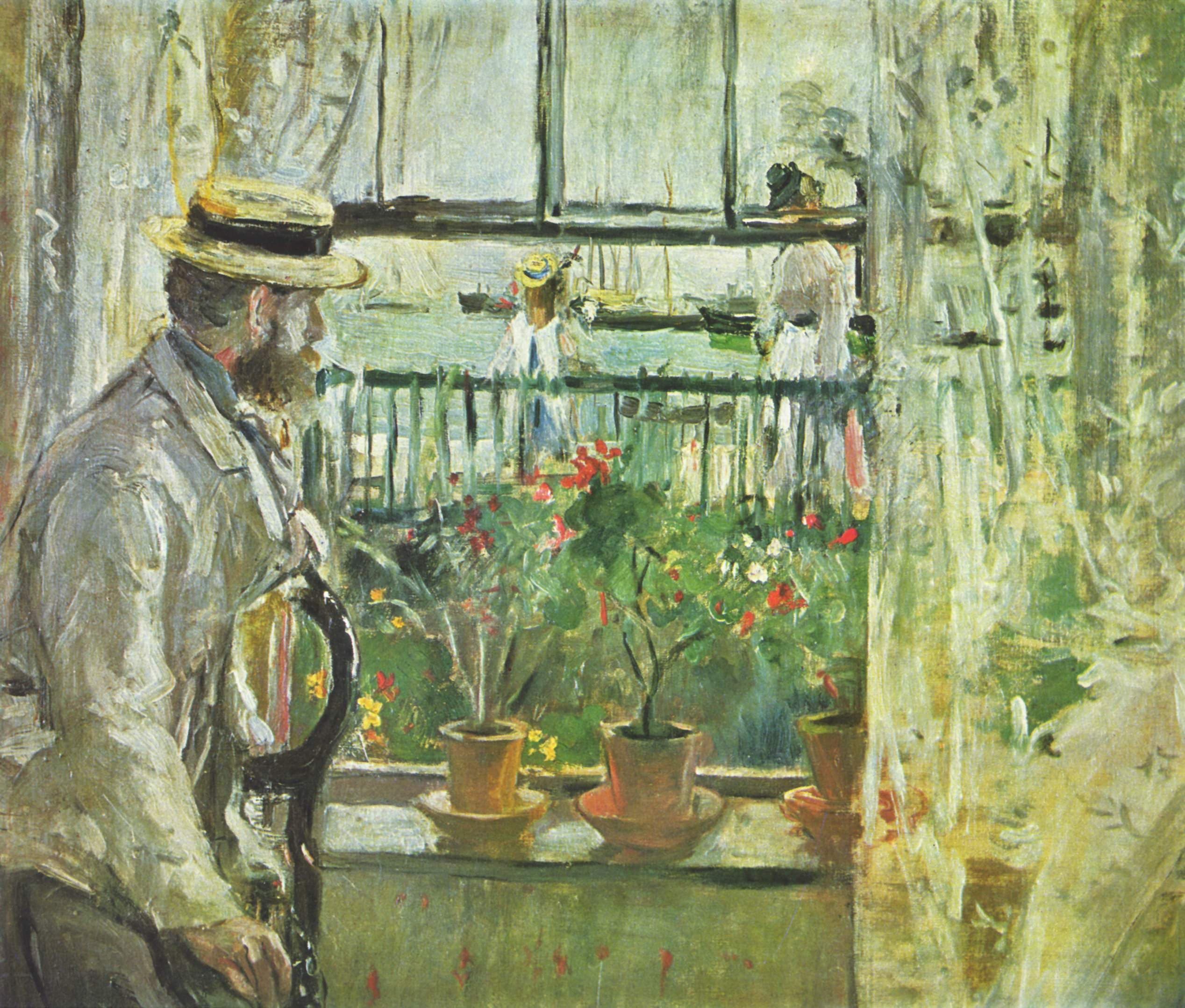
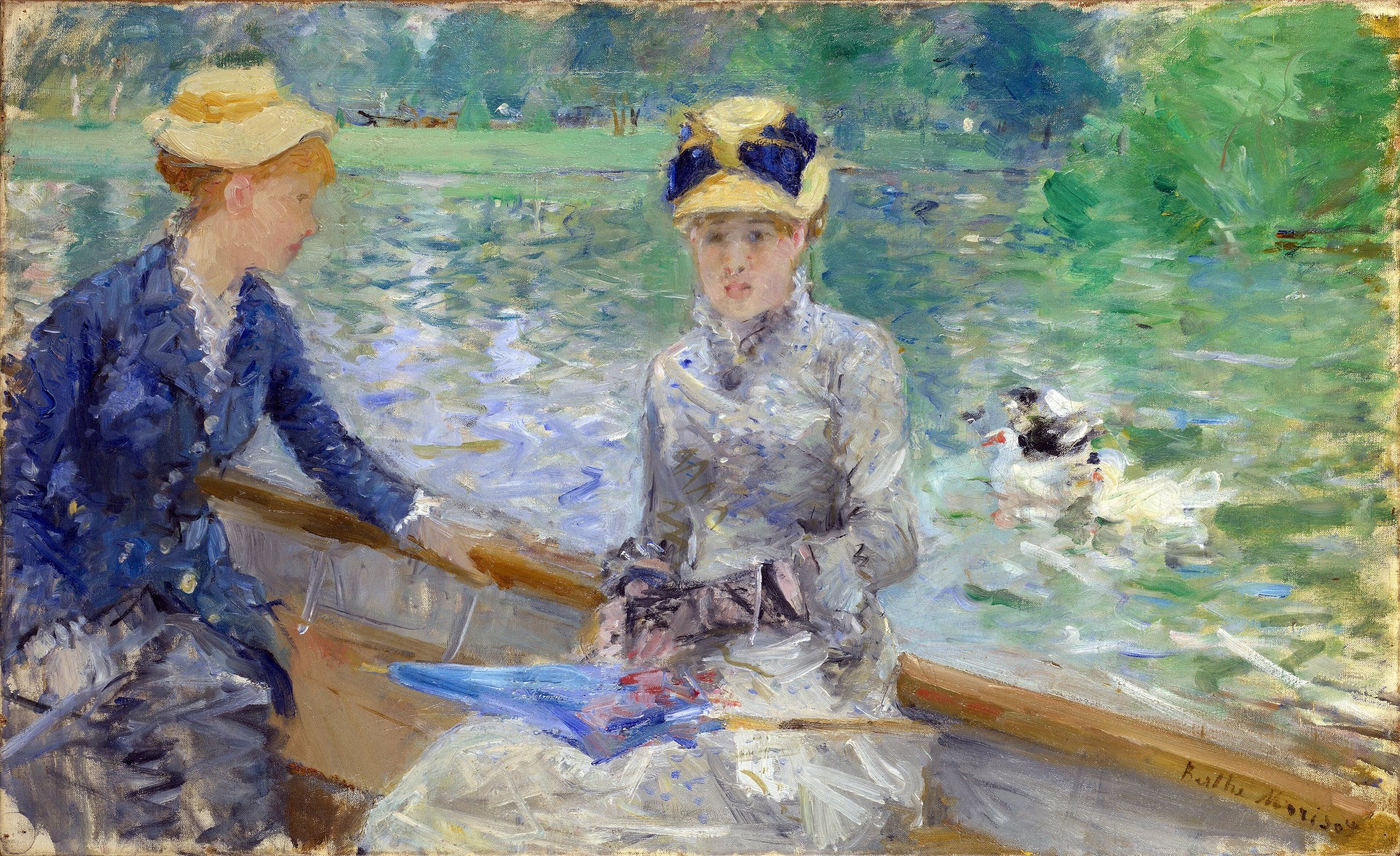
More by Berthe Morisot
If you like Berthe Morisot
Explore painters from the same movements and circles.
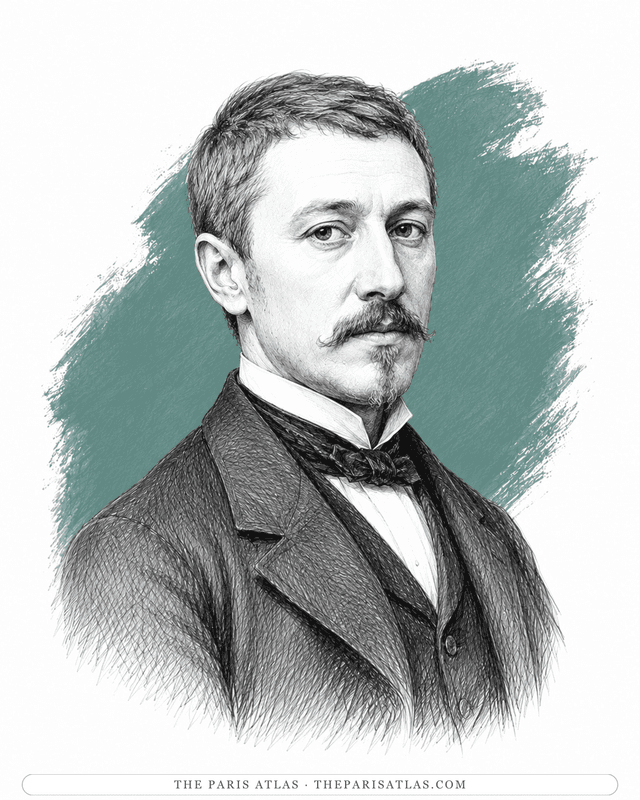
Gustave Caillebotte
Painter of Haussmann's geometry and the group's organizer-financier; his bequest of Impressionist paintings forced the French state to take the movement in.
View artist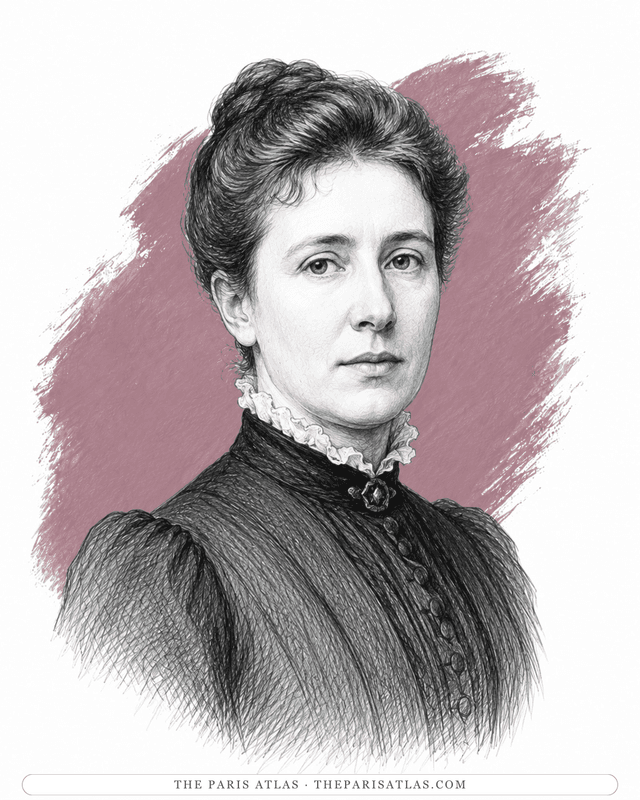
Mary Cassatt
Mary Cassatt was an American painter and printmaker known for her depictions of women and children. Based in France for the last fifty-two years of her life, she was the only American to exhibit with the original French Impressionist group, participating in four of its eight exhibitions. Edgar Degas invited her to exhibit with the group in 1877 after the Salon jury rejected her submissions.
View artist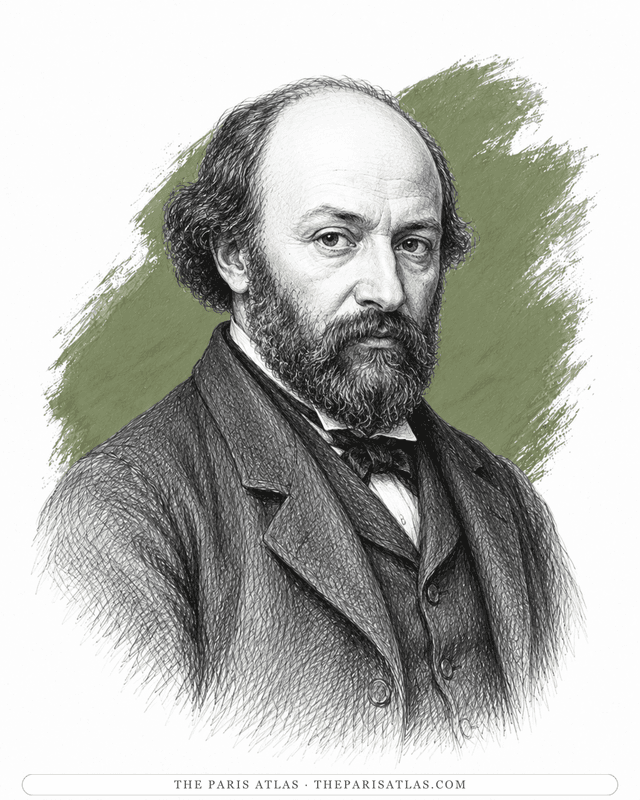
Paul Cézanne
Painter between Impressionism and everything after — shown in the independents' exhibitions, emulated by the Cubists, and present at the Orangerie through 15 works in the Walter-Guillaume collection.
View artist
References
The sources below include collection records, catalogues, scholarly research, and primary materials that informed this page. They document The Cradle, its making, and its place in cultural history.


3↑Le Berceau
WebsitePanorama de l'art, Réunion des musées nationaux – Grand PalaisUsed forWeb source consulted for documented facts and historical context presented on the The Cradle page.
These references provide the documented foundation for this work's history and interpretation. Claim-level citations remain attached to the specific claims they support.
 Explore more resources