The Harbor at Lorient
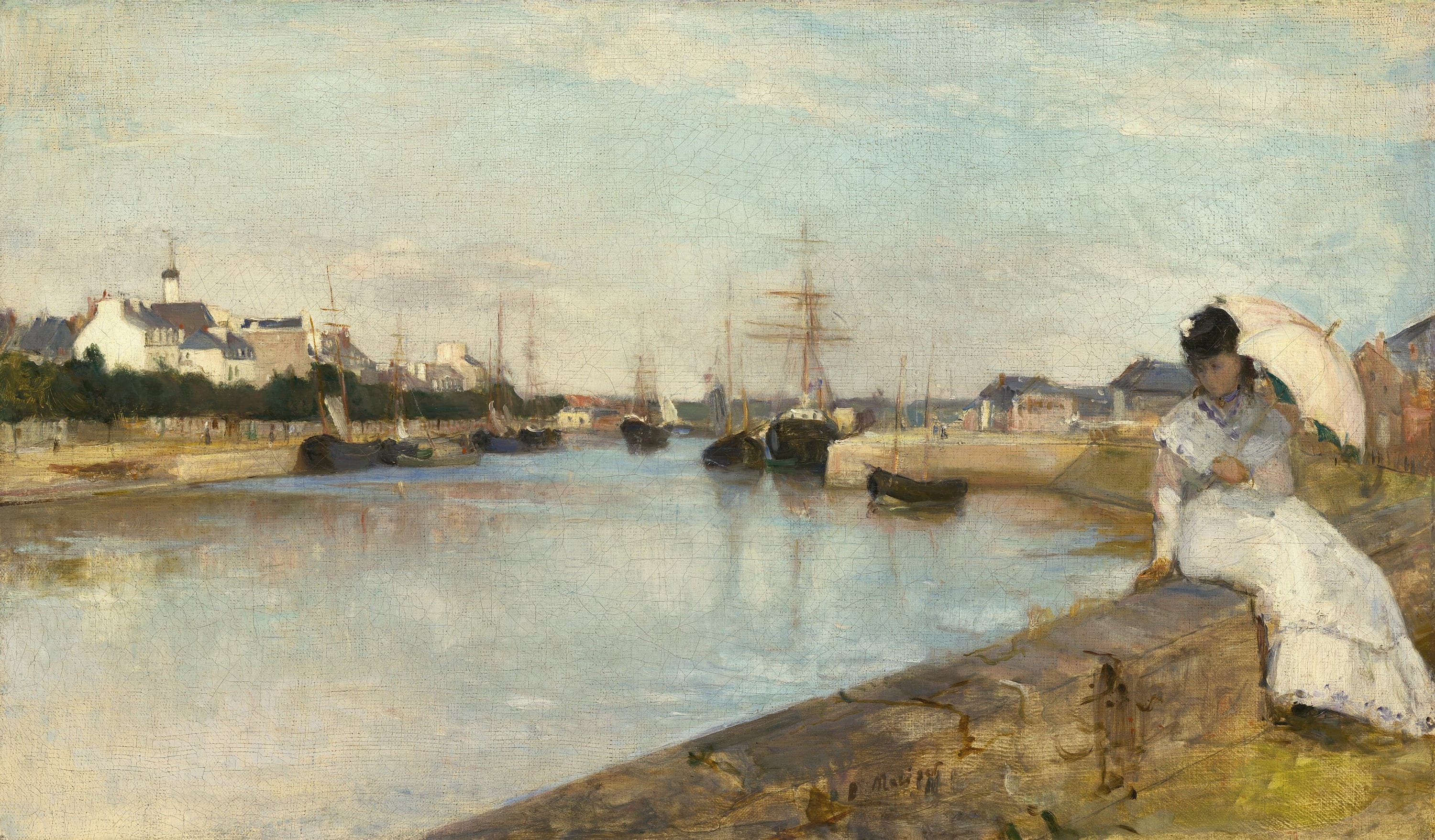
Berthe Morisot painted the outer harbor at Lorient in the summer of 1869, while staying with her newly married sister Edma. Edma sits on the stone parapet at the right with a pink parasol tilted behind her shoulder, small against a wide stretch of water and moored shipping. Morisot gave the canvas to Édouard Manet that year. It is now at the National Gallery of Art in Washington, which shows it in Gallery 82.
- 1869
- Oil on canvas
- National Gallery of Art, WashingtonWashington, D.C., United States
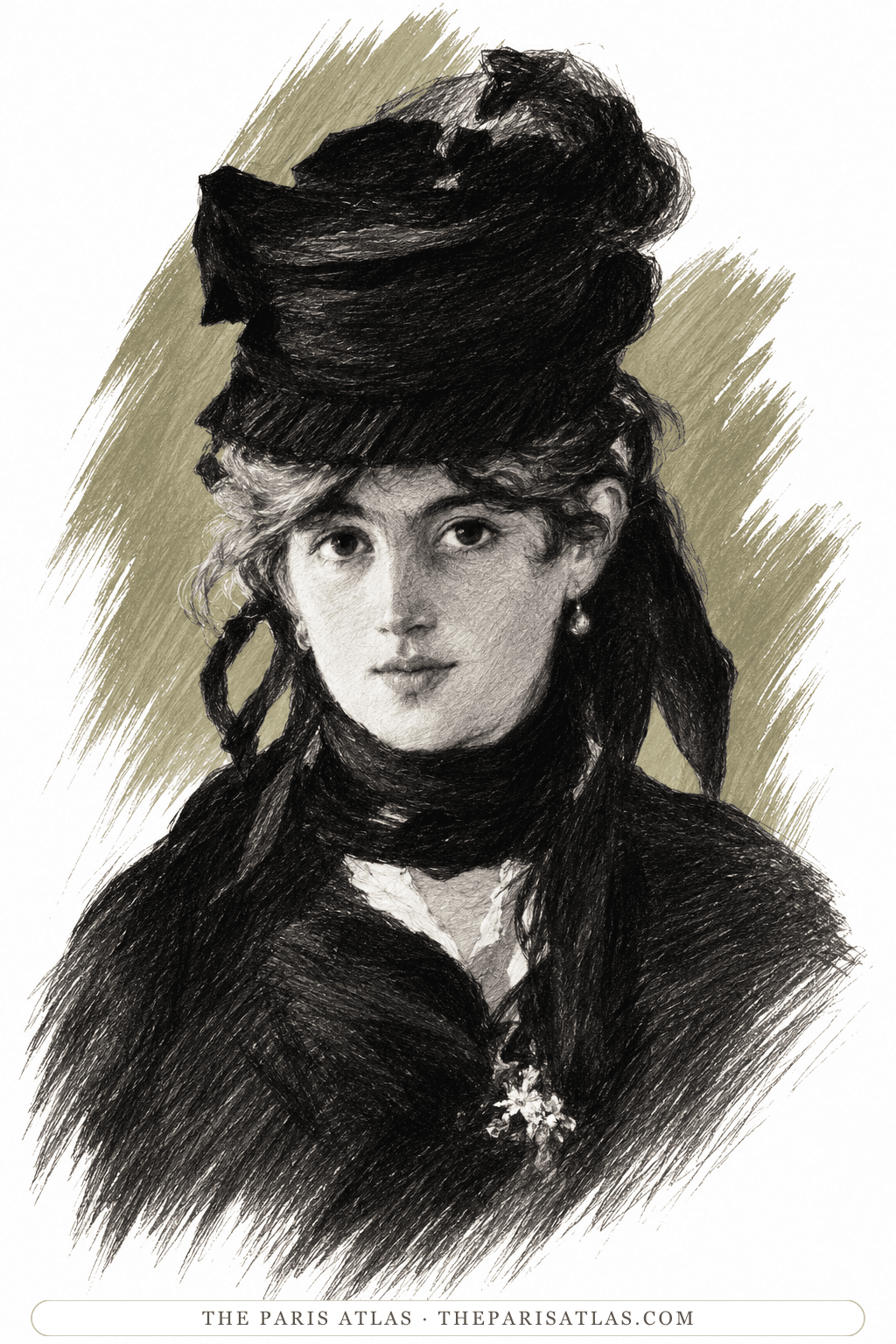
About Berthe Morisot
What the painting shows
A wide, pale stretch of harbor water fills the middle of the canvas under a high sky. A stone quay runs in from the lower right corner and turns away into the distance. A young woman in a long white dress sits on the near side of that wall, angled to the left, leaning on one hand and looking down at the water. Her dark hair is pinned up with a white flower in it, and the bodice carries violet trim and a small gold brooch. She holds a shell-pink parasol, lined in green, tilted behind her shoulder.
Across the water, dark-hulled ships lie against the far quay, masts crossed with yards and carrying no sail, and behind them a line of trees and a row of cream-colored houses run along the shore. The roofs are slate-gray and reddish-brown. A church spire rises at the far left. The town on the near side continues away to the right.
The National Gallery of Art gives the canvas as 43.5 by 73 centimeters and records the signature in dark paint at the lower center: B Morisot.[1] Water and sky take up most of the canvas.
Why Morisot was in Lorient
Berthe Morisot's older sister Edma had trained as a painter with her. In 1868 Edma became engaged to Adolphe Pontillon, an acquaintance of Édouard Manet's, and after the marriage in 1869 she stopped painting.[2]
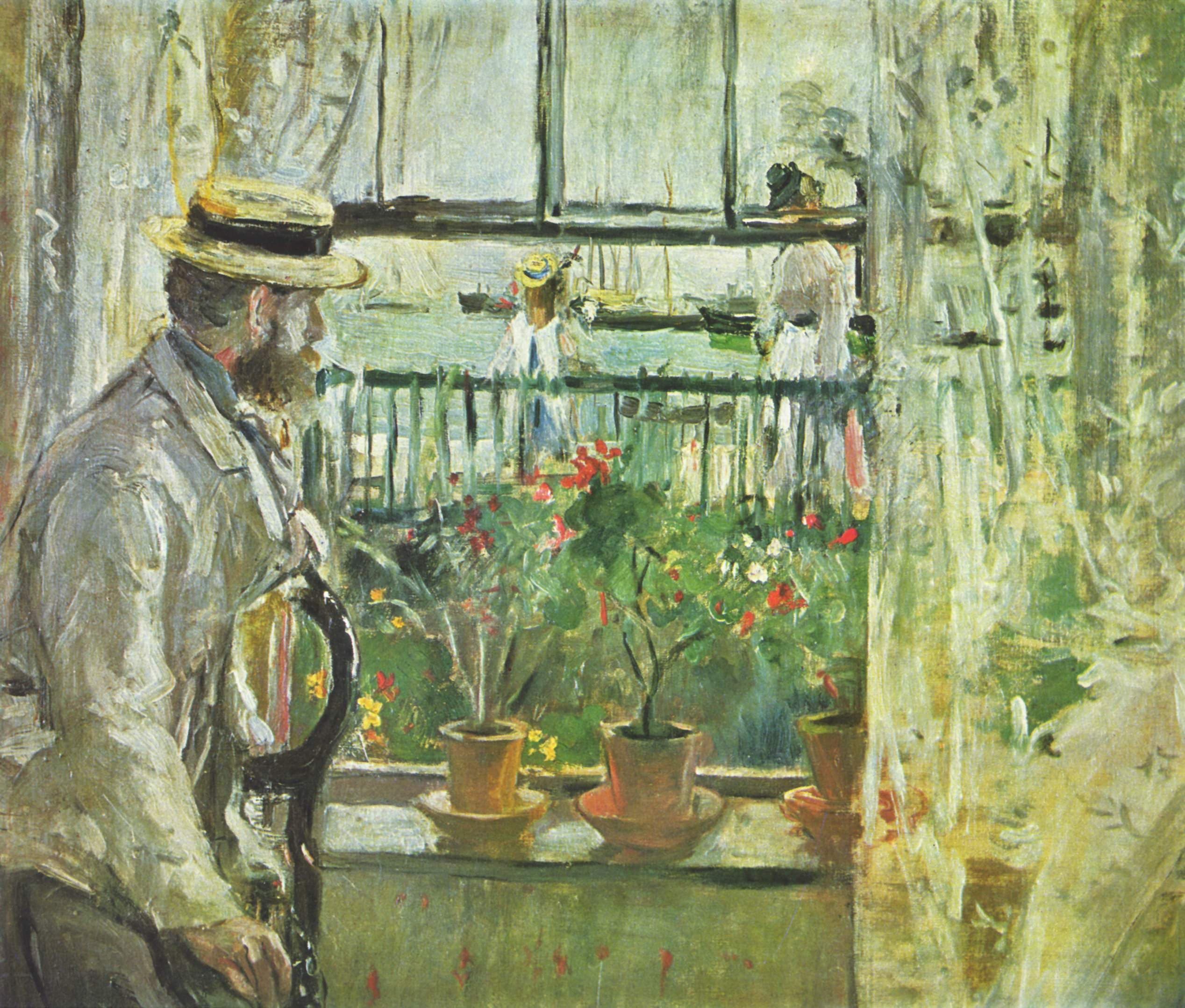
Morisot went to stay with her at Lorient, on the south coast of Brittany, in the summer of 1869. Two of her strongest early canvases came out of that visit: this one, which puts Edma on the parapet in the foreground, and Young Woman at a Window, which is also of her.[2]
When the National Gallery of Art borrowed the painting for a Mellon exhibition in 1966, it was listed under a longer title: The Harbor at Lorient with the Artist's Sister Edma.[1]
A present for Édouard Manet
The first line of the National Gallery of Art's ownership chain is short: gift of the artist to Édouard Manet, 1869.[1] Morisot had met him the year before, while copying a Rubens in the Louvre, and he became her closest colleague for several years.[2]
Édouard Manet was the painter, not the man Morisot later married. She married his younger brother Eugène Manet on 22 December 1874.[2]
After Manet the picture went to Gabriel Thomas, a cousin of Morisot's, who had it by 1896, and then to his wife by inheritance. Captain Edward H. Molyneux owned it in Paris by 1952 and sold it on 15 August 1955 to Ailsa Mellon Bruce in New York, who left it to the National Gallery of Art in 1970.[1]
Hung as a seascape in 1874
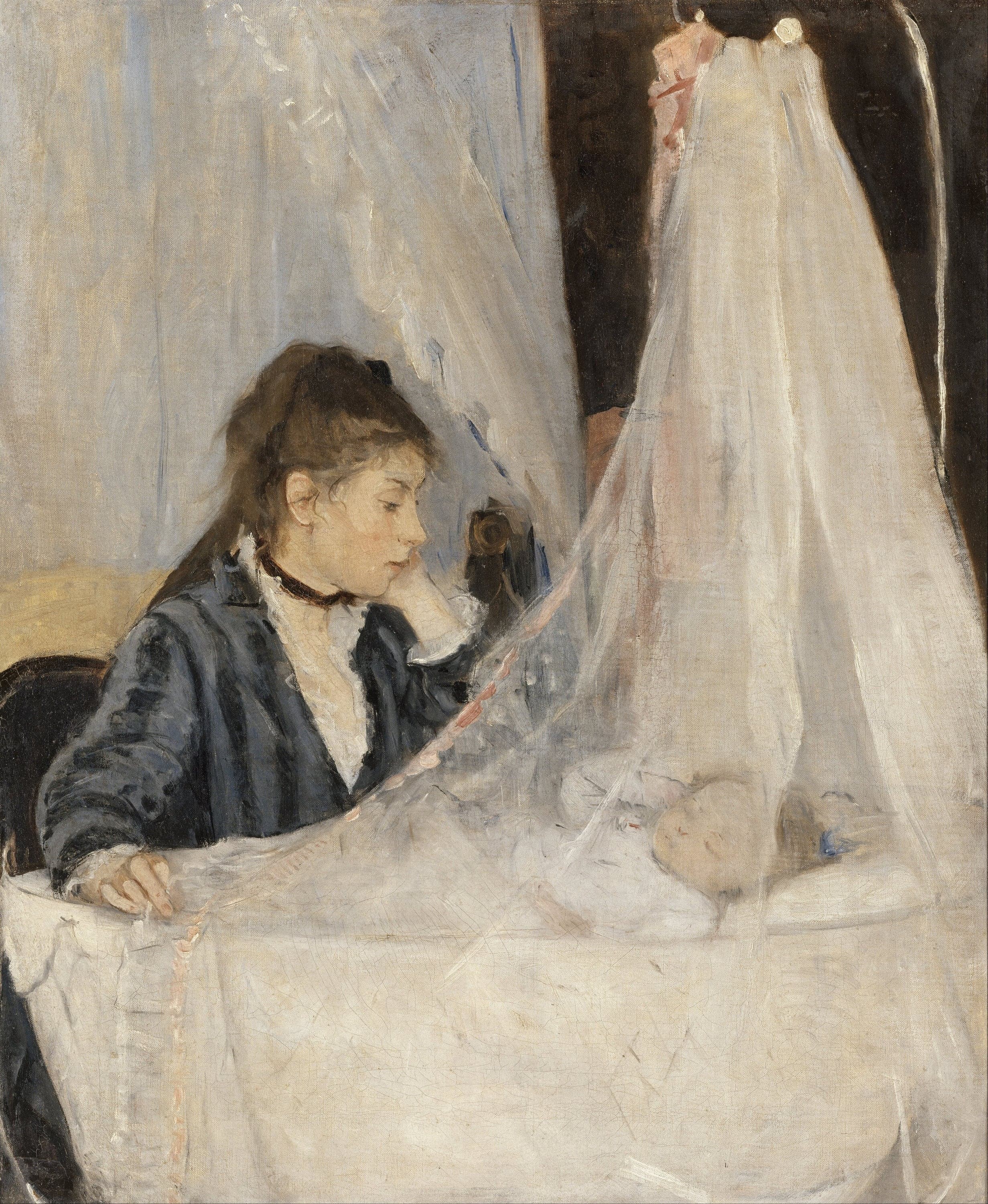
The painting was catalogue number 105 at the first Impressionist exhibition in 1874, listed simply as Marine — seascape.[1] It went on the wall one number after The Cradle, which the Musée d'Orsay records as number 104.[3]
The exhibition opened on 15 April 1874 in the photographer Nadar's studio at 35 boulevard des Capucines, put on by the Société Anonyme des Artistes Peintres, Sculpteurs, Graveurs, etc. Around thirty artists showed roughly 200 works without a jury. Attendance was about 3,500 over the month, and sales were poor.[4]
It kept the title Marine for a long time afterward. It was shown that way at La Libre Esthétique in Brussels in 1894, and again in Tokyo in 1994 at an exhibition about the year 1874.[1]
Close reading
Reading the work, detail by detail
The figure sits at one edge of a picture that is mostly water and sky. These six views move from the far shore across the harbor to Edma Pontillon on the parapet and the signature below her.
1.Edma on the parapet
Edma Pontillon sits on the near side of the quay wall, angled to the left, leaning onto her right hand and looking down at the water. She is painted small and placed at the edge, with the full width of the harbor opening to the left of her.
2.The parasol
The parasol is the largest warm shape in the painting. It leans back behind her shoulder rather than over her head, so her face stays in full light, and a green lining shows where the rim turns under. Its curve is set against the straight run of the far quay.
3.The signature
The National Gallery of Art records the inscription at the lower center: B Morisot. Berthe Morisot put it on the surface of the quay rather than in a corner, where the eye crosses it on the way to the seated figure.
4.Masts across the channel
The masts and yards are drawn in thin reddish-brown strokes, and the hulls are laid in as dark blocks with a deckhouse indicated on the largest. Lorient was a naval port, and the shipping is what marks the place. Berthe Morisot keeps all of it in the middle distance.
5.The town on the far shore
The far bank is a band of buildings and trees under a high sky, with a spire at the left. The roof lines and the spire are among the crispest drawing in the canvas, and a few figures walk the quay below as single small strokes. The town establishes where the picture is and then stays out of the way.
6.The empty middle
Most of the lower left holds nothing but water, with a thin strip of the near bank running in at the left edge. The reflections are short horizontal touches over a flat ground. That emptiness is what makes the seated figure at the right read as small.
Timeline
1868
Morisot meets Édouard Manet in the Louvre, introduced by Henri Fantin-Latour. Edma Morisot becomes engaged to Adolphe Pontillon the same year.
1869
Morisot stays with Edma at Lorient in the summer and paints the harbor. She gives the canvas to Édouard Manet that year.
1874
Shown as catalogue number 105, titled Marine, at the first Impressionist exhibition at 35 boulevard des Capucines.
1896
In the collection of Gabriel Thomas, a cousin of Morisot's, in Paris.
1952
Owned in Paris by Captain Edward H. Molyneux and exhibited in his collection.
1955
Sold on 15 August to Ailsa Mellon Bruce, New York.
1970
Bequeathed to the National Gallery of Art, Washington, as part of the Ailsa Mellon Bruce Collection. Accession 1970.17.48.
1987
Included in Berthe Morisot, Impressionist, which opened at the National Gallery of Art and traveled to Fort Worth and South Hadley.
Where to see it
National Gallery of Art, Washington
Constitution Avenue NW, between 4th and 6th Streets, Washington, DC 20565, United States
The West Building entrance is at 6th Street; the East Building entrance is at 4th Street. Check the museum’s current display information for the work’s building and gallery.
Recorded on view in the West Building, Main Floor, Gallery 82. Gallery displays change, so check the official object record before making a special visit.
Plan your visit on the museum’s official website (opens in a new tab)Frequently asked questions
Who is the woman in The Harbor at Lorient?
Edma Pontillon, Berthe Morisot's older sister. Morisot was staying with her at Lorient in the summer of 1869. The National Gallery of Art listed the painting in 1966 as The Harbor at Lorient with the Artist's Sister Edma.
Where is The Harbor at Lorient?
The National Gallery of Art in Washington, accession number 1970.17.48, in the Ailsa Mellon Bruce Collection. The museum records it on view in the West Building, Main Floor, Gallery 82. Displays change, so check the object record before a special trip.
How big is The Harbor at Lorient?
43.5 by 73 centimeters, about 17 by 29 inches. It is a small, wide canvas, and the figure of Edma occupies only the right-hand edge of it.
Where is Lorient?
On the south coast of Brittany, in the Morbihan. It is a naval port, and the painting shows the outer harbor with moored shipping and the town along the far shore.
Did Berthe Morisot give this painting to Édouard Manet?
Yes. The National Gallery of Art's ownership chain opens with a gift from the artist to Édouard Manet in 1869. He was her colleague and the brother of Eugène Manet, whom she married in 1874.
Was The Harbor at Lorient in the first Impressionist exhibition?
Yes, as catalogue number 105, under the plain title Marine. The show opened on 15 April 1874 in Nadar's studio at 35 boulevard des Capucines.
Is the painting signed?
Yes. The National Gallery of Art records the inscription at the lower center of the canvas, in dark paint: B Morisot.
More by Berthe Morisot
If you like Berthe Morisot
Explore painters from the same movements and circles.
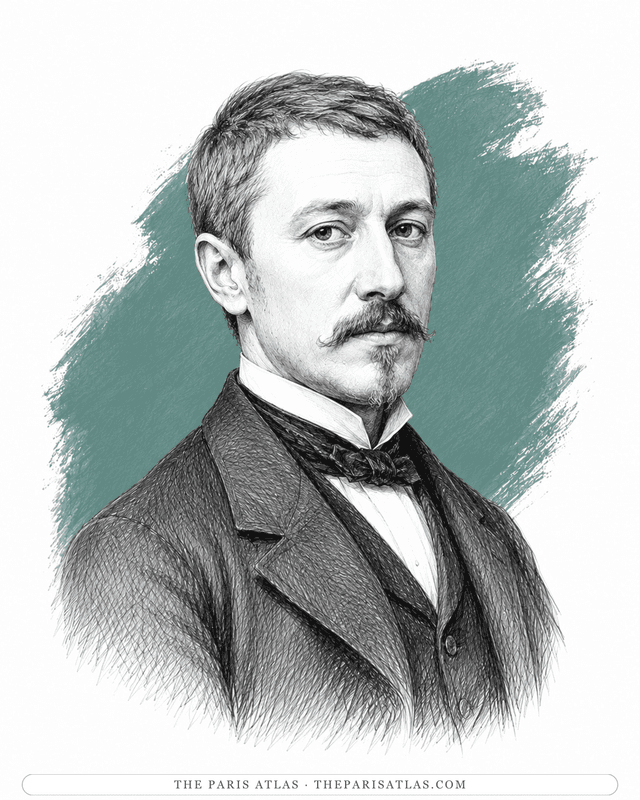
Gustave Caillebotte
Painter of Haussmann's geometry and the group's organizer-financier; his bequest of Impressionist paintings forced the French state to take the movement in.
View artist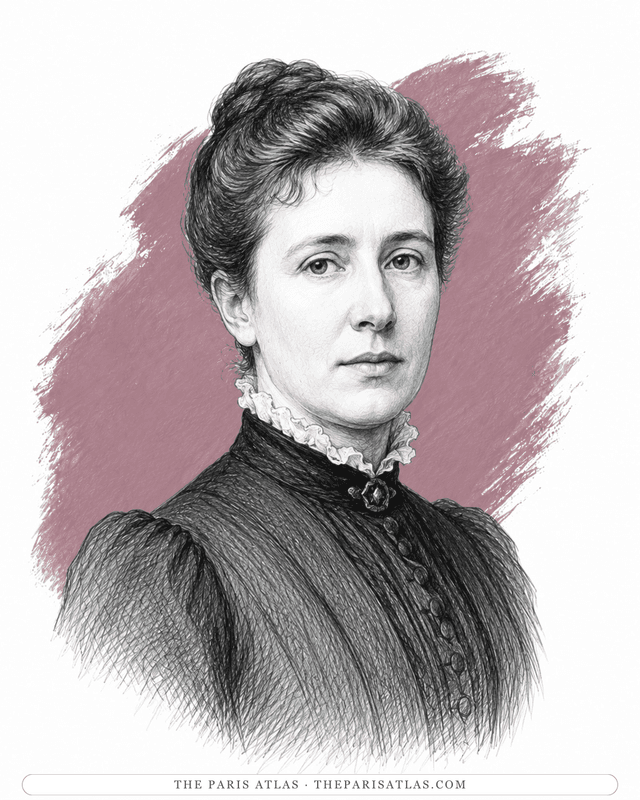
Mary Cassatt
Mary Cassatt was an American painter and printmaker known for her depictions of women and children. Based in France for the last fifty-two years of her life, she was the only American to exhibit with the original French Impressionist group, participating in four of its eight exhibitions. Edgar Degas invited her to exhibit with the group in 1877 after the Salon jury rejected her submissions.
View artist
Paul Cézanne
Painter between Impressionism and everything after — shown in the independents' exhibitions, emulated by the Cubists, and present at the Orangerie through 15 works in the Walter-Guillaume collection.
View artist
References
The sources below include collection records, catalogues, scholarly research, and primary materials that informed this page. They document The Harbor at Lorient, its making, and its place in cultural history.


3↑Le Berceau (Berthe Morisot) — Musée d'Orsay
WebsiteMusée d'OrsayUsed forWeb source consulted for documented facts and historical context presented on the The Harbor at Lorient page.
4↑1874: The Birth of Impressionism
WebsiteNational Gallery of Art, WashingtonUsed forWeb source consulted for documented facts and historical context presented on the The Harbor at Lorient page.
These references provide the documented foundation for this work's history and interpretation. Claim-level citations remain attached to the specific claims they support.
 Explore more resources