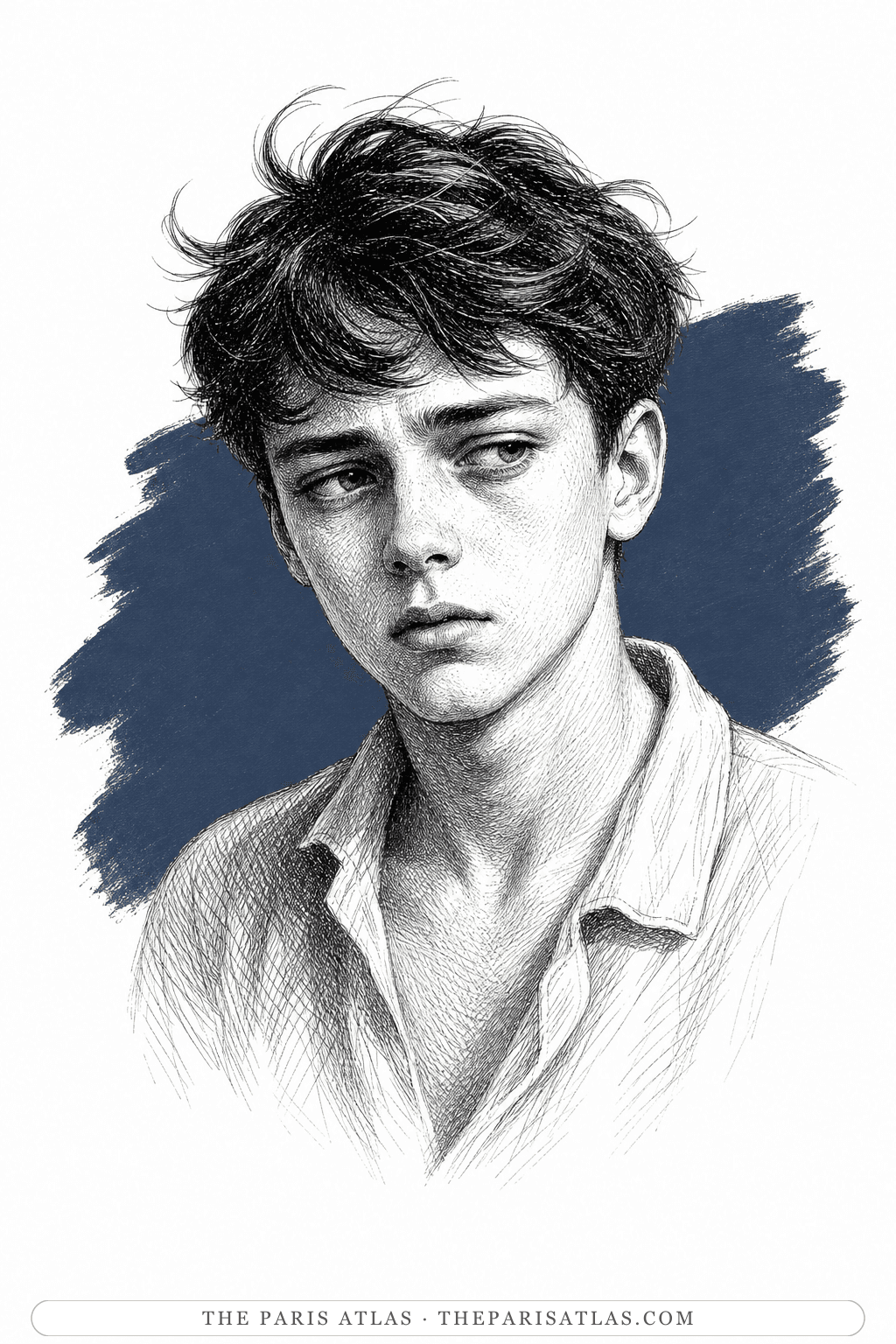
Philippe (Phil)
Sixteen, and Vinca's summer companion since childhood — the boy whose initiation by an older woman changes what he is to her.
To stop being sixteen. He tells Vinca he cannot bear the years of school and waiting ahead of him, and asks why he cannot be twenty-five now.
The book

At a glance
- Sixteen; the opening page puts him at sixteen and a half, twelve months older than Vinca
- Philippe Audebert. Everyone calls him Phil; Madame Dalleray calls him monsieur Phil
- Son of a small Paris manufacturer; his parents holiday with the Ferrets, whose daughters are Vinca and eight-year-old Lisette
- Paris in term time, as a day boy at a lycée; the Brittany coast from July to October, eleven kilometres from Saint-Malo
- The baccalauréat, then law or his father's shop: iceboxes for hotels and châteaux, headlamps and car parts
- The central character. Every chapter is with him except the passages Colette gives to Vinca and to Madame Dalleray
Who they are in the book
Spoiler-freePhilippe Audebert, who is called Phil by everyone in the book, is sixteen years old and the son of a small Paris manufacturer. Every summer since before he could walk, his family has rented a house on the coast of Brittany, near Cancale, together with another Paris family called the Ferret. In all of those summers his companion has been the Ferrets' daughter Vinca, who is fifteen. The novel opens with him lying on a dune watching her walk down to the rocks with two shrimping nets over her shoulder, comparing this year's Vinca to last year's. The two families treat the pair as brother and sister and as an engaged couple by turns, and both sets of parents assume they will marry.
What Phil feels most of the time is impatience. Told to be patient, he says out loud that he is choking at the idea of being only sixteen, lists the years of examinations and resits and false starts in front of him, and asks why he cannot simply be twenty-five straight away. He is also possessive in a way the book states flatly: he wonders privately whether he loves Vinca as much as he says, and concludes that in any case she belongs to him.
In August a woman staying at a rented villa a few kilometres along the coast, Madame Dalleray, begins asking him in for cold drinks. She is about thirty. In early September, after everyone in the house is asleep, Phil walks over the hill to her villa and comes out of it again at half past one in the morning, no longer a virgin. He sits in the garden at home until after three, then goes up and opens the shutters in a hurry to see his new face in the mirror, and what Colette says he found there was tired, ringed eyes and lips still faintly coloured by a painted mouth, features less like a man's than like a bruised young girl's.
Most of the book is what this does to him, and almost none of it is triumph. He stops being able to watch Vinca fish. He faints in the middle of a conversation with his father. He begins dividing everything in his life into before and after, and complains, silently, that no novel he has ever read warned him that a boy does not leave childhood behind in one night but keeps swaying afterwards for days.
How Philippe (Phil) Is Portrayed
- The shrimp he lets get awayIn the first chapter he takes over Vinca's net in a rock pool and catches her bare arm with his free hand, holding her wrist loosely, like a bracelet. A big shrimp comes to the rim of the net and he does not lift it. It swims off. Vinca asks why he let it go, and he tells her it will come back, you only have to wait.
- He cannot stand being sixteenThe word patience sets him off. He shakes Vinca by the shoulder and tells her he is dying at the thought that he is only sixteen, with the baccalauréat, the examinations, the technical college and the years of pretending to his parents that he likes a career all still to come.
- What he is supposed to becomeHis father sells iceboxes to hotels and châteaux and headlamps, spare parts and hardware for motor cars. Phil's future is the baccalauréat and then either law or the shop, the customers and the correspondence. He draws turbines and aeroplane propellers in the evenings, which makes Vinca's father call him the future engineer.
- The parents barely exist for himColette calls the adults in the house the Shadows. Phil and Vinca sit inside the family circle every evening, answer politely, and hear the conversation as if through water. When somebody at the card table jokes about marrying the two of them off, neither reacts.
- Meeting the woman on the seaweed trackA woman in white walks down the cart track used to collect seaweed, sinking her high white heels and her cane into the sand, and calls him boy. He stands up bare-chested, she changes her tone and calls him monsieur, and she asks how old he is. He says Vinca is fifteen and he is sixteen. She repeats the number and makes no comment at all.
- The glass of orangeadeShe gives him one iced orangeade in a shuttered room so dark he trips over the furniture. He remembers three white fingers with a diamond on one of them lifting the ice cube out of his glass, a red and blue macaw on a perch that never makes a sound, and resin and geranium burning in a dish. He drinks two mouthfuls without tasting them and leaves by pushing his way out through furniture he cannot see. For days afterwards the smell follows him about, and he asks Vinca whether she does not think the shrimps smell of benzoin, the perfumer's resin, today.
- The blue thistlesTo settle what he thinks of as a debt, he cuts an armful of blue sea thistles from a hollow in the dunes, tearing his hands on them, and throws them over her wall rather than knock. They cut her cheek. She asks whether he picked them to please her or to please himself, does not like his answer, and tells him not to come back.
- He gives her his arm backAt a later visit she grips his wrist and pushes his sleeve to the elbow. He shouts at her to let go and knocks a saucer to the floor. She does not move, and leaves her hand lying open on her knee. He looks at it for a long moment and then puts his bare arm back into it, deliberately.
- He stops being able to watch the fishingThe day after his first night with her, Vinca crushes a small crab underfoot and then works a conger eel out of its hole with an iron hook and shows him the blood on the end of it. He tells her to leave the animal alone, goes white, and then sits down on the rocks and sobs. Vinca stands over him holding the wet hook, listens, decides what the crying means, and walks off without a word.
- He faints on the terraceHis father stops him to explain that the two families are buying the holiday villa and adding wings to it, and says in passing that Phil will probably marry Vinca and probably will not, and that her dowry will be small. Phil loses the thread at the word corbelling, then loses consciousness altogether and comes round with his head on his mother's knees.
Madame Dalleray leaves the coast without warning two days before Phil's own family is due to go back to Paris.
The novel ends with Phil and Vinca.
If you like The Ripening Seed


If you like Colette
Explore authors with a similar voice, perspective, and influence.

Henry Miller
The Brooklyn dropout who arrived in Paris broke at thirty-eight and wrote the exuberant, banned books that ended American censorship.
View author
Louis-Ferdinand Céline
The doctor of the Paris slums who wrote the century's blackest, funniest novel — and changed the sound of French prose.
View author
Martha Gellhorn
War correspondent who covered the Spanish Civil War, D-Day, and conflicts across five more decades; Hemingway's third wife, 1940–1945.
View author