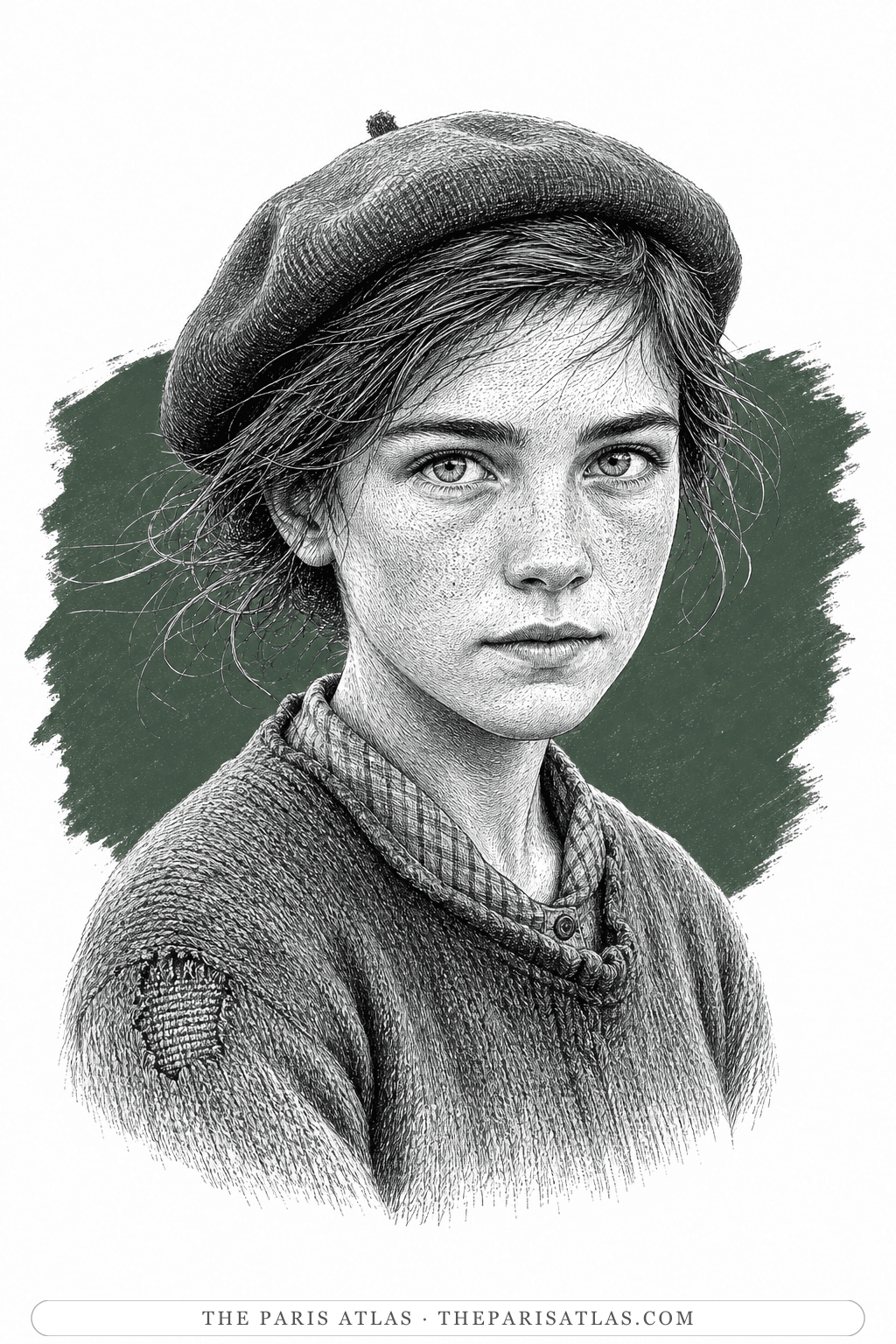
Vinca
Fifteen, Phil's lifelong summer companion — the one left to absorb the summer's knowledge and go on living with it.
To keep Phil, on whatever terms are available. She tells him that while he is tormenting her, at least he is there.
The book

At a glance
- Fifteen; the opening page puts her at fifteen and a half
- Vinca, the botanical name of the periwinkle. Colette also calls her la Pervenche, the Periwinkle
- Daughter of M. and Mme Ferret; her aunt Marthe holidays with them, and her sister Lisette is eight
- Paris, where she attends classes rather than a lycée; back from Brittany on 20 September to buy the autumn clothes
- No examinations. The household accounts, Lisette's upbringing, the servants, and a marriage her parents assume will be to Phil
- One of the two central characters; the second half is largely her discovery of the affair and what she decides to do about it
Who they are in the book
Spoiler-freeVinca is fifteen, the elder daughter of the Ferret family, who rent a house on the coast of Brittany every summer together with the family of Philippe Audebert, the boy she has grown up beside. Vinca is the botanical name of the periwinkle, a small blue flower, and Colette calls her la Pervenche, the Periwinkle, because her eyes are that colour. When a stranger asks Phil what the name means, that is the answer he gives. She was born twelve months after him and the two have been together every July to October of their lives.
Out of doors she is the more capable of the two. She fishes for shrimp and crab in the rock pools, dives every morning, swims, jumps, throws a stone fifty metres and hits the reef she aimed at, and carries the picnic baskets herself when Phil offers to take one. Her knees are scarred, her hands are those of a gardener's boy, her checked skirt is three years old and her espadrilles have gone stiff with salt. Phil taught her these games himself, and is startled all summer by how good at them she has become.
Indoors she is already doing a woman's work. She pours the coffee, cuts flowers for the table, sews dresses for her eight-year-old sister Lisette, bones Lisette's sardines for her, and sorts and packs the family's summer clothes because her mother's rheumatism would flare if she did it. She will not sit the baccalauréat. Her mother has explained the plan and Vinca repeats it without complaint: she will keep the household accounts, bring up Lisette, manage the servants, and marry. Phil, who is enraged by it, calls her a born slave. She points out that neither of them has any choice at fifteen and sixteen.
She is also the one who does not break. She works out that there is another woman weeks before she has any proof, and when she finally has it she does not go to pieces, does not tell her parents, and does not stop eating her dinner. What she does instead is the last third of the book.
How Vinca Is Portrayed
- How she is dressed on the first pageA darned jersey, espadrilles gone hard with salt, a checked skirt three years old and short enough to show her knees, a wool beret gone blue-grey like a dune thistle, and two shrimping nets over her shoulder. Colette itemises the outfit in the opening paragraph, in answer to the question Phil has just called out to her, which is whether she is going fishing.
- Her name is a flowerVinca means periwinkle. Colette returns to the blue of her eyes on almost every page she appears on, and notes that it takes nothing from the sea and nothing from the sky: it goes green for a moment in strong sun and otherwise stays exactly itself.
- How strong she isShe picks up a pebble on the beach and hits a small reef fifty metres out, and Phil is impressed and slightly wary, having forgotten that he trained her to do it. During an argument she throws a piece of rock into the sea hard enough to astonish him.
- The lunch in the white dressA visitor from Paris comes to lunch and Vinca is put into starched white organdie with ten flounces. Phil sulks that she looks ridiculous. Then a gust knocks the table over and she catches a falling chair with her foot and a flying lace mat with her chin, all without interrupting the stream of coffee she is pouring. The visitor tells her mother that she is becoming ravishing. Vinca hears it and smiles at him, and Phil, watching from behind the piano, admits to himself that he was wrong and that she is very pretty.
- The life her mother has plannedAsked what she is going to do, she answers with her mother's list: the accounts, Lisette's education, the servants, and marriage when it comes. She does not present it as a disappointment. Phil asks whether that is really enough for the next five or six years and she says yes, while they wait, because they are fifteen and sixteen and have to wait.
- The afternoon on the rockSheltering from an August storm on a ledge above the sea, she closes her eyes and begins sliding, slowly and deliberately, until her feet are over the drop. She is taking Phil with her: he understands, tightens his arm round her and hauls her back. She opens her eyes, sees that he has decided they are not going to die, and shouts at him that he does not love her enough.
- She notices before she has any proofWeeks before she has any evidence, she starts pulling her hand out of his on the evening walk and stopping conversations dead. Colette says she was obeying suspicion rather than modesty, and that she could smell another woman on him the way you can smell that someone has been eating sweets.
- Packing up the summerNear the end of the holiday Phil finds her kneeling in the shed sorting the summer clothes onto a worn sheet, talking to herself like a working woman: Lisette's bathing suits, her own scalloped dress, three pairs of espadrilles, two of Phil's old vests with the armholes gone. She turns out the pockets of the sweaters and they are full of pink shells and dried seahorses.
- What she says when he shouts at herHe picks a fight over nothing while she works, gets insulting, then apologises, and finally blames her for not answering back. Her explanation is the plainest line she is given in the book: while he is tormenting her, at least he is there.
She finds out about Madame Dalleray on her own.
The confrontation happens on a ledge above the beach, and she does most of the talking.
If you like The Ripening Seed


If you like Colette
Explore authors with a similar voice, perspective, and influence.

Henry Miller
The Brooklyn dropout who arrived in Paris broke at thirty-eight and wrote the exuberant, banned books that ended American censorship.
View author
Louis-Ferdinand Céline
The doctor of the Paris slums who wrote the century's blackest, funniest novel — and changed the sound of French prose.
View author
Martha Gellhorn
War correspondent who covered the Spanish Civil War, D-Day, and conflicts across five more decades; Hemingway's third wife, 1940–1945.
View author