The Stone Breakers
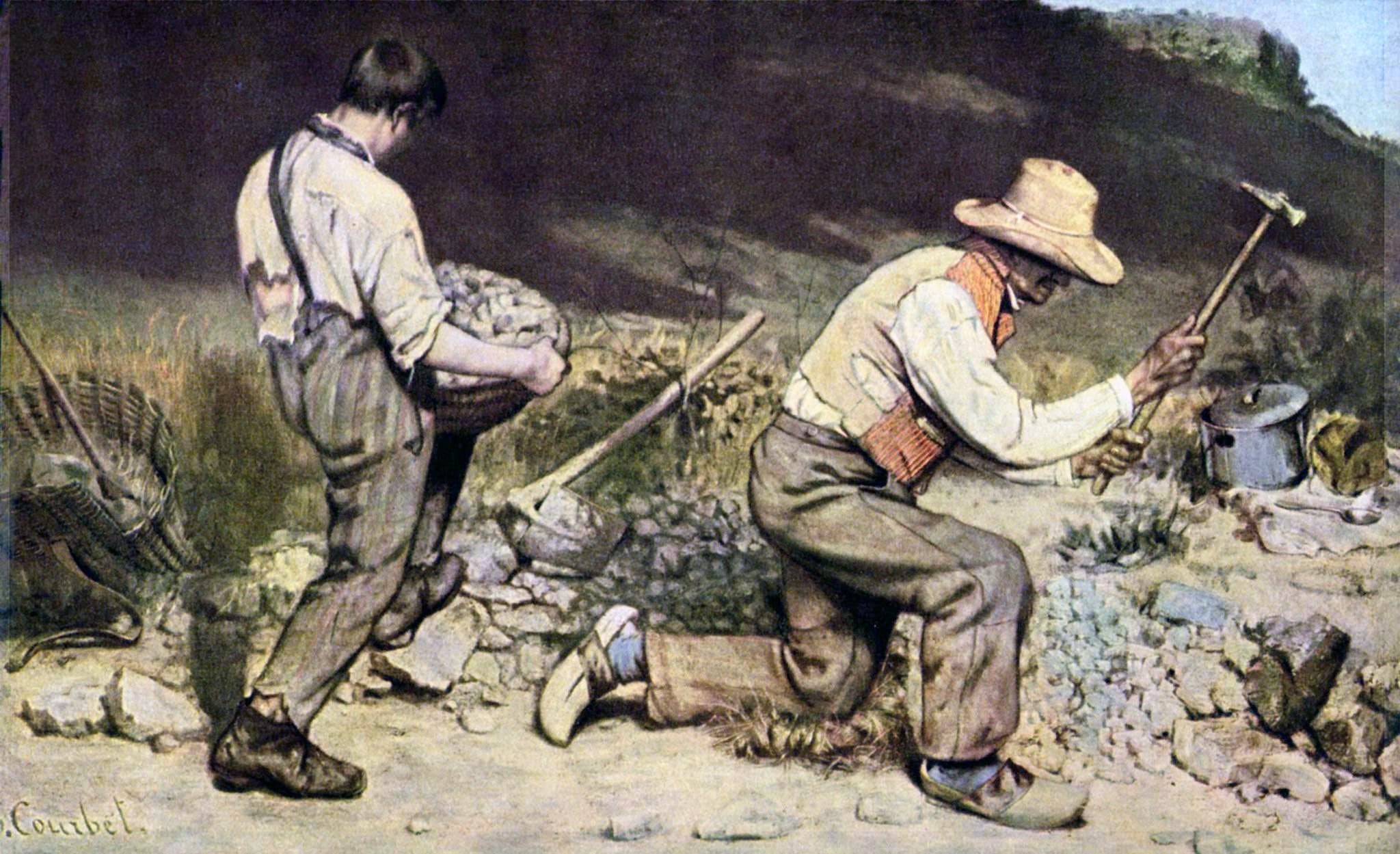
Two men break stones at the side of a road: an old man kneeling with a hammer and a young one carrying a basket of rock. Gustave Courbet showed it at the Salon of 1850 alongside A Burial at Ornans, and it became the picture people pointed to when they argued about Realism. It no longer exists. The painting was destroyed in February 1945, during the war, and only photographs survive.
- 1849
- Oil on canvas
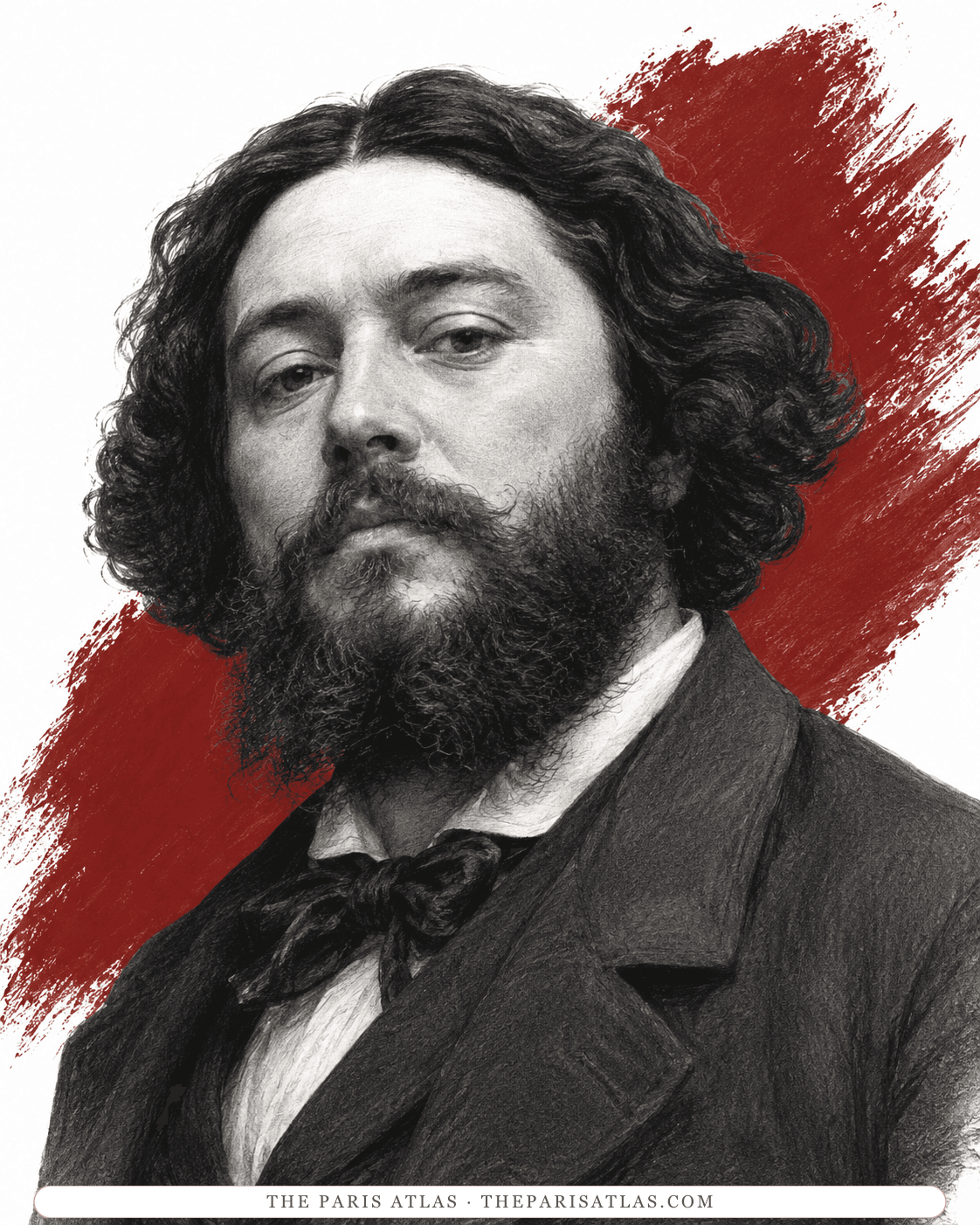
About Gustave Courbet
What the painting showed
An old man kneels on one knee at the left, side-on to the viewer, raising a hammer to break a stone. His hat hides his face. His shirt is torn at the shoulder and his trousers are patched at the knee. Beside him a young man in a dirty waistcoat hauls a basket of broken rock, straining under its weight, his face also turned away.
Behind them is a bank of earth and stones that fills most of the canvas and blocks out the sky except for a strip at the top right. There is a cooking pot and a crust of bread on the ground. Neither man's face can be seen.
The canvas measured 165 by 257 centimetres, about five and a half feet by eight and a half. The two figures were close to life size.
The Salon of 1850
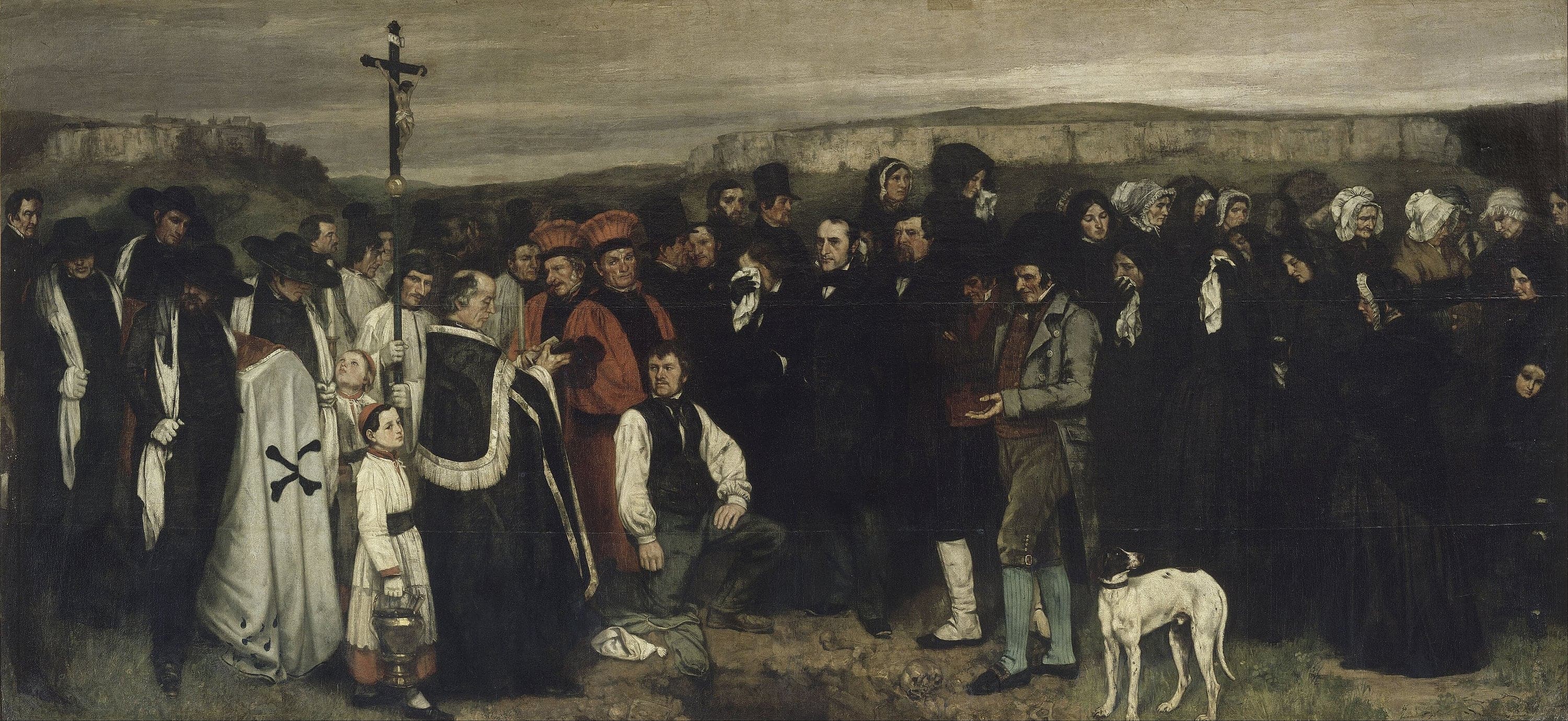
Courbet sent it to the Salon of 1850–51 together with A Burial at Ornans and After Dinner at Ornans. Two roadmenders at near life size, with no story attached and no moral drawn, was a new kind of subject for a canvas that size. The picture became one of the standard examples in the argument about Realism that followed.
Courbet said he had seen the two men at work near Maisières, not far from Ornans, and asked them to come to his studio.
How it was lost
The Gemäldegalerie in Dresden acquired the painting in the early twentieth century. In February 1945 it was being moved out of the city for safekeeping, along with 154 other pictures, when the transport was destroyed. The painting was lost with the rest of the load.
What survives is photographic. The composition is well recorded, but the canvas itself is gone, so nothing now shows the object as it was rather than as a camera recorded it.
Close reading
Reading the work, detail by detail
The painting was destroyed in February 1945 and only photographs of it survive, so these views read a reproduction rather than a canvas. What they show is how completely Gustave Courbet refused the picturesque: two labourers at life size, neither face visible, and as much attention given to a cooking pot as to either man.
1.The hammer at the top of its swing
The hammer is caught at the top of the swing, the one point in the stroke where nothing is moving. It is the only diagonal in a picture otherwise built from horizontals, and it reaches almost to the upper edge of the canvas.
2.A hat where the face should be
The brim covers everything above the jaw. Gustave Courbet gives a canvas over eight feet wide to two men and shows neither face. Salon painting used labourers as picturesque staffage with readable expressions; refusing the face is the argument.
3.The basket, carried at the hip
He carries it against the hip with both hands, which is how a full basket is actually moved. The stone inside is broken small, ready for a road bed. Nothing about the pose is arranged for the viewer's benefit.
4.The clothing is doing the description
The shirt is torn open at the shoulder and the trousers below are patched at the knee. Gustave Courbet paints the damage at the same scale and finish as everything else, so poverty registers as fact rather than as pathos.
5.A pot, a bowl and a crust
Their food sits at the edge of the picture, painted with the care a still life would get. A pot, a bowl, a spoon and a crust of bread. It is the whole of what the day provides, and it takes up as much canvas as either man's head.
6.Boots and the ground they kneel on
One knee is down on broken stone with the clog turned up behind it, the sole worn through at the toe. The ground is the same pale rubble the men are making. Gustave Courbet lets the foreground run right to the bottom edge, so the viewer stands in the same debris.
Timeline
1849
Painted, after Courbet sees two roadmenders at work near Maisières and asks them to sit for him.
1850–51
Shown at the Salon with A Burial at Ornans and After Dinner at Ornans.
early 1900s
Acquired by the Gemäldegalerie in Dresden.
1945
Destroyed in February, with 154 other paintings, when the transport moving them out of Dresden is lost.
Where to see it
Formerly Gemäldegalerie Alte Meister, Dresden — destroyed 1945
A current public viewing location has not been confirmed.
Frequently asked questions
Where is The Stone Breakers?
Nowhere. The painting was destroyed in February 1945, along with 154 other pictures, when the transport carrying them out of Dresden was lost. It had belonged to the Gemäldegalerie in Dresden since the early twentieth century. Only photographs of it survive.
What did The Stone Breakers show?
Two men breaking stones by a road: an old man kneeling with a hammer raised, and a young man hauling a basket of broken rock. Neither face is visible. A bank of earth fills the background and blocks almost all of the sky.
Why was The Stone Breakers important?
Because of what it refused to do. Two labourers were painted near life size on a large canvas, with no story, no moral and no idealisation, and shown at the Salon of 1850 beside A Burial at Ornans. It became one of the standard examples in the argument about Realism.
How big was The Stone Breakers?
165 by 257 centimetres, about five and a half feet high by eight and a half wide, with the two figures close to life size.
Who were the men in The Stone Breakers?
Roadmenders Courbet said he had seen working near Maisières, close to his home town of Ornans, and asked to come to his studio. He did not name them, and the painting shows neither face.
More by Gustave Courbet
If you like Gustave Courbet
Explore painters from the same movements and circles.

Tarsila do Amaral
Brazilian painter who spent the 1920s moving between São Paulo and Paris, studied Cubism under André Lhote, Albert Gleizes and Fernand Léger, and used what she learned to paint Brazilian towns, railways, plants and bodies. Her 1928 painting Abaporu prompted the manifesto that gave the Anthropophagic movement its name.
View artist
Arman
French-American artist, lifelong friend of Yves Klein, and a founder of New Realism.
View artist
Jean Arp
Strasbourg-born sculptor and poet — Hans in German, Jean in French, both all his life — who co-founded Dada at the Cabaret Voltaire in 1916, composed collages by dropping torn paper 'according to the laws of chance', and settled at Meudon outside Paris in a house his wife Sophie Taeuber-Arp designed.
View artist
References
The sources below include collection records, catalogues, scholarly research, and primary materials that informed this page. They document The Stone Breakers, its making, and its place in cultural history.


1Stone Breakers — An Introduction to Nineteenth Century Art
NonfictionMichelle Facos, RoutledgeUsed forPublished analysis and historical context used in preparing the The Stone Breakers page.

2Biographie de Gustave Courbet — Institut Gustave Courbet
WebsiteInstitut Gustave Courbet, OrnansUsed forWeb source consulted for documented facts and historical context presented on the The Stone Breakers page.
3Gustave Courbet
WebsiteEncyclopaedia BritannicaUsed forWeb source consulted for documented facts and historical context presented on the The Stone Breakers page.
4Gustave Courbet, Un enterrement à Ornans — collection record
WebsiteMusée d'OrsayUsed forWeb source consulted for documented facts and historical context presented on the The Stone Breakers page.
These references provide the documented foundation for this work's history and interpretation. Claim-level citations remain attached to the specific claims they support.
 Explore more resources