A Burial at Ornans
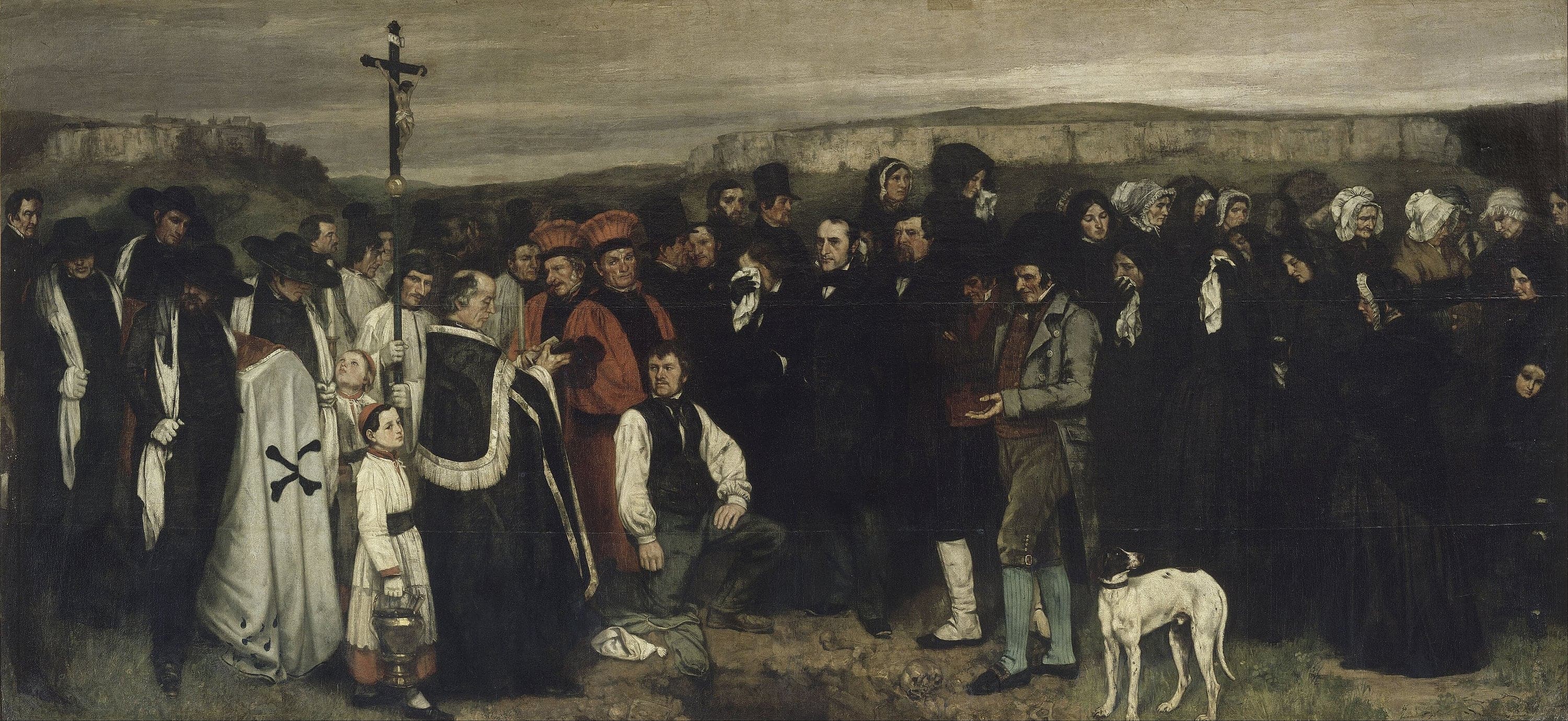
Forty-odd villagers stand around an open grave at Ornans, Courbet's home town in eastern France, painted life size on a canvas more than twenty-two feet wide. The scale was the provocation. Life-size figures on a canvas this big were reserved for religious and historical subjects, and Courbet gave that treatment to a funeral for someone whose name the painting never supplies.
- 1849–1850
- Oil on canvas
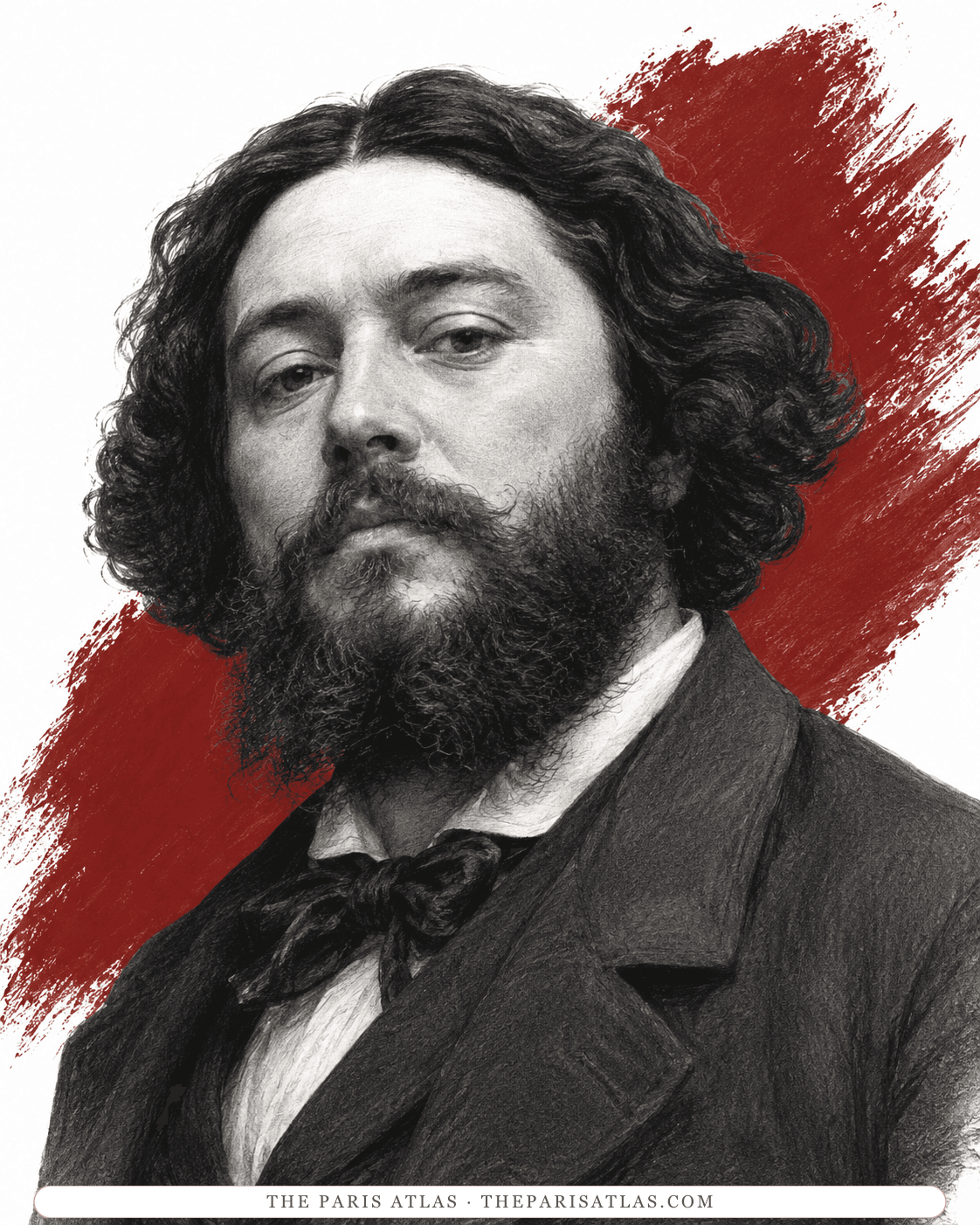
About Gustave Courbet
What the painting shows
A crowd is arranged in a long band across the canvas. The pallbearers hold the far left, in wide black hats with long white mourning scarves down their chests. Then comes the clergy: a priest reading from an open book, a crucifix raised above the heads on a staff, and two beadles in scarlet robes and caps. The men of the town follow in black coats and hats, then a group of women, several of them weeping into handkerchiefs. A dog stands in the foreground, looking away from the grave.
At the centre bottom is the grave itself, a dark rectangular hole with a skull and some bones beside the freshly turned earth. Behind the crowd are the low limestone cliffs of the valley and a strip of grey sky. There is no focal figure, no gesture organising the rest, and nobody is idealised.
The canvas is 315 by 668 centimetres — about ten feet high by twenty-two wide. The people in it were Courbet's neighbours in Ornans, and many sat for him.
Why the size mattered
French painting ran on a hierarchy of genres. Biblical and mythological subjects earned the biggest canvases and life-size figures; scenes of ordinary life were painted small. The Musée d'Orsay puts the transgression plainly: Courbet painted his villagers life-size, a privilege usually reserved for biblical and mythological figures, and made no attempt to idealise them.
Courbet's own title for it was longer than the one that stuck — Painting of Human Figures, the History of a Burial at Ornans. Calling it a history was the argument in miniature.
He had won a medal at the Salon of 1849 for After Dinner at Ornans, which exempted him from jury approval in later years. He used that exemption to send three monumental canvases of everyday life in the Ornans country to the Salon of 1850–51, of which this was the largest.
The Pavilion of Realism
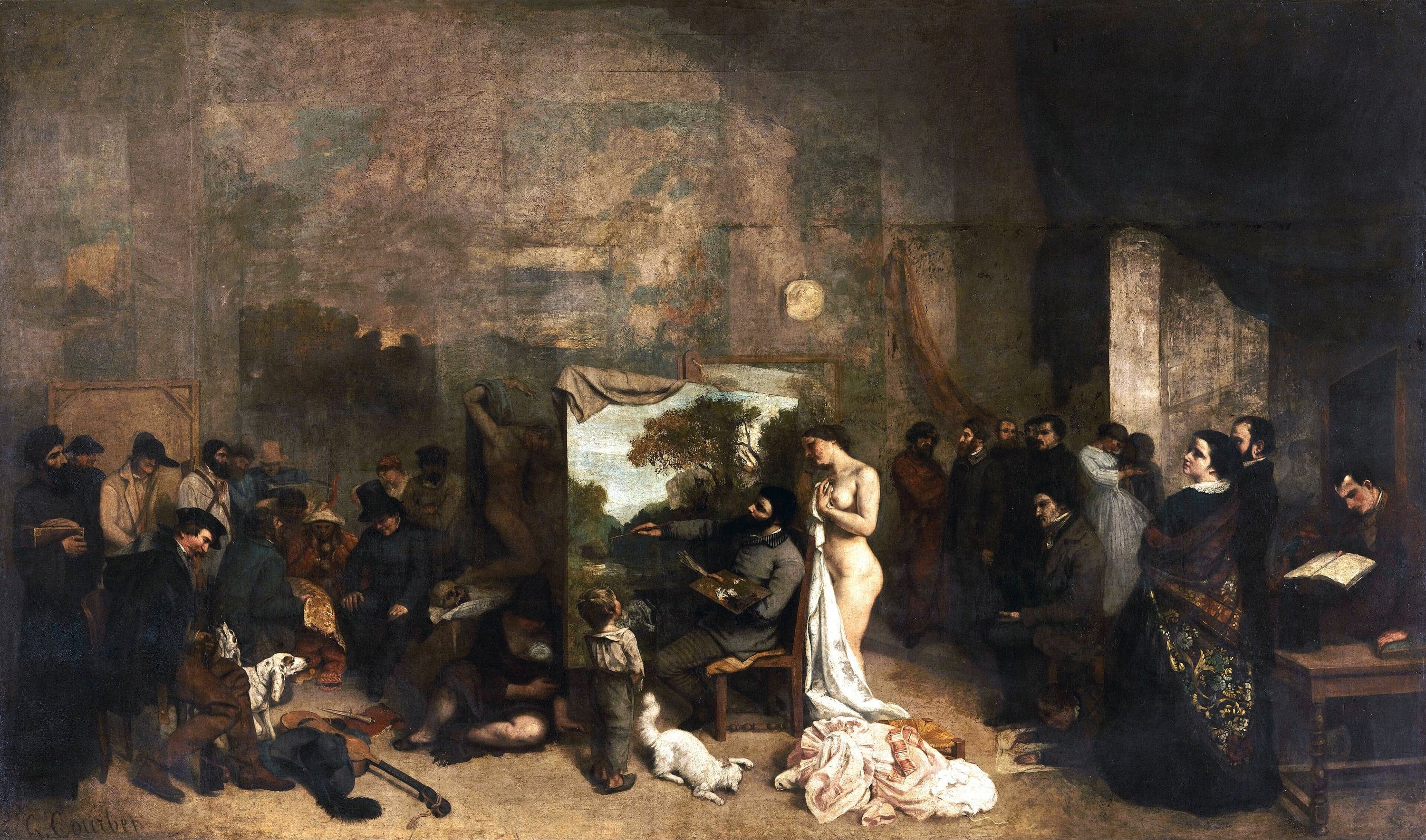
In 1855 the jury of the Universal Exhibition in Paris turned down The Painter's Studio. Courbet responded by building a shed near the official exhibition at his own expense, calling it the Pavilion of Realism, and showing his own work there. A Burial at Ornans hung in it.
The two paintings still hang together. They are the largest things in the Orsay's Courbet room, facing each other.
Close reading
Reading the work, detail by detail
The canvas is a band of figures more than twenty-two feet long, and no part of it is arranged to lead the eye. Gustave Courbet gives the same weight to a beadle's scarlet robe, a dog looking the wrong way and a skull lying on turned earth. Working across it in close view shows a picture organised by rank and costume instead of by a focal point.
1.The pallbearers hold the far left
Four men in wide black hats stand at the extreme left, each with a long white scarf hanging down his chest. Their gloved hands are closed on the bier they carry. They come before the clergy in the procession, and the white bands are the only bright thing in that corner of the canvas.
2.Only the crucifix rises above the cliffs
A processional cross on a long staff clears every head in the picture and stands against the grey sky. It carries a small pale figure of Christ, with a gilt knob on the staff below the crossbar. Nothing else in the crowd breaks the line of the limestone cliffs behind.
3.A priest reads while two beadles wait in scarlet
The priest is white-haired and reads from a book held open in front of him, in a black cope with a broad white and gold band down the front. Beside him two men in scarlet robes and pleated scarlet caps turn their heads the same way. Their faces are flushed almost to the colour of the cloth.
4.The gravedigger is the one figure looking up
He kneels on one knee in white shirtsleeves and a black waistcoat, the only man in the crowd without a coat on. His head is raised and turned back towards the priest. His hat and a grey-green jacket lie on the bare earth beside his boot.
5.A skull sits on the earth at the bottom edge
A skull sits upright on broken earth at the very bottom of the canvas, with long bones scattered near it. The ground here is raw brown, dug over and not levelled. The bones are set below every face in the picture, at the height of a standing viewer's feet.
6.The women's skirts become one black field
Heads and white linen caps stay separate at the top of the group, and several women hold handkerchiefs against their eyes. Below the waist the dresses stop reading as separate garments and become one black field running to the right edge. The caps and handkerchiefs are the only light in that half of the canvas.
7.The dog looks out of the picture
A white hound with a liver-brown head stands in the foreground in a dark collar. Its head is turned to the right, away from the grave and out of the picture. Beside it a man stands in an olive coat, knee breeches and blue-green stockings with buckled shoes.
Timeline
1849
Wins a medal at the Salon for After Dinner at Ornans, which exempts him from jury approval in later years.
1849–50
Paints A Burial at Ornans, using his neighbours in the town as models.
1850–51
Shown at the Salon as one of three monumental canvases of everyday life in the Ornans country.
1855
Hangs in Courbet's own Pavilion of Realism, built beside the Universal Exhibition after the jury rejected The Painter's Studio.
1877
Given to the State by the artist's sister, Juliette Courbet, after his death. Now RF 325.
Where to see it
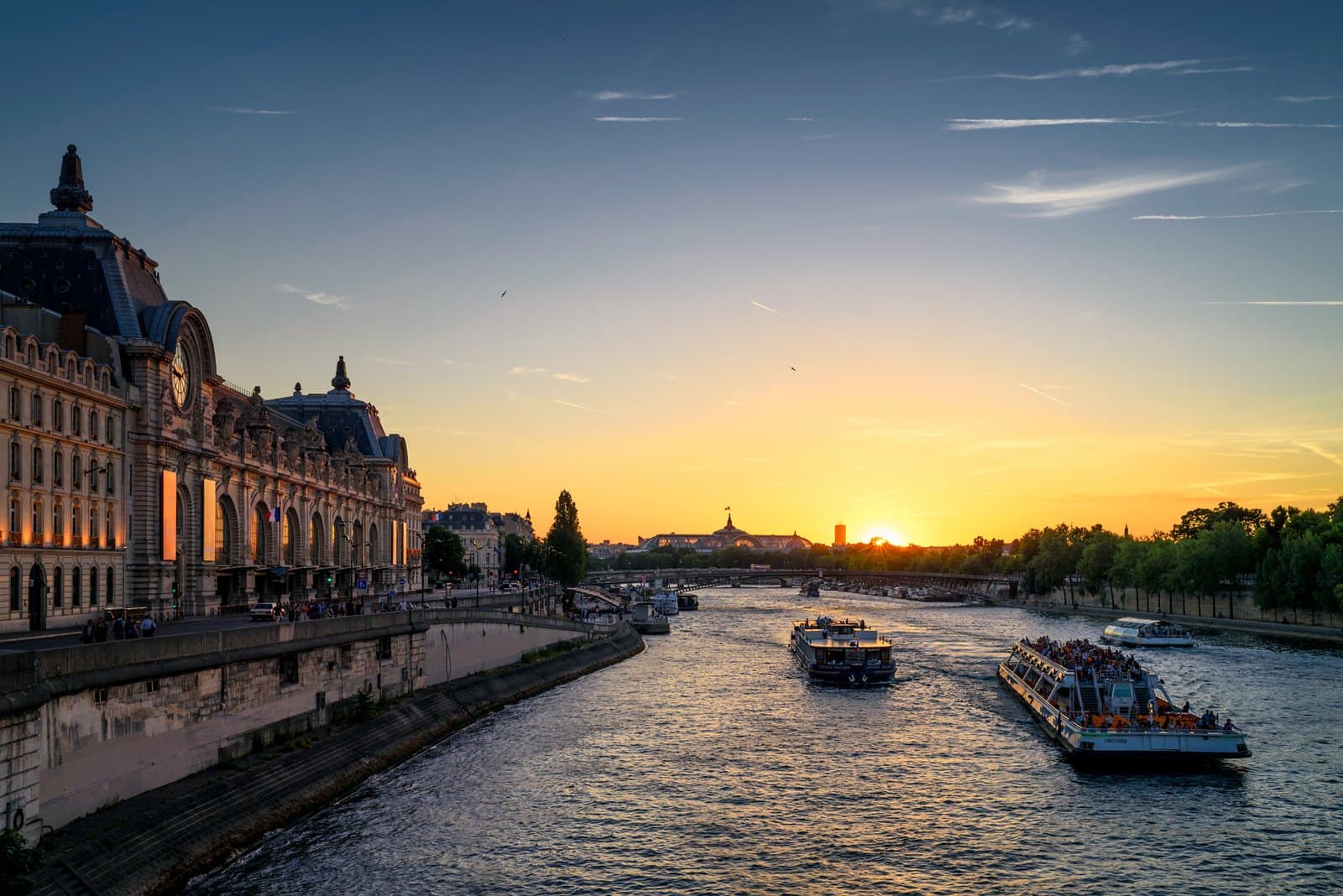
Musée d'Orsay
Esplanade Valéry Giscard d’Estaing, 75007 Paris, France
Displays and loans can change. Check whether this work is on view before making a special trip.
Plan your visitFrequently asked questions
Where is A Burial at Ornans?
The Musée d'Orsay in Paris, accession number RF 325. It hangs in the museum's Courbet room, facing The Painter's Studio.
How big is A Burial at Ornans?
315 by 668 centimetres — roughly ten feet high and twenty-two feet wide. The figures are life size, which is the whole point of the picture.
Whose funeral is it in A Burial at Ornans?
The painting never says. The identity of the dead person is not given, which is part of what made it provocative: a canvas on the scale of a history painting, devoted to a burial with no named subject and no event of public importance.
Why was A Burial at Ornans controversial?
Because of the scale. French painting reserved life-size figures and canvases this large for biblical, mythological and historical subjects. Courbet gave that treatment to villagers at a country funeral and did not flatter any of them. His own title called the picture a history.
Who are the people in A Burial at Ornans?
Residents of Ornans, Courbet's home town in the Doubs valley in eastern France. Many of them sat for him. The painting shows pallbearers, a priest and two beadles, a kneeling gravedigger, the men of the town, a group of weeping women, and a dog in the foreground.
Is A Burial at Ornans a Realist painting?
It is usually treated as the manifesto of the movement. Courbet took a subject from ordinary life, painted it at the size of history painting, refused to idealise anyone in it, and then exhibited it in a building he called the Pavilion of Realism in 1855.
More by Gustave Courbet
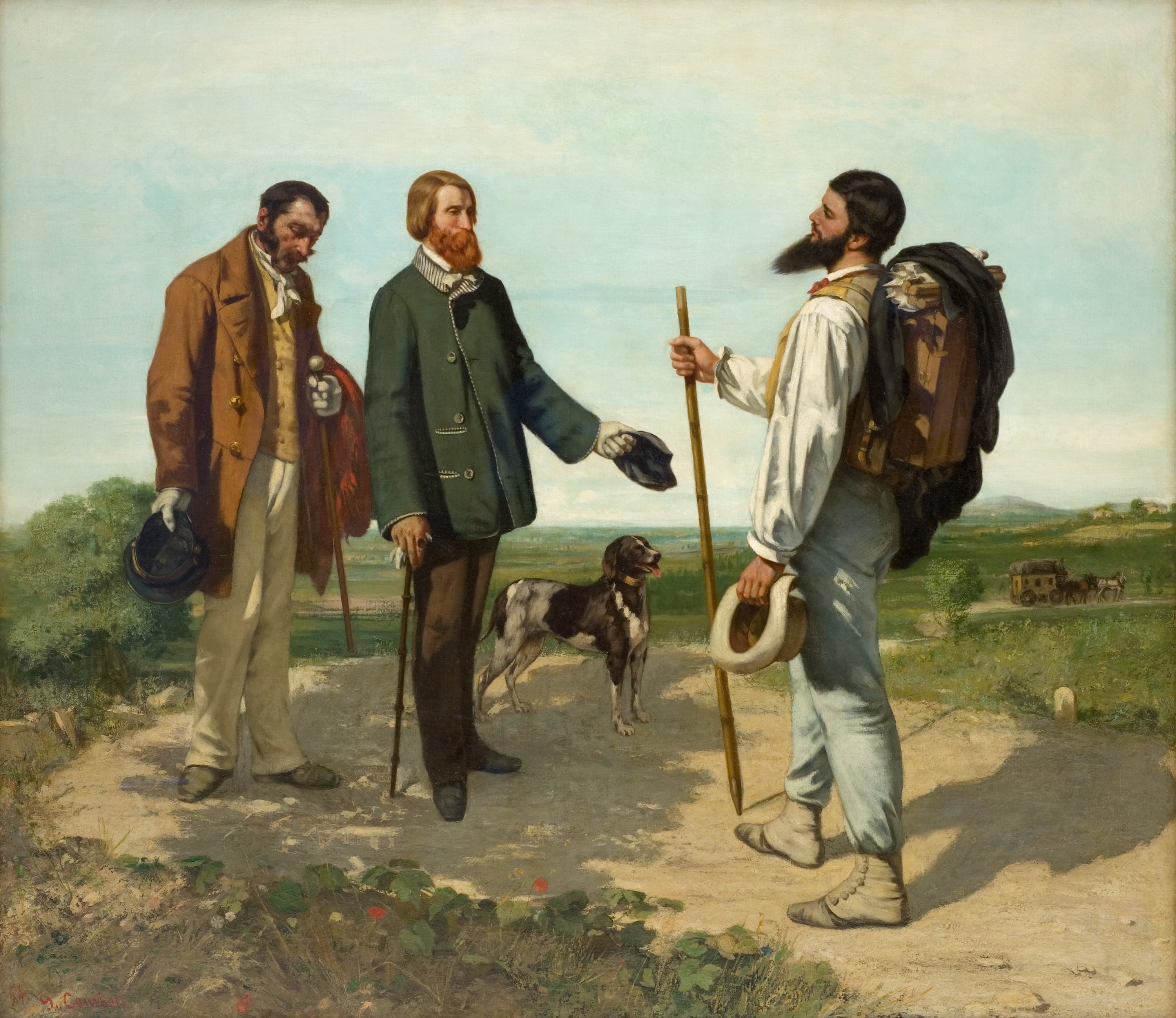
If you like Gustave Courbet
Explore painters from the same movements and circles.
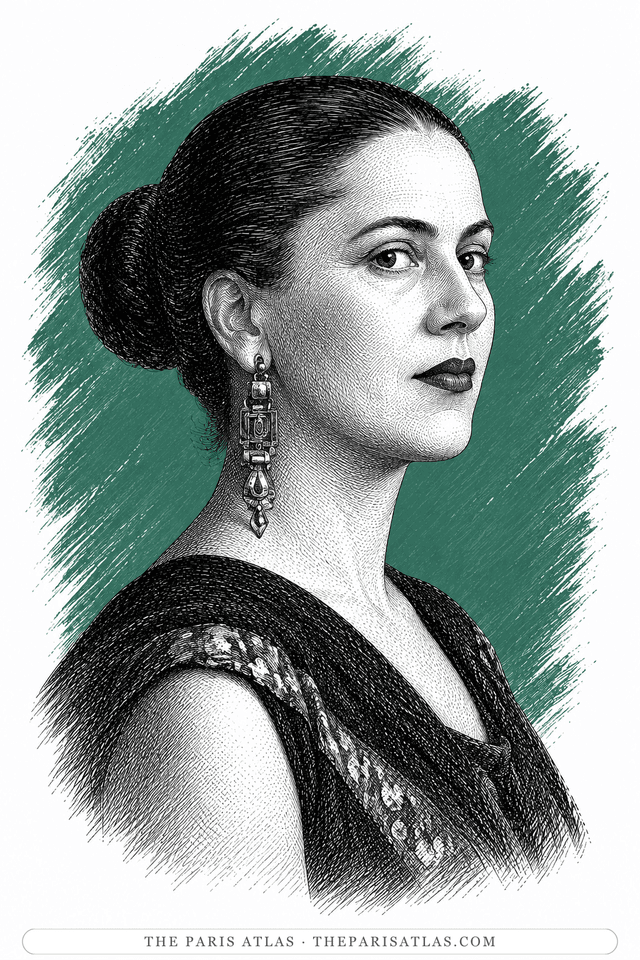
Tarsila do Amaral
Brazilian painter who spent the 1920s moving between São Paulo and Paris, studied Cubism under André Lhote, Albert Gleizes and Fernand Léger, and used what she learned to paint Brazilian towns, railways, plants and bodies. Her 1928 painting Abaporu prompted the manifesto that gave the Anthropophagic movement its name.
View artist
Arman
French-American artist, lifelong friend of Yves Klein, and a founder of New Realism.
View artist
Jean Arp
Strasbourg-born sculptor and poet — Hans in German, Jean in French, both all his life — who co-founded Dada at the Cabaret Voltaire in 1916, composed collages by dropping torn paper 'according to the laws of chance', and settled at Meudon outside Paris in a house his wife Sophie Taeuber-Arp designed.
View artist
References
The sources below include collection records, catalogues, scholarly research, and primary materials that informed this page. They document A Burial at Ornans, its making, and its place in cultural history.


1Gustave Courbet, Un enterrement à Ornans — collection record
WebsiteMusée d'OrsayUsed forWeb source consulted for documented facts and historical context presented on the A Burial at Ornans page.

2L'Atelier du peintre, Gustave Courbet (RF 2257)
Official recordMusée d'OrsayUsed forOfficial record used to verify names, dates, institutional details, or other factual information on this page.
3Biographie de Gustave Courbet — Institut Gustave Courbet
WebsiteInstitut Gustave Courbet, OrnansUsed forWeb source consulted for documented facts and historical context presented on the A Burial at Ornans page.
4Gustave Courbet
WebsiteEncyclopaedia BritannicaUsed forWeb source consulted for documented facts and historical context presented on the A Burial at Ornans page.
These references provide the documented foundation for this work's history and interpretation. Claim-level citations remain attached to the specific claims they support.
 Explore more resources