The Storm (Black Landscape)
by Yves Tanguy
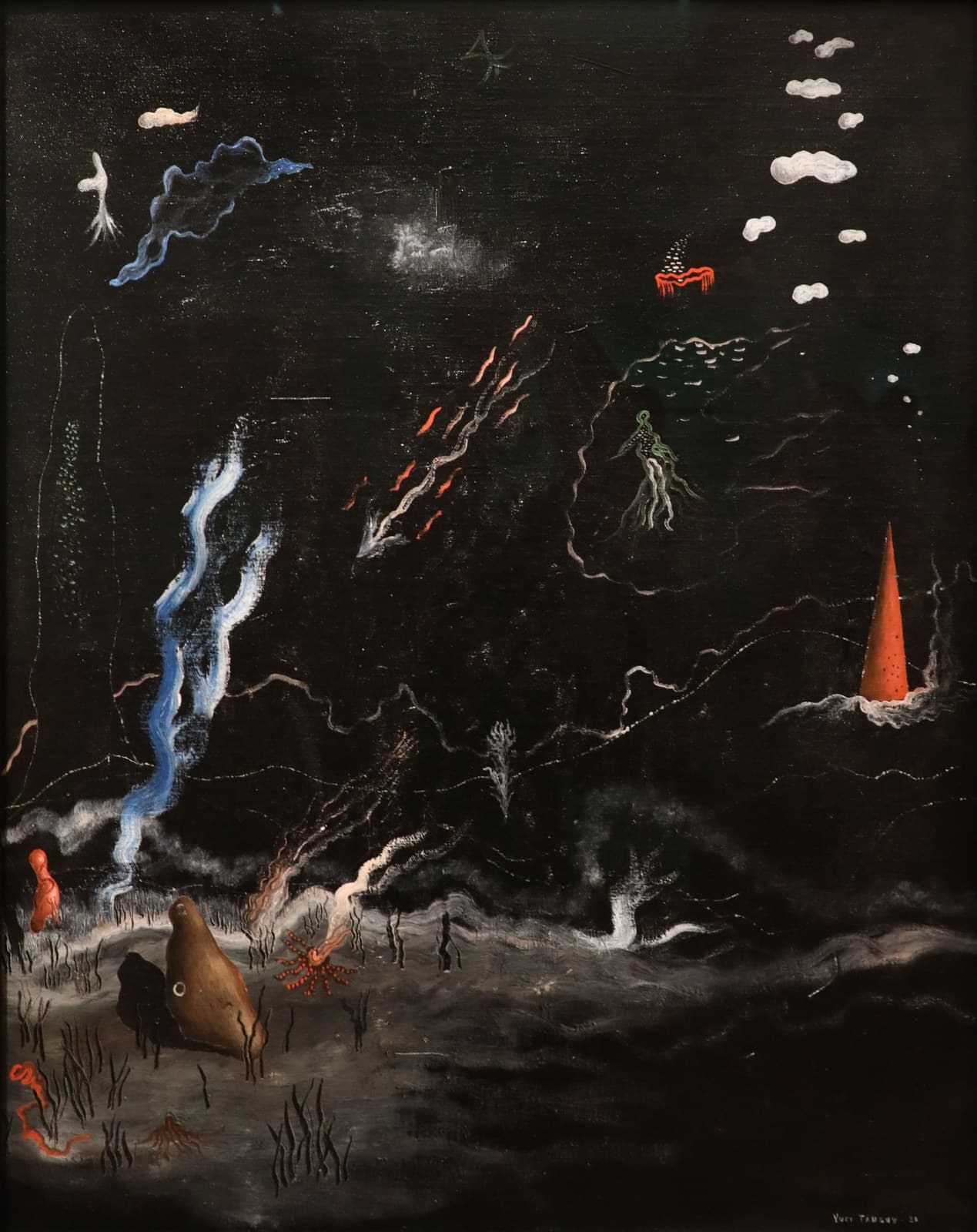
A near-black canvas with a pale churning ground along the bottom and a crowd of small invented things scattered across the dark. A vermilion cone stands on the right. A brown boulder with a white eyelet sits on the left. Yves Tanguy painted it in 1926, his second year of painting and the year after he joined the Surrealist group in Paris. It belongs to the Philadelphia Museum of Art as part of the Louise and Walter Arensberg Collection.
- 1926
- Oil on canvas
- Philadelphia Museum of ArtPhiladelphia, United States
About Yves Tanguy
What the painting shows
Most of the canvas is black. Along the bottom a pale grey ground churns in soft horizontal drifts, and the line where it meets the dark reads as a horizon without ever being drawn as one. The Philadelphia Museum of Art calls that faint horizon the thing that turns the picture into a dark vista rather than a flat field.
Scattered across the black are small painted objects that belong to no known species. A vermilion cone stands on the right with white spray breaking at its foot and small dots down its length. A brown boulder with a white ring set into it rests on the ground at the lower left. Beside it sits a red starfish shape with beaded arms.
Higher up the colour thins out. A blue ribbon curls at the upper left beside a small white plume shaped like a hand. A row of white cloud-blobs steps down the right edge and trails away into single dots. A run of red-orange darts crosses the middle diagonally, and a grey-green tuft hangs on the right with filaments trailing below it.
The canvas is 81.6 by 65.4 centimetres, about thirty-two by twenty-six inches. Yves Tanguy signed it at the lower right in white, with the last two digits of the year after his name.
His second year of painting
Yves Tanguy had no art-school training. He decided to paint after seeing a picture by Giorgio de Chirico in a dealer's window in Paris around 1923, and began working without instruction. The Philadelphia Museum of Art records that he joined the Paris Surrealist group in 1925.
The 1926 pictures are the ones where the invented world arrives. The earlier canvases still carry recognisable Paris streets bent out of shape. Here there is no architecture and no figure, only a ground, a dark above it, and things placed on and in that dark.
The museum also records Yves Tanguy's own account of how the pictures came: he claimed they arrived like visions. That claim sits with the Surrealist interest in automatism, in letting an image form without a plan and then painting it out in full detail.
How it reached Philadelphia
Louise and Walter Arensberg collected modern art in California and built one of the earliest American holdings of Surrealist painting. Their collection went to the Philadelphia Museum of Art in 1950, and the credit line on the canvas reads "The Louise and Walter Arensberg Collection, 1950".
The museum catalogues it under European Painting with the accession number 1950-134-187. As of September 2026 the collection record shows it on view. The frame measures 98.7 by 83.2 by 10.5 centimetres, which is a good deal larger than the canvas inside it.
Why the reproduction is small
Yves Tanguy died on 15 January 1955, so the French term of the author's life plus seventy years expired on 31 December 2025. The painting entered the French public domain on 1 January 2026, which is why freely licensed photographs of it appeared on Wikimedia Commons that month.
The United States position is not settled. A painting made and first published in France before 1939 is a foreign work, and the Uruguay Round Agreements Act restored the American copyright in works still protected in France on 1 January 1996. A restored term runs ninety-five years from first publication, and nobody documents when this canvas was first published.
The Philadelphia Museum of Art still routes reproduction of the work through the Artists Rights Society. The atlas therefore shows a reduced reproduction for editorial commentary and excludes it from commercial reuse. The reasoning is recorded in full beside the image file.
Close reading
Reading the work, detail by detail
Almost the whole canvas is black, and the objects in it are easy to miss at full size. The close views pick out the vermilion cone on the right, the brown boulder with its white eyelet, the blue ribbon at the top corner and the pale ground that carries everything.
1.A vermilion cone on the right
The cone is the brightest thing in the painting and the only large patch of saturated colour. Small dots run down its length. A white curl of spray breaks at its base, and a pale ridge runs away from it to the left.
2.A boulder with a ring set into it
The brown form sits on the ground like a boulder, and a white ring is set into its upper left as though it were an eyelet. Beside it a red starburst opens its arms, each one beaded along its length. Black spikes rise from the ground around both.
3.A blue ribbon and a white plume
The ribbon curls twice and carries a darker core along its length. To its left a small white form spreads into fine points like a hand or a feather. A short pink streak floats above them both.
4.White blobs stepping down the edge
Seven or eight rounded white forms step down the right edge in a line. They start large and paired, then shrink, then give out as single dots. Nothing connects them and nothing explains the order they fall in.
5.A tuft hanging with filaments
The form hangs rather than stands, and pale filaments trail from it toward the ground. Above it a row of small white marks curves across the dark. Yves Tanguy gave it no name and painted nothing else like it in the canvas.
6.Red darts crossing the middle
A run of short red-orange dashes crosses the middle of the canvas on a diagonal, pointing up and to the right. Grey streaks run beside several of them. They are painted flat, with no shading, so they sit on the black rather than in it.
7.The ground that makes it a landscape
The pale grey paint drifts in soft horizontal bands and rises into the black without a drawn edge. The Philadelphia Museum of Art calls this faint horizon the thing that makes the picture a vista. Thin black spikes rise from it like stubble.
Timeline
1923
Yves Tanguy sees a painting by Giorgio de Chirico in a Paris dealer's window and decides to paint, with no training.
1925
Joins the Surrealist group in Paris, as the Philadelphia Museum of Art records.
1926
Paints The Storm (Black Landscape) in oil on canvas, 81.6 by 65.4 centimetres, and signs it at the lower right.
1950
Enters the Philadelphia Museum of Art with the Louise and Walter Arensberg Collection, as accession 1950-134-187.
2026
The French copyright term expires on 1 January, and freely licensed photographs of the painting reach Wikimedia Commons.
Where to see it
Philadelphia Museum of Art
2600 Benjamin Franklin Parkway, Philadelphia, PA 19130, United States
The museum's collection record shows the painting on view as of September 2026. Check before travelling.
Plan your visit on the museum’s official website (opens in a new tab)Frequently asked questions
Where is Yves Tanguy's The Storm?
At the Philadelphia Museum of Art, under the full title The Storm (Black Landscape). Its accession number is 1950-134-187 and it came in with the Louise and Walter Arensberg Collection in 1950. The museum's record shows it on view as of September 2026.
When did Yves Tanguy paint The Storm?
In 1926. That was his second year of painting and the year after he joined the Surrealist group in Paris, which the Philadelphia Museum of Art dates to 1925.
How big is The Storm (Black Landscape)?
The canvas is 81.6 by 65.4 centimetres, roughly thirty-two by twenty-six inches. Its frame is much larger, at 98.7 by 83.2 by 10.5 centimetres.
What are the objects in The Storm?
They are invented. Yves Tanguy painted no recognisable species and gave none of them names. A vermilion cone stands at the right, a brown boulder with a white ring set into it rests at the lower left, and a red starfish shape with beaded arms sits beside the boulder.
Why is the painting so dark?
Almost the whole canvas is black, and the only light is the pale churning ground along the bottom. The Philadelphia Museum of Art describes a faint horizon line that turns the composition into a dark vista rather than a flat black field.
Did Yves Tanguy train as a painter?
No. He decided to paint after seeing a picture by Giorgio de Chirico in a Paris dealer's window around 1923 and worked without formal instruction. He had been to sea and done his military service before that.
More by Yves Tanguy
If you like Yves Tanguy
Explore painters from the same movements and circles.
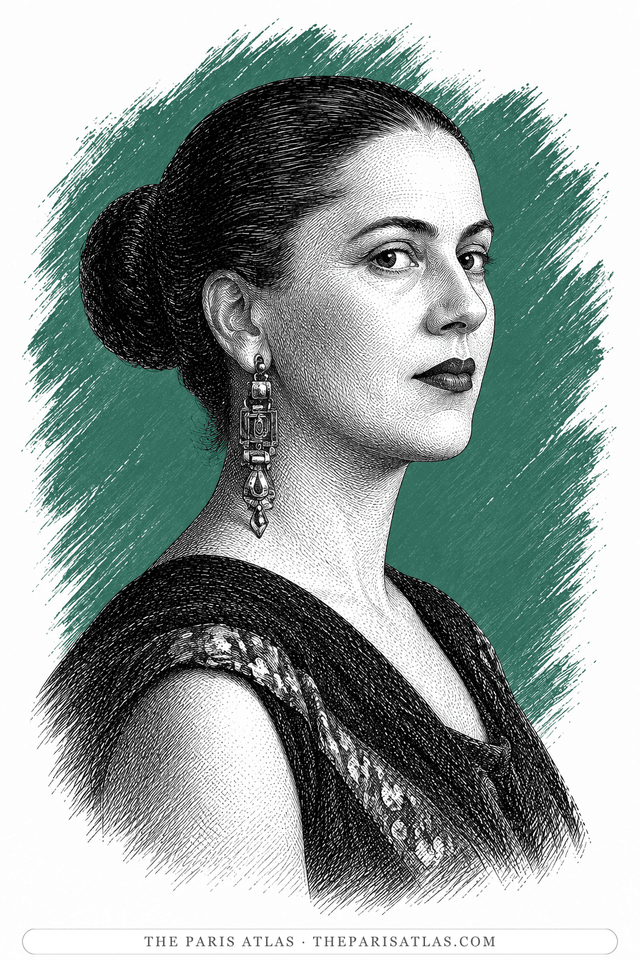
Tarsila do Amaral
Brazilian painter who spent the 1920s moving between São Paulo and Paris, studied Cubism under André Lhote, Albert Gleizes and Fernand Léger, and used what she learned to paint Brazilian towns, railways, plants and bodies. Her 1928 painting Abaporu prompted the manifesto that gave the Anthropophagic movement its name.
View artist
Arman
French-American artist, lifelong friend of Yves Klein, and a founder of New Realism.
View artist
Jean Arp
Strasbourg-born sculptor and poet — Hans in German, Jean in French, both all his life — who co-founded Dada at the Cabaret Voltaire in 1916, composed collages by dropping torn paper 'according to the laws of chance', and settled at Meudon outside Paris in a house his wife Sophie Taeuber-Arp designed.
View artist
References
The sources below include collection records, catalogues, scholarly research, and primary materials that informed this page. They document The Storm (Black Landscape), its making, and its place in cultural history.

1The Storm (Black Landscape), 1926
Official recordPhiladelphia Museum of ArtUsed forOfficial record used to verify names, dates, institutional details, or other factual information on this page.

2Yves Tanguy
WebsiteThe Museum of Modern ArtUsed forWeb source consulted for documented facts and historical context presented on the The Storm (Black Landscape) page.

3The Inquiring Eye: Early Modernism
NonfictionNational Gallery of ArtUsed forPublished analysis and historical context used in preparing the The Storm (Black Landscape) page.
4Yves Tanguy: chronology and retrospective press dossier
Exhibition catalogueCentre PompidouUsed forCatalogue scholarship used to verify attribution, provenance, chronology, and interpretive context for The Storm (Black Landscape).
These references provide the documented foundation for this work's history and interpretation. Claim-level citations remain attached to the specific claims they support.
 Explore more resources