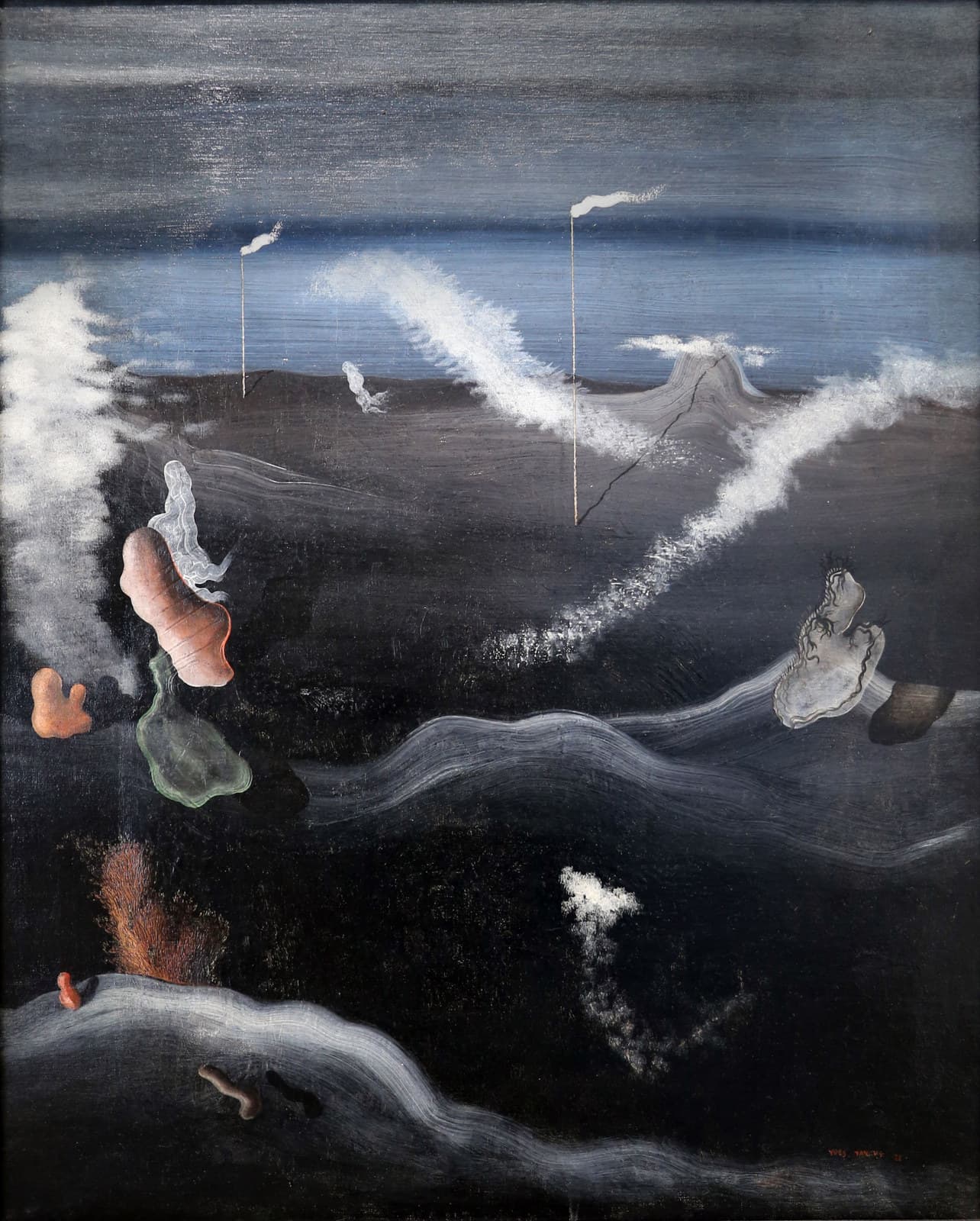
Paysage avec nuages roses
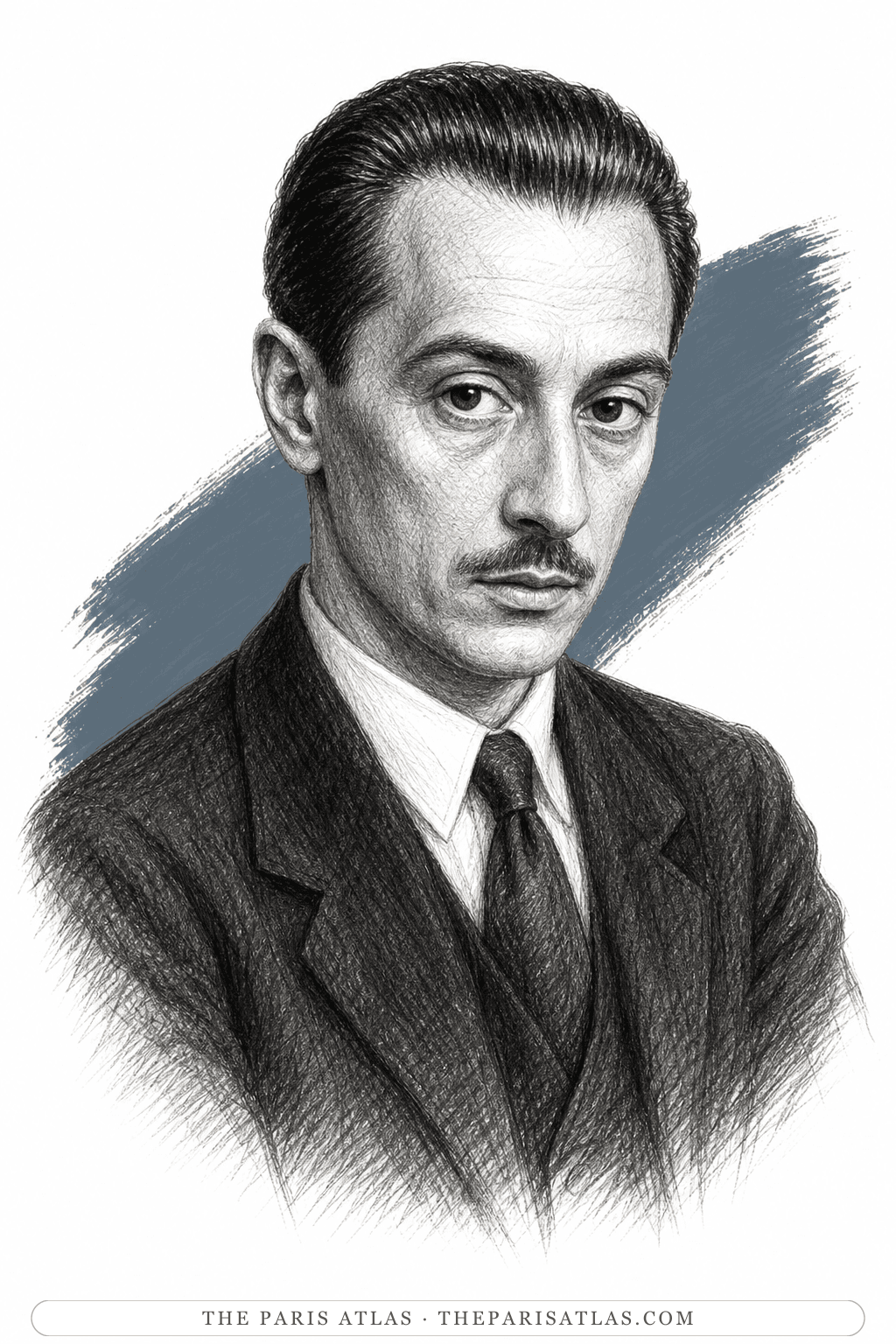
by Yves Tanguy
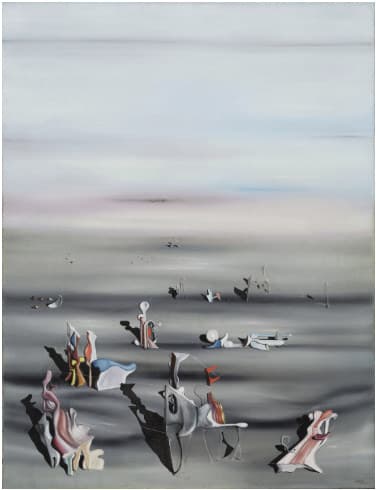
A dark landscape under a band of luminous blue, with white crusted ridges running across it like frost and two thin stalks trailing smoke from the far shore. A salmon-pink segmented form stands at the left above a pale green shield. Yves Tanguy painted it in 1928, in the years he was living at 54 rue du Château in Paris. Museum Boijmans Van Beuningen in Rotterdam bought it in 2007.
- 1928
- Oil on canvas
- Museum Boijmans Van BeuningenRotterdam, Netherlands
About Yves Tanguy
What the painting shows
The top of the canvas is banded grey, and below it a wide stripe of luminous pale blue runs the full width. Beneath that lies a dark brown headland, and beneath that the ground goes almost black. Museum Boijmans Van Beuningen describes a nocturnal landscape with a high horizon and a deep foreground.
Two thin white stalks rise from the far ground, each topped by a small puff of white smoke. The line of the right-hand one continues a long way down into the dark. White ridges cross the middle of the picture in crusted chevrons, painted in a dry, granular white that reads as frost or surf rather than cloud.
The objects are gathered at the left. A salmon-pink segmented form, bulbous and lit along one edge, stands above a pale sage-green shield with a translucent look. A small orange two-lobed shape floats beside them, and a pale grey wavy ribbon rises behind. Lower down a rust-orange feathery tuft sits on a grey mound striped with fine contour lines.
On the right a grey wrinkled form with dark veins lies beside a smooth dark brown mass. Long white wavy bands sweep across the lower middle. A flecked white chevron with a trail of dots hangs below them. The canvas is 81 by 65 centimetres, the same standard French format as The Storm (Black Landscape) of 1926, and Yves Tanguy signed it in red at the lower right.
The title names clouds
The title translates as landscape with pink clouds. There are no pink clouds in the canvas. The white forms crossing the middle are white, and the blue band above them carries no pink at all.
The only pink is the segmented form standing on the ground at the left, which is solid, closer to flesh than to vapour, and clearly not in the sky. Yves Tanguy's titles regularly sit beside his pictures rather than describing them, and this one behaves the same way.
Painted from 54 rue du Château
Museum Boijmans Van Beuningen records that Yves Tanguy lived in the rue du Château in Paris from 1923 to 1928, and that the apartment soon became a meeting place for artists. He shared it with Marcel Duhamel and Jacques Prévert, and the address became one of the fixed points of early Surrealism.
The museum dates his meeting with André Breton to December 1925 and calls the encounter one of great significance to him. It adds that he remained one of André Breton's most loyal friends and assistants until he left for the United States in 1939.
This canvas belongs to the last of the rue du Château years. Christie's has sold a separate Tanguy canvas titled after the address and after Jacques Prévert, which gives a measure of how firmly the place is attached to his name.
Eighty years in private hands
The museum's provenance begins with Simone Collinet, who held the painting from 1928 until 1956. It then passed to the Galerie Furstenburg in Paris in 1956, to René de Montaigu in Paris in 1957, to Jaqueline Grammont in Paris, and to a private collection in Paris.
Museum Boijmans Van Beuningen bought it in 2007. The credit line names the Stichting Museum Boijmans Van Beuningen, the VriendenLoterij, the Rembrandt Association, the Mondriaan Fund, VSBfonds and the Cultuurfonds, together with private donors who gave at a benefit dinner on 28 September 2007.
The inventory number is 3577 (MK). Nearly eighty years passed between the year Yves Tanguy painted the canvas and the year a museum first owned it.
Why the reproduction is small
Yves Tanguy died on 15 January 1955, so the French term of life plus seventy years expired on 31 December 2025 and the painting entered the French public domain on 1 January 2026.
The United States leg cannot be closed. A painting made and first published in France before 1939 is a foreign work whose American copyright the Uruguay Round Agreements Act restored, and a restored term runs ninety-five years from first publication. The long private provenance makes that date harder to find rather than easier, because there is no early museum catalogue to point at.
A reduced reproduction is therefore shown for editorial commentary and excluded from commercial reuse.
Close reading
Reading the work, detail by detail
The canvas is dark and the light is concentrated in a blue band across the upper third and a set of white crusted ridges below it. The close views separate those ridges from the objects gathered at the left, and take in the two smoking stalks that stand on the far shore.
1.A band of blue across the upper third
The blue runs the full width of the canvas in fine horizontal strokes, brightest at its lower edge. Banded grey sits above it and a dark brown headland below. Museum Boijmans Van Beuningen describes a nocturnal landscape with a high horizon.
2.Two stalks giving off smoke
Each stalk is a single thin white line with a small puff of smoke at the top. The right-hand one is taller and its line carries on a long way down into the dark ground. Nothing at the base of either explains what is burning.
3.White ridges laid on like frost
The white is dry and granular, built up in a crust that catches the light differently from the smooth ground beneath it. One ridge forms a chevron across the middle and another runs away on a long diagonal. Neither behaves like a cloud or a wave.
4.The only pink in the painting
The form is segmented like a grub and lit along its right edge in orange. Below it sits a pale sage-green shape with a translucent look, and a grey wavy ribbon rises behind. The title names pink clouds, and this solid form on the ground is the only pink on the canvas.
5.A wrinkled shell beside a smooth mass
The grey form is wrinkled and veined with fine dark lines that run to its edges. The brown mass beside it is smooth and unmarked, with a soft highlight along its top. Putting the two together sets a worked surface against a blank one.
6.A striped mound at the bottom
The mound is drawn in fine parallel contour lines that follow its curve, the same method used for the wavy bands higher up. Two small brown worm shapes lie on its slope. Behind it a rust-orange tuft rises like a burnt shrub, with a small red hook beside it.
Timeline
1923
Yves Tanguy begins living in the rue du Château in Paris, as Museum Boijmans Van Beuningen records.
1925
Meets André Breton in December, an encounter the museum calls one of great significance to him.
1928
Paints Paysage avec nuages roses in oil on canvas, 81 by 65 centimetres, in the last of the rue du Château years.
1928
The painting passes to Simone Collinet, who keeps it until 1956.
1956
Sold through the Galerie Furstenburg in Paris, then to René de Montaigu in 1957, Jaqueline Grammont, and a private Paris collection.
2007
Museum Boijmans Van Beuningen buys the painting with public and private support, including funds raised at a benefit dinner on 28 September.
Where to see it
Museum Boijmans Van Beuningen
Rotterdam, Netherlands
A public viewing address has not yet been confirmed for this holding.
The museum's main building has been closed for renovation since 2019, and its collection is shown at other venues. Check the object record before travelling.
Frequently asked questions
Where is Yves Tanguy's Paysage avec nuages roses?
At Museum Boijmans Van Beuningen in Rotterdam, inventory number 3577 (MK). The museum bought it in 2007, with support from Dutch public funds and from private donors who gave at a benefit dinner that September.
Are there pink clouds in the painting?
No. The title translates as landscape with pink clouds, but the forms crossing the middle of the canvas are white, and the only pink is a solid segmented shape standing on the ground at the left. Yves Tanguy's titles often sit beside his pictures rather than describing them.
Where did Yves Tanguy paint it?
In Paris. Museum Boijmans Van Beuningen records that he lived in the rue du Château from 1923 to 1928, sharing the apartment with Marcel Duhamel and Jacques Prévert, and this canvas dates from the last of those years.
How big is Paysage avec nuages roses?
81 by 65 centimetres, about thirty-two by twenty-six inches, in oil on canvas. That is the same standard French canvas format as The Storm (Black Landscape) of 1926.
Who owned the painting before the museum?
Simone Collinet from 1928 to 1956, then the Galerie Furstenburg in Paris, then René de Montaigu in 1957, then Jaqueline Grammont, then a private collection in Paris. Museum Boijmans Van Beuningen bought it in 2007.
When did Yves Tanguy meet André Breton?
In December 1925, according to Museum Boijmans Van Beuningen. The museum calls the meeting one of great significance to him and records that he stayed one of André Breton's most loyal friends and assistants until he left France in 1939.
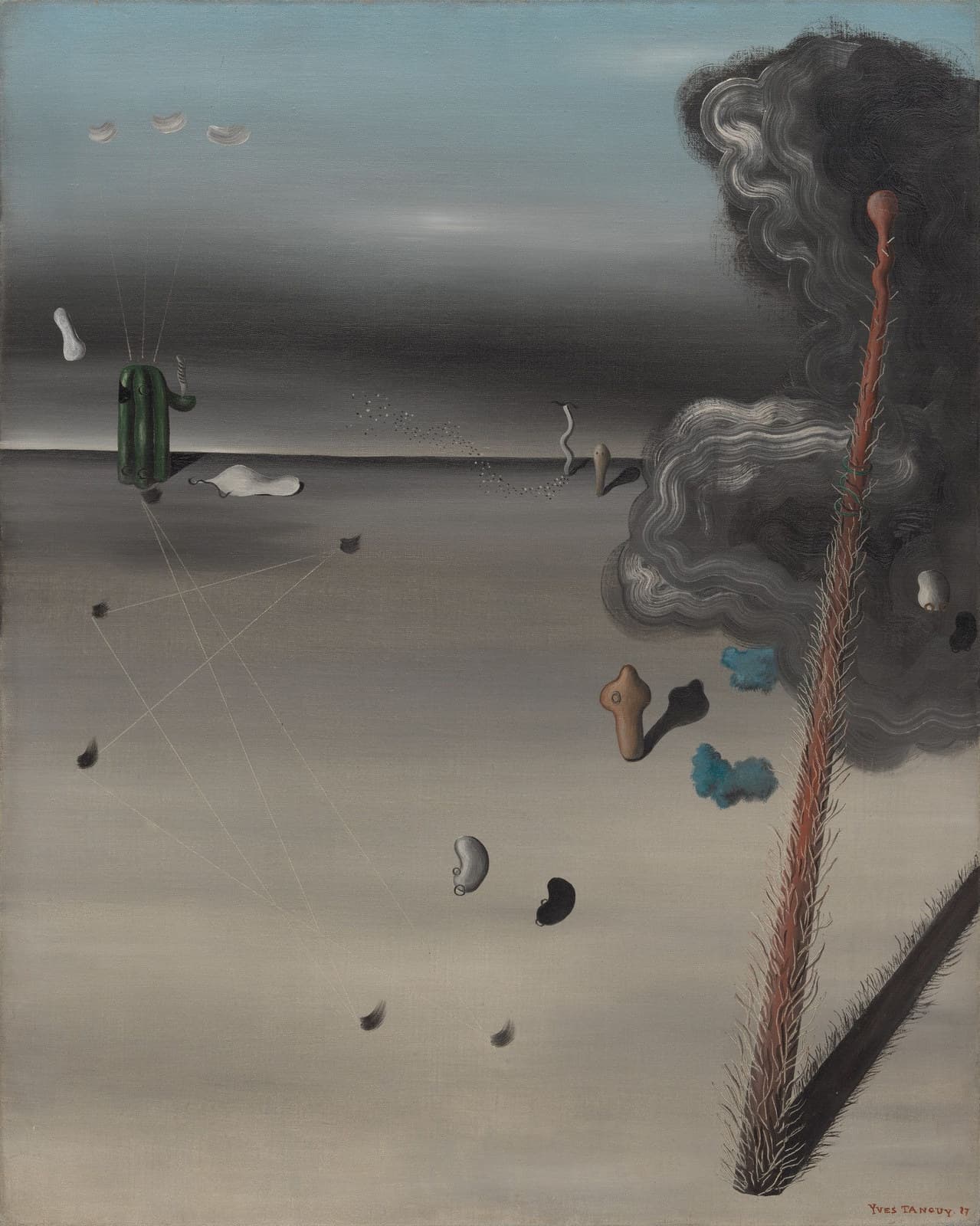
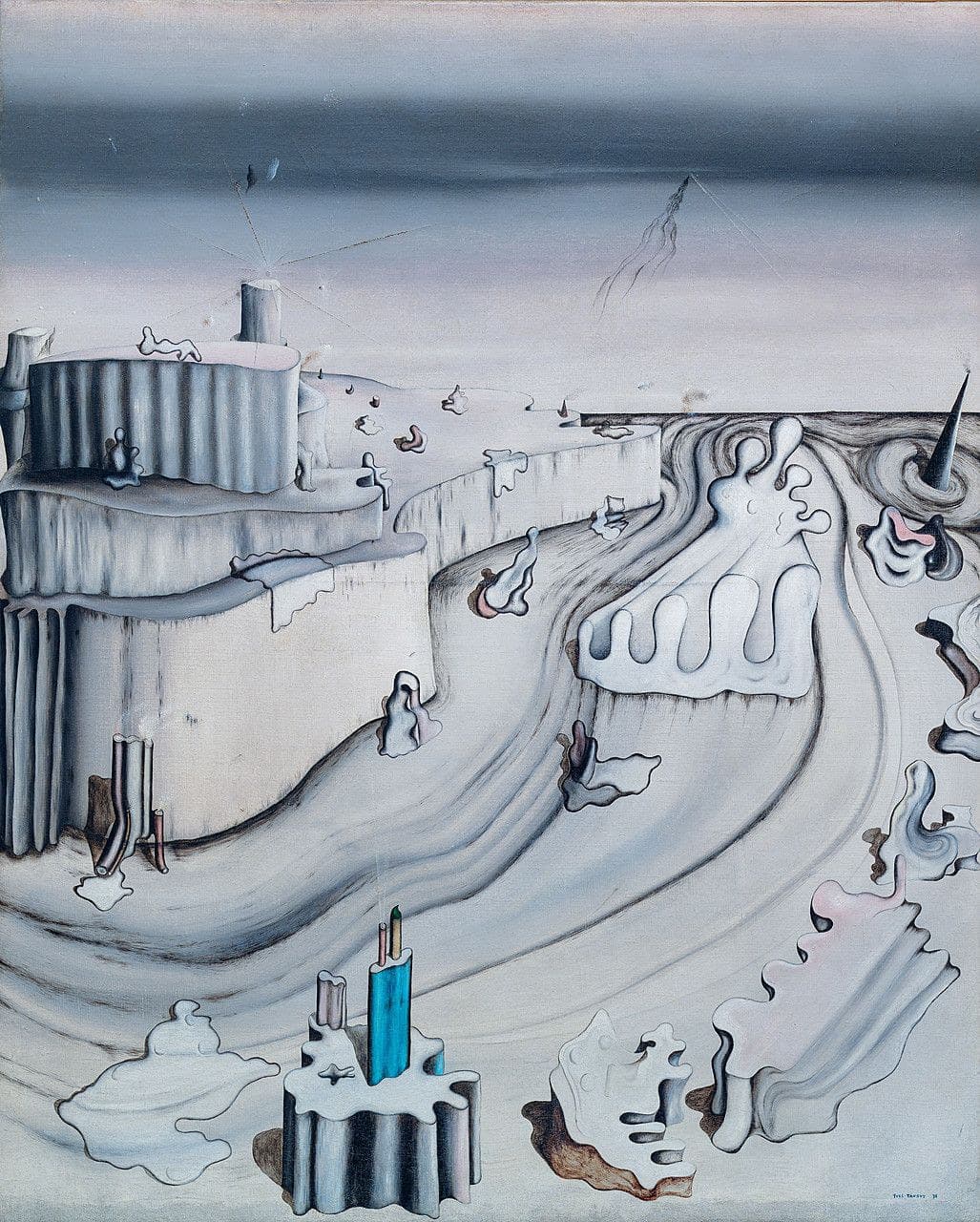
More by Yves Tanguy
If you like Yves Tanguy
Explore painters from the same movements and circles.
Tarsila do Amaral
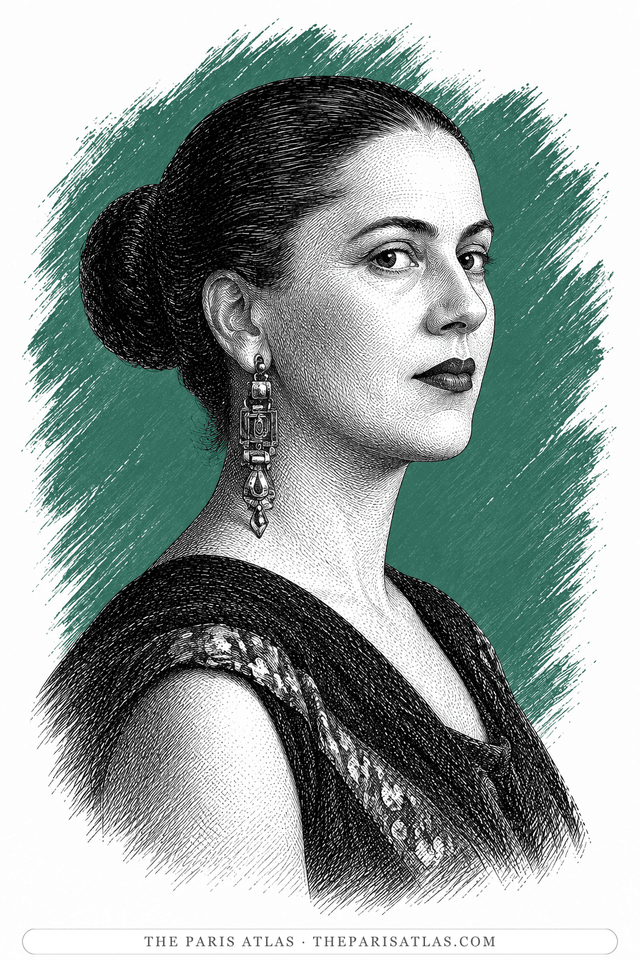
Brazilian painter who spent the 1920s moving between São Paulo and Paris, studied Cubism under André Lhote, Albert Gleizes and Fernand Léger, and used what she learned to paint Brazilian towns, railways, plants and bodies. Her 1928 painting Abaporu prompted the manifesto that gave the Anthropophagic movement its name.
View artist
Arman
French-American artist, lifelong friend of Yves Klein, and a founder of New Realism.
View artist
Jean Arp
Strasbourg-born sculptor and poet — Hans in German, Jean in French, both all his life — who co-founded Dada at the Cabaret Voltaire in 1916, composed collages by dropping torn paper 'according to the laws of chance', and settled at Meudon outside Paris in a house his wife Sophie Taeuber-Arp designed.
View artist
References
The sources below include collection records, catalogues, scholarly research, and primary materials that informed this page. They document Paysage avec nuages roses, its making, and its place in cultural history.

1Paysage avec nuages roses
Official recordMuseum Boijmans Van BeuningenUsed forOfficial record used to verify names, dates, institutional details, or other factual information on this page.

2Le Testament de Jacques Prévert (La Rue du Château)
WebsiteChristie'sUsed forWeb source consulted for documented facts and historical context presented on the Paysage avec nuages roses page.
3Yves Tanguy: chronology and retrospective press dossier
Exhibition catalogueCentre PompidouUsed forCatalogue scholarship used to verify attribution, provenance, chronology, and interpretive context for Paysage avec nuages roses.
4Yves Tanguy
WebsiteThe Museum of Modern ArtUsed forWeb source consulted for documented facts and historical context presented on the Paysage avec nuages roses page.
These references provide the documented foundation for this work's history and interpretation. Claim-level citations remain attached to the specific claims they support.
 Explore more resources