The Furniture of Time
by Yves Tanguy
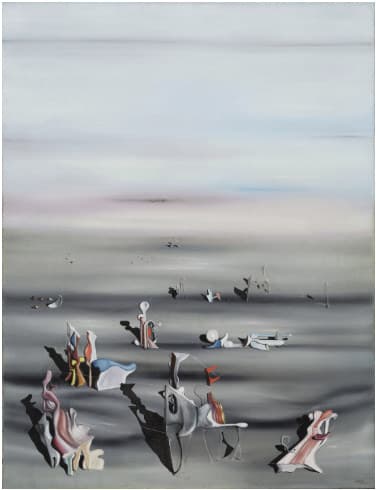
A wide grey plain under a sky that turns mauve at the horizon, with pale objects standing in the foreground and throwing long black shadows. A screen with a dark oval opening stands at the centre, and painted blocks in yellow, pink and green are stacked at the left. Yves Tanguy painted it in 1939, the year he left France. It is the largest of the three canvases James Thrall Soby left to the Museum of Modern Art.
- 1939
- Oil on canvas
- The Museum of Modern ArtNew York, United States
About Yves Tanguy
What the painting shows
The upper half is sky, graded from pale grey-lilac down to a soft band of pink-mauve where it meets the ground. A faint dark smudge sits on the horizon. Below it a grey-green plain runs forward in horizontal bands that grow darker and more marbled toward the bottom edge.
Small dark specks are scattered across the middle distance, and a thin pale stalk topped with a round white knob stands among them with a black shadow at its foot. Further forward, a white form with a sphere and a blue collar lies beside flat slabs of pale blue and white, laid out like planks on the ground.
The foreground carries the objects. At the left stands a cluster of uprights: a pink coiled form, a yellow bow shape, red and white striped posts and a tall white banner, all throwing long black shadows to the left. Below them, small blocks in yellow, pink and pale green are stacked like steps and capped in white.
At the centre stands a grey-white screen with a dark oval opening near its top, a rust-brown bar behind it and fine wires crossing in front. It casts the heaviest shadow in the picture, a black wedge running down and to the left. A small orange arrow sits on a thin stick beside it, and at the right a pink and white ribbon curls on a white slab.
The year he left France
1939 is the year Yves Tanguy left France for the United States. He had lived and worked in Paris since he began painting, and he stayed in America for the rest of his life, taking citizenship in 1948.
The Museum of Modern Art's collection data gives the year and not the place. Nothing in the record says whether the canvas was finished in Paris or after the crossing, and the question is not a small one: it decides which country's copyright rules apply to the picture.
The museum prints no French title for the painting, and none is recorded elsewhere. The English form is the only title it carries.
The Soby bequest
The credit line reads "James Thrall Soby Bequest" and the accession number is 1256.1979. The museum's data records the acquisition date as 11 December 1979.
Two other Yves Tanguy canvases came from the same bequest. The Mood of Now, painted in 1928, entered on the same day as 1252.1979. A small untitled panel on wood, dated 25 December 1954 and measuring 8.3 centimetres square, followed as 696.1980 in December 1980.
The Museum of Modern Art's website refuses automated requests, so these figures come from the museum's own published collection dataset rather than from the object pages.
The gap in the rights
Yves Tanguy died on 15 January 1955, so the French term of life plus seventy years expired on 31 December 2025 and the work entered the French public domain on 1 January 2026.
The American position turns on where the canvas was painted, and that is the fact the record does not supply. A painting made in the United States is a United States work, so the Uruguay Round Agreements Act does not reach it. On ordinary American rules a 1939 work either lost its copyright for want of renewal, or ran life plus seventy if it was never published. Either way the term ended with 2025.
A painting made and first published in France in 1939 is a foreign work whose American copyright the Act restored, and that restored term would run to 31 December 2034. Both readings are open on the evidence, so the atlas shows a reduced reproduction for editorial commentary and excludes it from commercial reuse.
Close reading
Reading the work, detail by detail
The reproduction available is small, and the picture is mostly empty sky and plain, so the close views concentrate on the foreground objects and the shadows they throw. They take in the standing screen with its oval opening, the stacked pastel blocks, and the pale stalk out in the middle distance.
1.A screen with an oval opening
The panel stands upright with a dark oval cut through it near the top. A rust-brown bar rises behind, and fine wires cross in front of the face. It throws the heaviest shadow in the painting, a black wedge running down and to the left.
2.Blocks stacked like steps
The blocks are stacked against each other at the foot of the upright group, each one capped with a white crest. Yellow, pink and pale green sit side by side. They are the only warm colours in the lower left of the canvas.
3.A yellow bow among the uprights
A yellow bow shape sits among red and white striped posts, with a pink coiled form at the outer edge and a tall white banner behind. All of them cast long black shadows to the left, which is the only thing telling the viewer where the light is.
4.A stalk with a knob in the distance
The stalk is thin and pale with a round white knob on top, and a small black shadow lies at its foot. Red and blue flecks sit on the ground beside it. Its scale is the main clue to how far back the plain runs.
5.A sphere, a blue collar and flat slabs
A white form carries a sphere at one end and a blue collar behind it. Beside it flat slabs of pale blue and white lie on the ground like planks put down in a row. Each has a thin dark edge and none is standing.
6.Where the sky turns mauve
The sky grades from pale grey-lilac down to a soft band of pink-mauve where it meets the ground. A faint dark smudge sits on the line itself. There is no drawn horizon anywhere, only the change of colour.
Timeline
1939
Painted in oil on canvas, 116.7 by 89.4 centimetres. The same year Yves Tanguy leaves France for the United States.
1948
Yves Tanguy becomes a United States citizen.
1979
Enters the Museum of Modern Art on 11 December with the James Thrall Soby Bequest, as accession 1256.1979, alongside The Mood of Now of 1928.
1980
A third Tanguy from the same bequest, an untitled panel of 25 December 1954, follows as 696.1980.
2026
The French copyright term expires on 1 January. The American term cannot be settled, because the record does not say where the canvas was painted.
Where to see it
The Museum of Modern Art
11 West 53 Street, New York, NY 10019, United States
The museum's published collection data records no gallery for the painting, so it is not on permanent display. Check the object record before travelling.
Plan your visit on the museum’s official website (opens in a new tab)Frequently asked questions
Where is The Furniture of Time?
At the Museum of Modern Art in New York, accession number 1256.1979. It came in on 11 December 1979 with the James Thrall Soby Bequest.
When did Yves Tanguy paint The Furniture of Time?
In 1939, the year he left France for the United States. The museum's record gives the year but not the place, so it is not documented whether the canvas was finished in Paris or in America.
How big is The Furniture of Time?
116.7 by 89.4 centimetres, or 46 by 35 1/4 inches as the Museum of Modern Art prints it. It is the largest of the three Tanguy works in the Soby bequest.
Does The Furniture of Time have a French title?
None is recorded. The Museum of Modern Art prints only the English title, and no French form appears in the museum's data or in the standard reference records.
What does the painting show?
A wide grey-green plain under a sky that turns mauve at the horizon. Pale invented objects stand in the foreground and throw long black shadows. A screen with a dark oval opening stands at the centre. A cluster of uprights and a yellow bow shape sit at the left, with blocks in yellow, pink and green stacked below them.
Who was James Thrall Soby?
A collector whose bequest brought three Yves Tanguy works to the Museum of Modern Art: The Furniture of Time and The Mood of Now in December 1979, and a small untitled panel of 1954 in December 1980.
More by Yves Tanguy
If you like Yves Tanguy
Explore painters from the same movements and circles.
Tarsila do Amaral
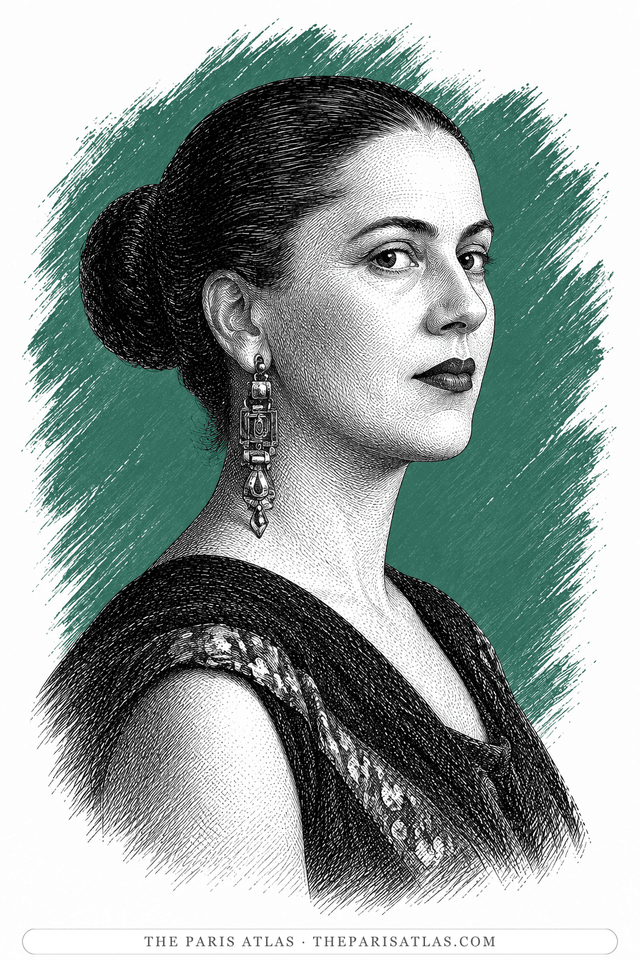
Brazilian painter who spent the 1920s moving between São Paulo and Paris, studied Cubism under André Lhote, Albert Gleizes and Fernand Léger, and used what she learned to paint Brazilian towns, railways, plants and bodies. Her 1928 painting Abaporu prompted the manifesto that gave the Anthropophagic movement its name.
View artist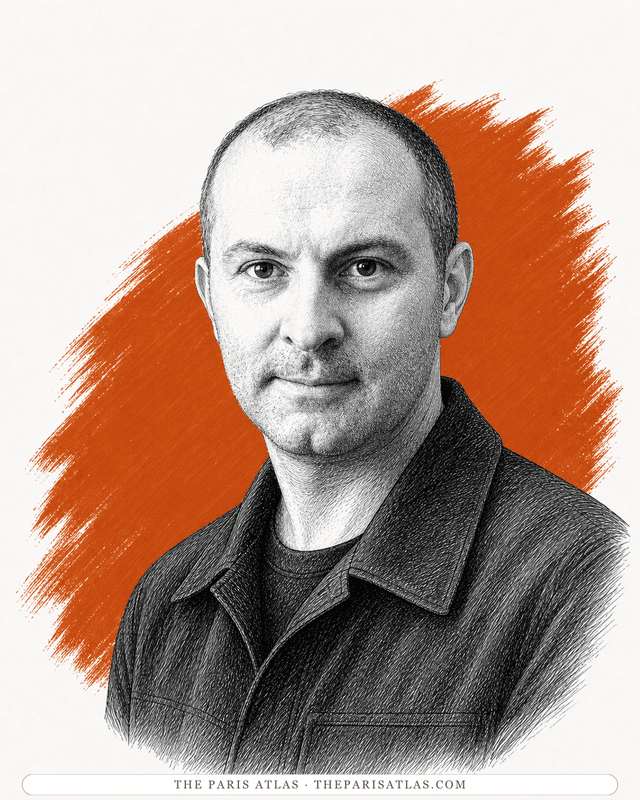
Arman
French-American artist, lifelong friend of Yves Klein, and a founder of New Realism.
View artist
Jean Arp
Strasbourg-born sculptor and poet — Hans in German, Jean in French, both all his life — who co-founded Dada at the Cabaret Voltaire in 1916, composed collages by dropping torn paper 'according to the laws of chance', and settled at Meudon outside Paris in a house his wife Sophie Taeuber-Arp designed.
View artist
References
The sources below include collection records, catalogues, scholarly research, and primary materials that informed this page. They document The Furniture of Time, its making, and its place in cultural history.


1The Furniture of Time, 1939
Official recordThe Museum of Modern ArtUsed forOfficial record used to verify names, dates, institutional details, or other factual information on this page.
2The Museum of Modern Art collection dataset
Official recordThe Museum of Modern ArtUsed forOfficial record used to verify names, dates, institutional details, or other factual information on this page.

3Yves Tanguy
WebsiteThe Museum of Modern ArtUsed forWeb source consulted for documented facts and historical context presented on the The Furniture of Time page.
4Yves Tanguy
Exhibition catalogueThe Museum of Modern ArtUsed forCatalogue scholarship used to verify attribution, provenance, chronology, and interpretive context for The Furniture of Time.
These references provide the documented foundation for this work's history and interpretation. Claim-level citations remain attached to the specific claims they support.
 Explore more resources