Mama, Papa Is Wounded!
by Yves Tanguy
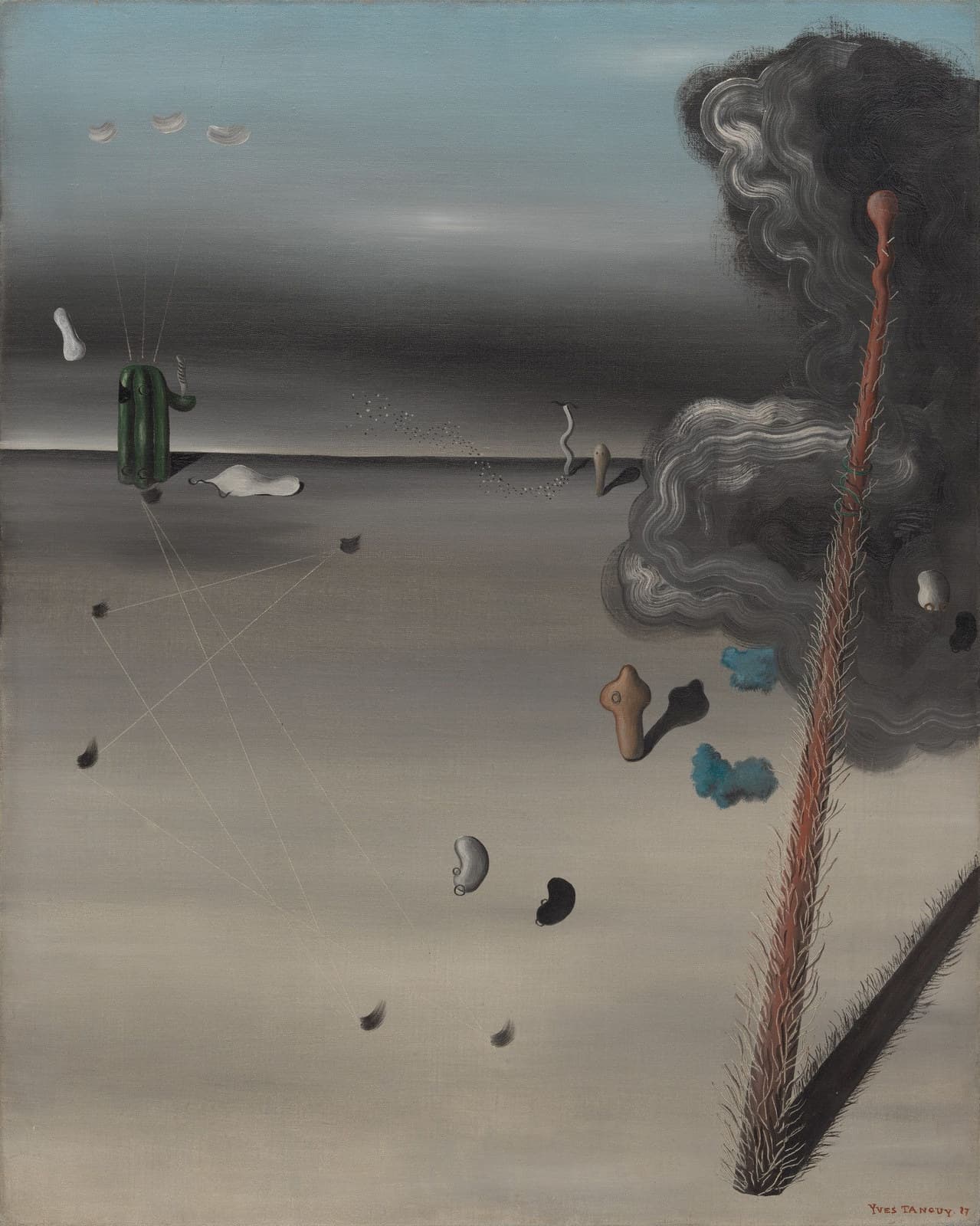
A flat grey plain runs back to a high horizon under a pale blue sky. A green slab stands at the left trailing white threads across the ground. A rust-red bristled stalk rises the full height of the canvas at the right, throwing a long black shadow, and a bank of grey smoke is drawn beside it in tight contour lines. Yves Tanguy painted it in Paris in 1927. The Museum of Modern Art bought it nine years later.
- 1927
- Oil on canvas
- The Museum of Modern ArtNew York, United States
About Yves Tanguy
What the painting shows
The ground is a flat grey-brown plain that runs back to a horizon set high in the canvas, with a band of pale blue sky above it. Three small white curved marks float at the upper left. Nothing in the picture is a plant, an animal or a building, and none of the objects has a name.
At the left a green upright slab stands with a rounded top and a small dark curl at its head. Fine white threads run from that head out across the plain like guy-ropes. A white bone-shaped blob hangs beside it, and a flattened white puddle form lies on the ground at its foot.
The right side carries the weight. A rust-red stalk rises the whole height of the canvas, bristled along its length with fine hairs, flaring at the base into a dark brush and throwing a long black shadow toward the corner. Beside it a bank of grey smoke is built entirely from tight concentric wavy lines, drawn as contours rather than painted as vapour.
Between them the plain is scattered with small things: a tan keyhole shape with a hole through it, a black comma, two turquoise cloud-patches, a grey bean marked with two small circles and a black bean beside it. An arc of tiny dark specks crosses the middle distance. The canvas measures 92.1 by 73 centimetres, and Yves Tanguy signed it in red at the lower right.
Bought before he left Paris
The Museum of Modern Art's collection data records the purchase date as 22 October 1936 and the credit line simply as "Purchase". The accession number is 78.1936. Yves Tanguy was still living in Paris at the time and did not leave France until 1939.
He was not the museum's only Tanguy purchase that year. The same data shows a second canvas of 1927, Extinction of Useless Lights, accessioned as 220.1936 and acquired on 4 December 1935. Two pictures from a single year of his work entered the collection within months of each other.
The Museum of Modern Art's website refuses automated requests, so the figures above were read from the museum's own published collection dataset rather than from the object page. The dataset gives the title, date, medium, dimensions, credit line, accession number and acquisition date.
A world with nothing named in it
Yves Tanguy taught himself to paint after seeing a picture by Giorgio de Chirico in a Paris dealer's window around 1923. His earliest canvases still held bent Paris streets. By 1927 the streets were gone and the ground, the horizon and the invented objects were all he needed.
That is what separates him from the other Surrealist painters. Salvador Dalí, René Magritte and Max Ernst worked by putting recognisable things in wrong places. Yves Tanguy built the things themselves, so there is no object in the picture a viewer can name, and the painting gives no help.
The title is an exclamation with no speaker and no scene to attach it to. Nothing in the canvas is wounded, and no parent appears. The words and the image were made to sit beside each other without explaining one another.
Why the reproduction is small
Yves Tanguy died on 15 January 1955. The French term of the author's life plus seventy years expired on 31 December 2025, so the painting entered the French public domain on 1 January 2026.
The American position is open. A painting made and first published in France before 1939 is a foreign work, and the Uruguay Round Agreements Act restored the United States copyright in works still protected in France on 1 January 1996. A restored copyright runs ninety-five years from first publication, and the first publication of this canvas is not documented.
The atlas therefore shows a reduced reproduction for editorial commentary and keeps it out of commercial reuse. The full reasoning is filed beside the image.
Close reading
Reading the work, detail by detail
The plain is nearly empty and the objects on it are small, so the close views are where the picture is. They take in the green slab and its threads, the bristled red stalk on the right, the smoke drawn in contour lines beside it, and the scatter of shapes across the middle ground.
1.A green slab trailing threads
The slab stands upright with a rounded top and a small dark curl at its head. Fine white lines run out from that head and cross the plain in both directions. They are drawn taut, like guy-ropes, and none of them reaches anything.
2.The bristled stalk and its shadow
The stalk runs the whole height of the canvas and is covered along its length in fine hairs. At the bottom it flares into a dark brush, and a long black shadow runs from that base toward the right corner. It is the only object anchored to the ground.
3.Smoke drawn as contour lines
The grey mass reads as smoke, but it is not painted as vapour. It is built from tight concentric wavy lines laid side by side, the way a map draws height. There are two lobes, a large one above and a smaller one below.
4.A keyhole shape and two turquoise patches
The tan form has a hole bored through its upper part and a waist below, which gives it the look of a keyhole. A black comma sits against its side. Two soft turquoise patches float near it, the only cool colour on the plain.
5.A white puddle on the ground
The white form lies flat on the ground and spreads at the edges like something poured. A smaller white shape hangs above it and to the left, off the ground, with nothing holding it there. Neither casts a shadow.
6.Two beans and a swarm of specks
The grey bean carries two small drawn circles on its surface. The black bean beside it has none and is painted flat. Small dark commas are scattered across the ground around them, and a wider arc of tiny specks crosses the middle distance above.
Timeline
1923
Yves Tanguy sees a Giorgio de Chirico in a Paris dealer's window and starts to paint without training.
1925
Joins the Surrealist group around André Breton in Paris.
1927
Paints Mama, Papa Is Wounded! in oil on canvas, 92.1 by 73 centimetres, and signs it in red at the lower right.
1935
The Museum of Modern Art acquires a second 1927 canvas, Extinction of Useless Lights, on 4 December, accessioned as 220.1936.
1936
The Museum of Modern Art purchases Mama, Papa Is Wounded! on 22 October as accession 78.1936.
1939
Yves Tanguy leaves France for the United States.
Where to see it
The Museum of Modern Art
11 West 53 Street, New York, NY 10019, United States
The museum's published collection data records no gallery for the painting, so it is not on permanent display. Check the object record before travelling.
Plan your visit on the museum’s official website (opens in a new tab)Frequently asked questions
Where is Mama, Papa Is Wounded!?
At the Museum of Modern Art in New York, accession number 78.1936. The museum purchased it on 22 October 1936 and the credit line reads simply "Purchase".
What does Mama, Papa Is Wounded! show?
A flat grey plain under a high horizon and a pale blue sky, with invented objects placed on it. A green slab stands at the left trailing white threads, a rust-red bristled stalk rises the full height at the right, and a bank of grey smoke beside it is drawn in tight concentric lines.
How big is Mama, Papa Is Wounded!?
92.1 by 73 centimetres, about thirty-six by twenty-nine inches. It is oil on canvas.
What is the French title of Mama, Papa Is Wounded!?
Maman, papa est blessé ! The Museum of Modern Art prints the English form, with a capital letter on Is.
What are the shapes in the painting?
They are invented and unnamed. Yves Tanguy did not work from recognisable objects placed in strange settings, which is how Salvador Dalí and René Magritte built their pictures. He made the objects up, so none of them corresponds to a thing in the world.
Was the painting made in Paris or America?
In Paris. Yves Tanguy painted it in 1927 and did not leave France until 1939. The Museum of Modern Art bought it in 1936, while he was still living there.
More by Yves Tanguy
If you like Yves Tanguy
Explore painters from the same movements and circles.
Tarsila do Amaral
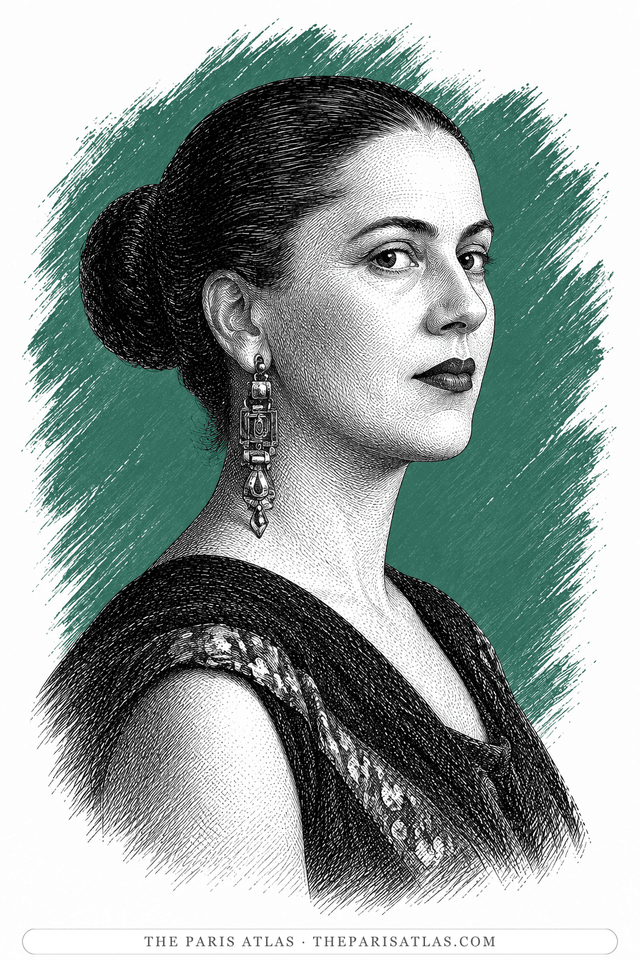
Brazilian painter who spent the 1920s moving between São Paulo and Paris, studied Cubism under André Lhote, Albert Gleizes and Fernand Léger, and used what she learned to paint Brazilian towns, railways, plants and bodies. Her 1928 painting Abaporu prompted the manifesto that gave the Anthropophagic movement its name.
View artist
Arman
French-American artist, lifelong friend of Yves Klein, and a founder of New Realism.
View artist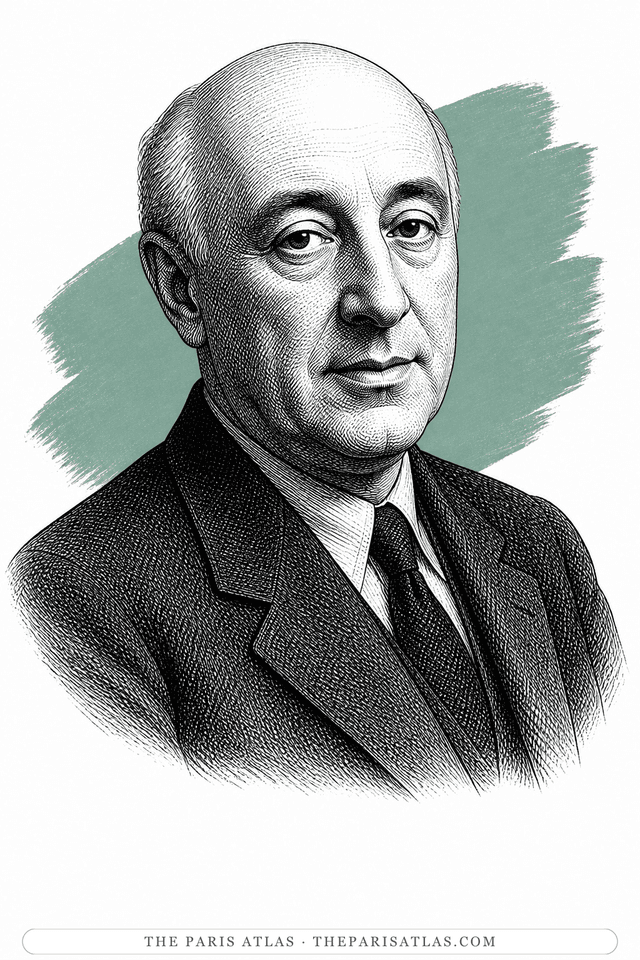
Jean Arp
Strasbourg-born sculptor and poet — Hans in German, Jean in French, both all his life — who co-founded Dada at the Cabaret Voltaire in 1916, composed collages by dropping torn paper 'according to the laws of chance', and settled at Meudon outside Paris in a house his wife Sophie Taeuber-Arp designed.
View artist
References
The sources below include collection records, catalogues, scholarly research, and primary materials that informed this page. They document Mama, Papa Is Wounded!, its making, and its place in cultural history.
1Mama, Papa Is Wounded!, 1927
Official recordThe Museum of Modern ArtUsed forOfficial record used to verify names, dates, institutional details, or other factual information on this page.
2The Museum of Modern Art collection dataset
Official recordThe Museum of Modern ArtUsed forOfficial record used to verify names, dates, institutional details, or other factual information on this page.
3Yves Tanguy
WebsiteThe Museum of Modern ArtUsed forWeb source consulted for documented facts and historical context presented on the Mama, Papa Is Wounded! page.

4The Inquiring Eye: Early Modernism
NonfictionNational Gallery of ArtUsed forPublished analysis and historical context used in preparing the Mama, Papa Is Wounded! page.
These references provide the documented foundation for this work's history and interpretation. Claim-level citations remain attached to the specific claims they support.
 Explore more resources