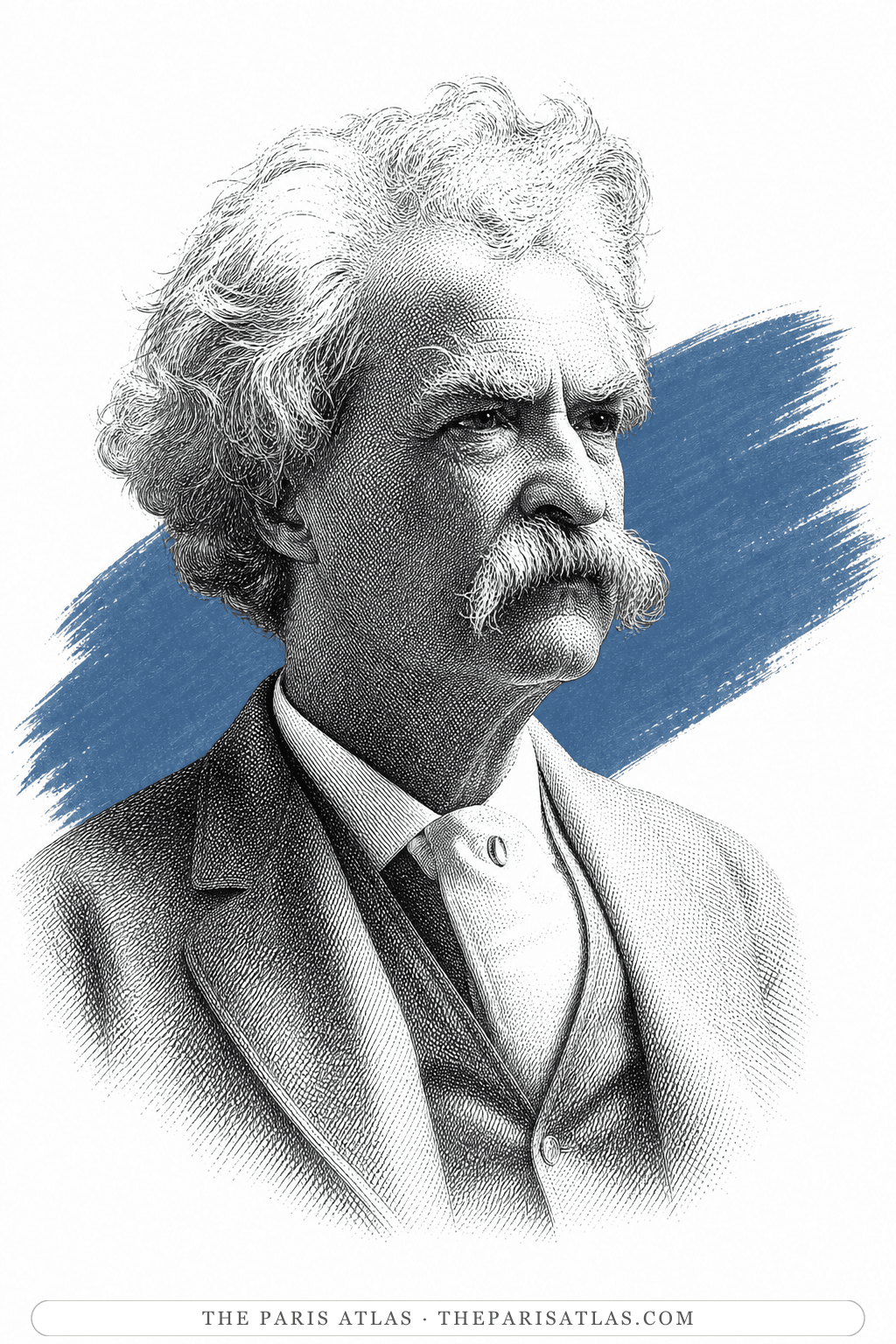
The Prince and the Pauper
Mark Twain
The Prince and the Pauper
Twain's earlier novel about a king who learns his own laws by suffering under them, set in Tudor London.
Read our takeA Connecticut Yankee in King Arthur's Court
Mark Twain
by Mark Twain
A Hartford factory boss wakes up near Camelot in the year 528, fakes a miracle with an eclipse, and tries to bring the nineteenth century to King Arthur's England.
Mark Twain's 1889 novel sends Hank Morgan, the head superintendent of an arms factory in Hartford, Connecticut, back to the England of King Arthur. A blow on the head in a fight with crowbars knocks him out, and he wakes near Camelot in the year 528. He escapes being burned at the stake by predicting an eclipse of the sun, and becomes the king's chief minister, known to everyone as The Boss. In secret he builds factories, schools, a newspaper and telegraph lines. The book mixes comedy about knights in armor with angry chapters about slavery, cruel laws and the power of the Church. Charles L. Webster & Co., the New York publishing firm Twain owned, brought it out in December 1889.
The novel opens with a frame story. A narrator who signs himself M.T. is touring Warwick Castle when a stranger starts talking about the knights of the Round Table as if he had known them. The guide points out a sixth-century coat of chain mail with a round hole in the left breast, which nobody can explain. The stranger mutters that he saw it done, and did it himself. That night at the Warwick Arms he hands over his manuscript, written on old parchment over older Latin writing, and the rest of the book is his story.[1]
The idea came to Twain on a reading tour with the novelist George Washington Cable in the winter of 1884 to 1885. In a bookshop in Rochester, New York, Twain picked up a copy of Sir Thomas Malory's Morte Arthure, and Cable told him it was one of the most beautiful books in the world. The first note in Twain's notebook imagined a modern man in a knight's armor, with no pockets, unable to scratch, and freezing solid in winter. Twenty-one years later he said he had wanted to dump the nineteenth century down into the sixth and watch what happened.[2]
He worked on the book slowly, starting in Hartford in 1886 and writing hardest at Quarry Farm near Elmira, New York, in the summer of 1888. He signed the preface in Hartford on 21 July 1889. Daniel Carter Beard drew the pictures for the first edition, and Twain wrote to him afterwards that there was only one artist who could have illustrated this book. In London, Chatto & Windus published it the same year under the title A Yankee at the Court of King Arthur.[2][3]
Hank Morgan was born in Hartford. His father was a blacksmith, and Hank learned his real trade at a great arms factory, where he could make guns, boilers, engines and anything else a body wanted. A worker called Hercules knocks him out with a crowbar. He wakes under an oak tree, is captured by a knight he takes for a circus performer, and is led to a castle. When he asks whether the town is Bridgeport, the knight says it is Camelot. A page named Clarence tells him the date is 19 June 528.[1]
Sir Kay presents Hank at the Round Table as a prisoner and a monster, and he is sentenced to burn. Hank remembers that a total eclipse of the sun fell on 21 June 528. Chained to the stake, he announces that he will blot out the sun, and the eclipse arrives on time. King Arthur agrees to make him perpetual minister in return for the sun's return. Hank then blows up Merlin's tower with gunpowder he has made himself and a lightning rod, and calls it a miracle. Soon the people give him the title of The Boss.[1]
Hank spends the next years building a hidden modern country. He sets up schools, mines, factories, a military academy and a newspaper, and trains young men in what he calls his Man-Factory. When a young woman named Alisande, whom he calls Sandy, comes to court asking for a champion to free forty-five princesses from three ogres, Hank is sent on the quest. The princesses turn out to be pigs, at least to Hank's eyes. He meets Morgan le Fay, restores a holy fountain with pumps and fireworks, and sees slaves driven in chains along the roads.[1]
Hank then takes King Arthur on a journey in disguise, dressed as ordinary freemen, so the king can see how his people live. Arthur carries a girl dying of smallpox down from a loft. The two men are later seized and sold at auction as slaves, the king for seven dollars and Hank for nine. Hank escapes and is caught again, and he and the king are brought to a gallows in London. Five hundred knights led by Sir Launcelot arrive on bicycles and save them.[1]
Hank kills Sir Sagramor in a tournament with a revolver and then challenges all the knights of the world. Three years later England has railways, telephones and steamboats, and slavery is abolished. Hank has married Sandy, and they have a daughter, Hello-Central. When the baby falls ill, the family goes to the French coast for sea air. While they are there, the Church lays England under an Interdict, a ban on all church services. War breaks out between Arthur and Launcelot, Mordred seizes the throne, and Arthur and Mordred kill each other.
Hank and Clarence proclaim a republic, and almost nobody follows them. With fifty-two loyal boys they hold a cave behind electrified fences, machine guns and a ditch that can be flooded. The battle leaves twenty-five thousand men dead, but the dead bodies poison the air and trap the defenders. Merlin, disguised as an old woman, puts Hank to sleep for thirteen centuries. In the last pages the narrator finds the stranger dying in his room in Warwick, calling for Sandy and their child.
Twain spent the spring of 1879 in Paris with his family, arriving on 28 February and settling at the Hotel Normandy on the rue de l'Échelle. Rain fell nearly every day. His biographer Albert Bigelow Paine says Twain took a dislike to France that he never lost. Paine also says Twain spent part of that spring rereading Thomas Carlyle's history of the French Revolution, a book he was never long without. The whole party read A Tale of Two Cities by Charles Dickens, and when the weather allowed they went to see the places where the Reign of Terror had happened.
His opinion of the Revolution changed over the next few years. In his Paris notebook he wrote that the Terror showed that the people were savages. In 1887, between spells of work on the Yankee, he told his friend William Dean Howells that he read Carlyle's book differently every time. When he first finished it in 1871, he wrote, he had sided with the moderate Girondins. Now he found he was a Sansculotte, one of the radical Paris crowd. He added that he was no mild one. He was a Marat, after Jean-Paul Marat, the fiercest of the revolutionary journalists.
Hank Morgan takes the same side in Chapter XIII. Watching free farmers work three days without pay on their bishop's road, he is reminded of France before what he calls the ever memorable and blessed Revolution. There were two Reigns of Terror, he says. One killed ten thousand people in a few months. The other had lasted a thousand years and killed a hundred million with hunger, cold and cruelty. Seven chapters later he decides that the people of Arthur's England need a Reign of Terror and a guillotine, and that he is the wrong man to give them one.
France itself appears in the book only at the edges. Twain's preface jokes about the Pompadour, Louis XV's mistress, as a problem for the theory that God chooses kings. Hank sends Sandy and the baby to the French coast, and in his last delirium he tells Sandy he dreamed she was in Gaul and could not get home. The earliest French translation held by the national library in Paris is Yankee à la cour du roi Arthur, by Odette Ferry and Jacques de Plunkett, published in Paris in 1949.
Eight years earlier Twain had sent a boy king, Edward VI, out among his own subjects in The Prince and the Pauper. He uses the same plan here. King Arthur travels in disguise, gets sold as a slave, and learns what his laws do to the people under them. Paine singled out this journey as the most powerful part of the Yankee, with its picture of a king learning mercy through his own fall.
Some of the scenes are nearly the same. In The Prince and the Pauper, Twain added notes quoting J. Hammond Trumbull's Blue Laws, True and False. One says that stealing woollen cloth from a weaver was a hanging crime in England. In Chapter XXXV of the Yankee, a young mother whose husband has been seized for the navy steals a piece of linen cloth worth a quarter of a cent, hoping to sell it and feed her baby. She is hanged just outside the walls of London while Hank and the king watch, chained in the slave gang. On the same journey the slave driver burns a woman accused of witchcraft and uses the fire to warm his freezing slaves.
Twain tied the slavery chapters to recent American history. In Chapter XXX, Hank stays with a poor charcoal burner who has helped his lord hang his own neighbours. Hank compares him to the poor whites of the American South, who were despised by the slave-owners and still fought for them. In Chapter XXV he writes that an aristocracy is only a band of slaveholders under another name.
Chatto & Windus, Twain's London publishers, wanted to soften the text for British readers. Twain refused. He wrote that he had already revised the book twice, that his wife Olivia had made him cut or soften many passages, and that he wanted to say a Yankee mechanic's say against monarchy. He added that the book had not been written for America. He had written it for England. Chatto & Windus printed it as he sent it, under the title A Yankee at the Court of King Arthur.
Most British reviewers were furious. Paine records that the book was called a lamentable failure and an audacious sacrilege, and that the attacks spread to Twain's earlier books. The Daily Telegraph gave it a long and more careful review. In America, William Dean Howells read the manuscript and wrote to Twain that it was a mighty great book that made his heart burn with wrath. Twain told Howells it was his swan song and his retirement from literature.
Twain chose Daniel Carter Beard after seeing his drawings for a Chinese story in the Cosmopolitan magazine. When the two men met at the Webster & Co. office, Twain asked Beard to read the book before drawing it, and Beard said he had already read it twice. Twain described Hank to him as a perfect ignoramus who could still build a locomotive or run a telegraph line. A few days later he wrote to his office that Beard should draw whatever he saw in his mind, funny or serious.
Paine says Beard shared the book's socialist leanings and called the drawings the best work of Beard's life. When they were finished, Twain wrote to Beard that he had gone netting for lightning-bugs and caught a meteor. The University of California Press edition of 2011 reprints Beard's drawings, 222 illustrations in all.
I am an American. I was born and reared in Hartford, in the State of Connecticut—anyway, just over the river, in the country.
“Bridgeport?” said I, pointing. “Camelot,” said he.
There were two “Reigns of Terror,” if we would but remember it and consider it; the one wrought murder in hot passion, the other in heartless cold blood; the one lasted mere months, the other had lasted a thousand years
Twain wrote to his London publishers that he wanted to say a Yankee mechanic's say against monarchy. The chapters on forced labor, slavery and the law are that argument.
A factory man from Hartford uses an eclipse, gunpowder and a newspaper to take over sixth-century England. He knows the date of the eclipse, and remembers that Columbus or one of those people once saved himself the same way.
Hank's two Reigns of Terror passage in Chapter XIII grew out of Twain's rereading of Carlyle, which Paine traces to his Paris spring of 1879.
Both books send a king among his poorest subjects. The Yankee repeats the earlier book's cruel laws, including a hanging for stolen cloth, in a much harsher voice.
A head superintendent from a Hartford arms factory, knocked back to the year 528. Clever, boastful, generous and ruthless by turns.
The page Hank meets on his first day at Camelot, who becomes his right-hand man, his newspaper editor and the last witness to his story.
A young woman who comes to court for a champion, leads Hank on a quest to free forty-five princesses, and later becomes his wife.
The king of Camelot, a brave and decent man who believes completely in rank. Hank takes him on a journey in disguise to see how his people live.
King Arthur's sister, charming in conversation and murderous in practice. She stabs a page for stumbling and hangs a composer for a bad tune.
A knight who takes offence at a remark of Hank's early on and challenges him. The duel takes years to arrive.
The greatest knight of the Round Table. He rescues Hank and the king on a bicycle, wins a fortune on Hank's stock exchange, and his love for Guenever starts the final war.
The king's foster brother and steward, who captures Hank on his first day and presents him to the Round Table as an ogre.
A poor charcoal burner who shelters Hank and the king, and Dowley, the prosperous blacksmith who buys his charcoal. Hank invites Dowley to dinner and ends up in an argument about wages.
The court magician, whose fame Hank sets out to destroy with gunpowder and science.
1879
In Paris for the spring, Twain rereads Carlyle's history of the French Revolution and visits places connected with the Terror.
1884–1885
On a reading tour with George Washington Cable, Twain buys Malory's Morte Arthure in a Rochester bookshop and starts making notes.
1886
Twain begins the novel in Hartford.
1887
Twain tells William Dean Howells that rereading Carlyle has turned him into a Sansculotte.
1888
Twain writes much of the book at Quarry Farm near Elmira, then finishes it in Hartford.
21 July 1889
Twain signs the preface in Hartford.
December 1889
Charles L. Webster & Co. publishes the novel in New York, with Daniel Carter Beard's illustrations. Chatto & Windus publishes it in London as A Yankee at the Court of King Arthur.
1949
Éditions de la Paix in Paris publishes a French translation by Odette Ferry and Jacques de Plunkett.
2011
The University of California Press publishes the Mark Twain Library paperback edited by Bernard L. Stein.


The Prince and the Pauper
Mark Twain
Twain's earlier novel about a king who learns his own laws by suffering under them, set in Tudor London.
Read our take
Charles Dickens's novel of the French Revolution, which the Clemens family read together in Paris in 1879.
Read our take
Twain's river novel of five years earlier, whose last chapters also ask what happens when a boy's love of adventure stories meets slavery.
Read our takeThe Man Who Would Be King
Rudyard Kipling
Rudyard Kipling's story of two modern men who make themselves kings over a distant people and are destroyed by it.
Read our take
Voltaire's satire also sends its hero through wars, slavery and religious cruelty, and makes comedy out of them.
Read our takeA factory superintendent from Hartford is knocked out and wakes in King Arthur's England in the year 528. He uses an eclipse to make himself the king's minister, then secretly builds a modern country with schools, factories and a newspaper.
A worker called Hercules hits him on the head with a crowbar during a fight at the factory. He wakes under an oak tree near Camelot. The book never explains how. The stranger in the frame story calls it a transposition of epochs.
Hank remembers that a total eclipse fell on 21 June 528. Sentenced to burn, he tells the court he will blot out the sun, and the eclipse begins while he is chained to the stake.
On a reading tour with George Washington Cable in the winter of 1884 to 1885, Twain bought Sir Thomas Malory's Morte Arthure in a Rochester bookshop. He started imagining a modern man trapped in a knight's armor.
Through the French Revolution. Twain reread Carlyle's history of it in Paris in 1879 and visited places linked to the Terror. Hank's passage on the two Reigns of Terror in Chapter XIII comes from that reading.
Chatto & Windus published it in London under that title in 1889. Twain refused to let them soften the text, and many British reviewers attacked it.
Daniel Carter Beard, whom Twain chose after seeing his drawings in the Cosmopolitan. Twain told him to draw whatever he saw in his mind, and later wrote that no other artist could have illustrated the book.
ISBN 9780520268166 is the University of California Press paperback in the Mark Twain Library, published in February 2011. The edition has 504 pages, was edited by Bernard L. Stein, and has 222 illustrations by Beard.
Explore authors with a similar voice, perspective, and influence.

The doctor of the Paris slums who wrote the century's blackest, funniest novel — and changed the sound of French prose.
View author
The Brooklyn dropout who arrived in Paris broke at thirty-eight and wrote the exuberant, banned books that ended American censorship.
View author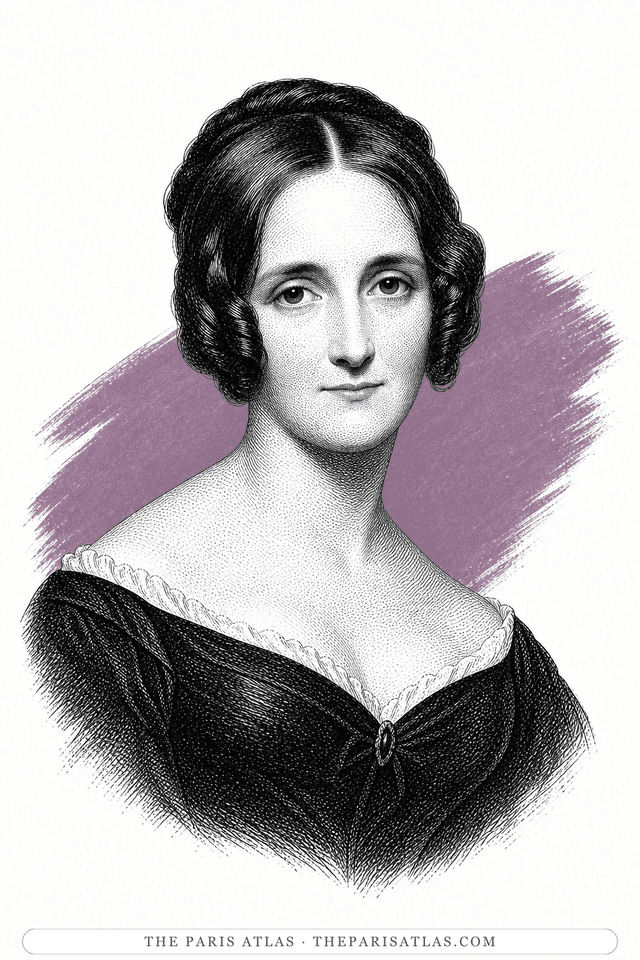
The author of Frankenstein, who first saw Paris at sixteen as a runaway. In the summer of 1814 she crossed from England to Calais with the poet Percy Bysshe Shelley and her stepsister Claire Clairmont, spent a week trapped in an expensive Paris hotel with no money, then bought a donkey and walked south-east across a France still wrecked by the Napoleonic wars. That journey became her first published book. Two years later, on a lake in Switzerland, she began her second.
View authorThe sources below include the primary text, editions, scholarship, archival materials, and other records that informed this page. They document A Connecticut Yankee in King Arthur's Court, its publication, and its place in literary history.


Twain's 1879 Paris stay, the Malory purchase with Cable, the writing years, Beard's illustrations, Howells's response and the British reception.
Library record of the first British edition and its title, with Beard credited.
The earlier novel's note on hanging for stolen cloth, compared with the Yankee's Chapter XXXV.
Library record of the first American edition, including its cover title.

Catalogue record for the 1949 Paris translation by Odette Ferry and Jacques de Plunkett.
Selected ISBN, publication month, page count, editor, illustrator and illustration count.
Library record confirming ISBN 9780520268166 as the 2011 University of California Press edition.
ISBN, page count, introduction and listed date of the Penguin Classics edition.
The primary text represented by this page, used for descriptions of the work’s contents and for any quoted passages shown here.
The primary text is the baseline reference for every book page. Additional references document publication history, interpretation, and historical context where that evidence is available.
 Explore more resources