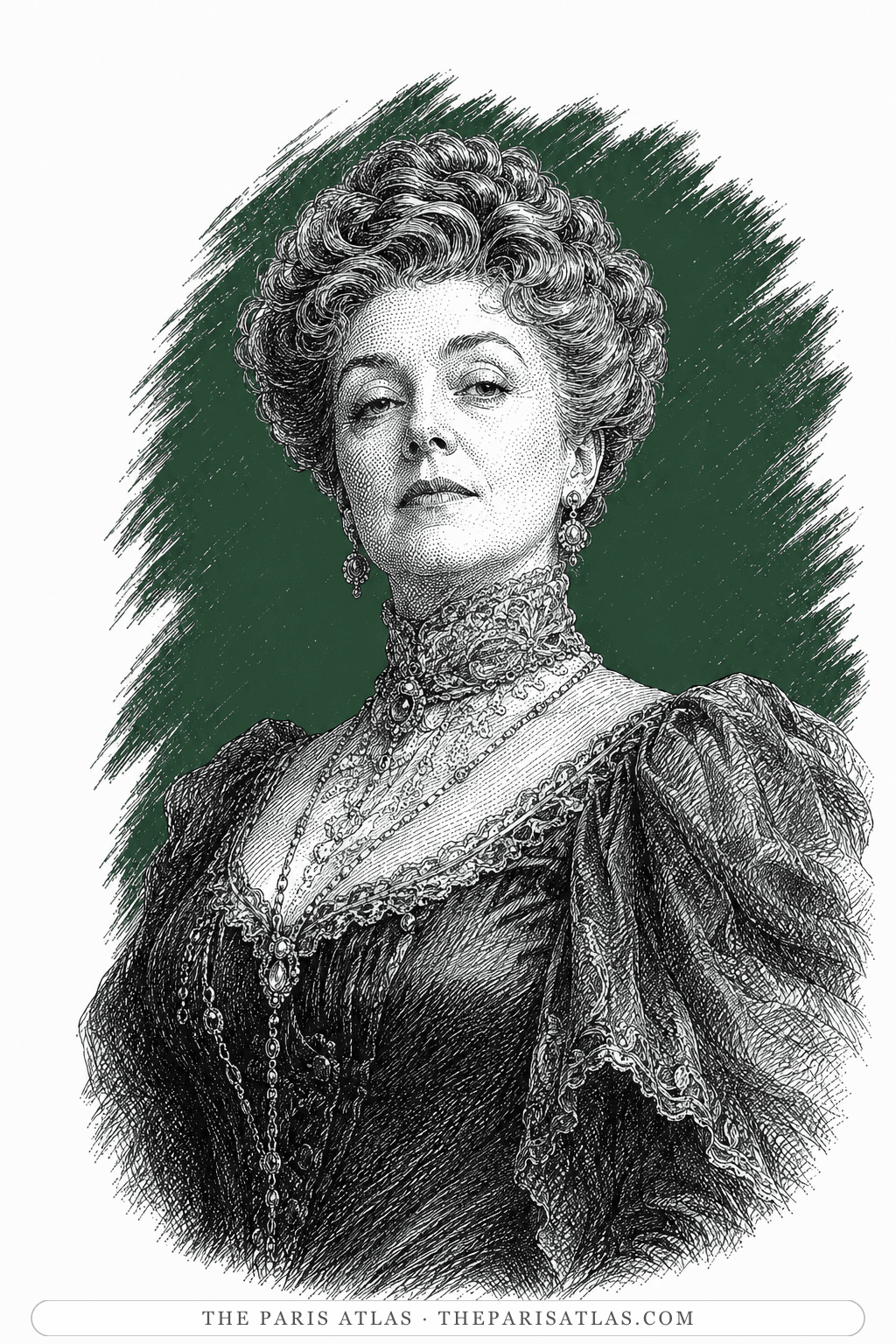
Charlotte Peloux
Chéri's mother and Léa's old friend and rival — a retired courtesan who arranges her son's marriage with a professional's eye.
Her son married, settled, and living where she can watch him. She says peace and quiet have been the ambition of her whole life, and she says the girl must be married until the girl is married.
The book

At a glance
- Chéri's mother, Léa's oldest friend and rival, and the woman who arranges the marriage
- A dancer from ten to sixteen, then a kept woman. Never married — Colette notes she is really Mademoiselle Peloux
- A large villa in its own grounds on the boulevard d'Inkermann at Neuilly, unaltered for twenty-five years
- Considerable, and unexplained. She holds compressed briquettes among other things
- Our national harpy, Madame Mère, the boss — and Lolotte to her face
- Leave your friends in peace when you are in trouble; tell them only about your happiness
Who they are in the book
Spoiler-freeCharlotte Peloux is Chéri's mother, and the person who sets the plot of Colette's 1920 novel going by arranging her son's marriage. She was a dancer from the age of ten to sixteen, and after that she lived the way Léa de Lonval lived: on money from wealthy men. She never married, and Colette points out that Madame Peloux is strictly speaking Mademoiselle Peloux. Old Lili, one of her card-playing friends, says as much to her face — people don't marry much in your family.
She is rich, and where the money is from nobody quite knows. She has a villa with grounds at Neuilly, on the western edge of Paris, big enough that the old stables became garages and the outbuildings still have kennels and laundries. Her friends say devoutly that Madame Peloux has money in that place, and then ask each other where Madame Peloux hasn't got money. She holds an open house on Sunday afternoons for a circle of elderly women who play cards in exchange for dinner and a brandy.
Physically she is a small barrel of a woman with tiny feet, enormous unforgiving eyes, a thin hard nose and a nasal voice that Colette describes as a trumpet. She is a comic character and a genuinely dangerous one. She has known Léa for twenty-five years, which Colette calls the hostile intimacy of two women of easy virtue — one enriched by a man and then dropped, the other ruined by another — and the friendship runs on watching each other for the first wrinkle and the first white hair.
The marriage she arranges is the book's central act. It is a piece of business, done with her son's fortune on one side of the table and a young heiress's on the other, and once it is done she keeps the newlyweds in her own house for four months and spends every day of it needling her daughter-in-law.
How Charlotte Peloux Is Portrayed
- A dancer from ten to sixteenLéa sometimes looks for the plump blond cupid and the dimpled nymph Charlotte used to be, and finds only the big pitiless eyes, the hard delicate nose, and a lingering habit of placing her feet in fifth position, the way girls in the corps de ballet were drilled to stand.
- The voiceLoud, nasal and off-key. She gets into an argument about whether Marie-Laure had her daughter in 1895 or 1894, blaring the dates and a story about a singing teacher and a man named Khalil-Bey who had given Marie-Laure a famous pink diamond, until Léa puts a hand over one ear and Chéri says that an afternoon like this one would be too good to be true if it were not for the sound of his mother's voice.
- Nothing in the house has changed in twenty-five yearsEvery successive mistake of her taste is still where she put it. When the water-green corridor flakes she has it repainted the same water green, and when a chaise longue wears out she hunts for the identical garnet velvet. Old Lili, who buys modern pictures, tells her the house is the house of an ant that has gone mad. Charlotte's answer: 'Pourquoi toucher à ce qui est bien?' Why touch anything that is fine as it is.
- The afternoon brandyShe sits Buddha-like in an armchair too high for her short legs, warming a glass of cognac in her palm and sucking at it, Colette writes, with the concentration of an alcoholic baby. Léa, who knows her, deduces from the fact that she is not asleep after a good Sunday lunch that she must be up to something.
- How she brought her son upBy handing him to the servants. The elderly baron de Berthellemy salutes her as the only loose woman who ever dared to raise her son as a tart's son: she doesn't read, she never travels, and she has her child brought up by the staff. When the boy was fourteen and screaming at being sent back to boarding school, she put her hands over her ears, shouted that she would not look at it, left Paris with a young man of dubious character and came back two years later on her own. Colette calls it her last weakness of the heart.
- She arranges the marriageShe produces the eighteen-year-old Edmée at a Sunday afternoon, waves her little arms and announces twice over that the girl must be married — she never states an obvious truth fewer than two times — and adds that they will all go to the wedding. Then she pushes the two young people into the front seat of the car and the older women into the back, calling out that youth must have its way.
- The fight over the contractChéri watches his mother and Edmée's mother tear at each other across his marriage settlement, and does an impression of it afterwards for Léa: his mother going up like an umbrella, informing the other woman that her son has not had a sou of debt since he came of age and that the list of securities bought since 1910 represents — and here he loses interest and starts naming parts of his own anatomy. He compares her to Catherine de' Medici, with better diplomacy.
- How she treats her daughter-in-lawFor four months she sets a trap a day, wasting her arrows, biting at random. One evening at dinner she calls Edmée by Léa's name three times, as if absent-mindedly, over the chrysanthemums in the middle of the table. Chéri lowers his eyebrows and asks his mother whether she needs a rest cure. She says nothing for a week.
- Her Sunday regularsMadame Aldonza, a very old dancer with bandaged legs, deforming rheumatism and a lacquered black wig on crooked, who begs for Léa's hats when Léa has finished with them. The baronne de la Berche, built like a peasant priest, hairy-knuckled, blessing everybody and, Colette says, concealing a savage cruelty. And old Lili, seventy or so, corseted, in revolutionary blue and white stripes, who arrives with an adolescent Italian prince she calls her great love.
- Her business affairsWhen Léa mentions the money she made on oil shares that winter, the alcoholic softness leaves Charlotte's face in an instant and she is sharp, dry and wide awake: you were in oil, and you didn't tell me. She counters that she was in compressed briquettes, which she had not mentioned either.
When Léa comes back to Paris after six months away, Charlotte turns up at the avenue Bugeaud to report that Chéri has come home to his wife and that everything is now perfect. She spends the visit taking Léa's temperature: praising Edmée as a saint and then as a brain, warning that the girl may smother her son's originality, and finally letting slip that Chéri knows Léa is back — because he is the one who told her, and who asked his mother to go and enquire after Nounoune.
Léa watches her cross the courtyard afterwards and thinks, with complete clarity, that the woman is on her way back to Neuilly to choose her moment and say the things that should never be said, and that at the very least she will make two people who might have been at peace tremble for a while. Then Léa admits something else: this enemy is the only person whose visit has done her any good, and the two of them are bound together like a pair of dogs that have found the same old slipper to tear up.
If you like Chéri


If you like Colette
Explore authors with a similar voice, perspective, and influence.

Henry Miller
The Brooklyn dropout who arrived in Paris broke at thirty-eight and wrote the exuberant, banned books that ended American censorship.
View author
Louis-Ferdinand Céline
The doctor of the Paris slums who wrote the century's blackest, funniest novel — and changed the sound of French prose.
View author
Martha Gellhorn
War correspondent who covered the Spanish Civil War, D-Day, and conflicts across five more decades; Hemingway's third wife, 1940–1945.
View author