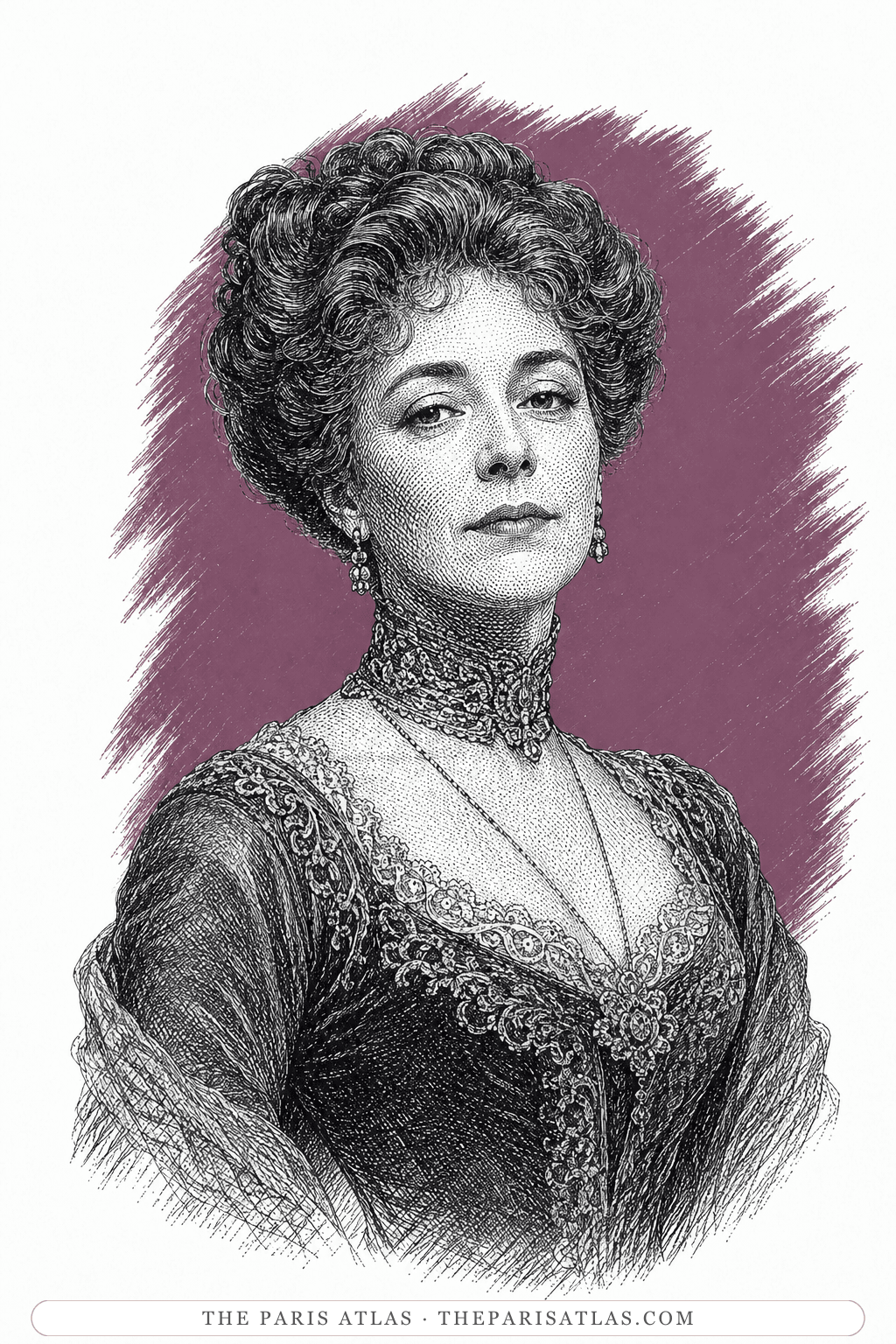
Léa de Lonval
Forty-nine, wealthy, and at the close of a courtesan's career — the novel's center, and the one who has to do the renouncing. She reads a balance sheet and a mirror with the same accuracy.
To keep her life exactly as she has arranged it, with Chéri in the middle of it. She keeps naming a date to give him up, and then letting the date pass.
The book

At a glance
- Forty-nine when the novel opens, in Paris in June 1912
- Léonie Vallon. Léa de Lonval is the name she works and lives under
- Courtesan — a woman kept in turn by wealthy men. Colette calls it a happy career, and Léa came out of it rich
- A private house on the avenue Bugeaud, by the Bois de Boulogne, with a butler, a concierge, a chauffeur and a lady's maid
- Her own. She audits the household books herself and made a large profit on oil shares over one winter
- Six years, since he was nineteen. She was born twenty-four years before him and says so
- Bacciocchi, young Lequellec, Spéleïeff the horse dealer, Anthime de Berthellemy
- He calls her Nounoune, a baby name from his childhood. She calls him her nasty nursling
Who they are in the book
Spoiler-freeLéa de Lonval is the central character of Chéri, a novel published in 1920 by the French writer Colette. She is forty-nine, she lives alone in a private house near the Bois de Boulogne in Paris, and she is rich. The money came from her work. Léa is a courtesan: a woman who lived on what a series of wealthy men paid her, and who has now reached the end of that career with a large private income. Colette says so in the opening pages, and gives her real name at the same time — she was born Léonie Vallon, and Léa de Lonval is the name she took.
How that worked is worth spelling out, because the novel takes it for granted. Léa was never an actress, a singer or a dancer, and she was never anyone's wife. Men installed her, paid for her, gave her jewels, and in time left or were left. She kept what she was given and invested it. She now owns everything around her, employs a butler, a concierge, a chauffeur and a lady's maid, goes over the household accounts after lunch, and mentions in passing that she made a killing on oil shares between December and February.
For six years her lover has been Fred Peloux, always called Chéri, who is twenty-five. He is the son of Charlotte Peloux, a retired courtesan who has been Léa's friend and rival for twenty-five years. Léa took him on when he was nineteen, thin and unwell, spent a summer in Normandy feeding him strawberries and cream and hired a professional boxer to train him. She has never given him money — he has a large income of his own, which she reckons at three hundred thousand francs a year. What she gave him was food, a bed, six years of her attention, and the habit of being adored.
Most of the novel is written from her side, and what Colette shows is a woman who reads her own body as accurately as she reads a set of accounts. Léa knows which colours have turned against her, why the necklace now comes off at night, and how many more years she can expect. She is not sentimental about any of it, and for a long stretch of the book she is very funny about it.
How Léa de Lonval Is Portrayed
- The first thing she is asked forThe novel opens with Chéri dancing in front of her long mirror wearing her pearl necklace and demanding that she give it to him. She tells him the pearls are heavy and he is straining the thread. He argues that a man may accept one pearl from a woman, or two, but is supposed to feel dishonoured by fifty. The necklace has forty-nine pearls. Léa is forty-nine years old, and Chéri says he knows the number.
- The line her friends still repeatAt a coaching meet around 1895, a journalist from the Paris paper Gil Blas addressed her as a dear artiste. Léa had never been on any stage, and her reply is the thing Colette says her friends still remembered years later: 'Artiste? Oh! vraiment, cher ami, mes amants sont bien bavards....' The only people who could have told him she was an artist, she means, are her lovers, and they have been talking too much.
- The house on the avenue BugeaudDark English furniture, tall mirrors, heavy silver. She lunches alone on dry Vouvray and June strawberries served with their stalks on a green Rubelles dish, inspects a fork for traces of red polishing powder while she eats, and tells the butler his floor wax has been sticky for a week and needs more spirit melted into it.
- The pink bedroomDouble lace at the windows, rose-coloured silk on the walls, gilded wood, and a bed of forged steel and chased copper that Colette calls severe to the eye and cruel to the shins. Léa knows the room is dated. Charlotte Peloux defends it by saying it is very La Païva — a celebrated courtesan of the previous generation, famous for the extravagance of her house in Paris.
- What she sees in the mirrorShe puts the necklace on in bed and picks up a hand mirror. Her own verdict is that she looks like a market gardener, a Normandy woman off to the potato field in pearls. She is harsh in the same practical way about her reddened outdoor complexion and her thickened neck, and easier on her nose, which Charlotte calls a Marie-Antoinette nose while adding that in two years Léa will have a Louis XVI chin.
- Why she takes the pearls off at nightChéri likes fine pearls and handles them in the mornings. If she wore the necklace to bed he would be looking at her neck too often, and would see that it has thickened and lost its whiteness. So the necklace comes off. It is the sort of calculation she makes constantly and mentions to nobody.
- Dressed, or naked, but never half-undoneAfternoons at Neuilly disgust her, because Charlotte Peloux takes off her corset after lunch and Chéri opens his waistcoat. Léa has never let her young lover see her untidy, in an open bodice or in slippers in the daytime. Naked if it comes to that, she says, but not half-undone.
- The summer she took him in handIn 1906 she carried a nineteen-year-old Chéri off to a house on the coast near Honfleur, woke him up to stuff him with strawberries, cream, frothing milk and grain-fed chicken, and sent for Patron, a boxer she knew, to train him. She watched the lessons from a chair and privately compared the two naked men. Patron's judgement on his pupil was that he would never make a boxer, because he was spiteful, and spite is no good in boxing.
- She takes her own temperatureAlone one night, months after Chéri's marriage, she is doubled over by something that arrives like a physical attack. She puts a thermometer under her arm, reads thirty-seven degrees, and works it out on the spot: it is not physical, she is in pain, and arrangements will have to be made.
- The wedding presentShe takes him to the jeweller to buy him a shirt pearl for his marriage. He wants a pinkish one; she overrules him and picks a white one, on the grounds that it should be something male, and jokes about how much she is going to save without him.
- One rule she has never brokenThirty years of lovers, and not one of them old. Léa is proud of it, in plain words: she has never soiled her hands or her mouth on a withered creature, and she has no intention of settling in the arms of an elderly gentleman now. Asked to picture what an elderly gentleman would be, she decides on a man of forty.
After six months away she comes home to Paris, and Chéri arrives at her door at midnight, having walked out on his wife. They spend the night together, and in the morning Léa is already making plans: she consults a railway timetable, tears cheques out of her book, and starts telling him how they will manage the money, the luggage and the letter he will have to write. She says out loud that she was stupid ever to think he was just another passing boy, and that he was the love you only get once.
It does not survive the morning. Chéri, watching her, says he will still be twelve years old for the next fifty years with her, and that he is not only complaining, he is accusing her. Sunlight reaches the table and shows him the loose skin on the backs of her hands. He starts to say that he came here after months of that life, and stops. Léa finishes the sentence for him: he came here and found an old woman.
Then she takes the blame. She says she loved him as though they were both going to die within the hour, that she was born twenty-four years before him and dragged him down with her, and that if she had really been the finest woman he says she was she would have made a man of him instead of keeping him. She tells him to go back to his wife, and to remember, when he is about to frighten the girl, everything Léa never taught him. Then she finds his shoes and his tie, and will not help him dress.
She watches from the window. He stops in the courtyard and she thinks for a second he is coming back, and throws her arms up — and a breathless old woman in the long mirror does the same thing, and Léa wonders what she has in common with that madwoman. Chéri walks out through the gate, buttons his overcoat over the previous evening's shirt, looks up at the spring sky and the flowering chestnuts, and fills his lungs like a man who has escaped.
If you like Chéri


If you like Colette
Explore authors with a similar voice, perspective, and influence.

Henry Miller
The Brooklyn dropout who arrived in Paris broke at thirty-eight and wrote the exuberant, banned books that ended American censorship.
View author
Louis-Ferdinand Céline
The doctor of the Paris slums who wrote the century's blackest, funniest novel — and changed the sound of French prose.
View author
Martha Gellhorn
War correspondent who covered the Spanish Civil War, D-Day, and conflicts across five more decades; Hemingway's third wife, 1940–1945.
View author