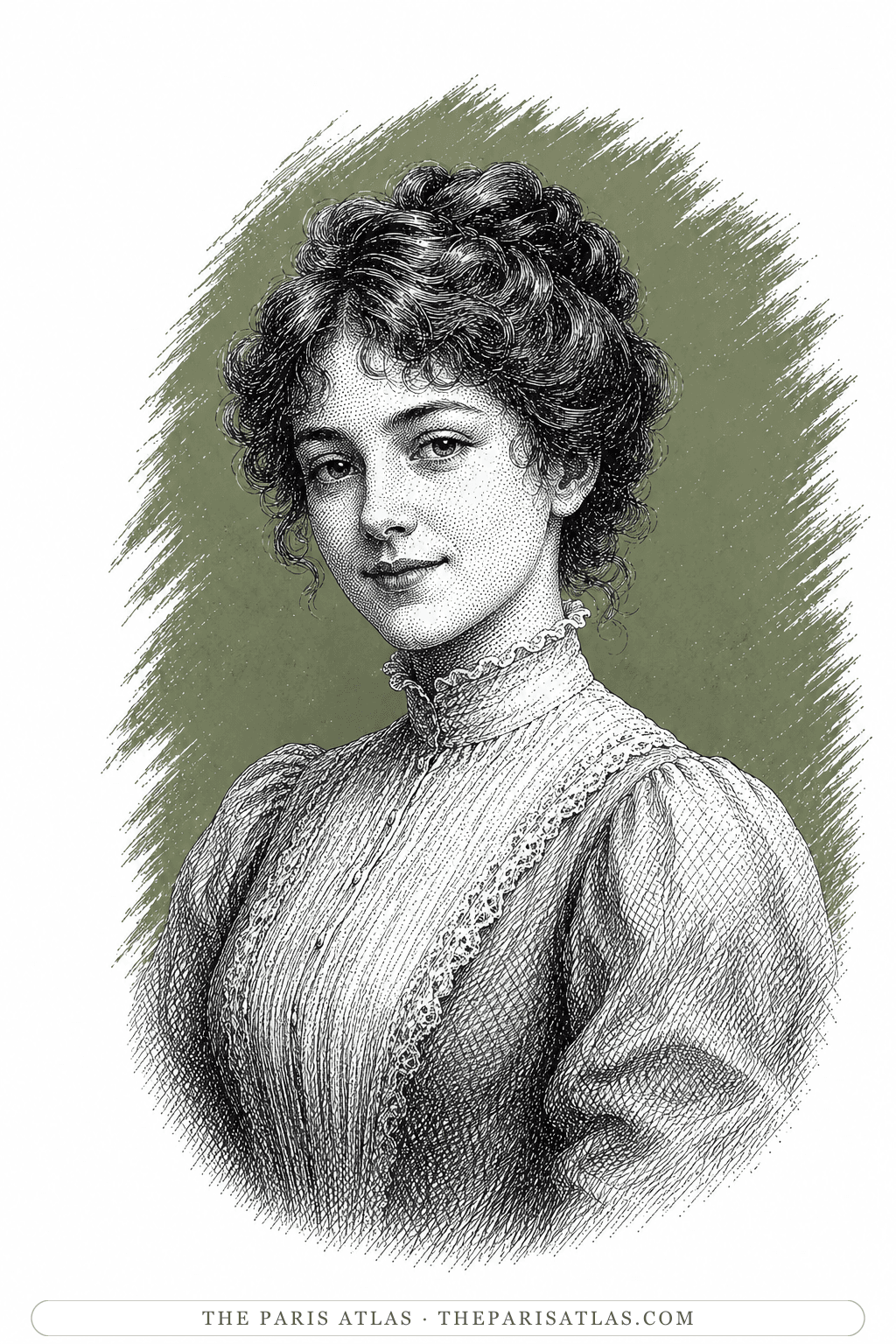
Edmée
The eighteen-year-old heiress Chéri marries — young, watchful, and married to a man whose attention never arrives.
To be loved by her husband, and to be the only woman he thinks about. She says so once, all at once, and it is the only time in the book she raises her voice.
The book

At a glance
- Eighteen when she is introduced; nineteen on 5 January
- Daughter of Marie-Laure, a red-haired beauty of the same demi-monde. No father appears, and Chéri says he has no idea where her money comes from
- Convent boarding school, and a baccalauréat, which Colette notes and Chéri mocks
- Her own. Chéri puts the dowry at fifteen hundred banknotes out of her mother's private box, plus good jewellery
- Charlotte Peloux's villa at Neuilly for four months, then the new house on the avenue Henri-Martin with its black bathroom and basement pool
- Fred. She lets Chéri slip out once, when he frightens her, and regrets it
Who they are in the book
Spoiler-freeEdmée is the girl Chéri marries in Colette's 1920 novel. She is eighteen when she first appears, just out of boarding school, and she is brought to a Sunday afternoon at Charlotte Peloux's villa at Neuilly to be looked over. Charlotte announces to the room that she must be married. Within weeks the marriage is arranged, and Edmée turns nineteen on the fifth of January, married to a man of twenty-five who has been the lover of a woman of forty-nine for the past six years and has no intention of giving her up.
Her mother is Marie-Laure, a red-haired beauty from the same Paris world of kept women, and the worst thing in Edmée's life. Marie-Laure never scolded her daughter; she simply punished her. Never a harsh word and never a tender one. Boarding school, then holidays alone, then long stretches shut in a well-furnished room — and then, the moment her mother saw that the girl was becoming beautiful in her own right, the threat of marriage. Any marriage.
What that upbringing produced is a young woman who is quiet and much harder to move than she looks. She has a baccalauréat, which her husband uses against her whenever he wants to be unpleasant. She survives four months in her mother-in-law's house, absorbing a fresh insult daily without once losing her composure, and Charlotte, who is not generous about other women, ends up calling her a brain and worrying that she may be too strong for Chéri.
The marriage itself is a business arrangement between two fortunes, and Edmée is the only person in it who is in love. Chéri's own account of the marriage, given to Léa: the girl loves him, she admires him, she says nothing.
How Edmée Is Portrayed
- The afternoon she is put on showShe stands in the shade of a straw blind at Neuilly while her mother and Charlotte Peloux discuss her age over her head — nineteen springs, says Charlotte; eighteen, says her mother — and Charlotte announces that the girl must be married and that they will all go to the wedding. Edmée looks at her with plain fright and says nothing. Léa touches her arm to see what will happen, and the girl jumps out of her skin.
- What she looks likeAsh-brown hair, frizzy and so light it looks powdered, hazel eyes that hide, small square teeth, low elegant shoulders, and a necklace of small pearls, all perfectly round and perfectly matched. Léa's reading of her, on first meeting, is that she has quietly everything her mother has flashily, and that Marie-Laure must hate her for it.
- What she says about her motherChéri asks whether she is frightened of his mother. Not frightened, she says: you jump at a door slamming, but you are not frightened of it. 'On a peur du serpent qui passe dessous....' What you are frightened of is the snake that goes under it. He asks whether she means Marie-Laure. She says yes.
- Her education, used as a weaponTwice Chéri prefaces an insult with the fact that she took her baccalauréat — once when he has finished explaining that his eye is shaped like a sole and asks whether she, the educated one, knew that, and once when he wants her to supply the saying about not touching the axe. She answers both times, correctly and flatly.
- Searching his deskHe catches her with both hands on his papers. She starts to say she is tidying, stops in the middle of the lie, and tells him the truth: she meant to sort things honestly, and then the temptation came, and she has touched things that are not hers. She waits, shaking, for whatever happens next.
- The one time she says everythingIt comes out in the same scene, when he half-remembers a letter about a honeysuckle at a window and she realises whose it was. She tells him he has never loved her, that he wounds her and despises her, that he thinks only about that old woman, and asks why on earth he married her. He watches her cry with straightforward astonishment. Nobody has ever cried in front of him before, and he ends up patting her head with the words Léa uses to calm him down.
- How he speaks to her when he is cruelHe stops using the familiar tu and gives her a lecture on the going rate: nineteen years old, white skin, hair that smells of vanilla, and in bed the eyes shut and the arms limp — very nice, but is it rare? He also tells her she is the one thinking like a whore, and offers his own definition of a kept woman as one who arranges to receive more than she gives.
- She offers him a divorceCoolly, in the middle of that quarrel, and without crying. She says she saw better-looking men than him in Italy, that they are everywhere, that her nineteen years are worth anybody's, and that a marriage nowadays is not a serious measurement. There are quick divorces if you pay for them. He refuses, and tells her why: because she loves him.
- Four months as a lodgerThe new house is not finished, so the couple live at Neuilly under Charlotte Peloux, who sets a trap for her daughter-in-law every day for four months and never lands one. Edmée handles it with the patience, silence and easy use of a prisoner's weapons that her childhood taught her, and privately reckons that after her mother, Charlotte's ordinary spite is dew.
- She plans her own houseWalking down her mother-in-law's hospital-green corridor she says she does not like the dinner bell, a small sad thing that sounds like a provincial orphanage, and that in their house meals will be announced and not rung, and there will be none of these boarding-house manners. She does not turn round, and does not see the sudden attention on her husband's face.
Three months after the honeymoon Chéri walks out and lives at a hotel. Edmée stays at Neuilly and does not complain to anyone. She writes him one perfectly ordinary letter saying she will remain there until further notice and passing on the regards of one of her mother-in-law's card-playing friends. He cannot make anything of it and throws it away. When he finally comes home she asks him nothing at all, and Charlotte reports afterwards that the reconciliation was settled in the bedroom, immediately.
Then he leaves again, at night, for Léa. Edmée is on the balcony in a white dress as he crosses the garden, and he thinks she may have seen him. He spends the night at the avenue Bugeaud, and Léa, lying awake planning how to take him away, thinks of the anxious young woman standing at that window and shrugs the picture off: there is nothing she can do about it, and one person's happiness is another's.
By morning Léa has changed her mind and is sending him back. Her last argument is about Edmée: the girl loves him, it is her turn to tremble, she will suffer as a woman in love and not as a mother who took the wrong path, and he is to speak to her as a husband rather than as a spoiled boy. Chéri walks home. The novel ends before he arrives, and the sequel, The Last of Chéri, takes up what became of the marriage.
If you like Chéri


If you like Colette
Explore authors with a similar voice, perspective, and influence.

Henry Miller
The Brooklyn dropout who arrived in Paris broke at thirty-eight and wrote the exuberant, banned books that ended American censorship.
View author
Louis-Ferdinand Céline
The doctor of the Paris slums who wrote the century's blackest, funniest novel — and changed the sound of French prose.
View author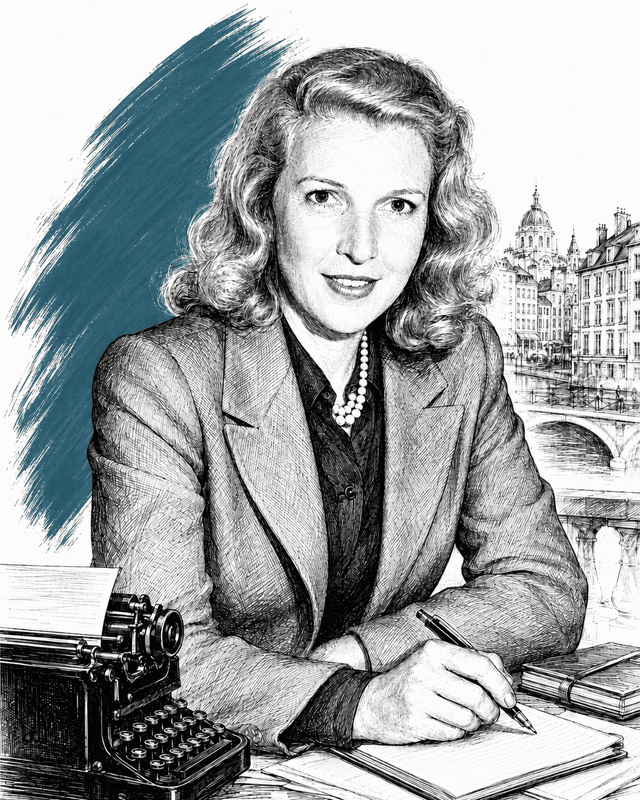
Martha Gellhorn
War correspondent who covered the Spanish Civil War, D-Day, and conflicts across five more decades; Hemingway's third wife, 1940–1945.
View author