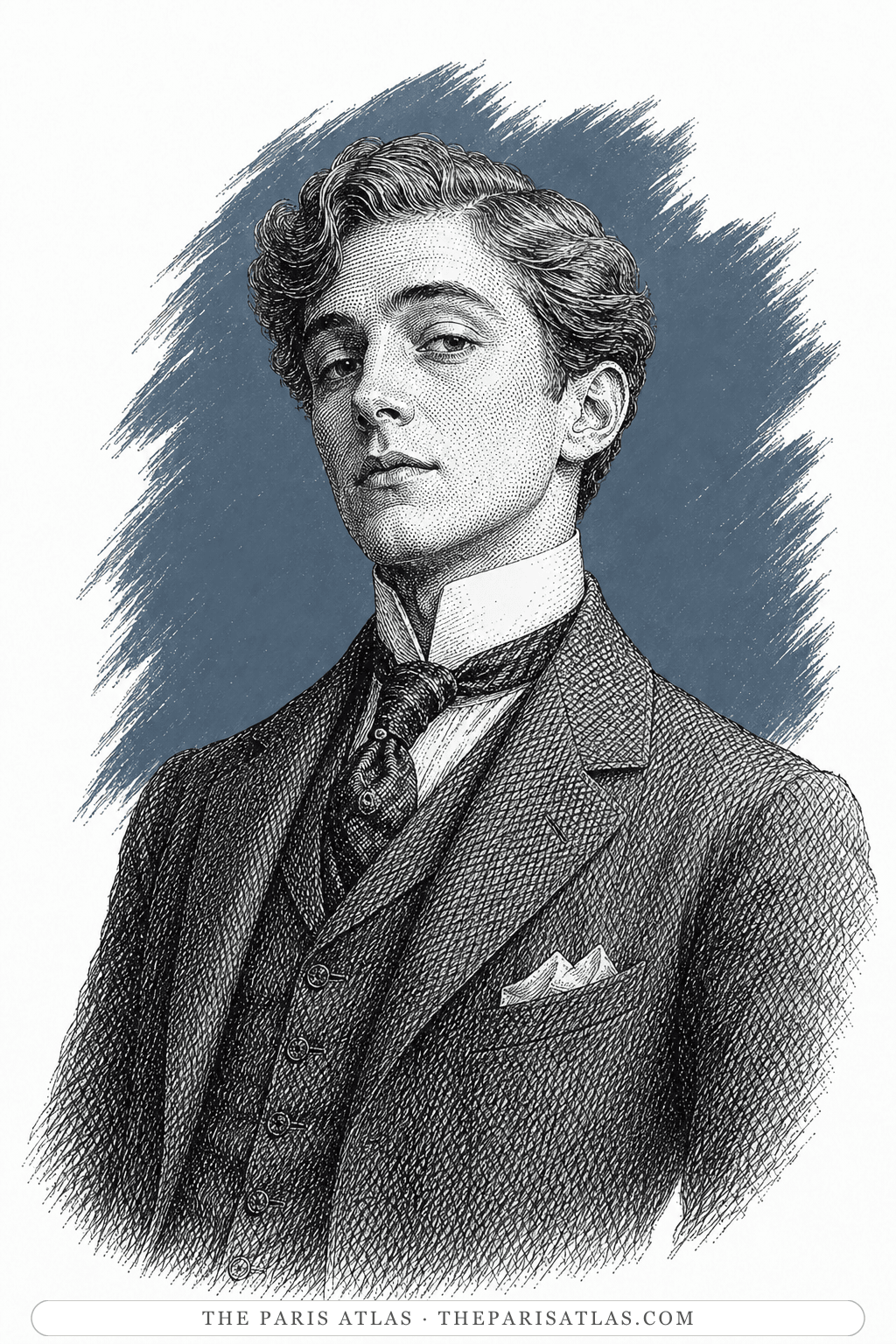
Fred Peloux (Chéri)
Twenty-five, beautiful, and idle — the kept young man who discovers, too late, what the arrangement meant to him. The novel's proof that immaturity can be a privilege.
To be the last man in Léa's life. He tells her so before his wedding: he does not care that he was not her first, but it would have been proper for him to be the last.
The book

At a glance
- Fred Peloux. Chéri, French for darling, is the childhood nickname everyone uses
- Twenty-five. He was nineteen when the affair with Léa began
- Only son of Charlotte Peloux, a retired dancer and courtesan, of Neuilly. No father appears in the book
- His own, inherited. Léa reckons it at three hundred thousand francs a year, and he has never taken money from her
- None, ever. He left school at fourteen and never went back
- Edmée, aged eighteen, in a wedding arranged by his mother; honeymoon in Italy and the Italian lakes
- The vicomte Desmond, a professional hanger-on whom Chéri pays and orders about
- Nounoune
Who they are in the book
Spoiler-freeChéri is the young man the novel is named after. His real name is Fred Peloux; Chéri, which is French for darling, is what his mother's circle has called him since he was small, and it stuck. He is twenty-five, he is rich, he is extremely good-looking, and he does nothing at all. For six years he has been the lover of Léa de Lonval, a courtesan of forty-nine — a woman who lived on money from a series of wealthy men — who is also an old friend of his mother's.
He was brought up at Neuilly, on the edge of Paris, by his mother Charlotte Peloux, a former dancer who then made her living the same way Léa did. There was no governess and no nursery discipline. He picked up the servants' gossip before he could pronounce it, ate their late suppers in the kitchen, was bathed in his mother's iris-scented bathwater or wiped down with the corner of a towel, was stuffed with sweets and occasionally forgotten at dinner time. At twelve an American woman in an illegal gambling room gave him handfuls of gold coins to play with and called him a little masterpiece. A priest was hired to tutor him and dismissed after ten months. At fourteen he was sent to boarding school, escaped, was sent back, and after his mother pulled him out again he stopped studying entirely.
What he did learn was money. He goes through his chauffeurs' account books, counts the bottles in the cellar, and can quote unit prices for fibro-cement and coloured stucco well enough to make contractors careful. When his mother panicked about his spending he told her, 'Ta galette, c'est la mienne.' Your dough is mine, he means, and she should stop worrying about it.
Colette gives him almost no inner life on the page, and that is deliberate. He tells Léa nothing. After three months together she has still had none of the confidences, the gratitude or the night-time talk she has had from every other young lover, and she says he gives away nothing of himself except himself, and stays as secretive as a courtesan. What he feels comes out sideways, in rudeness, in sudden tears he cannot explain, and in the things he does when nobody has told him to.
How Fred Peloux (Chéri) Is Portrayed
- He is wearing her pearls when the book opensThe first scene is Chéri in silk pyjamas and suede slippers in front of Léa's mirror, wearing her pearl necklace and asking her to give it to him. She tells him to take it off. He examines himself instead, and observes that whoever gave her that piece of furniture did not short-change her.
- What he looks likeNeither tall nor short, with hair Colette compares to a blackbird's plumage, a hard flat chest, very small teeth and eyebrows that sweep up towards the temple. Women stop dead in the street when he passes; three shop girls on the pavement outside Léa's gate ask each other whether they are allowed to touch. He never turns round. Léa's private complaint is that he is ugly when he laughs, because he only laughs out of spite or mockery.
- The explanation of his own eyeHe sits his new wife down and explains, entirely seriously, that his eyes are beautiful because they are shaped like a sole. The corner by the nose is the fish's head, the upper line is its back, the lower line runs straighter and is the belly, and the long corner towards the temple is the tail. If his eye were shaped like a dab, open as wide below as above, he says, he would look stupid.
- He audits everythingHis mother has met him on the cellar stairs coming back from counting bottles. On holiday in Normandy he storms out with a ledger and a pen behind his ear over three hundred and twenty francs of petrol and seventy-seven francs of oil in a fortnight. Colette notes that the figures he throws on the paper come out slim, agile and fast, and look nothing like his own big slow handwriting.
- Why he marriesLéa asks him straight out. He says one has to settle down eventually, and then that there are large interests at stake — his own. The girl has a fortune of her own: fifteen hundred banknotes out of her mother's private box, he says, and jewellery of the proper sort. Asked whether the money came from her father, he says he has no idea.
- Called a pimp, and delightedDuring the fight over the marriage contract, Edmée's mother suggests it might be wiser not to talk too loudly about the savings Chéri accumulated in 1910 and the years after. He does not take the point until Léa spells it out for him at lunch: the woman has called him a kept man. He is enchanted, raises his glass to her, and says he asks for nothing better than to be paid the same compliment when he reaches Léa's age.
- The house he buildsOnce married he puts up a new house on the avenue Henri-Martin with a black bathroom, a Chinese drawing room, a basement swimming pool and a gymnasium, and tells the architect he is paying and expects to be served. For the smoking room he wants walls of a blue that is afraid of nothing and a violet carpet that fights the blue. When Edmée says the scheme needs one pale note, a white vase or a statue, he tells her the white vase will be him with no clothes on.
- What he actually wantedTold that Léa has been through this many times before, he loses his temper about the one thing that bothers him: 'Ce que j'aurais voulu, ou plutôt ce qui aurait été... convenable... propre... c'est que je sois le dernier.' He does not mind not having been her first lover, he means. What would have been decent is for him to be her last.
- He walks outThree months after coming back from his honeymoon he leaves his wife at his mother's house without a word of explanation and moves into the Hôtel Morris with Desmond, a lifelong friend he keeps on a retainer. He sends Desmond to the telephone to tell his mother he is dining out, then to say he has been taken ill, then keeps counting the days: sixteen, seventeen, three weeks and he goes home. He does not go home.
- The nights he spends on the floorHe starts sitting out whole nights at the flat of a woman called la Copine, who smokes opium and encourages her guests to. Chéri never smokes it and looks at the cocaine tin like a cat being shown medicine. He sits on the mat with his back to the wall, and what he keeps staring at is the string of fake pearls on her reddened, withered neck. Once he reaches over, strokes her hennaed hair and weighs the hollow beads, then pulls his hand back as if he had caught a nail in frayed silk. Weeks later the first thing he asks her is why she is not wearing them.
- The route he takes at nightHe falls into the habit of walking Paris alone after midnight. Every second night the walk ends at Léa's shuttered house on the avenue Bugeaud, where he brushes the gate, puts one finger on the bell without pressing it, says a quiet joking hello to nobody, and leaves — the way people who cannot sleep have to touch a door handle three times first.
One night in April he passes the avenue Bugeaud and finds the lights on: Léa is back from six months in the south. He gets as far as the next avenue, sits down on a bench, opens his coat, lets his hands fall open and says quietly to himself that so this is happiness, and he had not known. Then he goes home to his wife and is nice to her for a while.
It does not hold. He turns up at Léa's bedroom door at midnight, in evening dress, with his hat on, and announces that he is moving back in. They spend the night together. In the morning, while she plans their departure over the breakfast chocolate, he tells her that with her he will be twelve years old for the next fifty years, and that he is accusing her of it. Then he sees the skin on the backs of her hands in the sunlight, and cannot finish his own sentence.
Léa finishes it for him, sends him back to his wife, and tells him to remember everything she failed to teach him. He goes. On the pavement he buttons his overcoat over the previous night's shirt, looks up — not at her window, but at the spring sky and the chestnut trees in flower — and fills his lungs like a man let out. The sequel, The Last of Chéri, published in 1926, records what that escape was worth.
If you like Chéri


If you like Colette
Explore authors with a similar voice, perspective, and influence.

Henry Miller
The Brooklyn dropout who arrived in Paris broke at thirty-eight and wrote the exuberant, banned books that ended American censorship.
View author
Louis-Ferdinand Céline
The doctor of the Paris slums who wrote the century's blackest, funniest novel — and changed the sound of French prose.
View author
Martha Gellhorn
War correspondent who covered the Spanish Civil War, D-Day, and conflicts across five more decades; Hemingway's third wife, 1940–1945.
View author