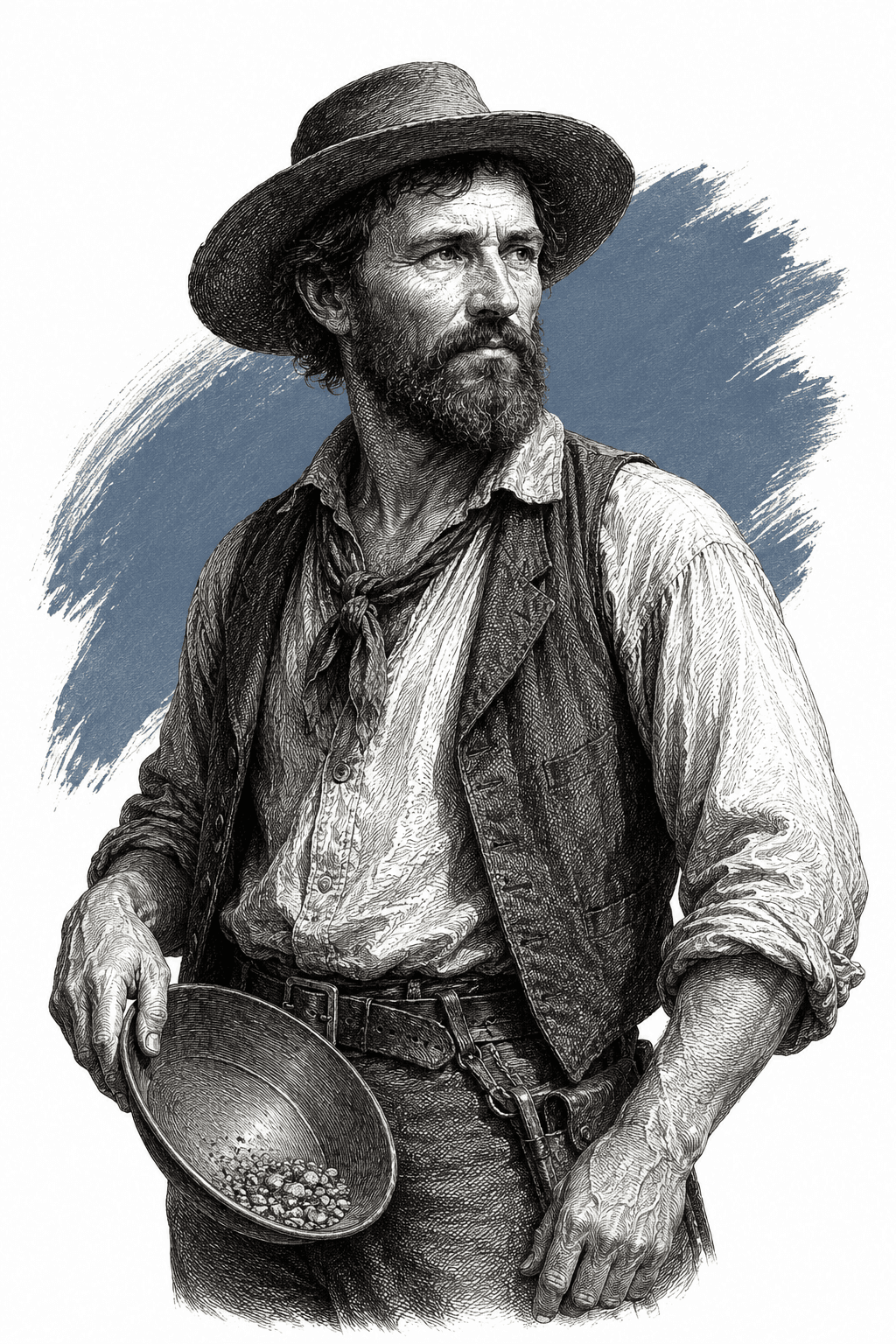
James W. Marshall
The carpenter from New Jersey who found the first gold in the bed of a mill canal at Coloma in January 1848, working on a saw-mill for Johann August Sutter.
To be believed. His own workmen laugh at him when he tells them the metal is gold, so he rides down the mountain through a rainstorm to fetch the one man whose word will settle it.
The book

At a glance
- James W. Marshall — carpenter, in Johann August Sutter's employment at the Coloma saw-mill
- New Jersey
- Grains of gold weighing about four ounces, in the bed of the mill canal at Coloma
- The mill workmen, who laughed at him; then Sutter, who tested the metal
- Coloma and Sutter's fort in January 1848, and once more in Washington thirty years later
- James W. Marshall · 1810–1885 · New Jersey
Who they are in the book
Spoiler-freeJames W. Marshall is a carpenter from New Jersey, employed by Johann August Sutter to build a saw-mill at Coloma, about eighteen hours' ride up into the mountains from Sutter's fort. Blaise Cendrars gives him no history, no family and no first name beyond the initial. He exists in the book for two scenes, and between them the world changes.
The first is in January 1848, and it is told in Sutter's own voice — Cendrars presents that chapter as his translation of a manuscript Sutter wrote. Marshall arrives at the fort soaked through, insists on a locked room, and produces a few grains of yellow metal wrapped in a scrap of cotton. Sutter tests it with acid, reads an article on gold in an encyclopedia, and tells him it is the real thing. The second scene comes thirty years later, in Washington.
How James W. Marshall Is Portrayed
- His tradeA carpenter, from New Jersey. He is at Coloma building a saw-mill because Sutter needs planks — for a larger steam mill still under construction downriver, and for a palisade at the village of Yerba Buena at the foot of the bay, the settlement that became San Francisco.
- What he had in his pocketSeveral small grains of metal, about four ounces in all, wrapped in a piece of cotton.
- Nobody believed himHe had already told the workmen at the mill that it was gold, and they laughed at him and treated him as an idiot. It took nitro-muriatic acid and an article in the Encyclopedia Americana before anyone agreed with him.
- The locked doorHe will not say a word anywhere he might be overheard. When Sutter's bookkeeper walks in on ordinary business, Marshall pockets the metal and shouts at his employer for leaving the door unlocked. They bolt it and push a wardrobe against it before he takes it out again.
- The ride backSutter tells him to eat, sleep at the fort and ride up in the morning. Marshall refuses, gallops off into torrential rain without a bite, and is found the next morning halfway up the zigzag path beside a riderless horse, half out of his mind and nearly dead of hunger.
- Sutter's own account of himWriting years afterwards, Sutter calls him simply his carpenter and says that it was Marshall who brought the gold to light while working on the foundations of the saw-mill. There is no anger in it. Nowhere in the book does Sutter blame him for anything.
Cendrars's last sight of him is in Washington, decades on. Sutter, by then a fixture of the government corridors, passes three orderlies taking an old man to the asylum. The man is filthy and fighting them, filling his mouth and eyes and ears with gutter dirt, his pockets stuffed with muck and a sack of stones on his shoulder. It is Marshall, and he recognises his old employer: he told him so, there is gold everywhere.
That scene belongs to the novel and not to the record. The real James W. Marshall lived out his life in the California gold country and died there in 1885.
If you like Gold


If you like Blaise Cendrars
Explore authors with a similar voice, perspective, and influence.

Henry Miller
The devoted heir — Miller crowned Cendrars above every living writer, and the torrential first-person prose is the family resemblance.
View author
Louis-Ferdinand Céline
The other voyager at the end of the night — spoken rhythm, black exuberance, and a war wound at the center of everything.
View author
Ernest Hemingway
Author of The Sun Also Rises and A Moveable Feast; his pared-down style, developed in 1920s Paris, became the most imitated in American prose.
View author