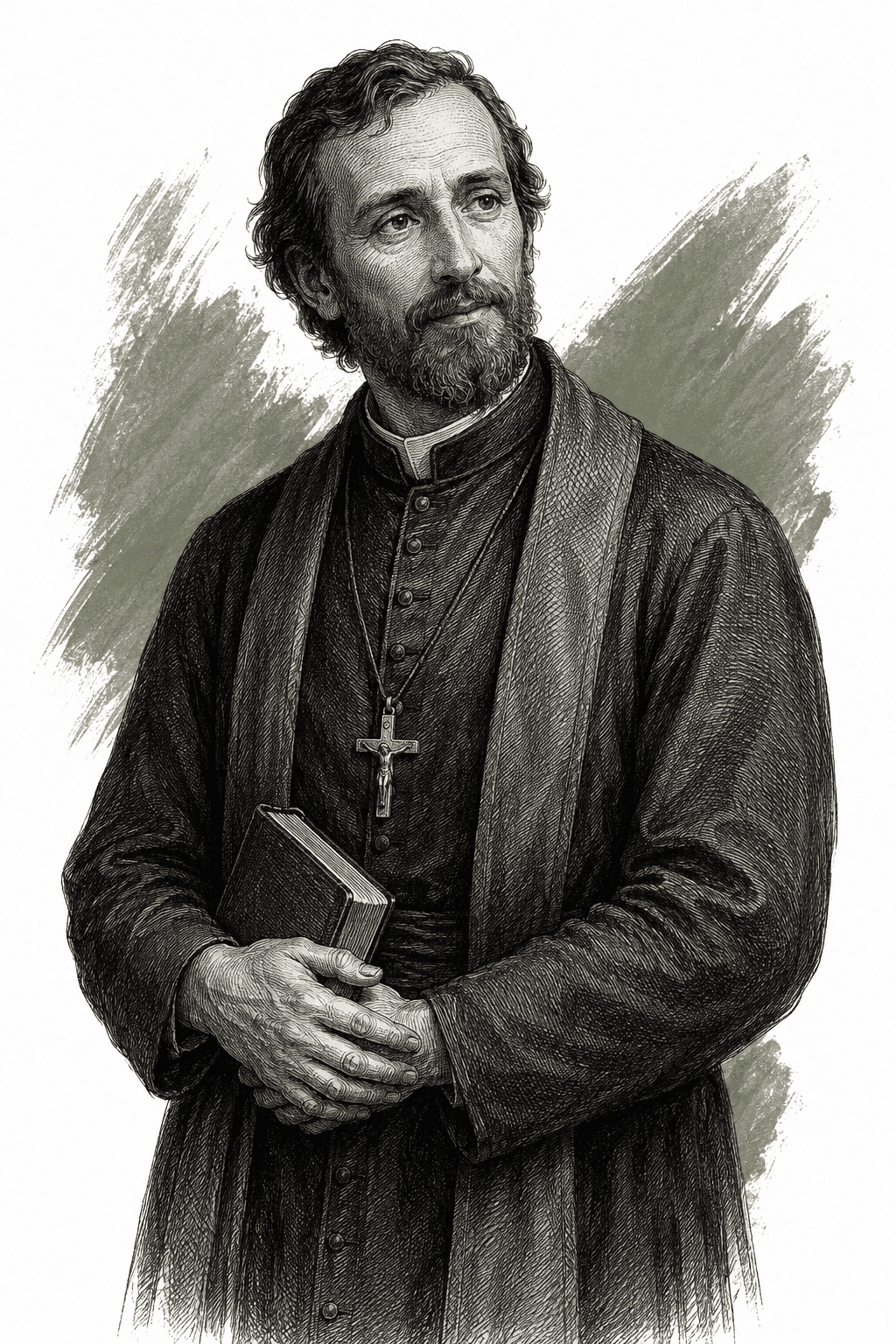
Père Gabriel
The missionary among the Californian Indians who cannot read or write, travels only on foot, and is the one man who comes to Johann August Sutter when the gold rush ruins him.
To keep the Indian and Islander workers out of the mining camps and away from the distillers. By Sutter's account he goes and fetches them back himself, often at real risk to his life.
The book

At a glance
- Père Gabriel — missionary, and in the narration's phrase the protector of the Indians
- Read or write
- On foot, only
- Born Merz, in Martin Birmann's village in the canton of Basel — Sutter says he is not certain of it
- Chapter twelve at the Hermitage, chapter fourteen at the mountain pass, and at length in Sutter's letter home
Who they are in the book
Spoiler-freePère Gabriel is a Catholic missionary working among the Indians of California, and the narration calls him their protector. He can neither read nor write, and he travels only one way, on foot. Blaise Cendrars keeps him almost entirely off the page and then hands him two of the book's turning points.
He appears first at the Hermitage after the gold rush has emptied Sutter's estate, and it is what he says at the parting that puts Sutter back to work. He is also the reason Sutter has any workers left: the Indians and Pacific Islanders who had drifted off to the diggings and the liquor shops come back at his word. And he is the one who buries Sutter's wife.
How Père Gabriel Is Portrayed
- What kind of priestIlliterate, rough, on foot everywhere, and — in the book's account — listened to as an oracle by the Sioux, Osage, Comanche and Blackfeet. None of those are Californian peoples; Cendrars is not being careful with the map here.
- His nameSutter writes that the man's real name is said to be Merz and that he comes from the same Swiss village as Martin Birmann, the lawyer who looked after Sutter's children back home. Then he adds that he cannot be sure of it, because Gabriel never talks about his family.
- He started out as Sutter's enemyDuring the frontier fighting, Sutter says, nobody was more bitterly against him than Gabriel, who objected to his putting Indians and Pacific Islanders to work, and objected harder because Sutter was a fellow Swiss. Sutter also claims Gabriel came round to the view that neither the colony nor the workers could have survived without the other — which is Sutter's version of the argument, written in his own defence.
- The one who cameWhen the strike emptied the estate and everyone else went, Gabriel was the only man who came to Sutter. He brought workers back from the camps, kept them out of reach of a distiller the book names as Shannon, and turned the Hermitage into a temperance settlement.
- What he says at the partingWalking Sutter as far as the trail up to the Sierra, he tells him, in substance, that a piece of the wall of the world fell on his shoulders and he is still standing; that thousands of people are landing every day to start lives in this country; that it, and not Switzerland, is his real homeland; and that he should get back to work. Sutter does.
- The night of the fireSutter's last stop on the way east is Gabriel's mission at the mouth of the pass. The old missionary is standing on his stone terrace at three in the morning with his Indians around him, all of them watching a red glare that keeps rising and dying in the sky to the north-east. He is relieved to see Sutter alive. He is also the one who makes him turn round and look at it.
If you like Gold


If you like Blaise Cendrars
Explore authors with a similar voice, perspective, and influence.

Henry Miller
The devoted heir — Miller crowned Cendrars above every living writer, and the torrential first-person prose is the family resemblance.
View author
Louis-Ferdinand Céline
The other voyager at the end of the night — spoken rhythm, black exuberance, and a war wound at the center of everything.
View author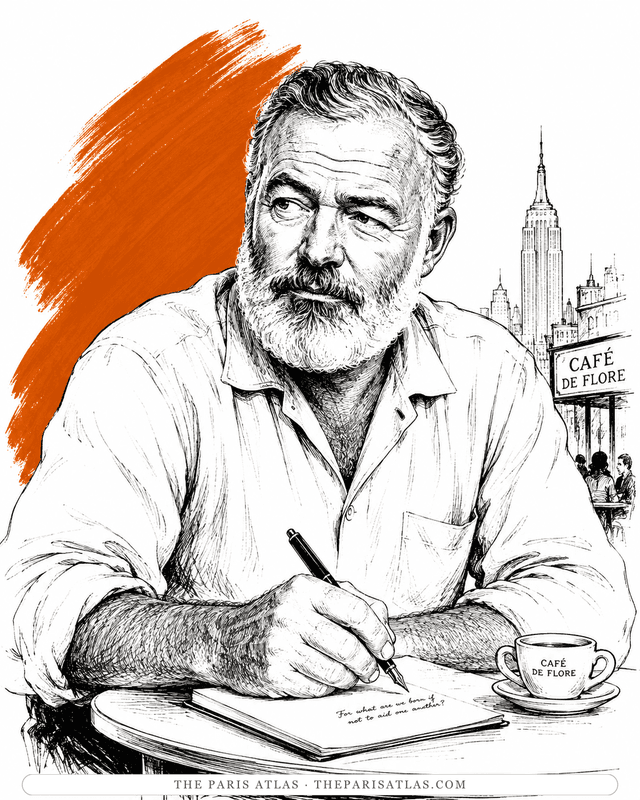
Ernest Hemingway
Author of The Sun Also Rises and A Moveable Feast; his pared-down style, developed in 1920s Paris, became the most imitated in American prose.
View author