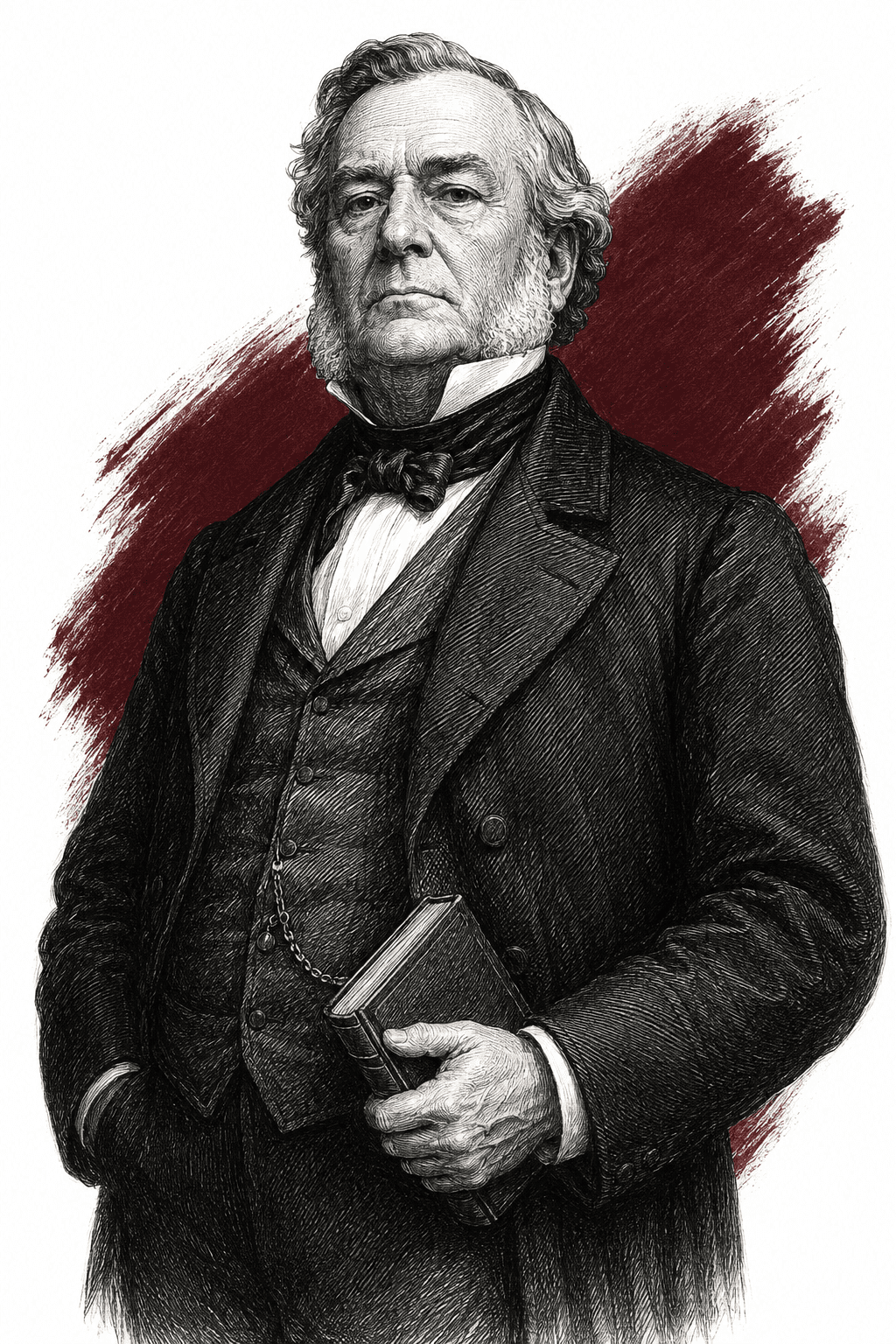
Judge Thompson
The California judge who hears Johann August Sutter's land case and rules for him in 1855 — and then spends years trying to talk him out of the victory.
To get Sutter out of the case alive. He has no doubt about the law. He wants the old man to take a settlement, drop the suits against ordinary settlers, and start again on new ground.
The book

At a glance
- Judge Thompson — described as the highest law officer in California
- 15 March 1855, for Sutter and against the United States
- Plutarch's Lives, in a rose garden below the Twin Peaks
- Himself, Mrs Thompson, and for a time the two Sutters they took in
- Chapters fourteen to sixteen — the judgment, the country house, and the pension
Who they are in the book
Spoiler-freeJudge Thompson is, in the book's account, the highest law officer in California, and the man who decides Johann August Sutter's claim to the land the gold rush was standing on. Blaise Cendrars gives him no first name and almost no history. What he gives him is a temperament: careful, literal, fond of the Greek classics, and slow to conclude anything.
On 15 March 1855 Thompson upholds the grants two Mexican governors had made to Sutter and declares the ground under several California towns to be Sutter's personal property. The judgment and its reasoning fill more than two hundred pages. Afterwards he takes the ruined man and his daughter into his own house and argues with him twice a week for the rest of the book, without ever persuading him.
How Judge Thompson Is Portrayed
- The judgmentDelivered on 15 March 1855. It finds the claim just, holds the two Mexican land grants sound and inviolable in law, and awards Sutter territories that several towns and villages have been built on. With its legal reasoning it runs to more than two hundred pages, and it is given against the United States.
- What it costs himBy that evening San Francisco is in uproar. The distillers stave in casks and hand out free drink on their steps, the law courts are set on fire, the record office is sacked, the state archives are destroyed and the prisons are stormed. Someone proposes lynching Thompson.
- How he spends his timeAt the end of each summer he retreats to a white house with a wooden portico below the Twin Peaks, walks his nurseries and rose beds and carries a volume of Plutarch's Lives under his arm. He learned Greek young and never let it go.
- The householdAfter 1855 the Thompsons take in Sutter's daughter Mina, who is in bed with her hands and face twitching and cannot get her words out. Mrs Thompson nurses her back. Sutter is given a room too, and the judge drives out twice a week to sit with him.
- The advice he keeps givingWithdraw the suits against the individual settlers. Give up the claim on gold already dug and gold still to come, because neither the state nor Washington will ever collect a penny of it. Announce that a million dollars in damages would settle the matter, and ask for new land instead, of which California has plenty. Sutter answers every time that he is asking for justice, not money.
- The one thing Sutter takes from himThompson gets the state government to grant the old man a life pension of three thousand dollars a year. It is the only piece of his help Sutter accepts, and in Washington the pension is swallowed every year by the lawyers and hangers-on working the case.
The ruling is what destroys the little Sutter had left. Within a day the same crowd that had carried him through San Francisco on its shoulders the previous autumn marches on his estates and burns the Hermitage and the two ranches he had built for his sons to the ground. Thompson goes on believing the judgment was right, and the book's last chapter records that Congress never pronounced on the case at all.
Cendrars gives Thompson no first name, and the character should not be read as an identified historical judge. What he is for in the book is plain: he is the one person in California who grasps what has happened to Sutter, and there is nothing he can do with the understanding.
If you like Gold


If you like Blaise Cendrars
Explore authors with a similar voice, perspective, and influence.

Henry Miller
The devoted heir — Miller crowned Cendrars above every living writer, and the torrential first-person prose is the family resemblance.
View author
Louis-Ferdinand Céline
The other voyager at the end of the night — spoken rhythm, black exuberance, and a war wound at the center of everything.
View author
Ernest Hemingway
Author of The Sun Also Rises and A Moveable Feast; his pared-down style, developed in 1920s Paris, became the most imitated in American prose.
View author