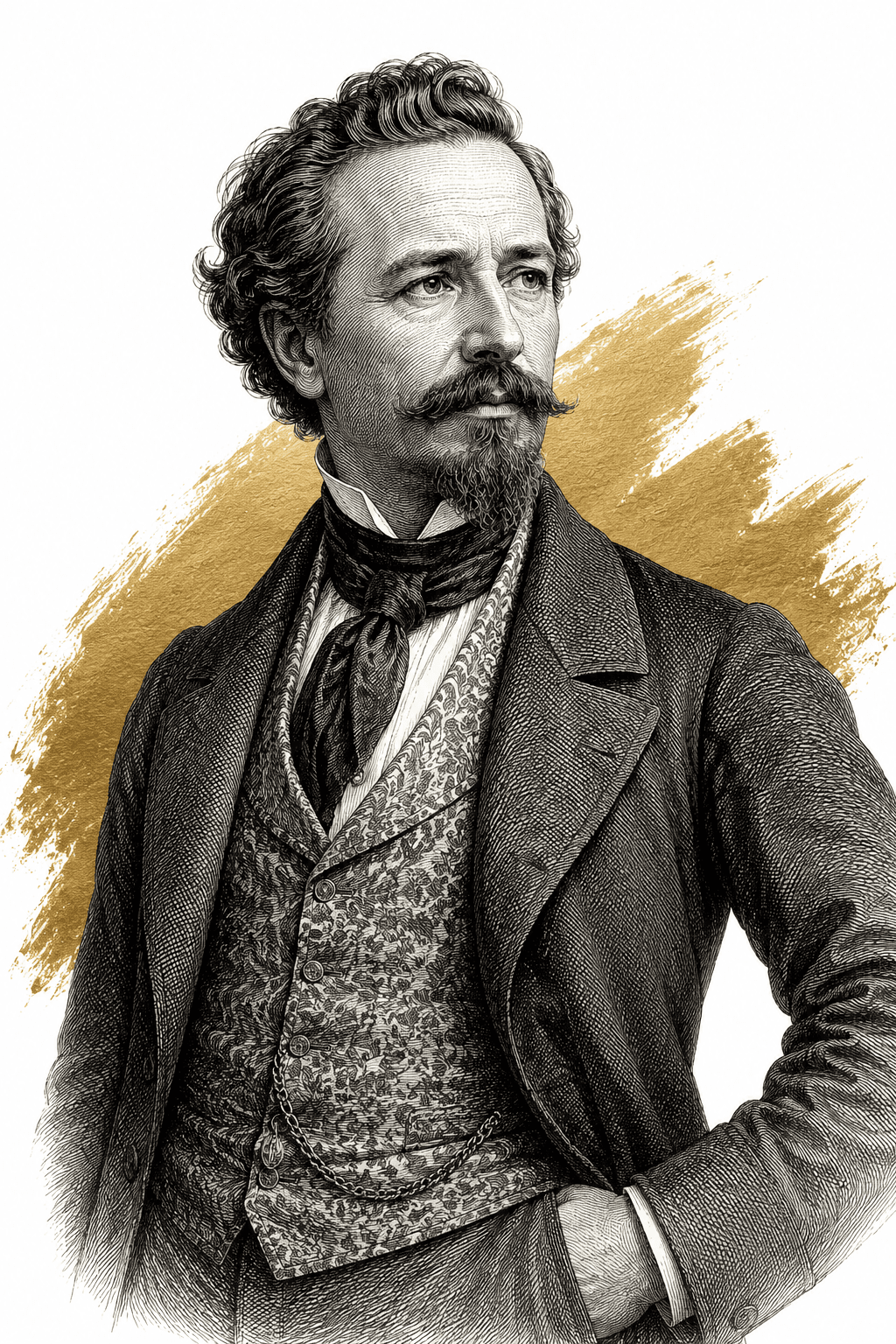
Johann August Sutter
The Swiss runaway who built a private colony in the Sacramento Valley, and was ruined when gold was found on his land in January 1848.
A country of his own. Cendrars has him hear the word California from traders passing through his Missouri farmhouse, sell everything he owns, and cross a continent and an ocean to get there. What he asks the Mexican governor for is a free hand and to be left alone.
The book

At a glance
- Johann August Sutter — Swiss emigrant, founder of the New Helvetia colony in the Sacramento Valley
- 15 February 1803 at Kandern, in the Grand Duchy of Baden, into a family of Basel paper-makers
- May 1834, from Runenberg in the canton of Basel, a day ahead of an arrest warrant
- Captain by the Mexican governor who granted him his land; General from 1854, when San Francisco's first mayor handed him the commission at a public holiday
- A wife, Anna, and four children left behind in 1834: Emile, Victor, Arthur and Mina
- Basel, New York, Missouri, the overland trail, Honolulu, Sitka, the Sacramento Valley, and finally Washington
- Found on his land at Coloma in January 1848 by James W. Marshall, his carpenter
- Johann August Sutter · 1803–1880 · Kandern, Grand Duchy of Baden — from a Swiss family of Runenberg, canton of Basel
Who they are in the book
Spoiler-freeJohann August Sutter is the subject of the book and almost its only continuous presence: Blaise Cendrars keeps him on the page from the first paragraph to the last. He walks out of a Swiss village in May 1834, leaving a wife, four children and a stack of debts, lands in New York that July, works his way west as far as Missouri, and in 1839 talks the Mexican governor of California into giving him land in the Sacramento Valley. He names the colony New Helvetia, after the Latin name for Switzerland.
Cendrars does not make him admirable. Putting him aboard the steamer at Le Havre, the narration lists what he is — a bankrupt, a fugitive, a tramp, a thief and a forger — and then has him lift his head and sip a glass of wine. He robs the men he walks across France with. He reaches Paris on a forged letter of credit. In Honolulu he sets up a shipping company to bring Pacific Islanders to California as forced labour. What the book gives him instead of virtue is scale and speed: within a decade he is the largest landowner in the United States, and Cendrars covers those years in a handful of pages.
Then, in January 1848, a carpenter working on one of his mills finds gold in the bed of a canal at Coloma. Within weeks Sutter's own workers have gone to the diggings and strangers are camped in his wheat. He spends the remaining thirty-two years of his life trying to be paid for it.
How Johann August Sutter Is Portrayed
- The first sight of himMay 1834, in the Swiss village of Runenberg. He is tall and thin, with a face already worn, straw-coloured hair escaping from under a silver-buckled hat, hobnailed shoes and a heavy blackthorn stick. He asks the village for travel papers, is refused, pushes a coin into a boy's hand, spits into the fountain and drives off. The arrest warrant from Berne arrives that night, after he has crossed the frontier.
- The New York years, in one paragraphHis first two years in America go by in a single paragraph of jobs. He works for a draper, a druggist and a delicatessen; sets up as a dentist, a taxidermist and a circus ringmaster; sells Jericho roses off a gilded wagon; teaches mathematics at a mission school; and ends up keeping a bar at Fordham where, Cendrars says, Edgar Allan Poe drank alone. The book states it and moves on. It is one of the places where it is telling a story rather than keeping a record.
- He hesitates exactly onceRiding at the head of his wagons on the trail west, he reins in, tosses a coin and calls heads to go on. It comes up heads. Cendrars marks this as the first and last time in his life that Sutter asked a question he could not answer himself.
- What New Helvetia wasA walled settlement with walls twelve feet high and five feet thick, a bastion at each corner, nine guns, a standing garrison of a hundred men and two armed sloops on the river. Around it, by the book's count: four thousand oxen and steers, twelve hundred cows, fifteen hundred horses and mules, twelve thousand sheep, and harvests returning more than five times the seed.
- Who did the workIn Honolulu, before he has even seen California, Sutter works out that labour is his problem. He forms a company to carry Pacific Islanders — the book calls them Kanakas — across an ocean where nobody is watching for slave ships, and the book says plainly that the islanders are to be seized. A hundred and fifty of them walk up the Sacramento in his first column; by the second year there are six island villages on his land and a fresh convoy every three months. He also tells the Mexican governor that he intends to collect what is left of the Indians from the broken mission stations, put them on land and set them working under his direction. About two hundred and fifty come.
- The man after the strikeCendrars turns his hair and beard white in the space of a sentence. Afterwards he wears a long woollen coat and a hare-skin cap, stammers, cannot sleep, and carries the Book of Revelation in his pocket. He also wears a signet ring made from the first nuggets, engraved with his father's phoenix and the date of the discovery, and turns it on his finger while other men make speeches about him.
- Temperance, and wineRebuilding, he refuses either to dig for gold or to distil liquor, and runs a genuine temperance campaign among the Indian, white and Chinese workers around him. Cendrars notes the exception: he attacks whisky and brandy and never wine, because California's wine came from his vineyards. He tells himself he has the newcomers by the throat and that they are the ones who will pay his lawyers.
Sutter sues. He claims the ground under San Francisco and three other towns, brings actions against 17,221 individual settlers, and asks California for twenty-five million dollars and the federal government for fifty. On 15 March 1855 Judge Thompson rules for him and confirms the Mexican land grants. San Francisco answers the same night: the law courts are burned, the record office is sacked, the state archives are destroyed, and ten thousand people march on his estates with wagons of gunpowder. The Hermitage, Burgdorf and Grenzach are burned, the stock is shot, the vines are cut down, and the Indian, Chinese and Islander workers the mob can catch are hanged. Jean Marchais, the French blacksmith who had stayed on at the old fort when everyone else left, is found hanging from a tree.
The children go too. Arthur is killed defending his property. Victor is lost at sea off the Straits of Magellan. Emile, the eldest — the son Sutter had sent east to law school so that the family would have its own lawyer for the case — dies by suicide in a rough house near the harbour, and Cendrars gives no more than that one sentence about it. Mina, the daughter, survives, is nursed back at Judge Thompson's house, marries a young dentist at Christmas, and finds that she cannot bear to look at her father.
The last twenty-five years go on the case. Sutter petitions Congress in 1866, the Senate in 1868 and again in 1870, asking for less each time, and each petition is drafted by whoever has hold of him that year: a swindler he met at a revival meeting, an infantry sergeant, a photographer from the canton of Vaud. In 1873 he joins a German-American sect in Pennsylvania whose lawyer-founder reopens the suit, tours him around Washington in a general's uniform and pins decorations on him. On 17 June 1880 he is sitting in the sun on the bottom step of the Capitol when a seven-year-old match-seller runs down and tells him Congress has awarded him a hundred million dollars. Six other boys are behind him, laughing. Sutter stands, says thank you, and falls dead. It is a Sunday and Congress is not sitting.
Cendrars ends by noting that Congress never ruled on the case, that Sutter's descendants dropped it, and that in 1926 anyone with a right to it could still come forward — the book's closing line asks who wants gold. He is also careless with his own arithmetic: having given Sutter's birth year as 1803, he calls him seventy-three at his death, and Henry Longan Stuart's 1926 translation carries a footnote from the translator correcting Sutter's age at the 1854 parade. It is a novel working on a real life.
If you like Gold


If you like Blaise Cendrars
Explore authors with a similar voice, perspective, and influence.
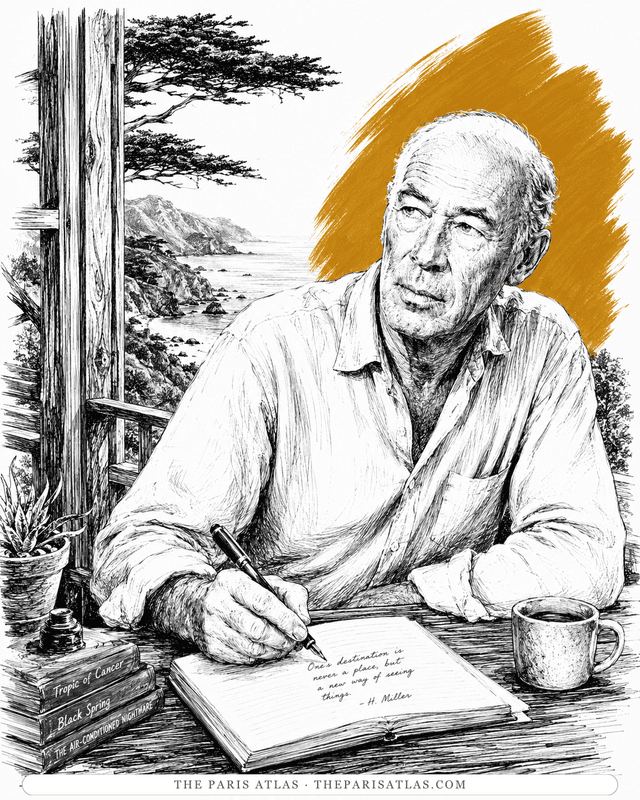
Henry Miller
The devoted heir — Miller crowned Cendrars above every living writer, and the torrential first-person prose is the family resemblance.
View author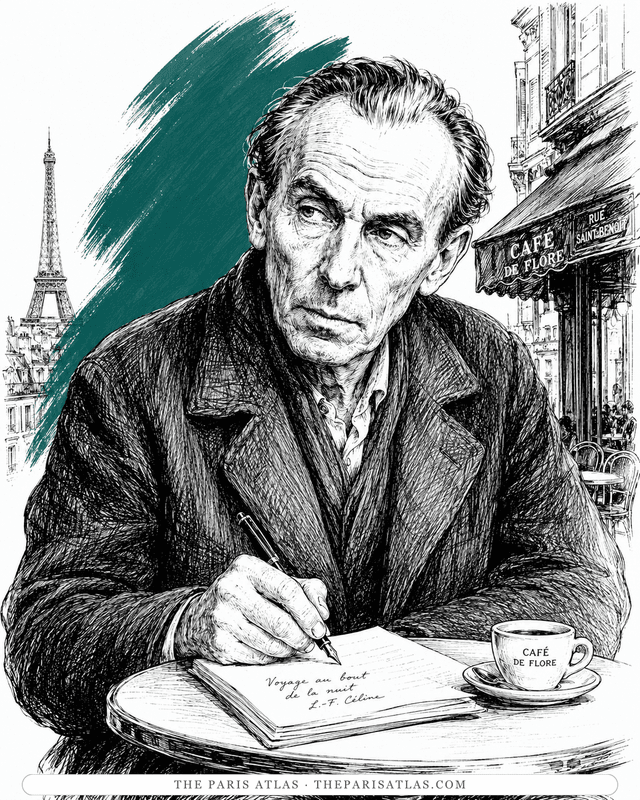
Louis-Ferdinand Céline
The other voyager at the end of the night — spoken rhythm, black exuberance, and a war wound at the center of everything.
View author
Ernest Hemingway
Author of The Sun Also Rises and A Moveable Feast; his pared-down style, developed in 1920s Paris, became the most imitated in American prose.
View author